All posts by lmmenna

A Compelling Novel

I (Lydia) have been reading and enjoying the novel Life After Life by Kate Atkinson. The novel invites readers to consider the question: What if you could live again and again until you got it right? This premise is explored through the experiences of the Todd family set against the backdrop of two world wars. Atkinson plays with narrative structure and time by repeatedly re-ordering the past and the present, as protagonist Ursula Todd and others supporting characters experience deaths, near deaths, and frequent chances to begin life anew. Each time the author reimagines one of these lives, the reader is provided with a glimpse into how the alternate choices made by a character can profoundly shift circumstances and outcomes. The novel could be read as book about the practice of writing, the practice of reading, and the complex relationship forged between author and reader. The novel repeatedly reminds the audience of the multiple choices an author makes when weaving together a narrative, and the conscious choices a reader makes to commit, or not, to the path outlined by the author. Overall, the novel provides a compelling and worthwhile read.

Lifeafterlife

What’s in a word?

Sheryl Sandberg, the Chief Operating Officer of Facebook, has teamed up with the Girls Scouts USA to start a campaign that calls for a ban on the use of the word bossy in everyday language. Sandberg suggests that referring to girls as “bossy” can limit their full leadership potential.  The website of Sandberg’s non-profit organization LeanIn.Org states,

“When a little boy asserts himself, he’s called a “leader.” Yet when a little girl does the same, she risks being branded bossy. Words like bossy send a message: don’t raise your hand or speak up. By middle school, girls are less interested in leading than boys—a trend that continues into adulthood. Together we can encourage girls to lead. Pledge to Ban Bossy”. 

Sandberg’s “Ban Bossy” initiative has recruited an ensemble of spokeswomen, including Condoleezza Rice, Diane von Furstenberg, Jennifer Garner, Jane Lynch, and perhaps most notably megastar Beyoncé.

The Ban Bossy project highlights how a word can come to signify particular social and cultural dynamics.  While I do understand the goals driving this initiative it makes me uneasy when a group advocates for the banning of words no matter how well intentioned their motivations might be. Words carry with them a history, at times a history of injustice and painful disparities, but an awareness of history is critical if we hope to effect systemic change.  Perhaps, an alternative to “banning” is reclaiming words in an attempt to shift the negative connotations associated with a particular word. 

http://www.slate.com/blogs/xx_factor/2014/03/10/ban_bossy_sheryl_sandberg_and_the_girl_scouts_team_up_with_beyonc_but_miss.html

Picture Books

arrival_02Clare and I (Lydia) routinely integrate picture books into our pre-service literacy methods courses. We often begin each class with a read aloud from a picture book. The feedback we have received from student teachers suggests they appreciate this practice because it introduces them to a variety of texts they can use in the classroom, and it models storytelling and read aloud techniques. We have often used the creative and compelling picture books of author Shaun Tan in our literacy courses. I wanted to share a quote from Shaun Tan in which he comments on the “visual language of illustrations”.

“the word illustration is a little misleading, because the best illustrations do not actually illustrate anything, in the sense of describing or illuminating. My own narrative images, and those of my favourite artists, are actually far more concerned with deepening the uncertainty of language, enjoying its ambiguous references, exploiting its slipperiness, and at times, confessing its inadequacy.  My own aspirations as an illustrator – using that term advisedly – is to simply present the reader with ideas that are essentially silent, unexplained, and open to very broad interpretation”.— Shaun Tan

(Quote taken from an essay originally written for ABC Radio National’s Lingua Franca.)

A multitude of communication resources

cartoon_newliteracies

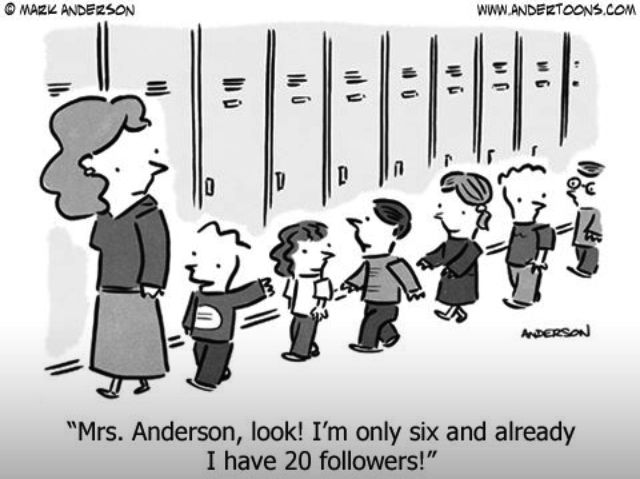
When I saw this comic it made me chuckle.  I enjoyed the comic’s gentle reminder that children/youth routinely engage with and expertly navigate a variety of communication tools. Clare and I (Lydia) conducted a two-year collaborative self-study of our efforts to incorporate various technological resources (e.g. a wiki) into our pre-service literacy methods courses. This research helped us identify both the challenges and successes we encountered along the way.  Our research efforts also made us more mindful of why we chose to incorporate certain technological resources into our pedagogical practice — questioning for what purpose and to what end.   Through the analysis of our efforts we realized that we had initially seen technology as an end in itself, not as a tool to support learning. In the second year of the study, we focused much more on student learning and became more systematic in our efforts. Over the two years of the study, our identities as teacher educators shifted as our pedagogies became richer, our use of technology more fully integrated into our literacy courses, and we received validation from others and from each other.

“Everything Changes When You Read”

The Guardian published an edited version of a lecture Neil Gaiman delivered as part of the Reading Agency’s annual lecture series. In the lecture Gaiman makes an impassioned argument for the importance of libraries and the benefits of reading fiction.  He compellingly notes, “prose fiction is something you build up from 26 letters and a handful of punctuation marks, and you, and you alone, using your imagination, create a world and people it and look out through other eyes. You get to feel things, visit places and worlds you would never otherwise know. You learn that everyone else out there is a me, as well. You’re being someone else, and when you return to your own world, you’re going to be slightly changed”.

http://www.theguardian.com/books/2013/oct/15/neil-gaiman-future-libraries-reading-daydreaming?CMP=twt_gu

photo12

Mapping my morning commute

On twitter this week I (Lyida) read about a storytelling project that invited teachers to use digital tools to capture and represent dimensions of “their world”. The representations  (e.g. pictures, video, audio) were publicly shared on a blog. It would be interesting to use aspects of this idea in a teacher  education literacy course but I wanted to experiment with it first.

   Fruitstand  Subway1

Subway2  Bike  Museum

library