All posts by poojadharamshi

The Danger of a Single Story

When engaging with students about Media Literacy, I (Pooja) often like to begin with novelist Chimamanda Ngozi Adiche’s powerful TED talk entitled The Danger of a Single Story. Through the use of her own narrative, Adiche speaks about the prevalence of a “single story” or the dominant culture portrayed throughout most school curriculums. Adiche shares the following memory of being taught a single story:

At about the age of seven … I wrote exactly the kinds of stories I was reading: All my characters were white and blue-eyed, they played in the snow, they ate apples, and they talked a lot about the weather: how lovely it was that the sun had come out. This despite the fact that I lived in Nigeria; we didn’t have snow, we ate mangoes, and we never talked about the weather, because there was no need to.

Adiche speaks about the impacts the single story has on an individual, on a community, and on society at large. While a young school girl in Nigeria, Adiche recalls only reading authors from the West. Having never encountered the works of an African author or seeing people like her appear in books, she believed she could not (or should not) be a writer.  She asserts that when we receive only one perspective on anything it creates stereotypes, “and the problem with stereotypes is not that they are untrue, but that they are incomplete. They make one story become the only story.”adiche
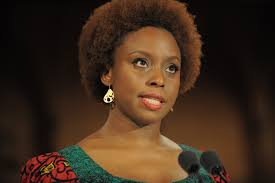
This TED talk sparks lively discussion in the classroom. Students often think back to their early schooling and many recall “single stories” they experienced. As a class, we capture all of these experiences on a large poster. As new text is introduced in the course we often refer back to this “single story” poster and discuss who’s stories are being represented in what we read/hear/see.

A Daily Reminder

I (Pooja) work at a higher ed. institute with a population that is very diverse. I have many mature students, with a history of interrupted education, who are looking to make a fresh start with school after work many years in unfulfilling jobs. Even though school has failed them in the past, they come in hoping to form a new relationship with school. This cartoon and this quote are taped up above the photocopier in our office. It is a daily reminder of my work and the students I serve.

comic

Everybody is a Genius. But If You Judge a Fish by Its Ability to Climb a Tree, It Will Live Its Whole Life Believing that It is Stupid. –Einstein

The Power of Introverts

“In a gentle way, you can shake the world.” – Gandhi

Introverted-Thinkers

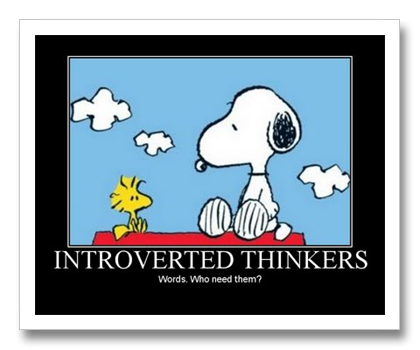
At a professional development session I (Pooja) attended this week, I joined a conversation about the power of introverts. The conversation was framed around Susan Cain’s book entitled Quiet: The Power of Introverts in a World That Can’t Stop Talking. We live in a society where extroverts are the ideal; we value personality over character. This presentation, given by some of my quieter colleagues, was  powerful because it forced me to reflect on ways I engage and include introverts in the classroom. The presenters explained that introversion and extraversion is not a black or white matter; rather we all fall somewhere along the continuum depending on the situation we find ourselves in. I also learned that introversion is not to be confused with shyness- a mistake many people (including myself) make when speaking about introverts.

images

I mostly identify as an extrovert. Knowing this is important because it can influence how I design my  course to be more inclusive for all my students. As a more extroverted person, I walked out of the session with practices to consider revising in my classroom. Here are a few of the things I’ve been thinking about:

  • Mindful of airtime- I often become uncomfortable in silence, and so I will fill in silent moments with talking or engaging only the most vocal members of the class in discussion. Silence can be a powerful thing; these are the moments where reflection occurs.
  • Independent Work vs. Group Work- I try and put my students into pairs and/or groups every chance I get. I now am beginning to realize this is not the optimal working condition for all. I need to find a balance of group work and independent work.

Learn more about the power of the introverts here:

http://www.thepowerofintroverts.com


“The Secrets of Sugar”

I (Pooja) watched an eye-opening documentary on CBC’s Fifth Estate. The documentary sugaruncovers some frightening facts about the effects of sugar and the sugar industry. Most of us are eating way too much sugar on a daily basis. Surprisingly, sugar is added in food items such as ketchup, yogurt, soy milk, and salad dressings. There was one alarming segment in particular in which I couldn’t help but think about the effect of sugar on children in school. Research was conducted on a sample of lab mice to observe how they reacted when their sugar consumption increased. The results were disturbing. Before any sugar consumption, the mice were alert and able to navigate through the set-up maze. However, as sugar consumption increased, their alertness levels decreased significantly. They moved sluggishly through the maze, bumping into the walls along the way. Some could not even make it to the end. This made me think so many of our young learners who consume high levels of sugar from their school cafeterias, vending machines, convenient stores, and/or home. Although in the past decade there has been a push towards healthier food for our school-aged children, there is a need for a deeper awareness around all the places where sugars are hidden.

Learn more about “The Secrets of Sugar” here:

http://www.cbc.ca/fifth/episodes/2013-2014/the-secrets-of-sugar

Book Clubs + Canada Reads

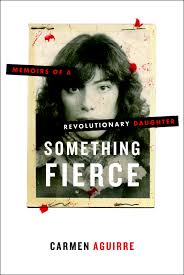
As a Ph.D. student and an educator, I (Pooja) find myself mostly reading academic journal articles or student writing these days. While I enjoy reading both types of text, I miss reading for pure pleasure; in particular, I miss reading novels. Novels are a commitment of both time and energy, but when you read a truly great novel it is totally worth it.somethingfierce

I recently formed a book club with some colleagues/fellow educators. Although I have a lot of my plate already (don’t we all?!), I thought this would be a great opportunity to connect with colleagues on a more personal and informal level, (not to mention being pulled into the world of a fascinating  novel). We selected Something Fierce: Memoirs of a Revolutionary Daughter by Carmen Aguirre. This book, written by a Canadian author, was the official selection of the 2012 Canada Reads initiative. I’m currently reading the final pages of this gripping memoir, and I highly recommend it to anyone looking for a great read while supporting a Canadian author. I made time for reading this book during every opportunity I could: riding the subway, sitting in the doctor’s office, waiting for my oatmeal to cook in the morning. I was surprised to find how many of those small moments I had each day, which would usually be taken up by scrolling through my smartphone. Our book club meets for the first time tomorrow evening at a colleague’s home.  I’m looking forward to discussing the book in a relaxing atmosphere.

Learn more about the Canada Reads project:

http://www.cbc.ca/books/canadareads/

A Short Summary of the book:This dramatic, darkly funny narrative, which covers the decade from 1979 to 1989, takes the reader inside war-ridden Peru, dictatorship-run Bolivia, post-Malvinas Argentina and Pinochet’s Chile. Writing with passion and deep personal insight, Carmen Aguirre captures her constant struggle to reconcile her commitment to the resistance movement with the desires of her youth and her budding sexuality. Something Fierce is a gripping story of love, war and resistance and a rare first-hand account of revolutionary life.

Source: (http://www.amazon.ca/Something-Fierce-Memoirs-Revolutionary-Daughter/dp/1771000368)

Studying Beyonce… in Higher Ed?

Lately, Beyonce has been in the news a lot more than usual. Recently, without any warning(or PR), she released a self-titled  album to the public. She was also, debatably, the most talked about performance at the 2014 Grammy’s a few weeks ago. However, the most interesting news I (Pooja) have recently read about Beyonce has to do with the world of academia.

Rutgers University now offers a course called “Politicizing Beyonce,” in which her musical career is used as a lens to investigate“race, gender, and sexual politics.”  The instructor of the course, a Ph.D. student, says “he’s seeking to help students think more critically about media consumption.”

I am intrigued by this course, yet not sure what to make of it. Is this a relevant and contextualized way of studying issues of race and gender or is this normalizing our (society’s) idolization of celebrities by creating a place for it in higher education?

What do you think?

Read more about this course:

http://www.huffingtonpost.com/2014/01/30/rutgers-beyonce-course_n_4697541.html

http://newsfeed.time.com/2012/01/27/rutgers-beyonce-course-5-potential-lessons-on-the-syllabus/

Source: www.policymic.com
Source: http://www.policymic.com

Narratives of Teacher Educators

Book cover

I (Pooja) recently finished reading Negotiating critical literacies with teachers: Theoretical foundations and pedagogical resources for pre-service and in-service contexts (Vasquez, V.M., Tate, S.L, & Harste, J.C., 2013). This book provides a theoretical framework, insightful examples, and pedagogical resources for ways to incorporate critical literacy practices into pre-service and in-service teacher education. The final chapter of this text entitled “Teaching and living critical literacies” especially interested me. This concluding chapter focused on the narratives of the authors who are all teacher educators. They shared early childhood memories, classroom teaching experiences, and turning points (e.g. being the first in the family to attend college; protesting the Viet Nam War). Much of what the book’s authors shared in their written narratives reflected closely what many of our critical literacy participants in our SSHRC study have expressed. Many can identify turning points and life events in their early childhood, which contributed significantly to their philosophy and stance towards teaching and learning. Maya from our study identified being placed in a low-track after immigrating to the U.S. as a defining moment. This has influenced her practice because she now focuses on having her student teachers understand multiple perspectives and interrogate their assumptions of students, curriculum, and schooling. Providing a specific example of this pedagogical stance, Maya told us about how she conducts an entire lecture in Spanish, locating student teachers as second language learners.

This final chapter reinforced how meaningful it is to create space for the voices of literacy teacher educators.  The narratives of our participants are rich with experiences that influence their practices in the classroom. Stacie L. Tate, book author and teacher educator, articulates this well: “When people ask how I decided to become a teacher and researcher, I always reply, “I was groomed for this.” (p. 99).

International Baccalaureate symbol

IB schooling in Mumbai

While in Mumbai, I (Pooja) had some candid conversations with my cousins (who now have school-aged children) about schooling. The International Baccalaureate (IB) has quickly become the new standard. My cousins spoke highly about the IB curriculum, noting that it encouraged students to view themselves as “global citizens.”  The curriculum, they commented, deviated away from that of traditional schooling in India. The skills were now focused on: critical thinking; intercultural awareness; independent learning; evaluating and constructing arguments; and independent learning.

The pressures to get their children into an International Baccalaureate (IB) program were high. My cousins already had aspirations of sending their young children to top-performing universities outside of India (mostly in the U.S., Canada, and U.K.).   A major concern I heard was that if they did not get into an IB program, how would they compete in this highly globalized world? I understood this to mean that in order to be competitive one had to be complete their formal education outside of India. This  was concerning  because competition aside, IB schools are extremely expensive, and so, not available to the vast majority of families in India. While very few are privileged to apply and possibly attend IB schools in India, most school children in India still attend public school. I am interested in learning more about the public school curriculum in Mumbai? How are public schools currently preparing their students to be  “global citizens?” or is this a notion that is still intangible for most? Pooja