All posts by ycleovoulou

The strikes in Toronto continue: Common struggles across university employees

Last week Clare wrote about the strikes happening in 2 Toronto based Universities.

The Next Generation of Academics: An Uncertain Future

Teaching Assistants and Course Instructors are still on strike.  The issues are complex and go beyond pay increase.  Pay amount, pay structure, working conditions and job security are pieces of the intolerable job structure. The situation of poor, unstable working conditions for graduate students and non-tenured faculty continues to be a continent-wide misfortune.  I recently read an article about the experiences of an adjunct-professor in Washington, DC.

http://www.washingtonpost.com/posteverything/wp/2015/03/06/i-was-a-professor-at-four-universities-i-still-couldnt-make-ends-meet/

The author writes about her experience:

There were things about the work I loved. One student wrote an excellent research paper on creative arts therapy as a healing tool for depression sufferers; the paper landed her a fellowship working with cancer patients. When I saw students nodding their heads during lessons on essay structure or avoiding wordiness, I felt reenergized. In fact, engaging students was a challenge I loved. The working conditions were what drained me completely.

There are similar stories here in Toronto and across Ontario. The stories are grim and unfortunate. I (yiola) look forward to posts where I can write about changes to the status of non-tenured faculty, teaching assistants and the ever so needed university staff members.


How educators understand poverty: One teacher’s perspective

More and more,  poverty awareness is coming up in my teacher education classes. Perhaps this is because I (Yiola) am gaining more confidence about how to frame, discuss, and process the issues associated with teaching poverty awareness.  Or perhaps it is because students are seeing issues of poverty play out in their placements and are comfortable to raise questions in our class.  Whatever the cause for the awareness I am glad this discourse has made its way into my classes.

Ultimately the questions lead to, what can teachers do? I teach two levels of teacher education courses this year: I teach at the Masters level and I am also teaching a first year undergraduate teacher education course.  I can safely say that most student teachers care about poverty awareness and I can also safely say most student teachers do not know what to do about it.

Then a student in my Masters level course shared this link with us:

The video is of one teacher beautifully expressing the trials and tribulations of one student in her class. It is a very sad story. It is depressing. But it is much more than that. The narrative presents a perspecitve that all teachers must have; an understanding that poverty makes life hard… BUT… this is not the fault of the child. The teacher’s acknowledgement that her student is smart and capable and kind is central to this discourse. Many scholars acknowledge that teachers must hold affirming views of their students. And, I sense that most students teachers shrug this concept off as “yah yah, of course. That is obvious. Of course I will like all my students.”  but to move beyond the circumstances and consequences of poverty to see that a child who is experiencing that plight IS capable, smart and kind is not so obvious.
When we viewed the video in class many of us were near tears.  I questioned whether this was a good thing or not. It is important to raise awareness but such awareness cannot  just hang out there in agony and leave students feeling despair. Awareness must move beyond understanding to the “what can I do? As a teacher what am I going to do?”.  Here the video stops short but our discussions continued.  Student teachers began to blend theory with their placement practice to try to make sense of how they could possible make “carrying the one” manageable so students living in poverty can make gains in their learning and their lives.  This is no easy feat. We set out some steps for our work as teachers: The first step is teacher awareness, the next step is having students know they are cared for and believed in, and the step after that to critically assess our own practices so our methods are accessible, manageable, and achievable so students feel success.  Each of these steps require intense reflection, listening, thinking, studying and experience.  I haven’t touched on levels of community or institutional activism and that is with intention. In my experience, student teachers need to understand that work for themselves first.
To have student teachers think and teach in these ways is activism.  Some student teachers are there in their understanding and are leaders… most are not. My goal is to support student teachers’ learning and further their understandings of the social determinants of educational success so they have the knowledge and skills to deal with issues in their classroom.
The video I share above is powerful. There are thoughtful, powerful descriptions in her narrative about her student(s), their families, and schooling that help illustrate just what it means to be a student living in poverty.

Technology in Teacher Education: Using Program Resources to Build Capacity

Last week I (Yiola) ran a “mini” Technology Day Conference in our teacher education program. At first I felt it was a large feat given that, while I value and try to model good use of technology, I am a novice digital technology user.  I quickly realized that my own knowledge of digital technology use was of less importance. What was more important was my vision for sharing good information about technology use in the classroom. I sought colleagues within the program who know much more than I do and together we set to work.

The Vision

I named the conference Technology in and for Learning.  The vision was to provide practical sessions on how to use digital technology effectively in the elementary classroom. I wanted these practical sessions to be framed in a theoretical context so students would have deeper understandings for how and why good practice is what it is.  At our institute we work in a tripartite:  the teacher education program, the laboratory school, and our research/tenure faculty.  I set out to find colleagues in each branch of our institute to contribute in some way to the conference.

The People

I found my colleagues were excited to participate in the development and execution of the conference:

Teacher Education — The students were the participants, Members of the practicum team were presenters, and the staff helped organize the event

Tenure Faculty / Research Team — The Presenters

Laboratory School teachers — The Presenters

The Details

A member of the research team designed a professional and stylish website for the Conference where students gathered the information and were able to register. Upon check-in students received name-tags with their sessions and room numbers conveniently recorded.
The afternoon ran smoothly with a thoughtful introduction shared by a research team member on the frameworks for using technology in the classroom. She shared the SAMR http://www.educatorstechnology.com/2013/06/samr-model-explained-for-teachers.html and the TPaK http://en.wikipedia.org/wiki/Technological_Pedagogical_Content_Knowledge models. The introduction brought scholarship to the forefront. Then, the laboratory school teachers shared interesting, informative and practical sessions on a variety of topics related to using digital technology in the classroom. These sessions included the following:

Smart Pedagogy using “Smart technology”

Effective ways to use Interactive White Boards in the ClassroomMore and more classrooms are equipped today with “Smartboards”, making the thoughtfulness and effectiveness with with teachers use them, an increasingly important task.  In this workshop, you will learn the fundamentals of using interactive white boards (IWB’s) in your classroom, but also how to combine the use of this amazing technology with a student-led and inquiry based community and curriculum.

iPads in the Classroom

We will discuss various ways to use iPads in the classroom for a whole group and small groups. We will highlight apps – especially free ones – that are both fun and useful, focussing on supporting different learners. We will touch on both positive aspects and drawbacks of integrating iPads in the classroom.

Technology to Support the 4 C’s

Communication, Collaboration, Creativity, and Critical ThinkingThis session will explore several ​examples of technological tools which can be used in the classroom to foster communication, collaboration, creativity, and critical thinking. Some of the tools considered will include Edublogs, Zydeco, Earth Tours, Plickers, Minecraft, and Twitter.

Knowledge Forum

Knowledge building is the process by which new knowledge is created. In one sentence, it can be described as “giving students collective responsibility for idea improvement.” Knowledge building starts with the natural tendency to play with ideas, but extends to the unnatural tendency to deliberately improve them. Knowledge building is a collaborative process, and moves forward through a collective effort to advance frontiers of knowledge, as these are perceived by the community.Knowledge Forum is a multimedia environment that supports emergent idea development and sustained, collaborative dialogue, helping learning communities capture their thoughts and questions, connect and organize their ideas, and build knowledge together.

In this hands-on workshop you will learn the fundamentals of using Knowledge Forum to support the learning in your classrooms.

Teachers Using Technology in Literacy
Classrooms

This session will look at various ways of engaging students with technology in the literacy classroom. Examples of using technology to promote reading and writing skills, and motivation for literacy will be discussed and shared.
The conference concluded with a panel discussion and question/answer.
It appeared that the students enjoyed the sessions. The goal was to provide an opportunity to think more deeply about the value of and use of technology in learning.  We have sent out a feedback survey so we will know what students liked and what suggestions they will have for improvement.
I am glad that I took the risk and designed a mini conference for our students.  It was a good start. The use of digital technology in the classroom is not my area of expertise but it is certainly an area I want to have more fluency. Working with my colleagues who do have more experience in the area was not only provided benefits for our students, I too learned a great deal!

FDK update: Language and the Arts

Today is a holiday in Ontario and in several Canadian provinces: Family Day. A day to spend much needed time with family. Family Day comes at a good time since temperatures are beyond unbearable to many (me! ~ Yiola!) and the winter blahs bring a natural insistence to just take an extended break.

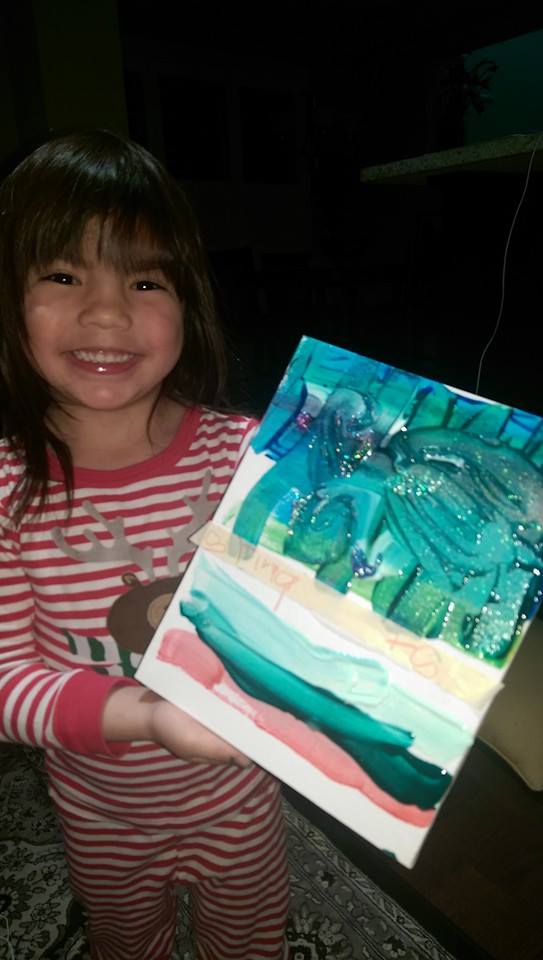
In honour of Family Day I would like to share a story about my family and how my Sylvia Clare (my four year old) is getting along in FDK.  About one week ago, while at home Sylvia Clare decided to paint. This was not unusual as she often paints at home. What was new was her language and ideas about art and herself.  She ushered me to the playroom, took the lead and began to explain that we were going to explore lines.  Lines I thought? So Sylvia Clare understands an element of art?  I sat in silence with what I imagine was a curious look on my face as she continued with confidence: “I’m an artist”.  Those words screamed at me with sheer joy and power. I had never called Sylvia Clare an artist… it was not something I thought of doing, although of course in my heart and mind I believed my child was an artist and a scholar and an athlete and a…..   ”

“Now mommy, you need to wear a smock so your clothes stay clean and roll up your sleeves. Please get the paints”.I followed her instructions.  Next thing I saw was Sylvia Clare carefully dividing the canvas. She began at the bottom and drew careful lines across the canvas using primary colours. Then on the upper part of the canvas she created thick textured, almost bubble like “scribble” where she mixed the colours. The entire time she was talking about her art: “Here mommy I am painting straight lines with primary colours, you see? And up here (top of the canvas) I am trying to see what scribble is like and I added some sparkle”.  She spent a lot of time working on her art and I sat and watched in amazement. Here are some pictures of Sylvia Clare from that day:

sylsmock

sylpaint

paint


Days passed and I wondered how Sylvia Clare was able to develop such clear language about the arts and conceptually understand the elements and most importantly to see herself as an artist. And then, the FDK newsletter came home.  The teachers shared the following in the newsletter:

The students have also been learning about a modern artist names Piet Mondrian from the Netherlands, who used primary coloured shapes and black lines to create famous pieces. They have used his method to create their own line designs. We have also experimented with bubble wrap. Some of the children are referring to themselves as “artists” now…

How one perceives oneself is often how one becomes. Sylvia Clare sees herself as an artist. She can talk about the arts and she confidently engages in art work.  So, on Family Day today I am certain we will be back in the playroom painting and playing and reading and doing… and I am sure that I will be the one who will learn the most.

Happy Family Day!

Dewey meets Delpit: Bringing theory to life in teacher education

Last week I (Yiola) tried something in my teacher education course that was less safe. I brought together divergent theorists,  multiple contexts and eras and encouraged practicum connections in ways that are not typical.  I was unsure of the outcome: would the student teachers understand? connect? appreciate? Just as I encourage our students teachers to take risk, I took a risk in hope new understandings, connections and realizations about teaching and learning would occur.  At the end of class students applauded… when does that ever happen? The comments and reactions at the end of class indicate that students appreciated the class content and left class with much to think about.

I have recently re-read Dewey’s Education and Experience (1938) and was inspired to share the ideas with my class, namely what is miseducative practice? And how do traditional and progressive models of education play out in classrooms today? We discussed how both models are quite transparent in today’s classrooms. We also explored Dewey’s recommendation of a theory of education that is based on a philosophy of experience. Student teachers felt that the notion of experience is now more commonly understood and a desired practice in teaching. We discussed how finding a coherent theory of education based on a philosophy of experience would require transcending the notion of “either/or” traditional or progressive models and moving into integrative reasoning. So this is all quite typical… and then I introduced Delpit.

In Delpit’s work Other People’s Children  (1988) Delpit described herself as “a product of skills-oriented approach to writing and a teacher of process oriented approaches”.  Her amazing chapter, The Silenced Dialogue,  illustrates Dewey’s request to have educators think deeply about the either/or debate between models of education and the implications of our practice on student learning. Delpit explains the following about her chapter, “My charge here is not to determine the best instructional methodology… Rather, I suggest that the differing perspectives on the debate over “skills” versus “process” approaches can lead to an understanding of the alienation and miscommunication, and thereby to an understanding of the “silenced dialogue”… this is precisely what Dewey asked of us fifty years prior, that as educators we must go deeper than thinking across methods; we must use a philosophy of experience to deepen our understanding of the best ways to teach children. For Delpit, the experiences are those of Children of colour and children who experience poverty.

Exploring Dewey’s concepts through the lens of power and Delpit’s context of literacy was remarkable. The process of grounding Dewey’s theories in Delpit’s work provided grounding for both scholars in ways that I wasn’t yet unprepared. Students were excited to talk about a philosophy of experience by looking as social context as a foreground for understanding models of education; for understanding why certain methods may work well and not well and how to move our practice forward so all students are not only learning but are successfully learning in ways that are empowering them.

The final layer of discussion in class was to connect the ideas to their own placements. To tell stories of methodological challenge and to explore how to address those challenges thinking about what Dewey suggests and what Delpit illustrates. Again, students were speaking in detail on the gaps and the glories in their classrooms and schools.  The result of this class: discussion sophisticated and practices validated.

We finished the discussion by reading aloud the last paragraphs of Delpit’s chapter; as a reminder of the enormous but yet delightful task we have as teachers if we truly wish to create learning for all:

We must keep the perspective that people are experts in their own lives. There are certainly aspects of of the outs tide world of which they may not be aware, but they can be the only authentic chroniclers of their own experience. We must not be too quick to deny their interpretations or accuse them of “false consciousness”…And finally, we must be vulnerable enough to allow our world to turn upside down in order to allow the realities of others to edge themselves into our consciousness…  

By doing what Delpit suggests and with keeping Dewey’s foundational perspectives in mind we as teachers can begin to understand how models work in classrooms.

“The Long Shadow”: The fortification of socio-economic class

A mere 4 percent of the first-graders Alexander and Entwisle had classified as the “urban disadvantaged” had by the end of the study completed the college degree that’s become more valuable than ever in the modern economy. A related reality: Just 33 of 314 had left the low-income socioeconomic status of their parents for the middle class by age 28.

A 25 year long study named The Beginning School Study out of John Hopkins University explores “disadvantaged” populations in Baltimore. The researchers observed and interviewed first graders into their adult lives over the course of twenty-five years. The evidence shows there is little upward mobility.

http://www.washingtonpost.com/blogs/wonkblog/wp/2014/12/27/what-your-first-grade-life-says-about-the-rest-of-it/

I am troubled by a comment made in the article: The families and neighborhoods these children were born into cast a heavy influence over the rest of their lives, from how they fared in the first grade to what they became as grownups. 

In my (Yiola) opinion, the perspective of family and community as the influence and determinant of health and success is short sighted. How a society and government collectively and resourcefully (or not) engage with families and neighbourhoods is by far the greater influence as is illustrated when the journalist explains:

The findings, meanwhile, accumulated in dozens of journal articles. Alexander and Entwisle helped establish that young children make valuable subjects, that their first-grade foundations predict their later success, that more privileged families are better able to leverage the promise of education. Also, disadvantaged children often fall even further back over the summer, without the aid of activities and summer camps.

These findings are not about the influence of family or neighbourhood; they seem more the result of the influence of quality of education, resources, opportunities that are available to populations, all of which surround socio-economic class. The structures and systemic values and institutions in place are not equal between those of high and low economic status: for example, inner city schools do not have the same resources as the schools in affluent areas – this is not the fault of the families nor the neighbourhoods nor the teachers.

We like to think that education is an equalizer — that through it, children may receive the tools to become entrepreneurs when their parents were unemployed, lawyers when their single moms had 10th-grade educations. But Alexander and Entwisle kept coming back to one data point: the 4 percent of disadvantaged children who earned college degrees by age 28.

“We hold that out to them as what they should work toward,” Alexander says. Yet in their data, education did not appear to provide a dependable path to stable jobs and good incomes for the worst off.  

My question then become  WHAT CAN BE DONE WITHIN EDUCATION and POLICY to allow education to be a dependable pathway?

It is not only a question of class but race certainly factors into the discussion as the researchers also discovered the following:

Alexander and Entwisle found one exception: Low-income white boys attained some of the lowest levels of education. But they earned the highest incomes among the urban disadvantaged.

They were able, Alexander and Entwisle realized, to tap into what remains of the good blue-collar jobs in Baltimore. These are the skilled crafts, the union gigs, jobs in trades traditionally passed from one generation to the next and historically withheld from blacks. These children did not inherit college expectations. But they inherited job networks. And these are the two paths to success in the Beginning School Study.

The findings confirm what we have known all along, that is classism and racism are an integral and embedded piece of our policies and existence. The idea that families and neighbourhoods are the influence is not accurate. Families and neighbourhoods are the circumstances caused because of the structures/policies/beliefs of society.

I cannot help but think of the book “The Short and Tragic Life of Robert Peace” a biography that Clare recommended some time ago here on the blog. Robert Peace grew up much like the urban youth in Baltimore. He was a genius and thrived in school so much so that he found himself a Yale graduate. However, he could not escape the drug-dealing life and was ultimately murdered in the neighbourhood where he grew up. Moving upward in socio-class is not only a matter of doing well in school or acquiring money (although these elements too are extremely difficult today). Education and money are not indicators of moving outside one’s class. There seems to be fortress like walls around different classes of our given society and only with extreme leaps and bounds and circumstances can one truly cross the borders.

The research methodology of this study is fascinating. 25 years of observation and interviews, of relationship building and reporting. The work of the researchers is exciting and so very interesting.

Inspiration: A compulsory component of being a teacher

I (Yiola) think about education… the endless complexities and barriers to just getting to good teaching and the kind of learning that leaves children feeling alive, fulfilled and competent.  What makes good teaching such a challenge? Government cuts, a culture of standardization, and a lack of appreciation for developing what I will call the tools of inspiration (the Arts, creative thinking, inquiry) are just a few of the challenges at the forefront of my thinking lately.

I believe most teachers begin their careers filled with excitement and determination to “make a difference”. However, without support and nourishment for inspirational teaching, teachers burn out. If teachers burn out, there is little hope for inspirational student learning.

An interesting link below talks about the need for teacher support. Let me ask you, what do you think teachers need in order for them to be, not only competent, but inspirational, creative, and “house on fire” kinds of educators?

http://www.creativitypost.com/education/apathetic_uncooperative_coals_wont_burn

The Power of Children’s Voices

My (Yiola) first blog post of the year. Happy new year friends and readers. Over the course of the holidays I developed a list of interesting topics and ideas that I am excited to share here on the site. Just as I was about to select one of my ideas to share, a student teacher sent this video my way today and it took precedence.  The messages may be imperfect yet the voices of children ~ of young adolescent women ~ make it so incredibly powerful for me. The energy and the passion and the inspiration rising from literacy make it a worthwhile share.  The rhythm alluring, the tone inspiring, the messages thought-provoking, the effort immense.  If literacy inspires young people to speak in such passionate ways about such timely issues, then I say BRING ON LITERACY TEACHING.

Enjoy.

A recently published article on the pedagogical nuances of one teacher’s critical literacy practice

In addition to the amazing work our research teams explore on literacy teacher educators and the longitudinal study of classroom teachers, I (Yiola) am interested in the pedagogical work of teachers. In particular, I am interested in teachers’  work related to critical literacy: What do teachers do? How do they do it? What challenges do they face? How do they overcome those challenges? Why do they choose to teach critical literacy?

I have spent many hours in classrooms observing teachers’ work to see first hand their practices. I have interviewed the teachers to hear first hand their perceptions and understandings of their work. From this research we have begun to share some of the findings.

In our article entitled:  An Inquiry-Based Approach to Critical Literacy: Pedagogical Nuances of a Second Grade Classroom  we share the details of second grade teacher Sarah’s practices during her “Selfology Project”. The Selfology Project is a literacy project that required students to explore their identities, histories, families while thinking about issues of race and equity.  How the teacher constructed critical literacy learning through an inquiry-based pedagogical framework is shared.  Below is the abstract for the article:

This case study explores the pedagogy and practices of an elementary school teacher who combines inquiry pedagogy and critical literacy. The authors gathered data for this analysis by conducting two interviews with a classroom teacher and observing classroom practices 12 times over a 6 month period. Through a general inductive approach to analysis, trends emerged that showed the classroom teacher used practices that combined traditional inquiry pedagogy for critical literacy development. This research provides insight into how this elementary teacher negotiated and connected inquiry to critical literacy. Furthermore, the findings can inform scholars and teacher educators of successful teaching strategies as they prepare future generations of elementary teachers.

For access to the article please go to: http://www.ajer.ca

Several elementary classrooms were observed over the course of one school year. I look forward to sharing more from this study soon.

Cozy reading: A literacy initiative in the early years

Literacy teaching is rich and varied. Teachers make many decisions at to how to teach literacy: what texts to use, what language to emphasize, what materials to include, what experiences to foster, and how to deliver instruction so students become confident and competent users of language.

Sylvia Clare’s school has a “cozy reading” program in place where parent volunteers come to the class for about 1 hour. During their 1 hour visit they take small groups of about 4-5 students into a cozy space located outside of the classroom. With comfy chairs snuggled in a nook of the school the parent reads a picture book or 2 to the students.

This is a simple program that does so much:

  • Exposes students to parents’ reading and demonstrating a love for reading.
  • Provides additional read aloud experiences for students. Every child receives small group read aloud time with an adult, while the classroom teachers remain in the classroom working with small groups on a number of projects.
  • Brings the parent community into the school in a way that is focused on learning.
  • Has children connect with parents of students in the class.
  • A nice way to foster relationships between parents and teachers that is also helpful to teachers’ work

I (yiola) really enjoy the cozy reading program. Being back in the early years classroom reminds me of how complex the environment is: 25 young children excited, active, and curious. The balance between learning and management is simply amazing… even walking the children out the room to the cozy reading nook makes me smile… because I say to the children “Okay let’s walk down the hall nicely so we are safe” and as soon as we exit the classroom door the children skip and run down the hallway!


Sylvia Clare in the Cozy Reading nook.