All posts by ycleovoulou

The First of the last: Happy December

Today is December 1st, the first day of the last month of the year.  I (yiola) have finished teaching for the term as courses have ended and student teachers are wrapping up their final week of classroom teaching placements. I have papers to read and evaluate and grades to report and then my thoughts move into the next term with considerations for how to make my courses and learning experience even better than the last.

It has been a wonderful term. Beyond feeling good about the term, I reflect on what I think has made my courses run smoothly. Below I list some of the elements that stand out as contributing to the making of successful learning experiences in my teacher education courses.

The Students: Hands down the most influential element for fostering successful learning experiences in my courses are the students; their preparedness, willingness to learn, participation in class, positive attitudes and approaches during class discussions, and openness to critically thinking about all they are learning.

Content and Pedagogy:  What to teach and how to teach in teacher education have always made for interesting discussions. As post-graduate education I see the courses as graduate level courses that are also part of a professional program. I ground the readings and my teaching in research and share information that is interesting, accessible, and what I will call connectable.  Connectable meaning bringing together the research with student teachers’ practical experiences and the Ministry curriculum. Research, practice, policy are the three points of my pedagogical content triangle.  The content needs to be current, relevant, accessible and grounded in research. My role is to bring the content to life; to encourage students to think about the content and how it applies to their practice and to student learning; to critique the content and think critically about it, not to criticize but rather to analyze.

Our teacher education classes are three hours long and within those three hours there are a number of pedagogical strategies used to engage and extend our learning:  what I call a lecturette is something I bring to each class ~ a short presentation that addresses and extends key issues based on research and scholarship; small group discussions; whole class discussions; student led presentations; short experiential opportunities. For example, last week as we explored program planning and cross curricular considerations I gave a short lecturette on the concept of program planning using Beck and Kosnik’s work from The Seven Priorities of Teacher Education. The literature we used was liberating in that it presented not only research-based content but also “real life” content of what it meant to consider for program planning. Student teachers were able to relate and think broadly about what it meant to program plan in the elementary classroom and this was evident through the class discussions.  We then moved into exploring some of the concepts presented in the reading and focused on integration and cross-curricular connections. I shared a read aloud Wangari’s Trees of Peace set a context for planning development. I modelled working through the beginnings of a planning process.  The students got into small groups and explored the curriculum looking at ways to integrate and build on what I started.  Students represented their thinking on chart paper which was put up for a gallery walk (that way avoiding every group presenting) and we came back and analyzed the experience of thinking about cross-curricular possibilities  and how it relates back to the broader scope of program planning.

Theory and Practice:  I teach theory. Even when I talk about practice, I am theorizing practice. As a teacher educator in my university classroom it is what I do. I can talk about my practice. I can have students talk about their practice and we can apply practical elements into the classes. These are some subtle ways of connecting theory to practice. What happens in our course that I believe really ties theory to practice is the presence of the practicum coordinator at our classes. The practicum coordinator is the person who sets up the teaching placements, consults with students about their teaching placements, visits the students at their teaching placements and brings to the program all elements of practice. This person also attends my courses. She often sits in on the classes, adds practice teaching suggestions and resources to the discussion and often extends the learning by taking twenty minutes to share insights between what we discuss in class and the teaching placements. The students share their experiences and provide concrete examples from their specific teaching placements.

Snack: Food = community. Food = nourishment. Food = caring.  The learning environment is enriched when there is time for the community to come together over a small snack during the break. This is an essential part of the class.

And then there are elements that run outside the courses  that have had such strong influence on my practice:

Mentorship:  The modelling and care my mentors have shown for teacher education has paved the way for my practice. The opportunity to be a Teaching Assistant in an exemplary teacher educators class during one’s doctoral journey holds much benefit. Clare Kosnik has been my mentor and has demonstrated excellence in teacher education that I have been able to learn. From planning, to content, to pedagogy, and community building I have received mentorship through observation, discussions, sharing, and co-teaching I have been able to extend and build on her amazing work.  Excellence does not happen at the onset of one’s practice but there is no better way to begin one’s practice than to listen, observe and work with an exemplary teacher educator.

Research:  Reading about teacher education, talking about teacher education, researching teacher education, writing about teacher education are at the core of my practice.  When I wonder how to design my assignments, I look to the literature and discuss with my mentor;  when I wonder how student teachers may respond to particular critical content areas, I look to the literature and quickly gain a clear portrait of what to expect and how to approach the potential reactions and experiences my students may face; when I prepare to teach issues of literacy teaching I look to the literature of literacy teacher educators and that allows me to consider my own practice and how to make it better for student teacher learning.

And now with December upon us, today is the first day of the last month of the year,  and the closing of a term is near I wish all teacher educators all the best.

FDK Update: Assessment and Communication

Full Day Kindergarten (FDK) Blog #4  tells the literacy teaching story from the perspective of a first time Full Day Kindergarten parent (Yiola).   In this post I share elements of the assessment process and how my child’s development has been communicated.

Here in Ontario it is “Parent-Teacher Interview” time. First term report cards have been written and parents and teachers, and sometimes students, are meeting to discuss student progress.  There are a number of ways the interviews are conducted: student-led conferences are now quite popular processes and the more traditional teacher-led conference sans student are still in effect.

When I received the school newsletter and read that report cards and interviews were about to take place I was surprised and a little anxious; I felt it was too early to have the teachers share my child’s development… I knew my Sylvia Clare was learning a lot but to put in writing her ‘levels’  or acquired learning after 8 short weeks of school seemed far too soon.  Well, I was right. The report cards and formal interviews were meant for students in grades 1 and up, not for kindergarten. Phew! That made more sense to me. As a parent of a child in kindergarten it makes good sense that children in the early years are not formally assessed … well, too early.  From a parent’s perspective, I wonder  if I would feel the same way if my children were in first or second or third grade?

What the FDK program has established is an “observation” time where each parent/guardian is invited to visit the classroom in action, to observe the daily life of the classroom and their child in the classroom. During the observation time the teacher offers some time to discuss questions or concerns with the parents/guardians. I was thrilled with the sounds of process as I was feeling so very curious about the sounds and vibes of the classroom and how Sylvia Clare got on inside that environment. A first hand eye-witness makes such good sense.

A short note arrived home a week before the observation. We were assigned a half hour observation time the following Monday morning.  This worked well for me, but I did wonder, how do full-time working parents without flexible schedules manage the observation?

Monday morning arrived and off I went to visit the classroom. Alive with children’s voices, questions, and energy I walked into a vibrant room filled with learning. I was welcomed by the Teacher and Early Childhood Educator. Sylvia Clare’s face lit up when she spotted me as she hustled over with excitement. I quickly slid into the flow of the room and began to learn what it was my child did in the FDK room. Sylvia Clare was working with another student building the 100s chart on the huge carpet area. She had the 70s cards and while the Senior Kindergarten student was building from the 40s, she watched and waited patiently for the 70s to turn up so she could add to the massive chart… a wonderful, collaborative learning experience.  When done, she showed me around the room:  building centres, reading nooks, sand table, art table, writing table, snack table and well organized low rise shelves embodied the room. The room was as I remembered it back in August (neutral colours, natural light, natural materials) but now evidence of student learning lined the walls; drawings, colourings, writings were on display and I could see Sylvia Clare’s work.

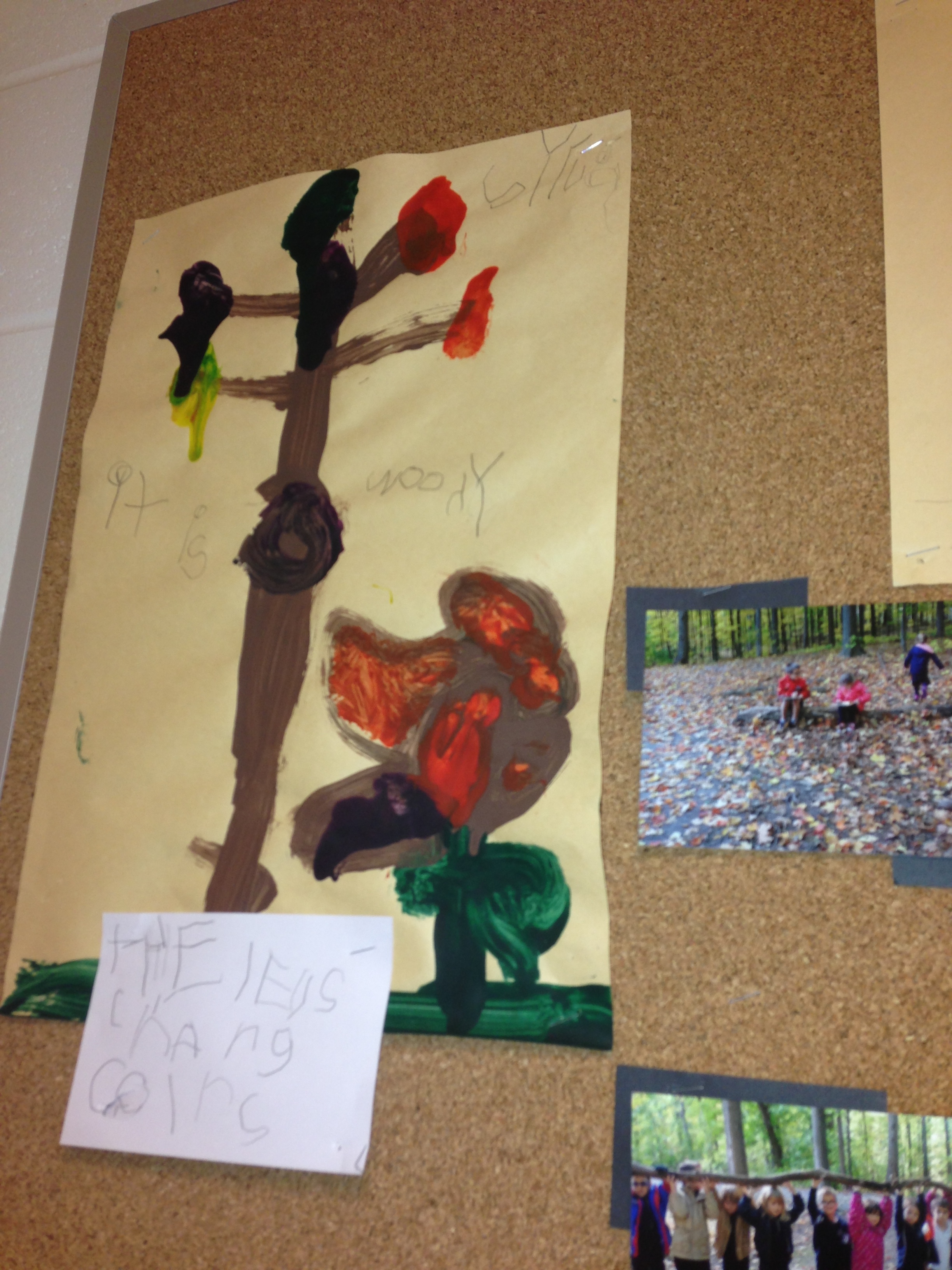
Sylvia Clare's portrait of "Woody", the tree the class adopted from the neighbourhood forest.
Sylvia Clare’s portrait of “Woody”, the tree the class adopted from the neighbourhood forest.

Children working in pairs, in small groups, independently on a variety of tasks throughout the room. The room was bustling yet highly organized. The room was loud but not noisy. I was thrilled to see so many “languages” brought to life (Reggio Emilia’s notion of the 100 languages in the classroom) ~ art opportunities everywhere; all purposeful and engaging. Everyone, including my Sylvia Clare had a place in the space and was engaged in the life of the room. The teachers encouraged Sylvia Clare to show me her portfolio (a binder with evidence of her work). Then Sylvia Clare led me to her interests where we explored and worked together.  Once well settled into the observation, the teacher sat down next to me and asked, “Do you have any questions or concerns?”  This was such an open and  welcoming way to start our discussion. My questions:

Is Sylvia Clare happy at school?

Does she have friends and is she social? Who does she play with the most?

Where does she spend most of her time in the room?

I see she is learning a lot from all that she shares at home. What do you think?

The teacher provided specific description of Sylvia Clare’s work in the classroom: what she talks about, who she plays with, what she enjoys doing, and how she interacts in the classroom. It was clear to me the teachers have a good sense of who Sylvia Clare is, what she likes, areas she has shown significant growth already and areas for improvement. Then I asked:

What can we work on at home to support her learning? 

Continued literacy development, focusing on sound/letter recognition.  I realize now, as a parent of a child who is developing their reading skills just how complex the process is for children. It takes time. Some children acquire skills faster than others; some struggle  but all children need time, exposure, practice to basic skill development. In theory, I knew this. To witness it through the lens of a parent however is somewhat different.  Experiencing literacy development in one young child in live time, watching her gain letter recognition, one letter at a time, one sound at a time, is quite fascinating.  Sylvia Clare is getting there. Beyond the daily read alouds and story telling I need to work through phonic games and drills with Sylvia Clare.

After our brief conversation I felt comfortable and confident that my child has adjusted to full day schooling and getting along well.  Sylvia Clare then ushered me over to the snack table and we chatted while  some of her friends came over to meet me. Shortly after, I said my goodbyes and was on my way.

It was remarkable observing my child in this setting; a setting outside our home, a setting in which I am but an observer and Sylvia Clare is the participant. The observation experience provided very clear, detailed description of my child’s work at school, far more than I would have gathered from a formal report card.


“Goodnight Moon” revisited

Many are familiar with the picture book Goodnight Moon by Margaret Wise.

Unknown

In case you are not familiar or need a refresher, here is a link to the story:

It is a lovely bedtime story, rhythmical and calming.  Originally published in the late 1940s, and still selling strong today, millions of children have enjoyed the simple tale. It is a classic.

And then came a parody, Goodnight iPad.  Amusingly written by “Ann Droyd” the book is awesome.

Unknown-1

When I (Yiola) first read the book I laughed and laughed and laughed. It is witty and clever while successfully maintaining the rhythm of the original.  It is a powerful message for 21st century learners: know when to unplug!  

Here is a link to the book.

Or for a flashier, more techy version, check out this link:

From the 1940s to today… the images and ideas that need a ‘good night’ have changed  drastically but a child’s wonder and desire to stay up has stayed the same.

I like how the traditional genre of the picture book captures the power of technology in our society so beautifully. A classic communication tool.

I plan to use this text as a closure piece on Technology Day next term.

“Goodnight gadgets everywhere”

Literacy development and genres: The graphic novel

When I (yiola) first began teaching  (in 2008) I asked student teachers if they knew about graphic novels.  The response was that few students were familiar with the genre or how and why it may benefit learning in the classroom. With each passing year more and more student teachers indicate they are familiar with graphic novels and more and more student teachers recognize the genre inside classrooms.

Some use the term graphic novels interchangeably with comics with others differentiate the two as distinct styles. In either case there are strong arguments for why the graphic novel is a powerful genre for literacy development.

6 Reasons You Need To Start Reading Comic Books

http://neillcameron.blogspot.co.uk/2014/09/comics-and-literacy-part-1-why-reading.html

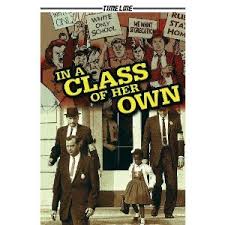
I introduce student teachers to David Booth’s book “In Graphic Detail” and I share the graphic novel “In a Class of her Own” to demonstrate how critical literacy and language acquisition can be developed in meaningful and interesting ways.

Unknown


http://www.theguardian.com/childrens-books-site/2013/mar/19/review-in-a-class-of-her-own-kathleen-gould-lundy

The sharing of the graphic novel as a useful genre in the classroom is a highlight in my course. Many student teachers become inspired to use graphic novels once they are introduced to why they are effective and how to use them in a classroom setting.

Please share any great graphic novel titles that you know to be outstanding.


Language and power: A well “articulated” analysis

It is  a rewarding feeling when a student teacher from years past emails a link to an article, a video, or an image that is reflective of the messages we discussed in our teacher education class. The message it sends me is this, “I remember you. I remember your teachings. I learned and am still thinking about what it means to be a teacher and what it means to teach literacy”.  Today I (Yiola) received a short email from a student of four years ago. She sent the following link:

The link takes us to a spoken word presentation entitled “3 Ways to Speak English” shared on TED during a theme based session called “Examining Prejudice”.  Her talk as part of the series is described as:

Educator Jamila Lyiscott delivered an incredible poem called “Broken English,” in which she showed that she is a “Trilingual orator” able to speak fluently at home, with Caribbean parents, at school in “proper English,” and with her friends in a language that is as formal and rules-based as the other two. The poem raised a big laugh when she pointed out, “You may think it is ignorant to speak Broken English, but even articulate Americans sound foolish to the British.”

My favourite part is when she says:

So I may not always come before you with excellency of speech

But do not judge me by my language and assume

That I’m too ignorant to teach

‘Cause I speak three tongues

One for each:

Home, school and friends

I’m a tri-lingual orator

What stands out for me about the poem and what I will share with my students in class this week:

1) The power of language and how we associate language with power

2) Language and how it informs our identities — how many languages do you speak?

3) Linguistic profiling: the racial identification and discrimination of an individual or group of people based on their speech  and how that plays out in society and in the classroom

4) History — and how it influences our use of language

I was moved by her words as Lsyiscott describes:

These words are spoken

By someone who is simply fed up with the Eurocentric ideals of this season

And the reason I speak a composite version of your language

Is because mines was raped away along with my history

I speak broken English so the profusing gashes can remind us

That our current state is not a mystery

I’m so tired of the negative images that are driving my people mad

So unless you’ve seen it rob a bank stop calling my hair bad

I’m so sick of this nonsensical racial disparity

5) Awareness, ourselves and teaching — what do we as educators do with this knowledge?

Here is a link to a prezi that Lysicott has used at presentations:

http://prezi.com/_htjpqeom2js/how-broken-english-made-me-whole/

6) How to take our linguistic diversity and turn it into power:

This is a linguistic celebration

That’s why I put “tri-lingual” on my last job application

I can help to diversify your consumer market is all I wanted them to know

And when they call me for the interview I’ll be more than happy to show that

I can say:

“What’s good”

“Whatagwan”

And of course …“Hello”

Because I’m “articulate”

I look forward to my class on Friday and to sharing thoughts, feelings and ideas about what all of this means to children, their families and the learning environment in our elementary school classrooms.


Technology in the Classroom

A short video clip that demonstrates how technology is being used in a local high school. Interestingly the purpose for the use of technology is connected with well being and class participation.

I (Yiola) am currently preparing a “technology day” conference that will emphasize and highlight the use of technology is classrooms for our student teachers. I like the examples shared in the clip. I will be sure to share the experiences of technology day that will take place next term.

http://toronto.ctvnews.ca/video?playlistId=1.2072063

Teacher collegiality: A priority in education

Teachers and Teacher Educators alike, I (Yiola) hope you have had a good start to the academic school year. By this time a productive learning environment is in the works, students are settling into routines and relationships and all wheels are in motion. Teaching and learning in classrooms is a complex enterprise. I believe we spend huge amounts of time thinking about and preparing our students for the classroom yet little time is spent on developing safe, supportive, resourceful environments for ourselves as educators.

Enter the social world of teaching for teachers. From novice classroom teachers to veteran teacher educators, research literature clearly shows that the conception that educators perform better when working together professionally is supported by organizational theory models… Such conceptions view authentic teamwork as an essential characteristic of the successful organization as its members interact regularly to share their ideas and expertise and develop common understanding of organizational goals and the means to their attainment (Shah, 2014).

See full article here:

teacher collegiality

Integrated classrooms, full day kindergarten teams, division teams, departments, staff and faculty and informal professional learning communities (PLC), require teamwork, moral support, and encouragement between educators.  What better way to engage in teacher preparation and teaching than feeling supported, appreciated and valued.  What are the key characteristics of collegial work environments?

The research literature indicates considerable consistency in the key characteristics of teacher PLCs. Participants working together regularly over an extended timeline, shared values and vision, practical activities focused on student learning, taking an inquiry stance, being reflective and collaborating and sharing experiences, are characteristics which are consistently highlighted (Susan Owen, 2014).

See full article here:

Owen

A supportive work environment, collegial atmosphere, shared vision, shared workload, appreciation and affirmation of colleague contributions, and genuine interest and commitment to the school/program make a significant difference to educators’ work. While the structure and environments are often built from the top down (i.e. principals or program leaders), much can be done within organizations to foster strong PLCs. These are messages I share with my student teachers as we consider how teachers work with early childhood educators in the kindergarten classrooms, and how the special education teacher communicates with the regular classroom teacher, and how teachers communicate with parents. Exploring how to work collaboratively and how to deal with conflict are important considerations for good teacher practice.

Teaching, service work, and research are approached with interest, enthusiasm, and care because of the collegial work environments that have been established within the PLCs. Below is a picture of wonderful colleagues and my cheering team. I am extremely grateful for the wonderful professional learning communities I am part of at OISE.

10013478_10154025542180121_1297636224_o copy

Left to right: Prof. Gisela Wajskop, me, Prof. Clare Kosnik

Front and centre: Sylvia Clare and Gallaway

Teacher Education, Schooling and the Teaching of Holidays

Today is Canadian Thanksgiving. For many Thanksgiving is a holiday of rest. A long weekend for a quick getaway or time to gather with friends and family to feast on turkey and pause for a moment to reflect on one’s blessings. For many, it is a happy holiday, not associated with historical ties or religion.  For others, Thanksgiving holds alternative feelings and reminders.  As a teacher educator I do not mention the holidays in my class nor do we discuss possibilities for addressing the holidays in the classroom. Now I am thinking maybe I should… not for the purpose of generating teaching ideas and strategies but for the broader more philosophical discussion of what should be considered when raising the topic of holidays in the classroom?

I remember Thanksgiving celebrations at school; we decorated autumn wreaths, coloured turkey pictures and shared what we were thankful for with one another. But, is that what Thanksgiving is about? To some, it may be just that. But is it something else? What are the perspectives? The history? And how do we share that information in ways that are inclusive and safe? In fact, how do we share any holiday content with children in our classrooms? I am interested in unraveling the embedded practices that are based more on tradition (doing what we’ve always done) and thinking more about the students in our classrooms and how the stories and histories and significances of the holidays may or may not touch their lives.

Quick searches online led me to inconsistent explanations of the origins of Thanksgiving in Canada. So I am left to share a simple wikipedia here:

http://en.wikipedia.org/wiki/Thanksgiving

There are significant differences between Canadian and USA Thanksgiving, far beyond the different date.

And then of course there is the perspective taking on the holidays. Thanksgiving is one where Aboriginal perspectives, for example, weigh heavily in my thoughts and move me to contemplate how best to approach the discussion of the holiday in schools.

There are several online resources available and people to talk to about the varying perspectives. Information can be found. Yet I am still left with the questions, how do we approach this in the classroom? Do we continue to colour in turkeys and refer to a ‘harvest’ that many 4 – 10 year olds cannot quite imagine and have children share what they are thankful for? Do we tell stories and share multiple perspectives on the past and present? Do we do nothing at all?

I’m interested to hear from teacher educators and teachers about what you are doing or have see done in teacher education and in schools.  An interesting discussion with many angles and points of view.

Sending warm wishes to those who have celebrated and enjoyed the holiday this weekend.

images

Literacy learning through music: A method of inspiration

All weekend I (Yiola) have experienced spontaneous musical encounters. Take for example sitting next to a 16 person chorus who spontaneously serenades my friends and me while dining at a local tex/mex restaurant. Or listening to my children sing Old Macdonald Had a Farm in the back seat of the car. These moments of ‘musical interlude’ have left me feeling inspired and intrigued about the power of music on the psyche, the emotions, and on teaching literacy.

A quick search online led me to several interesting and research-based articles on literacy learning through music. I will share these links with my student teachers. In my course we explore music education: music as a subject, music curriculum, music pedagogy, music integration. The links below add an exceptional layer of consideration for teaching music and literacy.

Click to access placing_music_en.pdf

Click to access impact_of_music_on_literacy.pdf

http://oneotareadingjournal.com/2012/learning-literacy-through-music/

Not only do research findings support literacy development through music, we also know that music, like an incredible book, touches the soul and ignites emotion. Brain development AND inspiration. A likely combination for student achievement.

I conclude this post with a brief video of another spontaneous musical encounter; this one between a 19 year old student and Billy Joel. I share this link not only for the music but for the power of relationship between student (confident, risk-taker) and expert (open, trusting, willing to explore possibilities). The music AND the experience gave me goosebumps. “That’s Michael Pollock. Remember that name”, says the teacher…

http://www.wimp.com/bravestudent/

‘H’ints and ‘H’appiness: Literacy learning in FDK

With the first month of school soon behind us I (Yiola) want to share some examples of my 4 year old daughter’s (Sylvia Clare) literacy learning in Full Day Kindergarten (FDK).

Example 1:  Phonemic awareness.  Sylvia Clare must be learning about the letter H.  On more than one occasion she has demonstrated her understanding of phonemes and phoneme isolation.  I said, “Sylvia Clare you must be hungry”. Sylvia Clare paused and responded, “Mommy, is hungry like Henry? huh huh huh.” I paused in surprise of her observation and connection and simply said, “Yes”.   Later in the evening I said, “Hendrix and Orion are going to visit soon” and Sylvia Clare responded, “Hendrix is like hungry and Henry, right mommy?”

Example 2:  Letter recognition.  One night earlier this week while tucking Sylvia Clare in bed I noticed she was curled in the most unusual position. I observed but said nothing. Just as I was about to pull the bed sheets up Sylvia Clare said, “Mommy, what letter do I look like?”   I respond, “hmmmm, interesting. I’m thinking you look like an I?”  Sylvia Clare laughs, “Noooooo. What letter do I look like mommy?”

She is also taking objects and forming letters. For example, while playing outside, she took two twigs and  placed them together to form the letter “V” and asked, “Does this look like a letter mommy? What letter is this?”

Example 3: Vocabulary development and comprehension.  More and more Sylvia Clare comes home with stories. Vivid stories. Curious stories.  Each day her stories grow in detail and description. The other day she explained she went on a trip to the forest in search of an oak tree. She shared,  “On the way to the forest, I held a boy’s hand [she paused and blushed]. His name is *Sam (changed) and he is in SK (senior kindergarten) so he is bigger.  I fell down on my way to the forest but I did not get hurt and the teacher gave me a bandaid. The forest close to the park mommy, you know the one we always go to.  We went into the forest just a little, not deep in the forest, only at the entrance. There we found a humungous oak tree. It had 4 trunks and they went out like this (uses her arms and points in four different directions). So it really looked like four trees stuck together. We looked at the bark”.  I asked if it was an angel oak tree. She was not sure but she continued to share news about her experience.

Example 4: Confidence.  Sylvia Clare drew a map of the world at home, wrapped it up and took it to school. I thought nothing of this as I dropped her off in the morning. Then I realized I left her lunch bag at home! I scrambled home and rushed back to the school to bring her  lunch.  By the time I returned to the school the children were engaged in outdoor play/education/inquiry.  I saw Sylvia Clare standing with one of her teachers, her map open and making reference to it. The teacher saw me and smiled, “Sylvia Clare is reading her map and we are now trying to find the treasure”.  How wonderful to see play and literacy in harmony. A reader is a person who reads. Sylvia Clare was demonstrating she is a reader. Then, at the end of the day when I went to pick her up she had another paper in hand. I asked, “What did you work on today?” and Sylvia Clare explained that she lost her map so she made another one – she developed a graphic organizer, a way to read, understand and appreciate the world. My thoughts:  thank you teachers, for providing the time and space for Sylvia Clare to engage in what interests her and thank you for appreciating those interests.

On her own, without probe, Sylvia Clare is offering hints of literacy teaching and learning.  With sly enthusiasm she is sharing her learning with me, in subtle, whimsical ways. She is sharing her achievements and understandings and I can tell she is proud that she is learning new things.  What excites me is that her learning is evident; in her sharing, practice and happiness. It is not coming home by way of worksheets or alphabet books.  I look forward to seeing and sharing what the upcoming months hold.