Category Archives: communicating ideas and research

Fort McMurray Disaster — Fort McMoney a documentary game

I (Clare) like many Canadians are watching the news as the fire in Fort McMurray fire RCMPAlbertaspreads to 850 square kilometres with; thousands being airlifted. It is reported that the “The wildfire in Fort McMurray could be the costliest disaster in Canadian history as estimates for insured damages run as high as $9-billion. Thousands of homes and businesses in Alberta’s fifth largest population centre have been destroyed.” http://www.theglobeandmail.com/news/alberta/fort-mcmurray-exodus-swells-as-fires-rage-a-lot-of-people-are-working-to-get-you-out/article29883034/

This catastrophe is on a monumental scale but it has touched me in a different way. For two years I worked with a teacher research group, Eureka, and one of the teachers, Mike Farley, did his research on the use of Fort McMoney http://fortmcmoney.com/#/fortmcmoneyin his geography class. Over a period of time the students played the game and he studied their reaction to using the game and their learning.

His data showed that the game had a HUGE impact of their learning. Fort McMoney is s an interactive documentary game that lets you decide the future of the Alberta oil sands, and shape the city at its centre.

Through the research group I watched/played the game which gave me an insight into the community and the complexity of the issues of the oil sands. I emailed Mike when I heard the news about the fire. He said that he and his students were so upset by the events because they understood Fort McMurray and the impact on this fire community. This is an example of gaming that brings the real world into the classroom. His students probably have a much better understanding of this devastating fire as a result of the playing this highly interactive and informative game.


There is a long description from the Globe and Mail of the game below and it is well worth checking out the game. http://www.theglobeandmail.com/report-on-business/industry-news/energy-and-resources/what-is-fort-mcmoney/article15583598/

A frozen highway spools out ahead of you, in the distance giant factory facilities with spewing smokestacks are carved out of virgin forest. It looks cold, cold like one of those Soviet factory towns in the Arctic Circle.

That’s the scene that greets you when you boot up Fort McMoney, which is a virtual world that went live online Monday. There are many places to see and even more characters you can interrogate and interview. Scores will be kept and leaderboards maintained to reflect actions taken by visitors: the more curious you are the more points you collect. This world is also episodic, new places and people will arrive every week over the next four, and visitors can vote for changes they’d like to see based on what they experience inside Fort McMoney.

If you have a passing familiarity with modern video games, you will recognize this structure. But while it is a game, it’s not fiction, it’s an interactive documentary about that most consequential Canadian oil town: Fort McMurray. It was produced by The National Film Board with French, German and Canadian partners, including The Globe and Mail. (Columnists Eric Reguly and Margaret Wente will be writing about their evolving views as they play along. Read Ms. Wente’s first take here and read Mr. Reguly’s here.) The makers of Fort McMoney call it a game and call users “players,” but there will be no “winners,” or rather there is no way to “lose” the game.

(Also, for such an innovative project, the language to describe it is lacking; we need a new term like Game-Umentary, but one that isn’t terrible.)

Functionally, it owes some of its game design DNA to 2012’s episodic zombie adventure The Walking Dead from Telltale Games. The winner of multiple video game awards, Telltale’s creation follows a similar forking structure: Like in Fort McMoney, each player’s experience with the game will vary because each decision you make, each question or action you commit to, changes the sequence of the next thing you see or are able to do. In The Walking Dead that often meant people you met in the game got eaten by zombies, in Fort McMoney it just means you visit a different part of one of Canada’s fastest-growing boom towns.

Over the next month players can dig through about eight hours of interviews and conversations with the real residents of Fort McMurray, a city which lies at the heart of Canada’s oil sands. The game asks players to choose whether the city should help crank oil production up to 11, or if it should essentially shut down the industry. That’s where the SimCity element of this game comes in: How the city grows, and how that affects Canada’s energy future, will be displayed in a series of projections, updated each week by the latest referendum.

This laboratory of democracy is hosted in the “dashboard” part of the game, and this is where it strays from being a pure choose-your-own adventure story (if still a documentary, there are no actors here), and turns into a civics experiment. Players will be invited to debate, share their in-game discoveries and vote on policies for the town and its ever-present oil.

The issues the Fort McMoney asks players to vote on in the weekly polls are ones the real town faces: If you could, how would you vote to change things about the trajectory of Fort McMurray and Canada’s exploitation of the second largest energy reserve in the world? The results of player voting will create a hypothetical Fort McMurray, one in which the future has been directed by the votes of this digital public square, like in a classical Greek democracy. Only here, the amount of debating, sharing and exploring you do can net you a higher score, and thus a heavier vote during the polls. It’s why a documentary is keeping score at all, as a reward for spending time “playing” the game.

The elephant in the room is that this game/documentary is about oil in those sands, and the environmental and human cost of boiling it out of them. Fort McMoney starts by introducing you to people living on the margins of this rapid growth, the young woman who was hoping to clean work camps but instead works as a waitress, the alcoholic who collects cans (claiming to clear $52,000 in one year recycling the discarded booze containers of Fort McMurray’s residents). In short order you meet the mayor of the town, and eventually oil sands executives and other leaders.

Creator David Dufresne talks about our civilization’s “addiction to oil” when he talks about the conversation he wants this game to spark. This is the part the NFB, Dufresne and his whole team, are really excited about. As Dufresne explained during a recent live Q&A about the project: There are no shortage of great books, documentaries or journalism about the “tar sands.” He says he was drawn to Fort McMurray thanks in part to stories about the town in The Globe and Mail. But for all of that, do Canadians feel any urgency to take action? He hopes to change that by giving people something gorgeous to look at, deep to explore, fun to argue about and which creates consequences for the user’s decisions. He hopes his video game will convince people to be the change they want to see.


Why I love blogging: Take my creativity post and watch the learning grow

Writing blog posts is one of my most favourite things to do. I (Yiola) do not think I’m an entirely seasoned blogger but with time, practice, and learning I hope to become good at it one day. Why? Well, as an academic one of my goals is to share what I study and what I know with others. One way I do this is through my teaching. I am a teacher educator. My goals as a teacher educator are to prepare pre-service teachers to become excellent teachers by thinking about what they teach, how they teach and most importantly who they teach.  I am also a writer — but a very particular kind of writer. I have been taught to write in academic prose for journal articles and book chapters. Sometimes our articles and books are read by others in the field.  But… blogging… this is an entirely different genre and such a wonderful way to network and meet amazing people – some directly in the same field and others in slightly different but related fields – while sharing knowledge and information. Since writing on the academic / teaching blog I have met wonderful people and learned many things and taken away wonderful ideas. Let me share an example based on something that happened recently.

Some time ago I posted a blog about creativity in teacher education. Here is the link below:

Promoting creativity in teacher education

Last week I received an email from a person who is in the field of creativity who has also done some good work in the area. This person shared their insights on what I had written and provided supportive feedback and then also shared their work with me. What a delightful process! I am now sharing their work with you. The following link leads to a list of ways to infuse creativity into the classroom. I reviewed the link and like it for several reasons: 1. It’s foundations and theoretical underpinnings are closely linked to the work I shared with my student teachers in our classes on creativity  2. The list is very easy to view and accessible  3. I found the list inspiring and doable — so yes! I will now proceed to share this link with my student teachers and friends.

http://www.fusionyearbooks.com/blog/creative-classrooms/

This is but one example of how blogging in academia and in teacher education serves such good purpose. Yet another example of how digital technology and literacy work hand in hand to foster communication and learning. I am delighted when I receive messages with feedback, interest, and sharing. Looking forward to more connections and learning through this medium.

Sleep Deprivation: A talk by Dr. Reut Gruber

The Dr. Eric Jackman Institute of Child Study Parent Education Association organized a fabulous event this week on sleep deprivation. I (Clare) attended and felt I learned so much!

The speaker Dr. Reut Gruber (professor at McGill University) walked us through “sleep for gruber-mainsuccess” which included a description of our sleep cycles and some of the consequences of sleep deprivation. Here are a few key points that I found incredibly informative.

  • Sleep is affected by intrinsic biological processes, cultural values, parental beliefs, school start time, and age
  • Sleep deprivation affects academic performance, mental wellness, and physical health
  • Regarding academic performance she said executive functions are affected, not allowing children to filter, make correction decisions, plan, resist distractions and regulate emotions
  • Regarding sleep, learning, and memory she said that we need to sleep so that the new information/learning can be integrated into what is already known. She said that we tend to think that if we expose children to “more” they will become “more brilliant” but knowledge needs to consolidated.
  • She gave a great analogy – if we do not sleep it is like not pressing the “save” button on our computer. Memory consolidation occurs when we sleep. For this process to occur we need to be “offline” that is be asleep.

Her work has been profiled on CNN, CBS …. Here is a link to some of her articles:

http://www.mcgill.ca/psychiatry/channels/news/dr-reut-grubers-research-featured-time-healthland-cbs-news-and-cnn-health-218643


Topics and Methods for Class Debates

In previous postings, I (Clive) have recommended debates as a way to give students a voice in university and school classrooms and also introduce some variety into class activities. Of course, the topics have to be interesting to the students if they are to get really involved; and the overly combative tone of traditional debating needs to be avoided so there are no hard feelings.

This term, in my graduate class of 22, I used two debating topics that worked very well. They were: (1) Teaching Values in School and (2) Formal Professional Development for Teachers. In each case we formed 4 groups (by numbering off from 1 to 4 around the class, including myself) and then assigned “positions” to the groups as follows:

Teaching Values in School

Group 1: On the whole, teachers should keep their values to themselves

Group 2: It is often appropriate for teachers to promote the values they believe in

Group 3: On the whole, schools should advocate general “human” values (e.g., treating women and men equally) even if they conflict with the values of the family

Group 4: On the whole, schools should honor and respect the values of the family, even if they conflict with general “human” values

Formal Professional Development for Teachers

Groups 1 & 3: Formal professional development has a very important role to play in teacher learning and school improvement. Examples of effective formal PD include….

Groups 2 & 4: Formal professional development does not play a major role in teacher learning and school improvement. Examples of more important methods and factors are….

Each group spent 20 minutes preparing their case, with each person in the group proposing and outlining an argument and/or example. Then each group in turn presented their case to the whole class, with every member of the group speaking. Finally, we returned to the whole class circle and went around with each individual saying what they thought about the topic (we didn’t have time to go all the way round the class, but this final activity also proved very valuable).

Notice that the “opposing” positions were softened by using phrases such as “on the whole,” “it is often appropriate,” “not a major role” (rather than “not any role”). Also, the emphasis on giving examples to support one’s case was a big success – I hadn’t used this before.

So, this was my experience. If you have a chance to experiment with debates, let us know what topics you used and how it went – we can do a guest blog!


Photo Journal of my Experience @ AERA

Here are some snapshots and highlights of my experience at AERA this year. If I (yiola) could name the experience I would call it:  Goosebumps and Inspirations… it was just that good.

  1.  I attended a Round Table session (this is where presenters gather at a “round table” and share their research). The Round table is a great opportunity to not only share your work but hear from others in a less formal manner.  This round table was hosted by the  Writing and Literacies special interest group (SIG) and the focus of the round table was critical literacy.  Dr. Barbara Comber from the University of South Australia presented on critical literacy pedagogy in the early years. Her work and my work are closely aligned.

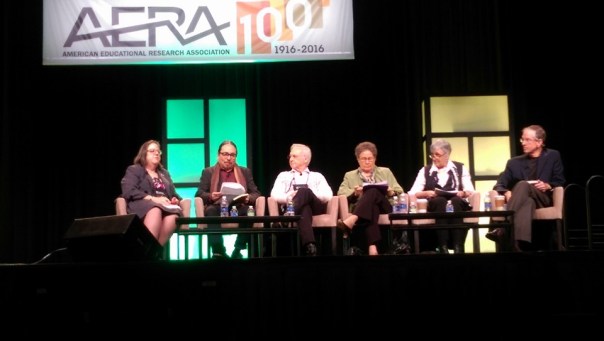
2.I attended a presidential talk that was a tribute to the life and work of Dr. Phil Jackson. The focus of the talk was on the question of education.  I really like what this panel did: each panel member selected a passage from a text written by Dr. Jackson and talked about its significance to them. A paragraph was read from The Practice of Teaching and the idea of transformative teaching… such an important and central idea in progressive education. A piece was read from Handbook of Research on Curriculum: Conceptions of Curriculum and the the idea that school is systematically harming children… and how can we work against that?  Linda Darling-Hammond read a passage from his famous book Life in Classrooms and spoke of the “multi-dimensionality and simultaneously nature of teaching” and the essential relationships associated with teaching. And, one panel member shared from Dr. Jackson’s last book published in 2012, What is Education and spoke of education as pure and simple; something we must rededicate ourselves too over time.

13001211_10156947381755121_1868962252431060235_n

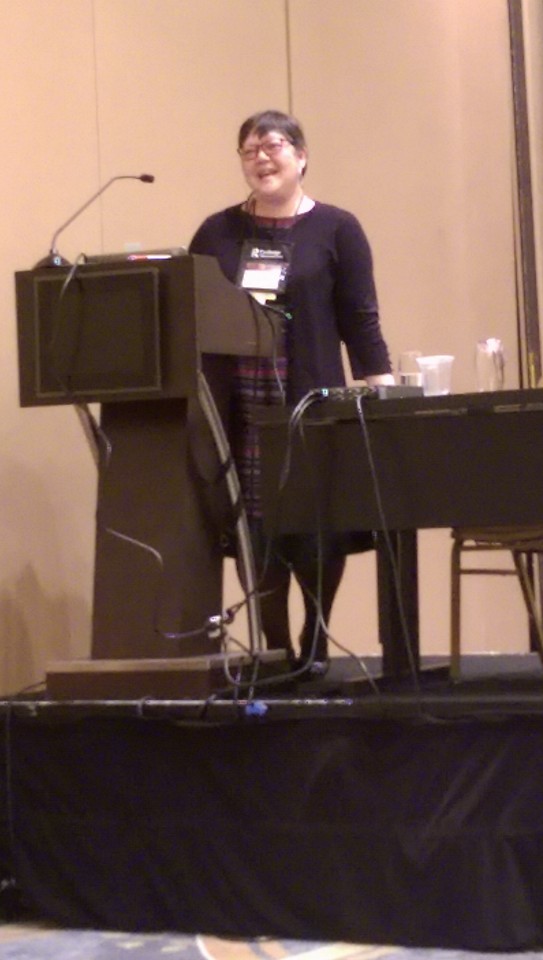
3. I was very fortunate to have the opportunity to listen to the presidential lecture  for Division K hosted by Dr. Lin Goodwin, Teachers College Columbia University.  A remarkable speaker who not only inspires with her words but truly challenged me to think about what quality teacher education requires. What I like most about Dr. Goodwin is her genuine nature. A distinguished academic and also a beautiful human being. Here are some pictures from her talk including slides from her presentation.

12998610_10156947381220121_6198746793740451746_n

13015255_10156947381525121_6392246007407300412_n13043368_10156947381450121_231103480067251929_n12994363_10156947381300121_7467634140817060326_n13012864_10156947381375121_7210803705214951729_n

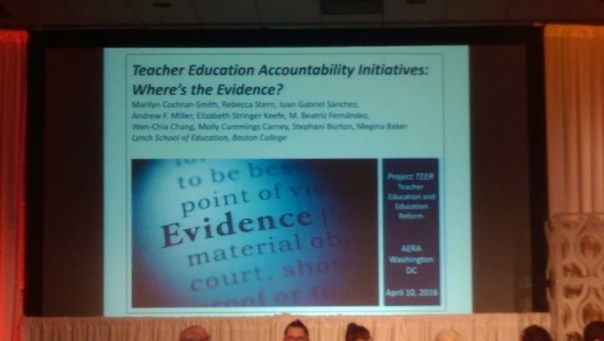
4. Yet another interesting Presidential session with Wayne Au, Marilyn Cochran-Smith, Kevin Kumashiro (and others) that explored policy and standards in Teacher Education. Laden with some controversial findings for the testing systems for new teachers and teacher education programs, the presentations were provocative and interesting:

13055504_10156947381160121_3248944785834068614_n13012858_10156947381050121_2214069562201491393_n

5. The last session I would like to share is one where we presented at the Constructivist SIG. A lovely group of people from across North America, we exchanged ideas of what it means to teach in constructivist ways. Our team leader Dr. Clare Kosnik presented work from the Literacy Teacher Education research and presented on a group of literacy teacher educators who had strong constructivist pedagogies.

Finally, AERA is held at such interesting places. One has to take some time to enjoy the beauty of the district and take in some of the sights.

Preparing for AERA

I (yiola) along with the research team and many other colleagues are preparing for the American Educational Research Association (AERA) conference that will be held in Washington DC this year. The conference begins on Thursday April 7th until Tuesday April 12th.

An enormous conference that attracts thousands of educational researchers from around the world and across disciplines and methodologies in the area of education. Each year the conference has a theme. This year the theme is Public scholarship to educate diverse democracies.  Here is a link to the site and more information about the conference:

http://www.aera.net/EventsMeetings/AnnualMeeting/2016AnnualMeetingTheme/tabid/15861/Default.aspx

The team and our close colleagues will be presenting at AERA.  We will be sure to post pictures and updates from the various sessions we attend. We hope to see you there. If you are not attending this year be sure to check out out blog for highlights next week.


Global Conversations in Literacy Research

One of the amazing things about our research team is we share common interests in literacy teaching and teacher education while at the same time we explore our own avenues of research. My areas of interest are in critical literacy pedagogy and teacher development.  I (yiola) have been enjoying and learning a great deal from another amazing literacy research based website and would like to share it with you.

Here is the link: https://globalconversationsinliteracy.wordpress.com

Global Conversations in Literacy Research (GCLR) is a series of interactive open access web seminars that feature cutting-edge literacy research conducted by international literacy researchers. GCLR is grounded in critical literacy, and sees as its mission to use networked technologies to connect global audiences in a virtual space that allows participants to exchange ideas on literacy theory, research, and practice. Each year, GCLR features scholars whose work addresses a range of literacy areas of interest to international audiences.

Some of my favourite researchers in critical literacy have shared webinars on the site.  I appreciate the global nature of the site and the sense of shared understandings through varied contexts.

An inspiring site — enjoy!

Butterfly Books: An amazing resource

It is common to find educators and parents in search of good books for children.  What makes a book good? What is a worthwhile read? What kinds of books do we want children to read? Why?  I have discovered a resource for thinking about and finding children’s books and am excited to share it with you.

Helen Antoniades, founder and operator of Butterfly Books, has embarked on a most inspiring journey in search of great books for children.

A front line social worker in Toronto, Ontario Canada, Helen has spent her adult life counselling children and adults from all walks of life. The  last 4 years of her practice was at the Hospital for Sick Children.  After 17 years of social work Helen, feeling burned out,  decided to start something new and explore her passion for healing others in an alternative way. Always passionate about books, she chose to share her knowledge of and experience with using books to help children understand and deal with issues in their lives.

Helen began her search by asking a lot of social worker colleagues for their go to books. Then she began asking friends in related fields. This interest grew into the blog, where she alternated “regular” pictures books with therapeutic books as suggested readings for children. As her journey continued Helen began exploring the “regular” books she was coming across and has broadened her scope to quality books that are reflective of diversity.  You can find Helen’s website at:

http://www.butterflychildrensbooks.com

Butterfly Book’s mission statement:

Butterfly Books is a children’s book subscription service whose goal is to make receiving a new book an eagerly anticipated, joyful event with an aim to foster and sustain a love of reading in children.
In addition to creating excitement about reading, the service will give children the opportunity to explore other worlds and experiences through books.  Part of the focus will therefore be on ensuring diversity of characters and topics within the books chosen.
This service is also a way to make giving books as a gift more inviting.  This personalized approach will connect families through the love of books and the satisfaction of a quality gift given and received. 
There is also a handy Facebook page with wall postings that share a book per week. It is an efficient and helpful way to access interesting books and gain insight to how they can be explored with children, often including book reviews.
Check out the website, like the FB page, and get connected with Butterfly Books!

Parsing the Practice of Teaching


I (Clare) and Clive both read the most amazing article on teacher education by Mary puzzle_pieces300x199Kennedy. For those who have followed this blog you will know that we are big fans of her work. You will also know that we believe in thinking about teacher education holistically. Trying to break it down in discreet bits misses the core issue- What are the goals of education? I would highly recommend this article to all teacher educators. Below is the Abstract and here is the link to the article. Well worth the read.Mary Kennedy_2016

Abstract:

Teacher education programs typically teach novices about one part of teaching at a time. We might offer courses on different topics—cultural foundations, learning theory, or classroom management—or we may parse teaching practice itself into a set

of discrete techniques, such as core teaching practices, that can be taught individually. Missing from our courses is attention to the ultimate purpose of these discrete parts—how specific concepts can help teachers achieve their goals, or how specific procedures can help them achieve their goals. Because we are now shifting from a focus on bodies of knowledge to a focus on depictions of practice, this article examines our efforts to parse teaching practice into lists of discrete procedures. It argues that we need to pay less attention to the visible behaviors of teaching and more attention to the purposes that are served by those behaviors. As a way to begin a conversation about parsing teachers’ purposes, I offer a proposal for conceptualizing teaching as a practice that entails five persistent problems, each of which presents a difficult challenge to teachers, and all of which compete for teachers’ attention. Viewed in this way, the role of teacher education is not to offer solutions to these problems, but instead to help novices learn to analyze these problems and to evaluate alternative courses of action for how well they address these problems.

Defining happiness: A child’s take on life.

IMG_0968From the mouths of babes. Motivational speaker Jay Shetty has some wise words for you on how to make the world a better place. A teacher asked her students to write down what they want to be when they grow up. There were the usual responses – astronaut, singer …. And one boy wrote down happy. When the teacher talked to the child suggesting he misunderstood the assignment, he responded. “Miss, I think you misunderstand life.” WOW!!!!

According to Shetty, it starts by pressing pause on your own life and improving the way you IMG_2826communicate with others.  The video is short but it reminds us about what is important in life. Well worth the time. In the video below watch him explain why it’s time for you to take a moment to become more conscious and aware. https://www.facebook.com/HuffingtonPost/videos/10153725769876130/