Category Archives: curriculum; teachers

Making Group Work More Personal and Inclusive

I (Clive) have posted before about the importance – in educational settings – of giving all Shawn Bullockmembers of a group a chance to speak. It now seems that similar observations are being made outside the educational realm. In Sunday’s New York Times Magazine (Feb 28, 2016), findings along these lines were noted in two studies from the world of work.

In a 2008-2010 Carnegie Mellon/M.I.T. study, a team of psychologists headed by Anita Wooley found that work teams with “pretty average members” were unusually effective when inclusive “group norms” were established. Wooley reported: “As long as everyone got a chance to talk, the team did well. But if only one person or a small group spoke all the time, the collective intelligence declined” (p. 24).

oopIn a later Google study called Project Aristotle, begun in 2012, researchers built on the Carnegie Mellon/M.I.T. study. They linked “conversational turn-taking” to a sense of “psychological safety” within a group. They found that work teams were more effective when there was a social emphasis and everyone had a chance to contribute. They reject a sharp personal/work dichotomy, stating that “no one wants to put on a ‘work face’ when they get to the office” (p. 72).

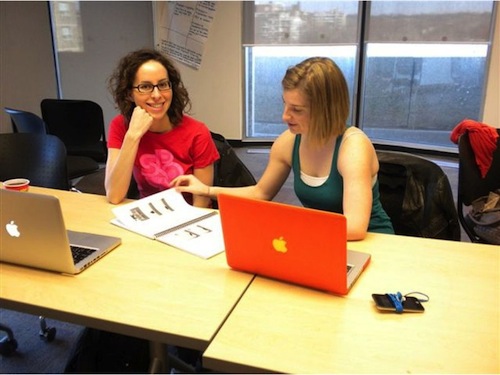
It seems hard to explain why group effectiveness and social inclusion would be connected Teachers working togetherin this way. More theory is needed in the area. But meanwhile I think we should consider these findings as we attempt to enhance our group discussion practices.


Motto for Education

I (Cathy)  came across this quote and felt it was most applicable to education.  As teachers and teacher educators we must be forward thinking and forward acting.  We must look to where or students and society is going to be and prepare them. Thank you # 99 for reminding us of our role in the progress of educational theory and praxis.


I skate quote


Mary Kennedy on Engaging Student Teachers More Deeply

As I (Clive) have said before, I’m a great fan of Mary Kennedy of Michigan State University. In earlier postings I commented on her complex vision of teaching and her incremental yet radical approach to school reform. Having read a new article of hers in the latest issue of the Journal of Teacher Education (Jan/Feb 2016), I wish to recommend it.

Ever courageous, Kennedy in this piece takes on the currently popular movement for the teaching of “core practices” in teacher education. While an improvement on earlier practice-focused teacher education approaches – in that the practices in question are medium-grained rather than too specific or too general – she believes this approach is (a) too didactic and (b) neglects the purposes of teaching. She proposes instead helping student teachers see that a variety of complex strategies are needed to achieve the purposes of schooling, and constant adjustments on their part are required along the way.

Kennedy is careful to note this is “not an either/or decision. I am not proposing that we abandon specific practices in favor of problem solving strategies. Instead I argue here for (a) less attention to bodies of knowledge, (b) less attention to specific teaching behaviors, and (c) far more attention to the persistent challenges” of achieving the purposes teaching. Her position is that in pre-service (and in-service) education we should “not recite knowledge or dictate practices to teachers, but instead engage teachers in more analysis and exploration of alternatives.” This seems to me to embody the constructivist approach to teaching that – as Kennedy has said elsewhere – most teacher educators advocate.

For those who may see this as an overly idealistic approach that will undermine pupil performance on standardized tests, Kennedy cites the findings of a review that “programs using these alternative pedagogies were generally more effective at raising student achievement than were the didactic programs that focused on either bodies of knowledge or specific teaching practices.”


Promoting creativity in teacher education

I (Yiola) have been building in how to embed creativity in classroom practice in my Teacher Education course for a number of years. This year I invited Lina Pugsley, a graduate of the Creativity and Change Leadership Program and Masters of Science in Creativity student from SUNY Buffalo  State,  to share with us what creativity means and how to teach creatively and teach for creativity through weaving creativity skills into our classroom lessons.

Our class consisted of information sharing about what creativity is and its complexity. I appreciated that we took time to unpack some of the misconceptions (a major one being creativity equals the visual arts) and to solidify some of its characteristics (creativity is problem solving, its innovation, its incubation, its idea generating, its colourful, etc.)

12572972_10156583591315121_606339910252037085_n

Lina presented us with a number of models and frameworks to think about ways of thinking about, teaching, and embedding creativity into our classroom practice.

Several great resources were shared and a number or creativity scholars introduced. From E. Paul Torrance to Ronald Beghetto, we were inspired!

12540548_10156583591375121_6677389572199015190_n

Once the theoretical and conceptual foundations were laid students in the class began to think more practically about what skills and strategies nurture creativity. This video set our curiosity in motion:

And, in creative fashion students explored, talked about and shared ways of bringing creativity skills into their teaching and lessons. We examined E. Paul Torrance’s 18 thinking skills from his book “Making the Creative Leap Beyond”

Some of the skills:
Be Original
Be Open
Visualize it Rich and Colourfully
Combine and Synthesize
Look at it Another Way
Produce and Consider Many Alternatives
Playfulness and Humour
Highlight the Essence
Make it Swing! Make it Ring!
Be Aware of Emotions
Be Flexible


The energy in the room was high. Students were interested and engaged.  They were encouraged to consider their personal teaching philosophy and to make creative thinking a priority in their teaching. It was an  inspiring experience. This particular teacher education course looks at methods in education. We explore planning, the learning environment, pedagogies and practices. Creativity, now in the 21st century, is a skill that students must acquire. It is not an innate skill that some are born with while others are not. Everyone has the capacity to develop their creativity skills and as teachers we need to learn how to create classrooms that foster, encourage, and celebrate creative thinking.in I believe the MA students gained a solid sense of what this is about.

For more information on Lina’s focus and work check out here website at:

http://www.keepingcreativityalive.com


Parent Research Night

This week I (Clare) attended the Parent Research Night at the Dr. Eric Jackman Institute of Child Studies (where I am the Director). It was a truly amazing evening because the two presentations demonstrated research that was for teachers and parents, done by teachers, and inspired by teachers. It was such a beautiful form of dissemination of research. The findings are not confined to a peer-reviewed article but were shared with the public.

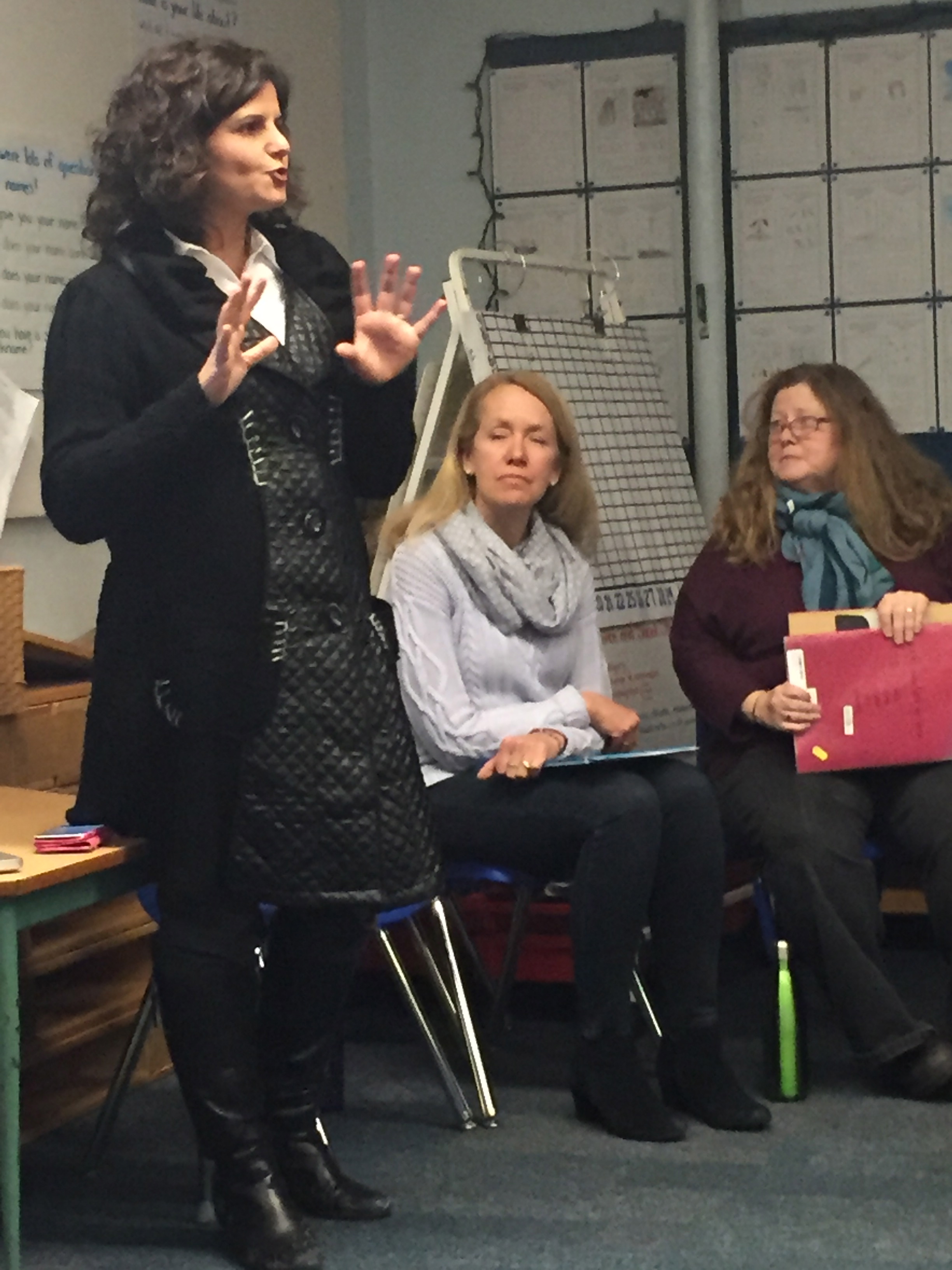
IMG_1147Dr. Patricia Ganea talked about the importance of shared reading with children. And she shared data on how children respond to images in children’s books – realistic (photos) vs fantastical (comic-like). Interestingly they relate much more to the latter.

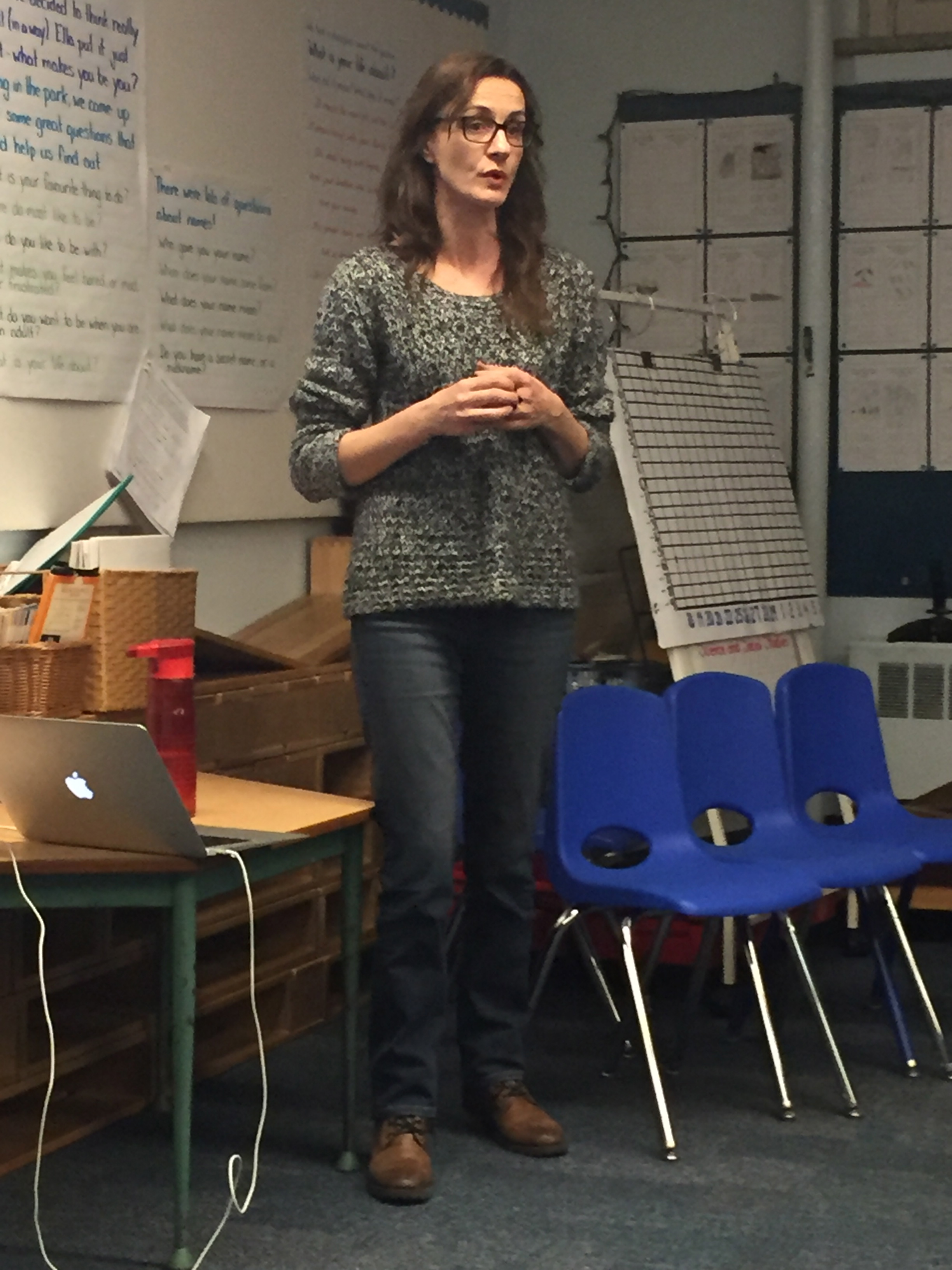
Then Dr. Yiola Cleovoulou and 3 teachers (Zoe Honahue, Cindy Halewood, and Chriss Bogert – who is now the VP) from the Lab School IMG_1153presented on their work with the children that was framed by critical literacy with an inquiry focus. They shared student work, read transcripts of actual conversations, and described activism work.

JICS has a tripartite mission: Lab school, teacher education program, and a research centre. Parent Research night truly brought all three together. http://www.oise.utoronto.ca/ics/index.html

The Future of Education?

I (Cathy) recently read a blog posted on the The Huffington Post.  If you are not familiar with the Huffington Post, it is an American online news aggregator and blog, that has been public for 10 years.   In 2012, The Huffington Post became the first commercially run United States digital media enterprise to win a Pulitzer Prize.

I qualify the source only because I am always suspect of individuals or groups that make claims or forecasts about education, yet  know little about the systems. As I consider The Huffington Post a relatively reliable and informative source, I gave the claims made by , a guest blogger who was the Former President for the  Society for Quality Education a second look.

In this blog, Dare proposes that all education systems are cartels  (an association of manufacturers or suppliers with the purpose of maintaining prices at a high level and restricting competition) and these cartels will be disrupted by the world of technology.  Dare suggests:

A software company might put together a complete online curriculum, with built-in testing and reporting, that allows students to progress at their own speed using tablet computers. Already much of this software exists, although it is not yet well organized. Another (or the same) software company might make it possible for parents to access individuals, or groups of individuals, who are willing to coach a group of other people’s children, possibly in their own homes or in a community centre, for a reasonable fee. Part of the software company’s services could be to vet the coaches and ensure they pass health and safety checks.

Dare uses Uber and Airbnb as examples of disrupters to systems and claims educational systems are next.  He goes on to say:

In fact, disruption is already taking place in the post-secondary sector — see UoPeople, the world’s first non-profit, near tuition-free, accredited online university. Currently, students can earn an undergraduate degree in business administration and computer science for $4,000 US, and more programs are being added.

I am fascinated by this blog for a number of reasons.  First, Dare assumes that a young adults  seeking to educate themselves  are comparable to young child who are learning to read and learning to socialize. I have taught children to read (and socialize) and I simply do not  think a  computer can do it.  There is a lot more to education than just text book learning!  Secondly,  Dare implies in the blog that teachers are oblivious to the affordances of technology and reject it for fear it will disrupt the “cartel” in which they participate.   Every teacher I know (from K to HE) incorporates (in degrees) technology into the teaching and learning in their classroom.  They are also aware that students can go online and teach themselves many things. They even encourage it.  The Khan Academy was designed for such learning and is largely responsible for the premise of flipped classrooms which are very popular right now  in Canadian colleges.  I do not think technology will disrupt the educational system.  I think it will just continue to enhance both teaching and learning. Technology and education will evolve together.

Lastly, Dare is completely oblivious to the most significant aspect of education – the relationship.  Countless studies have suggested a caring, attentive teacher can do more for a student than any other factor. Personally, I just can’t see technology completely replacing a good teacher, especially in the education of the young. People simply need people.

Thoughts?

http://www.huffingtonpost.ca/malkin-dare/ontario-education-future_b_8916284.html

Financial Literacy Advocate?

I (Cathy ) have met many literacy specialists, but never a  financial literacy advocate- until I met Shannon Lee Simmons. Her delightful sense of humor, bubbly personality, and brilliant financial mind make an intriguing combination.  Shannon is a Certified Financial Planner (CFP), Chartered Investment Manager (CIM), media personality, personal finance expert, and financial literacy advocate. She was named one of Canada’s Top 30 Under 30. Her passion: helping everyday people survive the new economic climate through personal finance, ethical investing and small business advice.

I explored her New School of FinanceTM   which is a collection of very practical and realistic on-line courses regarding every day finances. And the advice is excellent!  She truly makes finances understandable and interesting.  The list of her courses illustrates her quirky sense of humor and reveals her target audience- the millennials:

Can You Afford to Buy a Home?                                                                                                                            Sole Prop School                                                                                                                                              Budgeting with Your Boo                                                                                                                                        Don’t Get Effed at Tax Time                                                                                                                                    Baby Proofing Your Finances                                                                                                                                Track that Shiz                                                                                                                                                    GST/HST- The Good,  The Bad + The Ugly

I am fascinated by Shannon’s savy use of technology (she is wild about social media, especially Twitter) and how well she understands her market.  I suspect this very up-and-coming entrepreneur will do very well for herself and could probably give lessons to financial literacy teachers on how to engage an audience.  Check out her web site and view some of her videos.  You will know exactly what I mean.

http://www.newschooloffinance.com

shan

Shannon Lee Simmons:  Financial literacy advocate


Chimamanda Ngozi’s Book Being Distributed to ALL 16- Year-Old Students in Sweden

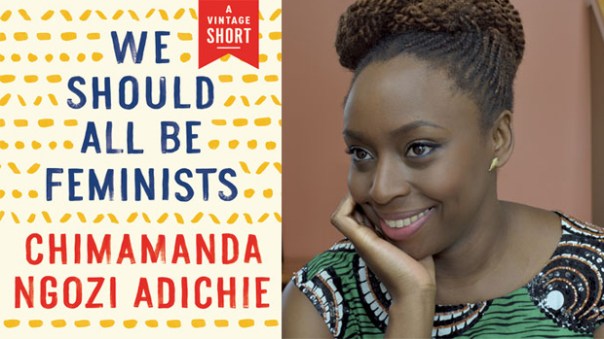
I have written about the powerful words of Ms. Adiche before. Her words stop us in our tracks and make us re-consider notions of identity, language, and gender. She has a new book out entitled We Should All Be Feminists. It is based on a speech she delivered at a TEDx conference a few years ago. I have already ordered it!

The most amazing thing about her new book is how it is being distributed. The Swedish Women’s Lobby has decided to distribute Adiche’s book to every 16-year-old student in Sweden. In a CBC article, publisher Johanna Haegerström believes her book will be an entry point into a larger discussion about gender roles in society. He said:

“Our hope is that the Chimamanda Ngozi Adichie text will open up a conversation about gender and gender roles, starting from young people’s own experiences”

adichie-composite

http://www.cbc.ca/books/2015/12/we-should-all-be-feminists-by-chimamanda-ngozi-adichie-is-being-given-to-every-16-year-old-in-sweden.html

“What curriculum do young people need in the 21st century?”

In his article for TES.com, John Dunford argues for whole education for ALL children not just those at top-attending schools. Dunford, Chair of Whole Education in the U.K., asserts those from econmically disadvantaged areas in the U.K. still receive “mid-20th-century knowledge-based curriculum.” He believes this antiquated curriculum “fails to recognise many of the needs of young people growing up in the 21st century.” He urges educators and policy makers to consider two key questions regarding curriculum:

  1. “What curriculum do young people need in the 21st century?”
  2. “What curriculum does most for the disadvantaged?”

In order to answer these questions, Dunford maintains it requires educators have unique set of knowledge, skills, and personal qualities in order to prepare young people for a rapidly changing world. Regarding the ways in which we view curriculum, he argues:

“It is not either/or; this is a both/and curriculum.”

To read the entire article click here: https://www.tes.com/news/school-news/breaking-views/%E2%80%98every-child-needs-a-fully-rounded-education-%E2%80%93-it-shouldn%E2%80%99t-just-be