Category Archives: curriculum; teachers

Findings from a Study on Knowledge Building

Richard Messina who is the Principal of the Jackman Institute of Child Studies is the co-author of the article: Fostering sustained idea improvement with principle-based knowledge building analytic tools by Huang-Yao Hong, Marlene Scardamalia, Richard Messina, Chew Lee Teo

I (Clare) thought this might be of interest to you because of the extensive use of knowledge building tools. Here is the abstract:

The purpose of this study is to explore the use of principle-based analytic tools to improve community knowledge building in a class of Grade 5/6 students. A flexible design framework was used to engage students in use of three analytic tools a Vocabulary Analyzer, a Social Network Tool, and a Semantic Overlap Tool. These tools are built into Knowledge Forum technology so principle-based assessment is integral to knowledge work. The primary source of data was discourse generated by students in Knowledge Forum over a school semester (approximately four months). Findings based on a mixed methods analysis reveal principle-based knowledge building analytic tools to be effective in increasing the frequency with which key terms are used by individuals, in their own productive vocabulary as well as in the shared community space, thus creating a more discursively connected community. Results additionally show a shift from problem generation and breadth of inquiry to increased self-assessment, reflection, and depth of inquiry; also, students report significant ways in which knowledge building analytic tools can increase knowledge building capacity.

Here is a link to the article: Huang-Yao article[1]

In lab schools, learning in classrooms benefits students and researchers

In lab schools, learning in classrooms benefits students and researcher

In the Globe and Mail, our national newspaper in Canada, David Israelson wrote an article on the Jackman Institute of Education. I (Clare) found it captured the spirit of ICS. It would be great if every child could have an education like ICS. http://www.theglobeandmail.com/news/national/education/in-lab-schools-learning-in-classrooms-benefits-students-and-researchers/article26498016/

Six-year-old Sophia Salamon and her nine-year-old sister Anna are being watched.ICS
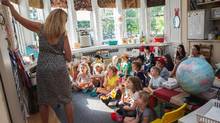
The Salamon sisters, in Grade 1 and Grade 4, respectively, are part of a bigger learning experience. Their school is the Dr. Eric Jackman Institute of Child Study Laboratory School, at the University of Toronto, where educators study how children learn by using the school’s classes as living models.

“When we looked up the school, we thought it sounded fantastic,” says Tracy Pryce, Anna and Sophia’s mother and a student at the University of Toronto.

“It’s in line with our educational philosophy. I compare it with my own experience when I went to school. Seeing my kids and what they’re getting from what they’re learning is such a difference from what I feel I had as a child.”

At a laboratory, or lab school, there are almost always visitors in the classroom, says Jackman’s principal Richard Messina. He laughs at the idea of his school’s 200 students being the educational equivalent of lab rats.

“It does conjure up images of mazes and exercise wheels,” he admits, “but our children become quite desensitized to having adults in the room.”

In September, for example, the school, which runs classes from nursery to Grade 6, was visited by a delegation of 24 educators from Kobe, Japan. “We have had 700 and 1,000 visitors per year,” says Principal Messina. “The children just continue with whatever they are working on and they’re used to speaking with adults about learning.”

The concept of a lab school comes from the work of educator and philosopher John Dewey, who set up the first lab school in Chicago in 1896. Prof. Dewey believed that the best way to train teachers was to have them teach and to accumulate new research and knowledge directly from the classroom.

The Jackman lab school, a few blocks from the U of T’s main downtown campus, is one of only a handful of schools of this type in North America.

The best-known lab schools in the United States are at Columbia University in New York and the original at the University of Chicago.

“Just as the physics department or the chemistry department have labs, the education department has a lab,” Mr. Messina says.

Being a lab school fulfills three functions, he adds. It produces research that can be applied to public education, it’s a forum for teachers to further their knowledge, and “we provide exemplary education to the children we are fortunate to have with us.”

“I feel very fortunate that we’re there,” Ms. Pryce says. There are 22 children in each class – half boys, half girls – and the school is committed to diversity.

To help ensure diversity in its enrolment, 13 per cent of the students receive tuition support, Mr. Messina says.

In addition to its teachers, each classroom has two Masters of Education students who are pursuing two years of graduate work while teaching.

“Almost all teachers in the school are involved in research that’s going on in their classroom,” says Julia Murray, a Grade 5-6 teacher at the school who is now on maternity leave and did her Masters at the Institute several years ago.

“The research going on is often cutting edge, and it’s about best practices in education,” she adds.

For example, Mr. Messina says scholars are researching the emerging concept of brain plasticity: “Think of the brain as a muscle that can be developed, metaphorically, so that errors should not be considered embarrassing but a natural and necessary part of learning.”

The Jackman lab school was also one of the major providers of research for developing play-based kindergarten programs and full-day kindergarten, he adds.

Ms. Pryce says she likes the school’s inquiry-based learning approach – encouraging her children’s natural inquisitiveness while maintaining classroom structure.

“There’s a strong philosophy of teaching children to ask questions, not for children to get information but to develop their own theories,” she says.

“It’s a secure environment socially, mentally, intellectually so they develop the confidence to speak out.

“The benefits for my children have really been clear.”

The school has a waiting list that parents sign up for when their children are born, he says. “We seem to draw applications through word of mouth. Many people seem to know about us even though we don’t advertise,” Mr. Messina says. Jackman evaluates its programs to make sure that students are being well educated and finds that they do well as they move toward higher education.

“We hear that our children seamlessly move on to Grade 7 and beyond, that they’re very comfortable with the inquiry process, stating opinions and knowing that these may change,” Mr. Messina says.

Accelerated Learning and where it begins

I (Yiola) have been hard at work preparing my teacher education courses. This year was an complete review and reconceptualization of the courses — significant updates to not only the literature but to the ways in which we will explore the content.  I will share some of the changes to the pedagogy of my courses next week. This week I want to start at the start. Where does accelerated begin and how does it begin? I came across this interesting post and wanted to share it here. It is about paperless early years classrooms.

https://tecribresearch.wordpress.com/2015/08/29/step-away-from-the-photocopier-reggio-inspired-liteplay-nomoreworksheets/

I remember when I taught first and second grade, I seldom used worksheets but I also did have the inquiry-based play either. My pedagogy was somewhere in between. But, truth be know, the teacher across the hall who had a full curriculum of worksheets was often commended for being highly organized and “on the ball” with her program.  I always wondered if that way of teaching was better. Her students, most of them, were learning to read and write. That is another truth. However, were they creative thinkers and problem solvers? Again, another truth, we did not pay much attention to those sorts of skills.  This was but a mere 10 – 15 years ago.

But now, I think we can all agree, that critical thinking and creativity and problem solving are very important skills for children to develop early in life. These skills do not develop from worksheet tasks. The link above talks about this and other inspirational considerations.

And so I share this post to begin at the beginning — play in the early years and how we move forward from there to more sophisticated modes of learning, through the grades and into post secondary teaching. Next week I plan to share some of challenges and questions I faced when reconstructing my courses.

A Memo To States: This Is How You Create A Teacher Shortage

Image Teacher Shortage

When I (Clare) was at AERA in the spring many of my American colleagues were despairing about the dramatic drop in applications to teacher education programs. The article below by Rebecca Klein helps demystify why teaching has becoming a less attractive career choice.

A handy recipe for a teacher shortage like the one in Kansas.

Rebecca KleinEducation Editor, The Huffington Post

http://www.huffingtonpost.com/entry/kansas-teacher-shortage-recipe_55c28ce6e4b0f1cbf1e3a2d7?cps=gravity_5059_5212323749430778575&kvcommref=mostpopular

It’s back-to-school time in Kansas, and kids are starting to trickle back into school hallways. But when these students arrive at their classrooms, they may not find a teacher standing at the front.

Kansas is suffering from a well-documented teacher shortage. Last year, more than 2,320 educators in the state retired, compared to 1,260 in the 2011-2012 school year, according to data from the Kansas State Department of Educaton. At the same time, 654 teachers decided to leave the state last year, compared to just 399 in 2011-2012. Over 270 open teaching and non-teaching school staff positions were listed on the Kansas Education Employment Board’s website as of Thursday afternoon.

Kansas has previously seen teacher shortages in areas like special education, as well as math and science. But this year, even typically popular jobs, such as teaching social studies classes or elementary school students, are proving hard to fill, KEEB coordinator Julie Wilson told The Huffington Post.

Those familiar with the situation say it is not surprising. A number of factors have recently converged to create a teacher shortage in the Sunflower State. Some of these factors are the result of actions taken by the state government and legislature. Over the past few years, Kansas has cut back on the job protections that give teachers due process rights, created a new school funding system that a district court panel ruled unconstitutional and cut taxes so severely that some districts lacked the revenue to stay open last school year.

“I find it increasingly difficult to convince young people that education is a profession worth considering, and I have some veterans who think about leaving,” Tim Hallacy, superintendent of Silver Lake Schools, told HuffPost last month. “In the next three years I think we’ll have maybe the worst teacher shortage in the country — I think most of that is self-inflicted.”

For other states looking to wind up in the same situation, here’s a surefire recipe for a teacher shortage:

The How To Create A Teacher Shortage Recipe 

Ingredients:

1 cup of rhetoric against teachers

2 pounds of bills and programs that attempt to de-professionalize teaching (specifically, a proposed bill that would make it easier to jail teachers for teaching materials deemed offensive and a new program that lifts teacher licensure requirements in certain districts)

3 tablespoons of a lack of due process rights for teachers

½ cup of finely diced repeated budget cuts amid a state revenue crisis

1 stalk of a new school funding system that is currently being challenged in state court

2 grinds of growing child poverty throughout the state

3 tablespoons of low teacher pay

1/3 cup of large numbers of teacher retirements

Practicing Situated Practice through Storytelling

As mentioned before, I (Cathy) am a committed supporter of  implementing a pedagogoy of mulitliteracies (New London Group, 1996) in the classroom.  There are many components to multiliteracies, but for this post I will highlight my use of  only one  component- situated practice.    The situated practice component suggests that pedagogy must consider “the affective and sociocultural needs and identities of all learners” (NLG, 1996, p. 85).  By the inclusion of  students’ “lifeworlds” or home-life and culture, a classroom environment is created where students feel secure and will take risks (NLG, 1996, p. 65).

In a recent storytelling workshop I delivered to ECE students (in a higher education setting), I was intrigued at how the significant situated practice became.   Prior to the class,  I asked the professor what cultures were represented, so I could reflect at least some of these cultures through my story selection.  The list was long, so I had to be selective.  I decided to tell a story from Jamaica, the US and one from India.  These represented not only a range of the participants’ cultures, but also a broad range of storytelling styles, which I thought might be useful for the students to see.   During the workshop I explained to the students that eventually being inclusive of all of the cultures and backgrounds represented in their classrooms  through the stories we tell (and books we read) was essential.  It was our responsibility to get to know our students and know what was important to them.  They agreed that this was important.  But I had a lot to learn about how important,  even when working with adults.

I knew how much the  participants  enjoyed and learned from the experience, as they were highly engaged during the workshop, but i was also treated to written feedback  as the  professor asked the students to post their critiques online.  The following comments caught my interest:

“The workshop really resonated with me… I learned about stance, gestures and facial expressions”

“I was amazed to see how storytelling could grab our attention”

“I am excited to step out of my comfort zone a little bit and try out these strategies with children”

My favourite was:

“I really enjoyed the ending of the workshop using the Urdu [story] “Ek thi Raja, ek thi Rani, doono margy khatm kahanni'” as Urdu is my mother tongue and I was able to understand this very famous [story].”

I did indeed end the workshop with a very short story in Urdu.  In case you do not understand Urdu, in this story there is a  king and a queen, they  die, so the story is over.   That’s it.  It is a traditional ending to a storytelling set.  I usually ask a participant to translate the story for the rest of the group.  Even though my Urdu is not the best, I can always tell who understood the story, because they are the only ones laughing.  Children  are usually delighted that I took the time and effort to be able to tell , regardless of how short,  a story from their culture.  But this small gesture never became more evident  to me than at the conclusion of this workshop.   I was approached by a woman wearing  a khimar (a long, cape-like veil that hangs down to just above the waist, but leaves the face clear).  The woman introduced herself and told me that she was most impressed that I told a story in Urdu.  She said she felt it made her Urdu speaking colleagues very happy.  She then asked me to do something I was not expecting.  “Would you”, she asked timidly, “consider sometimes ending your storytelling in Arabic?”  I smiled and immediately answered “of course, if you will teach me!”   She was delighted and proceed to teach me  the following traditional ending:

Touta touta.  Kelset el haa do tah.

This is now part of my repertoire.  I was never more convinced of how significant it is to honor the cultures of our students.   Young or older, it is their identity and they need us, their teachers, to validate this.  I will endeavor to enlarge my commitment to situated practice by sometimes speaking in Arabic for my students and hope my  students, whether ECE students, student teachers, or teacher educators will consider doing the same.

Bored? Try Mindfulness.

bored pic


I (Cathy)  sometimes wonder if children  just need go outside and be part of nature.  Life isn’t just about about  being entertained.  In our society of things, gadgets and high tech, this is sometimes overlooked.   An experience can be  about being contemplation or just learning to listen or observe.  My high school visual arts teacher, Robert Bateman was gifted at encouraging us (his students) to practice this.  He would tell us to just go sit in a field an look at one thing and listen. Pay attention.  I think now this practice would be called “mindfulness”.  As teachers, as parents, do we do  encourage this?  Just a thought.

Cyber -Seniors

“A humorous and heartwarming documentary feature, Cyber-Seniors chronicles the extraordinary journey of a group of senior citizens as they discover the world of the internet through the guidance of teenage mentors.”                                                                                                      Business Insider

Directed by Saffron Cassady, the idea for the Cyber-Seniors documentary began with a high school project that was launched by two sisters. The sisters had the support of their mom, Brenda Rusnak, who had worked her entire career with seniors. After a successful first year, Brenda helped continue the Cyber-Seniors program, expanding it to a second retirement home and helping to engage more youth mentors. Over the next ten months, Saffron and her film crew captured over 120 hours of footage and many memorable moments.  Of this film, the Washington Post reports:

Kerstin Wolgers made it through almost 82 years on this Earth without ever once checking an e-mail, watching a YouTube clip or sending a tweet. But last week, as part of a crash course that introduced her to the Internet for the first time, the former Swedish actress did all three — plus Googled, Instagrammed, Wikipedia-ed, shopped, video-gamed … even online-dated, eventually. “Lots going on here,” she says of Tinder. “It’s really exciting, if you asked me.”

Understanding how significant this program is to the lives of seniors was captured for me (Cathy) in a single moment when I watched one senior weep while he viewed his grandson play the piano via Skype. The differences technology makes in their lives, is remarkable.

Under the Getting Started heading of the web page for this documentary (link below) you can learn how to begin such a project in your community.  It also will let you know when the documentary is coming to a theatre near you.  Personally, I (Cathy) can’t wait to see it.

http://cyberseniorsdocumentary.com/

A delightful trailer for this film can be viewed at:

www.cyberseniorsdocumentary.com.


Hip-Hop Ed Fosters Connections

An article in the New York Times highlighted the work of high school English teacher Brian Mooney, who uses the lens of “hip-hop ed” to engage students in the study of complex literary themes. A blog Mr. Mooney created to share his curriculum and student work caught the attention of a broader audience — rapper Kendrick Lamar visited the high school. Students from Mr. Mooney’s English class and the after-school poetry club performed spoken word poems and raps for Kendrick Lamar.

Link to article: http://www.nytimes.com/2015/06/09/nyregion/kendrick-lamar-rapper-who-inspired-a-teacher-visits-a-high-school-that-embraces-his-work.html