Category Archives: education

Anti-Plagiarism Tools

plagarizing

At my (Cathy’s)  institution,  like most HE schools, plagiarism is an  issue.   According to Wikipedia, “Plagiarism is not a crime per se but in academia and industry, it is a serious ethical offense.”  I deliberately quote Wikipedia because that (sadly) seems to be a popular source for many students these days.  As the cartoon to the left implies, is copying from the internet plagiarism?  The many new sources for plagiarism checking indicates “yes”.  My institution supports a plagiarism locator called Turnitin.  It is a relatively simple tool to use. Once the text is submitted to the Digital Learning System, the tool highlights all words in sequence that can be located on the www and Google Scholar.  Hence, copying the words from Wikipedia becomes as evident as copying a paragraph from a journal article.  The professor has to look at the text and determine if the highlighted parts have been properly cited.  If not, the text is  plagiarized.  Although professors have access to this and can use it to check for plagiarism, it is used instead as a formative feedback took to encourage students to monitor their own work and how they are sourcing. Regarding Turnitin, Jennifer Haber, Professor of Communications at St. Petersburg College shares this email from one of her students:

Keeping an eye on the similarities percentage area keeps me aware of possible situations where I may be using too much (or even too little) outside resource information. Due to its ease of use and instructive benefit, I would say the service has played a significant part in my becoming a more improved writer. I would favorably recommend its use to any institution of learning.

This kind of feedback has sold Professor Haber on the use of this tool.  Besides Turnitin, many more of these tools are popping up on the internet.  Two popular sites are:  Best Plaigerism Checker and Proofreader  and  Plagiarisma.Net (links provider below).  With these kinds of free tools available and the  bad press plagiarism has been receiving, its  wonder that students still plagiarize.  Perhaps these tools will help reduce it happening in our schools.  Let’s hope so.

https://www.grammarly.com/plagiarismq=plagiarism&utm_source=google&utm_medium=cpc&utm_campaign=Search&utm_content=52804488846&utm_term=anti%20plagiarism%20checker%20free&matchtype=b&placement=&network=g&gclid=Cj0KEQjwmqyqBRC7zKnO_f6iodcBEiQA9T996EnCSJjGkjD4jvmQoquTIiBnRIyTkIHwt38N908eAMMaAvLd8P8HAQ

Plagiarisma.Net

http://www.turnitin.com/en_us/resources/blog/517-turnitin-educator-network/2381-what-students-say-about-turnitin

Voices Into Action

My (Clare) friend David Booth introduced me to an amazing program, Voices into Action, which helps students develop their David Booth social awareness.
Voices into Action is an online resource dedicated to providing students with access to information on issues regarding human rights, prejudice, and hatred. Designed by curriculum experts, this program utilizes a wide variety of media to present compelling information on a history of human suffering, stemming from social injustice that is still a problem today. This site will give you the knowledge and tools to speak out, and to go even further by turning your voice into action!
I have looked through some of the resources and they are fantastic – discussion questions, videos, news analysis, case studies, in-person interviews ….. There are 6 units available: human rights; genocide, understanding prejudice and discrimination, immigration; and personal action. All teachers I am confident will find these resources so useful. Here is the link: http://www.voicesintoaction.ca/Home

Larry SwartzFYI – Larry Swartz my dear friend is one of the Project Managers of Voices into Action. From my experience any project that Larry works on is outstanding!

Coding is the Fourth Literacy?

I recently came across an article that suggested “coding is the fourth literacy,” and digital skills such as learning how to code should be part of the contemporary classroom, in order to prepare children/youth for the future job market. The article noted “the UK government instigated a complete overhaul of the computing curriculum in England and Wales…. [with] programming skills placed at the heart of the new curriculum. Now children as young as five are being taught computational thinking and digital creativity… By embedding coding into the new computing curriculum, the UK Department of Education stated the new subject would “ensure every child leaves school prepared for life in modern Britain”.

Link to the article: http://www.gamesindustry.biz/articles/2015-05-04-coding-has-become-the-fourth-literacy


SAMR: Bloom’s Taxonomy for technology education

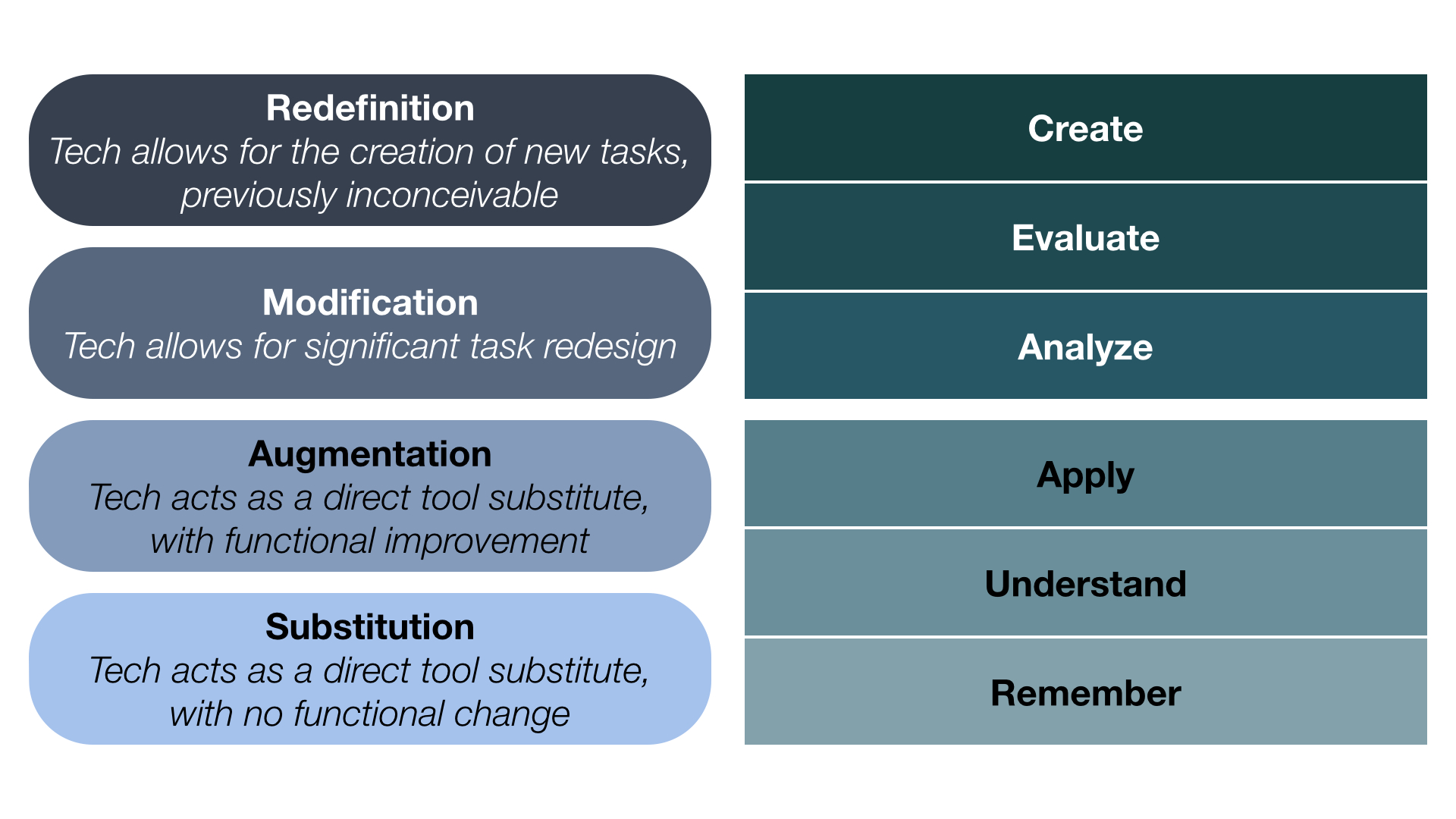
Dr. Ruben Puentedura developed the SAMR model as a way for teachers to evaluate how they are incorporating technology into their classroom practice.  Puentedura constructed his model in the form of a ladder and equates it with a student climbing the cognitive scale associated with Bloom’s Taxonomy.  (i.e. as a task moves from lower to upper levels of Bloom’s taxonomy, so does a task move from lower to upper levels of SAMR).

Below is a comparison of Bloom’s and SAMR:

diagram-puentedura

Puentedura’s model encourages educators to ask themselves if the student task is an act of substitution, augmentation, modification, or redefinition? The suggested threshold for moving from enhancing learning to transforming learning is between augmentation and modification.  As an example of this, consider a student writing a paper.  If the student writes the paper on a computer instead of on a piece of paper, this is an act of substitution.  If the student uses spell check and a formatting tool to assist with the writing process, this is augmentation as there is a slight change in the functional improvement.  Should the student publish the paper, perhaps on a wiki, blog site or through google docs, so other students can read it and give feedback, this is a modification of the process, for it now includes collaboration.  Lastly, in redefinition entirely new tasks are created which were inconceivable without computers and computer software tools.  In this level student transform their written stories into media productions using storyboards, filmed scenes and music.  Students can also publish these and receive feedback on the work.  In this level technology has redefined the task.

Working towards redefinition, is of course the goal for teachers who would like his/her students to be working in the highest thinking levels possible while using technology.

A short video introducing the SAMR model can be found at:                        https://www.commonsensemedia.org/videos/introduction-to-the-samr-model


Educational Research: Small Scale or Large?

On Monday, Clare and I (Clive) had the privilege of attending an outstanding symposium at Brock University on self-Image Brock Symposiumstudy research on teacher education. It was organized by Tim Fletcher and Deirdre NiChroinin and funded by their respective institutions, Brock University and the University of Limerick. Highlighted speakers were Clare, Julian Kitchen, and Tom Russell. Apart from the local audience, the symposium was streamed live and will be archived for online access at : http://brockvideocentre.brocku.ca/videos/ (Under Self Study Symposium — 01:46:06).

One issue that came up was the validity of self-study inquiry versus research with a larger sample size. It was noted that there is pressure (from tenure and promotion committees as well as policy developers) to conduct research larger in scope than the typical self-study project. Some suggest that to increase the “significance” of self-study research it may be necessary to combine a number of smaller projects.

From the audience, I made a comment that was lost electronically and Tim and Deirdre have asked me to repeat it here. My comment was as follows:

Small scale research by individuals or small groups often provides a depth of understanding not available through large scale research. We must not assume that bigger is better. While large sample research is suitable for certain purposes, often something is lost when we move to a larger sample and have to ask simpler, one-shot questions, where the meaning of the questions and answers is often unclear. The typical self-study project enables us to probe in considerable depth the nature, purpose, and effectiveness of various teaching practices.

Dewey, Schon and, more recently, Zeichner, Cochran-Smith, and Lytle have emphasized how much practitioners learn on the job; and Bryk et al. in their recent book Learning to Improve (Harvard Education Press, 2015) maintain that quantitative researchers must join forces with on-site practitioner-inquirers to build a complex, publically available framework of educational concepts, principles, and practices (somewhat akin to Wikipedia). Both types of research are needed. We must not privilege one over the other.

School Board Proposes Multi-language Immersion Program

The Toronto Catholic District School Board has plans to establish a multi-language specialty school. The proposed immersion program, being considered for north Scarborough as early as this fall, would offer instruction in French, Spanish, German, and Mandarin. Michael Del Grande, chair of the TCDSB noted “my view is we’re not preparing our students for the world stage, we barely do a passing job with French, and we’re a bilingual country! So we’re asking parents if they’d like to educate their children in the languages of some of the largest economies in the world.”  What do you think about this type of immersion program? Should other languages be included in the program?

Link to the Toronto Star article: http://www.thestar.com/yourtoronto/education/2015/04/28/multi-language-elementary-school-proposed-by-toronto-catholic-board.html

Sir Ken Robinson’s New Book!

skr

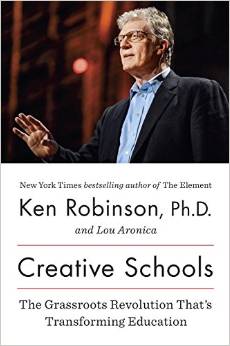
It has been nearly a decade since Sir Ken Robinson’s famous TED talk, How Schools Kills Creativity. (If you haven’t seen it, click here: http://www.ted.com/talks/ken_robinson_says_schools_kill_creativity?language=en). Robinson along with Lou Aronica have recently published a book titled Creative Schools: The Grassroots Revolution That’s Transforming Education. The text has received glowing reviews. I look forward to reading it in the very near future. Some of the reviews of the book (as listed on Amazon.com) include:

  • “This book is a wake-up call to the emerging global human resources crisis. Increasing boredom, disengagement and dropouts among students have become chronic aspects of many school systems around the world. Creative Schools is a must-read for anyone who is interested in critique, vision, and theory of change for the new course of schooling.” —PASI SAHLBERG, author of Finnish Lessons 2.0: What can the world learn from educational change in Finland 
  • Creative Schools is one of those rare books that not only inspires and brings a new sense of possibility to the goal of transforming education, but also lays out an actionable strategy. Ken Robinson is leading a daring revolution to change how we understand schools, learning, and most importantly, the passion and talent of our students. This is a global game-changer and I’m in.”—BRENÉ BROWN, PH.D., author of the #1 New York Times bestseller Daring Greatly
  • “This is the book we have been waiting for from Sir Ken Robinson —laying out what is fundamentally wrong with our education systems, and correspondingly showing what and how it should and could be different. He makes creativity, and much more, come alive. Don’t start reading this book unless you have three hours before you, as you will have difficulty putting it down. Then, think about what you might do and re-read the book with others to start making the changes. Creative schools indeed! The timing is perfect.”—MICHAEL FULLAN, OC. Professor Emeritus, OISE/University of Toronto and author of The Principal: Three Keys to Maximizing Impact

Jo Lampert: National Exceptional Teachers for Disadvantaged Schools Program

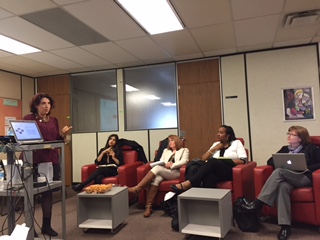
IMG_0339I (Clare) invited Jo Lampert from Queensland University of Technology to talk to our research group about IMG_0340the National Exceptional Teachers for Disadvantaged Schools Program which she and Bruce Burnett direct. This is an amazing program which aims to prepare student teachers to work in high needs schools.

The Faculty of Education developed the National Exceptional Teachers for Disadvantaged Schools (NETDS) program in 2009 to address the significant social issue of educational disadvantage through a teacher education program that explicitly focused on the preparation of high-quality teacher graduates. NETDS ensures that the best suited pre-service teachers are equipped to teach and encouraged to select employment in low socio-economic status school settings.

Each year we identify our highest-quality pre-service teachers who participate in a specialised curriculum that better prepares them to teach within low socio-economic status schools. We’ve partnered with the Queensland Department of Education, Training and Employment and key low socio-economic status schools to help channel these exceptional pre-service teachers into sites where they can have the greatest impact.

Jo LampertWe learned:

  • Approximately 90% of NETDS graduates have secured employment with schools below the Australian mean Index of Community Socio-Educational Advantage level of 1,000.
  • Many graduates secure full-time employment in low socio-economic status schools before they graduate.
  • School partners have grown from 3 in 2009 to approximately 50 in 2014.
  • We’ve developed distinctive workshops focusing on ‘real world’ issues related to disadvantage.

For more information go to their website: https://www.qut.edu.au/education/about/projects/national-exceptional-teachers-for-disadvantaged-schools

Technology, inclusion, and innovation: Students design an app for literacy development

“It is estimated that only 10 per cent of blind children and adults know how to read braille. It is an illiteracy rate long ignored by technology developers who have created thousands of educational apps for the sighted”.

The above statistic is sad news however, I (Yiola) came across this most inspiring news:  students in an local middle school designed a computer app that can teach people who are visually impaired how to read braille.

How exciting for students to make such an impact in the literacy learning of others. How exciting for students to be learning about inclusion, literacy, and technology. How exciting to be engaged in the design and inquiry process in such a real way.

http://www.ctvnews.ca/mobile/sci-tech/ontario-students-braille-app-shortlisted-for-lego-innovation-prize-1.2329612

Wishing our local middle school students all the best in this endeavour.