Category Archives: education

Teaching Hybrid

In a couple of weeks, I (Cathy)  will start teaching my first hybrid course.  Also known as mediated learning, blended learning, and web-enhanced instruction, this kind of course can be considered  “the middle ground between our society’s adolescent love affair with technology and ancestral need for human contact and a sense of belonging” (Landau, 2015).

Baker College’s Instructional Technology Web site on blended instruction defines some of the advantages of hybrid or blended instruction:

  • Providing tools to facilitate communication outside of scheduled class time and office hours enhances student-student and faculty-student communication.
  • The blended learning environment supports different learning styles and methods.  Students have time for reflection when participating in online discussions and can participate at a time and place that meets their needs.
  • Online materials are available 24 hours a day, seven days a week, insuring that students always have access to assignments and other handouts.
  • On-line testing can be used for student pretests and practice.  On-line discussion between class sessions can identify areas of student difficulty that need to be addressed in class.
  • Course management and administration is simplified with an online gradebook and tools for email management.

http://www.baker.edu/departments/instructech/blended.html

The Hanover Research Council (2009) suggests the following  best practice teaching strategies for online education:  Group problem-solving and collaborative tasks;  Problem-based learning;  Discussion;Case-based strategies;  Simulations or role play;  Student-generated content;  Coaching or mentoring;  Guided learning;  Exploratory or discovery;  Lecturing or teacher-directed activities;  Modeling of the solution process; and  Socratic questioning

Yet, even though there are numerous advantages to online learning and many strategies  to make it effective learning,  I am told many students simply ignore the online material and rely on what they learn in class.  I suspect this may be because they feel it is easier to play hooky from a computer, or their schedules simply get in the way.   However, I feel my students will miss a lot if they ignore the online portion of our course. So I am collecting strategies to entice the students to engage in the online offerings;

  • offer a mark for engaging on line
  • provide enticements or teasers for what they might find online
  • review of intended learning for online work in class to ensure clarity,

and finally

  • use video streaming and/or chat rooms at designated hours so students feel connected to the site

I hope these ideas work, as I am looking forward to giving this a try.  If you have taught a hybrid course and have some more ideas, I’d really like to hear about them… online of course!

Science Guy Becomes a Literacy Guy: Guest Post by Jason Gregor

In my (Clare) literacy grad course this past semester I had a group of amazing students — smart, experienced, caring, Jason Gregorthoughtful, and inquisitive. They were truly a joy! One of the students named us the Literacy Community. For the final product for the course the students were encouraged to do “something” meaningful for them and they could use any modality they wanted. One of the students Jason Gregor did an amazing paper which traces his journey from being a science enthusiast who did not value literacy to a strong advocate for literacy. His paper was so insightful I asked him if I could post in on our blog because those of us in teacher ed will relate to folks like Jason who slowly come to realize the place of literacy in teaching. Thanks Jason for letting me share your paper with the broader education community. Below is an excerpt from the paper and here is the link for the entire paper. Enjoy! JasonEssay

Why literacy is so important

 I never truly understood the hype around literacy. It seemed to be the biggest thing in the education system. As someone who did not like English very much and was much more focused on science, I felt that it kind of got all the limelight. Now however, I realize that I was wrong. I was dead wrong. While recently working on my final project of graduate school (I’m done much to my chagrin!) I took the opportunity to reflect on my experiences with literacy and how they have shaped the way that I viewed it (in a much skewed way). Thanks to Dr. Clare Kosnik and the two classes I took with her though, I have found that I was very wrong. Literacy is the most important area for education. Without literacy, you’ve got nothing! For this reason, I have become much more engaged with literacy education and feel very strongly towards it. Sure science is important, but without literacy, well, you wouldn’t be reading this right now! So, moral of the story, even the most disengaged, no matter what level they are at, be it student or teacher, can be motivated to re-engage with literacy. It’s never too late. Take it from me, I’ve been there.

And now for something totally different… but not really: The power of the teacher/student relationship

In teacher education, and on this site in particular, we often discuss the power of the relationship between teacher/student for fostering student success.  My blog today is about the teacher/student relationship but not the kind we  typically discuss in teacher education where we look to the classroom teacher and the child in a school setting. My blog today is about a Muay Thai (martial art)  trainer and his fighter.  There is much to learn about teaching and learning from the martial arts world. While the two contexts, martial arts and traditional schools, are vastly different the elements of the teacher/student relationship are transferable. In my experiences as a classroom teacher, teacher educator, and student and fighter of Muay Thai, there is much to be gained from thinking about and understanding the elements of such relationships and thinking about them in relation to one’s own practice. My partner is a martial artist and trainer of world class fighters. I have observed his practice for over a decade, watching closely and listening carefully in order to better understand his interactions with his students/fighters. One thing is for certain, the relationships involved for students who achieve greatness and significant improvement in, not only the martial art but also,  their overall quality of life have consistently demonstrated the following as leading elements to their success:

1. Love. Both teacher and student must love what they are teaching and learning.  Passion, excitement, and engagement seem to be necessary components for building a love for learning and achievement.

2. Respect. Both teacher and student must have respect: respect for themselves, each other, and the discipline they are learning. Respect includes training for the discipline itself. Consistency, practice, repetition, commitment to improvement  is part of demonstrating respect.

3. Belief.  When a student is able to visualize their success and believes they can achieve that success, they most likely will. Their teacher instills the belief and supports its development. Belief is likely to be most difficult because it requires trust, vulnerability, and will. However, belief is what generates the most power to achieve.

Love ~ Respect ~ Believe

My partner, Ajahn Suchart, believes. He believes in his students and he shows this in a number of ways: in his genuine care and belief in his students, in his belief in his own pedagogical content knowledge, in the giving of knowledge, his commitment to students’ development, in the time he devotes to his students. Over the years I have asked students “what is it about this place (Siam No1, the martial arts school) that make you love learning and strive for success?” The dominant responses are  “Ajahn Suchart believed in me”, “He is one of the few teachers I felt truly cared about me” and “Ajahn Suchart’s passion for Muay Thai is contagious”.  I am certain that the art itself, Mauy Thai, is a leading factor for wanting to improve and excel, yet just as with regular classroom teachers, it is the teacher and their commitment and belief in their students that holds much of the power to influence the learning experiences and achievement of students.

And when the teacher truly believes in their students, the possibilities for student achievement are endless… students are empowered to achieve.

Ajahn Suchart’s first World Champion, Clifton Brown, wrote this on social media:

Without the patience, dedication, sacrifice, of time, mind, and body, of Ajahn Suchart, I would not be the man I am.

When people comment on my power as a fighter, strength of my body, beauty of the technique I don’t believe they truly understand, it was buit by this man. Standing immovable at 5’5 taking us hitting him full out, for years. Pressuring us, more than any opponent could. Turning coal to Diamond… Yet, more than his physical dimensions, it was the immovability of his spirit, that forged me, and others into men.

I have become what I am as a man because of you, your faith and belief in me and my potential, even at times when I didn’t believe myself.

Thank you Ajahn(Professor). I love you.

clifton

Image is of Ajahn Suchart with World Champion Clifton Brown.

Ajahn Suchart and his students exemplify the elements of an effective teacher/student relationship. The image below reflects the beauty of a teacher/student relationship:  students’ successes are the teacher’s  fuel to continue teaching with passion, commitment and determination.

11091333_980103405335694_3785385439910581182_n

Watching Ajahn Suchart teach — with utter passion and complete belief — reminds me of what teaching is all about — believing — genuinely believing — in students and through this belief, helping reach their potential and fulfill their dreams.

I am inspired by Ajahn Suchart. His work as a teacher has left significant imprints on the lives of many. As a teacher (educator) this is what I strive to achieve as well — an imprint on the lives of my students.

To view Simon’s last competition click the link below… wait for the end to see the teacher rejoice in his student’s achievement:


Longitudinal Study of Teacher Continues: Multiliteracies Teaching in a Digital Age: Balancing the Old and the New

Clive and ClareClive and I (Clare) along with our amazing research team (many of whom have posted blogs) having been following 40 teachers, some for 10 years and others for 8 years. This has been incredibly rewarding research because we have seen how teachers change over time. In Growing as a teacher: Goals and pathways

Growing as a Teacher book cover
Growing as a Teacher

of ongoing teacher learning we reported on their first 8 years of teaching. We are VERY happy to report that we have received funding from the Social Sciences and Humanities Research Council of Canada (SSHRC) to continue our research for another five years. The title of our proposal was: Multiliteracies Teaching in a Digital Age: Balancing the Old and the New. Click here to see the Description of Research that we submitted to SSHRC. Final Detailed Description 2014We could not have conducted this research without the work of our research team and the cooperation of the teachers. We look forward to seeing how our teachers change and develop as mid-career to later-career teachers.

Fostering Home Literacy

A while ago, my (Cathy’s) niece asked me why I only gave her (and her brother) books and crafts as gifts.  I had suspected that she was sometimes disappointed her gift wasn’t a toy. I thought carefully before I answered.  “Well honey”, I said, ” I want you and your brother to grow up knowing you are smart and creative.  And I think books and arts and crafts help you to know that about yourself”     She pondered that for  few seconds and then said, “Ok, thanks”.  We have never looked back.

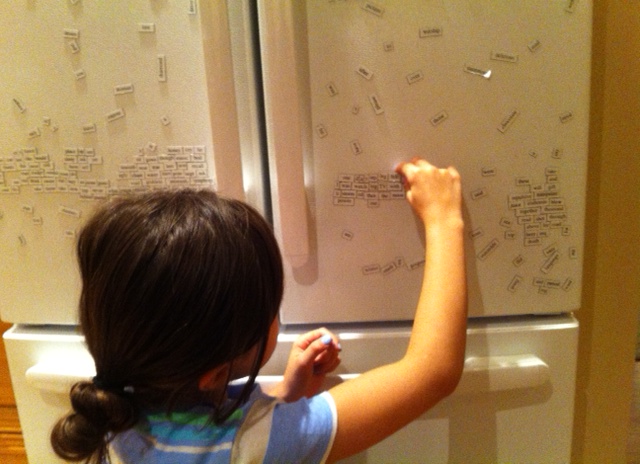
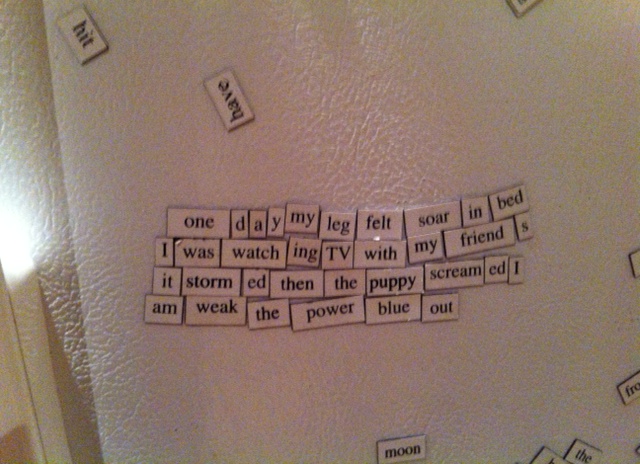
Lately, my niece has taken to the magnetic poetry on my fridge (words on little magnets that you can move around to create meaningful messages).  When she first noticed it, we only used it to find a word she knew.  Then she moved on to constructing a sentence.  When she came last weekend, she wanted to create a story.  It was challenging, because she could only words she could find on the refrigerator.  I was amazed at how long she stayed with the task.  I was also intrigued by the fact she knew two words were synonyms.  She didn’t call them that, she just knew they were the right word but spelled the wrong way.  I was delighted how long we spent together looking for the right words to move our story forward.  It ended up being a ‘scary’ story because the there was  storm and the puppy screamed, “which can only happen in a not real, scary story” I was told.   My niece was so thrilled with the results she invited several  people at the family party to come and read it.

When we felt our little project was complete, I said  to her “Brook, you are so creative and so smart” and she said, “I know”. That was my reward.  She did know it.  I also know what her next gift will be… a box of magnetic poetry for her own refridgerator at home.  I don’t know if her parents will appreciate it, but she will.  And that’s all that matters.

brookstory


                                                           http://magneticpoetry.com

Seymour: An Introduction

I (Clare) saw the most amazing movie: Seymour: An Introduction11189925_ori

It got rave reviews so Clive and I went to see it. The movie was directed by Ethan Hawke (yes that Ethan Hawke) and talks about Seymour Bernstein — “a beloved pianist, teacher and true inspiration who shares eye-opening insights from an amazing life. Ethan Hawke helms this poignant guide to life.” Bernstein was a world class pianist who gave it all up because of stage fright and stress.”

He teaches piano and is a Master Teacher in NYC. This is a must see for teachers because the way he guides and supports his students is “masterful.” He is caring yet gives specific feedback. He is a master teacher.

During the first 10 –15 minutes of the movie I thought was is going on here? It does not follow a traditional narrative structure but rather jumps around through different parts of his life. (The editing is amazing and the music is gorgeous.) You see him teaching master classes, working with students individually, talking to friends, recalling being a soldier in the Korean war … By the 20th minute I was hooked. I so want to meet Bernstein because he is so wise, caring, compassionate, and interesting. I can truly understand why Ethan Hawke was so inspired by him that he wanted to tell the world about Seymour. Here is the link to the trailer for the movie:

http://www.imdb.com/title/tt2219650/?ref_=nv_sr_1

The movie is short – 84 minutes – and if you are like Clive and me, you will not be able to stop thinking and talking about this truly remarkable man.

Mining Social Media

A recent CBC news article caught my eye because it highlighted how researchers, in fields such as psychology and computer science, are increasingly mining social media (e.g. Tweets; Facebook profiles) to gain insight into people’s physical and mental health. The article questioned if this method of data mining represents a means to conduct “personality research, without talking to any actual people.”  Computer scientist Michal Kosinski, from Stanford University, points out that “by looking at your Facebook profile or your Twitter feed, we can very accurately predict very intimate traits that you may not be aware you’re revealing.” How do you feel about this type of research – does it represent an innovative approach to health research or an invasive monitoring of our online space?

Link to article: http://www.cbc.ca/news/health/what-facebook-twitter-posts-reveal-about-your-health-1.3000893

SocialMedia

Implementing Change

I (Cathy) and my faculty development team have been tasked with gently suggesting  best practices for new faculty.  This is not not easy task and must be handled with sensitivity.   Administrator,  Ross Cooper, suggests the following five tips when sharing new ideas and practices with others:

Be contagious: Get genuinely excited about what you have to offer, which should come naturally if your ideas are valuable.

Involve as many stakeholders as you can: This is a point that may seem obvious, but it is one that is often ignored. David Weinberger writes, “The smartest person in the room is the room.” Keep this thought in mind, as in no way can a few people sitting behind their desks be able to operate more effectively on their own than with the help of various colleagues from throughout their organization.

Empower those with strengths that compliment yours:   Odds are there is at least one person in your organization/institution with strengths that compliment yours in every education-related area. Know who these players are and take advantage of them, especially if they are well respected by others.

Evoke emotions: According to John Kotter, one of the biggest mistakes you can make when attempting to achieve buy-in “is to communicate with all ‘head’ and no ‘heart.'”

Be Experiential: Try modeling inquiry-based learning by only revealing the research until you have clenched the attention and curiosity of your educators and made them realize that there just might be a way for them to improve upon a particular area of their practice.

Changes can not happen overnight.  \but these five steps might serve as a strtting pint for anyone who hopes of making an impact within a school district or institution.  http://blogs.edweek.org/edweek/finding_common_ground/2014/11/implementing_best_practice_overnight_is_not_best_practice.html

Writing is hard!

I (Clare) do a lot of writing. When my doctoral students comment about writing I always respond, “Writing is hard.” It takes time, is frustrating yet the finished product often makes me proud. Writing is  a thinking process. In the New York Times there was a great little article by Cheryl Strayed who brilliantly sums up the process. She notes:

I write to find out what I have to say. I edit to figure out how to say it right.

I love her insight so much I think I will put it on a post-it note by my computer. So when I am struggling with my writing I will be reminded why the process is often so challenging. Poochey And sometimes I rely on my little poochie for inspiration.

Another school year coming to an end in teacher education

Many universities have their last week of classes this week. The message I (Yiola) end my courses with and what I hope resonates with my student teachers is the message that, at the end of the day,  teaching is ultimately a relational act.  Teaching is about building relationships and fostering a sense of care — having students build a love, respect and belief in themselves and a concern for and desire to learn and achieve. As teachers, we play a significant role in that belief.

In my courses we explore instructional methods: lesson planning, learning environment, creative teaching, and so many curriculum areas. We frame these practices in critical pedagogy and a pedagogy of care. I do my best, in the weekly / bi-weekly class structure of the university, to model what I outline above.

inspiring

I came across this ad on social media and it caught my attention. It made me think of all those  I work with, teach, and care about.

To you I encourage: question thoughtfully, think critically, read intently, and teach confidently.

Wishing everyone a happy end of the school year.