Category Archives: education

Learning Flexible Program Planning in Pre-Service

Our 1-year consecutive B.Ed. program has begun and I’ve (Clive) had two meetings with my School & Society class. The student teachers are wonderful: committed, talented, experienced in many ways, worldly-wise but friendly. Where do such people come from? Why do they continue to go into teaching when it’s so hard to find a job? Anyway, I’m glad they do.

Our second class was on program development and I stressed that, when they become teachers, they will have much less teaching-time than they thought and will need to prioritize, be flexible, and make choices. This led to a discussion of the extensive unit and lesson plans they will be expected to submit during their program, and the massive long-range plan their future principal will require of them. I related how the teachers in our longitudinal study use shorter lesson and unit plans – and then very flexibly – and seldom refer to their long-range plans. They have trouble seeing the point of such detailed planning exercises.

We agreed that they have no choice – during the program and later – but to fulfill such requirements. However, it makes a big difference to see such planning as a “requirement” they don’t necessarily agree with – rooted in traditional “transmission” models – rather than a “state of the art” approach to teaching. Then they can produce the detailed plans quickly and without undue angst, and get on with the serious business of teaching.

Several students expressed relief at being able to approach it this way; and I saw it as an important window on the complexities of effective, autonomous teaching. It is true that our teaching has to be comprehensive, and we have to know where we’re going. But highly detailed lesson plans that we follow to the letter aren’t the best way to get there. What room does this leave for individualization, student construction of knowledge, and our own on the spot learning as teachers? For my own 3-hour class I usually have about 6 main topics, of which we get to 3 or 4 and often in a different order and with different time allocations than I had planned. And of course we discuss other topics that weren’t even on my list….


Division K Awards: Consider Nominating a Colleague

I (Clare) feel it is so important to recognize the fine work done by my colleagues. AERA Division K has a host of awards. Below is a list of awards. Please circulate this list of awards to your network and consider nominating a colleague for one of these awards.

DIVISION K –

Teaching and Teacher Education Awards

2014-2015 Call for Nominations

As teacher education undergoes increased scrutiny and is pressed to demonstrate its contributions to teacher and student learning, Division K’s awards take on added importance as a means by which to elevate exemplary scholarship in our field.

The AERA Division K awards aim to recognize the teacher education scholarship of division members who are addressing persistent issues of urgent concern to the field. While the six individual awards committees will focus, as intended, on their respective areas of emphasis, each will also take into account the Division’s overarching call for attention to issues of profession-wide concern. To this end, each committee will give special consideration to award submissions that hold promise for improving teacher education policy and practice in the following areas: strengthening, deepening and further developing the knowledge and research base for teaching and teacher education; providing rigorous and educative clinical experiences; preparing teachers to serve students with diverse cultural and experiential backgrounds; supporting teachers to understand and apply theoretical and empirical perspectives on teaching and learning; articulating well-designed, evidence-based pedagogical practices in teacher education; and/or developing and implementing new approaches for assessing and evaluating teachers’ practices in preservice and inservice settings. In particular, committees will weigh the potential of nominees’ work to advance the profession of teaching and the practice of teacher education.

Please consider submitting nominations so that we, as a Division, can showcase members’ excellent works, thereby building a stronger knowledge base and making our colleagues’ valuable contributions more widely known among educators and policymakers.

All nominees and nominators must be current members of AERA’s Division K. Self-nominations ARE NOT accepted. Letters of nomination should be sent via email to each award committee chair, referenced below. Particular requirements associated with each award and materials needed for the nominations are described in detail below. Please note that all nomination letters must be submitted by November 1, 2014.

 Outstanding Dissertation Award

Chair: Maritza Macdonald, American Museum of Natural History

This award recognizes a dissertation of exemplary conceptual, methodological, and literary quality on an important topic in teaching and teacher education.  For this year’s award, dissertations completed between August 1, 2013 and August 1, 2014 may be nominated. A dissertation may be submitted for consideration only once and can be nominated for an award within only one division of AERA. The committee uses a blind review process; only the committee chair will know the identity of the nominator and nominee.

Dissertations employing any theoretical and methodological orientation may be nominated as long as they make an important contribution to teaching and teacher education.  In addition to reflecting the highest of standards of methodological rigor, nominated dissertations should focus on issues that are currently crucial to the field, including teacher and teaching quality and innovative means for documenting and assessing the processes and outcomes of teaching, teacher education, induction, and/or professional development. Special consideration will be given to dissertations that generate insights which hold promise for advancing educational equity; the committee will also consider the strength of a dissertation as it relates to the overarching Division K call for focused attention on persistent issues of urgent concern to the field. (See the overarching call above.)

Nomination for the dissertation award comes in the form of a one-page letter and overview from a member of the dissertation committee. Upon receipt of nominations, the Dissertation Award committee chair will solicit additional materials directly from nominees. Additional nomination materials include: (1) a title sheet showing the dissertation title, awarding institution, members of the dissertation committee, date of completion of the degree, and nominee’s current contact information; (2) the table of contents of the dissertation; and (3) a summary of the dissertation written in an accepted publication format (such as APA) not exceeding 7500 words in 12-point font, exclusive of title page, references, and appendices and without author identification. Nominations must be received no later than November 1, 2014. All nominations should be sent electronically with the subject line “Division K Outstanding Dissertation Award Submission” to the chair, Dr. Maritza Macdonald, Senior Director of Education and Policy, American Museum of Natural History, mmacdonald@amnh.org

 Early Career Award

Chair: Kathy Schultz, Mills College

This award, made to a researcher in the first stages of the research career (degrees awarded during or after 2007 and up to two years post-tenure), recognizes a significant program of research on important problems of theory and/or practice that focus on teachers, teaching, or teacher education. Recipients of this award must be engaged in inquiry that extends a significant line of research, addresses an issue that has been neglected in the field, fills a gap in current knowledge, or raises significant questions about extant knowledge. In addition, awardees should be engaged in studying problems or questions that are timely and that contribute to current policy debates or dilemmas of practice. The scholar’s body of work must be characterized by methodological rigor, momentum and coherence, and must show potential to contribute significantly to scholarship in the field. In addition to criteria outlined here, the Early Career Award committee will also consider the strength of nominees’ submitted works as they relate to the overarching Division K call for focused attention on persistent issues of urgent concern to the field. (See the overarching call above.)

To nominate a Division K member for the Early Career Award, please submit a one-page letter describing the nominee’s qualifications and fit for the award. Upon receipt of nominations, the Early Career Award committee chair will solicit additional materials directly from nominees. These additional materials include: (1) the nominee’s most recent curriculum vitae, (2) two representative scholarly publications, and (3) one additional letter of support from an individual familiar with the nominee’s contributions to scholarship in teaching or teacher education. Letters of support should address how the research demonstrates qualities detailed in the paragraph above as well as in the overarching call for Division K award nominations. Nominations must be received no later than November 1, 2014. All nominations should be sent electronically with the subject line “Division K Early Career Award Submission” to the chair, Dr. Kathy Schultz, Professor and Dean, Mills College, kschultz@mills.edu

Mid-Career Award

Chair: Guofang Wan, Virginia Commonwealth University

This award honors an outstanding researcher in the second stage of his or her research career, i.e., between 10 and 15 years beyond receiving the doctoral degree. It is designed to recognize a significant program of research on important issues in teaching or teacher education.

Examples of work that will be considered for selection include research and scholarship that illustrate how students learn a concept in a particular content area; generate insights into the role of culture, socioeconomic status, language background, religion, and/or sexual orientation in the learning and/or teaching process; capture the role of various factors or experiences in the careers of teachers such as mentoring, collaborating with others, conducting action research or participating in an inquiry group; advance equity in schooling or teacher education practices; show innovation and rigor in methodology; and/or illustrate how families/communities can become partners with teachers in educating their children. Work submitted will be evaluated according to how the researcher’s trajectory demonstrates beneficial aims and outcomes; how the body of work advances knowledge about teaching or teacher education; how the researcher’s corpus demonstrates contribution to the well-being of students, teacher candidates, teachers, teacher educators, or families/communities; and the scholarly robustness of the work.

The noted contribution may be the result of a single research project or the accumulation of projects that have shaped thinking and/or practices in teaching and teacher education. In addition to criteria outlined here, the committee will also consider the strength of nominees’ submitted works as they relate to the overarching Division K call for focused attention on persistent issues of urgent concern to the field. (See the overarching call above.)

To nominate a Division K member for the Mid-Career Award, please submit a one-page letter describing the nominee’s qualifications and fit for the award. Upon receipt of nominations, the Mid-Career Award committee chair will solicit additional materials directly from nominees. These additional materials include: (1) the nominee’s most recent curriculum vitae, (2) two representative scholarly publications, and (3) two additional letters of support from individuals familiar with the nominee’s contributions to scholarship in teaching or teacher education. Letters of support should address how the research demonstrates qualities detailed in the paragraph above as well as in the overarching call for Division K award nominations. Nominations must be received no later than November 1, 2014. All nominations should be sent electronically with the subject line “Division K Mid-Career Award Submission” to the chair, Dr. Guofang Wan, Professor and Director of Graduate Studies, Virginia Commonwealth University, gwan@vcu.edu

Innovations in Research on Diversity in Teacher Education

Chair: Lee Bell, Barnard College

The Division K Innovations in Research On Diversity in Teacher Education Award recognizes research that demonstrates innovation in addressing issues of diversity in teaching and/or teacher education.  Nominees may be individuals (junior, mid-career, or senior scholars) or a small collaborative group whose innovative research: explores and/or demonstrates powerful new ways to think about diversity in teaching and teacher education, giving direction to the field and to policy makers; offers an expanded vision of a theoretical framework, research methodologies, or practices regarding diversity in teaching and teacher education; or provides new models of research that give direction to the field concerning diversity in teaching and teacher education.  The innovative contribution may be the result of a single research project or the accumulation of projects that have directly shaped thinking and/or practices regarding diversity in teaching and teacher education and must have been published as a peer-reviewed publication, such as a journal article or scholarly book.

Nomination materials are rated in a two-phase process.  The innovation under consideration is the premiere criterion and should be clearly evident. After rating the value and importance of the innovation, additional criteria are examined regarding how the innovation: (1) focuses on diversity; (2) contributes to teacher education; (3) is significant/has made an impact; and (4) contributes to policy and practice.

In addition to criteria outlined here, the committee will also consider the strength of nominees’ submitted works as they relate to the overarching Division K call for focused attention on persistent issues of urgent concern to the field. (See the overarching call above.)

To nominate a Division K member for the Innovations in Research On Diversity in Teacher Education Award, please submit a one-page letter explaining how the nominee qualifies to be recognized for the award, clearly specifying the innovation under consideration and its value in addressing issues of diversity in teacher education. Upon receipt of the nominating letter, the award committee chair will solicit additional materials directly from each nominee. These additional materials include: 1) the nominee’s most recent curriculum vitae; 2) two representative scholarly publications; and 3) two additional letters of support from individuals familiar with the nominee’s contributions to scholarship in diversity in teaching or teacher education. Letters of support should address how the research demonstrates qualities detailed in the paragraph above as well as in the overarching call for Division K award nominations. Nominations must be received no later than November 1, 2014. All nominations should be sent electronically with the subject line “Division K Innovations in Research on Diversity Award Submission” to the chair, Dr. Lee Bell, Professor and Barbara Silver Horowitz Director of Education, Barnard College, leebell@barnard.edu

 Exemplary Research in Teaching and Teacher Education

Chair: Jon Snyder, Stanford University

This award recognizes the significant contribution to teaching and teacher education scholarship represented by a journal article or book published between January 2013 and July 2014. Special consideration will be given to nominated articles or books that: advance equity; generate insights that hold promise for ensuring the preparation of teachers who are equipped to serve all students; bring new methods to bear on the study of teacher education; reflect the highest standards of methodological rigor; and/or capture in ground-breaking ways the processes and outcomes of teacher education practice. In addition to criteria outlined here, the Exemplary Research in Teaching and Teacher Education Award committee will also consider the strength of nominees’ submitted works as they relate to the overarching Division K call for focused attention on persistent issues of urgent concern to the field. (See the overarching call above.)

To nominate a Division K member for the Exemplary Research in Teaching and Teacher Education Award, please submit a one-page letter describing the merits of the research publication, together with a copy of the nominated article. If a book is nominated, please ask the publisher to mail 6 copies of the nominated book to the award committee chair. Upon receipt of the nomination and written publication that is under consideration, the award committee chair will request a current curriculum vitae from each nominee. Nominations must be received no later than November 1, 2014. All nominations should be sent electronically with the subject line “Division K Exemplary Research in Teaching and Teacher Education Award Submission” to the chair, Dr. Jon Snyder, Executive Director, Stanford Center for Opportunity Policy in Education, jdsnyder@stanford.edu

Legacy Award

Chair: Celia Oyler, Teachers College, Columbia University

The Division K Legacy Award recognizes senior members of Division K who have made significant and exemplary contributions through their research, teaching and professional service in the field of teaching and teacher education. Special consideration will be given to contributions that reflect the purposes and goals of Division K: (1) to advance knowledge about teaching and teacher education; (2) to encourage scholarly inquiry related to teaching and teacher education, and; (3) to promote the use of research to improve teaching and teacher education to serve the public good. Recipients will be recognized in a profile in the newsletter and in the proceedings of the annual Division K Business meeting. In addition, a donation will be given to the recipient’s university to support graduate student travel to present at an AERA Annual Meeting. The recipient will also be featured on the Legacy Award Hall of Fame page of the Division’s website. Priority will be given to emeriti and newly deceased members so that their contributions can be honored in a timely and worthy fashion.

Any nominee must meet at least three of the following seven criteria: (1) has played an active and long-standing role in the work of Division K; (2) is highly respected and has been recognized by others (nationally and internationally) as a leader in the field of teaching and teacher education who has contributed to the public debate on critical issues related to teaching and teacher education; (3) has actively promoted the use of research to improve teaching and teacher education serving the public good; (4) has conducted original, and innovative research that has been widely accessible to other researchers and practitioners and has had a major impact on teaching and teacher education; (5) has a distinguished record of teaching in the field of teaching and teacher education, as evidenced by the receipt of teaching awards, and commendations from students, or the equivalent; (6) has played an active role in the preparation of high-quality and innovative materials for teaching and teacher education; (7) has supported others—in particular new and younger scholars—to further their research and teaching in the field through mentoring, collaborative research and professional development opportunities, and other similar activities, both in Division K and in other similar professional/academic venues.  In addition to these seven criteria, the Legacy Award Committee will also consider the strength of nominees’ submitted works as they relate to the overarching Division K call for focused attention on persistent issues of urgent concern to the field. (See the overarching call above.)

To nominate a Division K member for the Legacy Award, please submit a one-page letter describing how the nominee exemplifies the criteria described above.  The chair will also collect additional supporting documentation including: (1) curriculum vitae, (2) sample publications, and (3) personal website information. Nominations must be received no later than November 1, 2014. All nominations should be sent electronically with the subject line “Division K Legacy Award Submission” to the chair, Dr. Celia Oyler, Professor of Education, Teachers College, Columbia University, co74@tc.columbia.edu

A Community Literacy Initiative

On a recent walk I noticed the front lawn of a home in my neighborhood proudly exhibits a quaint little wooden structure perched a top a post, which at first glance looked like an oversized bird house, however, upon closer examination I noticed that the petite house is full of books and displays a sign that invites passersby to take a book and return a book. The small wooden house is part of the Little Free Library initiative, a not-for-profit organization that promotes literacy, a love of reading, and a sense of community. The project began in 2009 when Todd Bol of Hudson, Wisconsin, built a model of a one-room schoolhouse in honor of his mother, a former teacher who loved reading.  He filled the model schoolhouse with books and put it on a post in his front yard. According the website www.littlefreelibrary.org “a loyal cadre of volunteers made it possible to expand the organizational reach…. By January of 2014, the total number of registered Little Free Libraries in the world was conservatively estimated to be nearly 15,000, with thousands more being built.” Do you have a Little Free Library in your neighborhood or a community literacy initiative that you would like to share?

LittleFreeLibrary

How do teachers learn? Guest blog by Elizabeth Rosales

What are the ways teachers learn? What kinds of professional development activities do Elizabeth Rosalesteachers participate in during their careers? What are the main supports for teacher learning in Ontario? What are the professional learning activities teachers find more helpful? What are teachers’ critiques to the current professional development activities?

These questions were in my mind when I (Elizabeth) started my Master´s thesis research at the Ontario Institute for Studies in Education at the University of Toronto. Working with Clare Kosnik and Clive Beck in the longitudinal study of teachers (https://literacyteaching.net/projects/) has been a great opportunity to learn about teachers and teaching. My Master’s thesis research was a sub-study of this longitudinal study.

The experiences of Tanya and Anita – the two teachers who participated in my study – offered me a great opportunity to gain insight into their learning experiences. Drew on interviews that were held over their first eight years in the teaching profession, my aim was to:

  • identify the kinds of professional development opportunities that were available to the teachers, and
  • describe the teachers’ perceptions of the possibilities and limits of these opportunities.

The most relevant conclusions of my study are:

–        Mentoring can be very helpful provided the mentor is well-selected, the timing is precise, and the relationship is encouraging

The findings suggest that there are three key elements for a beneficial induction process: (i) the pairing process should consider a match in the teaching assignments of the mentor and mentee, (ii) the induction should start in the first year of teaching and early in the academic year, and (iii) the relationship should respond to the emotional needs of the new teacher.

–        Collaboration can significantly enhance teacher professional learning. However, the benefits can be constrained by educational policy pressures and different visions of teaching within the collaborating group.

The teachers participated in several formal and informal opportunities to collaborate with other teachers. They valued “bouncing ideas off each other” and “talking through” their pedagogical practices in these experiences.

Nevertheless, teachers critiqued the formal opportunities sponsored by the government since they focused on specific content that was not related to their needs. The research points to the necessity of teacher input and decision-making for the design and implementation of relevant professional development programs.

Also, teachers found it challenging when different vision of teaching emerge within the collaborating group. The findings suggest the importance of conducting a discussion of visions of teaching in order to establish common ground on which to build collaboration in a community of teachers.

–        University graduate degree work can be a valuable means of teacher professional learning through fostering connections between pedagogical theory and teaching practice.

The parallel work of teaching and part-time graduate studies presented one of the teachers with several opportunities to link theory and practice. There were reciprocal gains from participation in both spaces. For instance, the readings about new theories of literacy shaped her classroom practice, and also her teaching informed her research.

Further research is needed to understand the potential benefits of graduate studies as an alternative route for teacher professional development.

If you are interested in learning more about Tanya and Anita learning experiences, you can access the following link to download my full work (for FREE!)

https://tspace.library.utoronto.ca/handle/1807/65532

Your opinions and feedback are welcome!

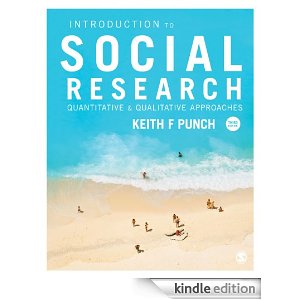
Introduction to Social Research: Quantitative and Qualitative Approaches by Keith Punch

If you looking for an outstanding book on conducting research you might want to consider Keith Punch’s new book, Introduction to Social Research: Quantitative and Qualitative Approaches. Keith has lonKeith Punchg been a leader in research methodology – his in-depth knowledge, his accessible writing style, his concise descriptions, and his realistic approach make his work outstanding. I (Clare) have found his work very helpful. You might find his chapter on grounded theory very useful. Below is a review of the book and here is the link:

http://www.amazon.ca/Introduction-Social-Research-Quantitative-Qualitative-ebook/dp/B00JIVFZGG/ref=sr_1_1?ie=UTF8&qid=1411018834&sr=8-1&keywords=keith+punch

This is a beautifully understated and highly accessible book. It focuses on the issues and practicalities of doing social scientific research, introducing a wide range of methods and approaches to get students thinking and a project underway. This new edition has been thoroughly updated, and there are welcome new chapters on theory, literature searching, research ethics and the internet. The book is authoritative and will be well used by students and teachers of social science research methods. — Amanda Coffey, Professor 20131007 Comprehensive, thoroughgoing and well organised, Punch’s book has a deservedly high reputation among social science researchers. This third edition, with new material on literature searching, ethics, theory and the Internet makes it a must-have for students and professional researchers alike. — Gary Thomas, Professor of Inclusion and Diversity 20131007 In this work, Keith Punch covers all the essentials of social science research with clarity and an obvious command of the subject matter. His coverage of quantitative and qualitative methods from design through to collection and analysis offers breadth and depth perfect for any undergraduate attempting to navigate the research world. I look forward to putting a copy of this latest edition on my shelf and recommending it students. — Dr Zina O’Leary, Unit of Study Coordinator, 20131007 This 3rd edition provides an accessible yet comprehensive and detailed framework for understanding social research. The clear layout with chapter objectives and summary questions offers a robust and practical learning structure for students which guides them through both theoretical and methodological approaches to contemporary research. No research methods course should be without it!! — Dr. Emma Bond, Deputy Director 20131007 All in all, this book is incredibly well structured and free from jargon and over complication. It is a joy to read, and it guides the reader step-by-step towards understanding what social research is all about. — Dr Sophie Lecheler LSE Book Reviews Website

A Strong Tradition of Inuit Oral History

This month Parks Canada announced the discovery of one of the lost ships from Sir John Franklin’s Arctic expedition. The two ships from the Franklin expedition, HMS Erebus and HMS Terror, and their crews disappeared during a search for the Northwest Passage in 1846. Recent sonar images from the waters of Victoria Strait, just off King William Island in Nunavut, revealed the wreckage of a ship on the ocean floor.

The discovery of the Franklin ship demonstrates the strength and reliability of Inuit oral history. For more than 30 years local historian Louie Kamookak has been interviewing elders to collect the stories about the Franklin expedition. According to Inuit oral history the two ships appeared on the northwest side of King William Island. One of the ships was crushed in ice and the other ship floated further south. The Parks Canada team may not have discovered the Franklin ship without Inuit knowledge and the strong tradition of Inuit oral history. Kamookak noted, “for us Inuit it means that oral history is very strong in knowledge, not only for searching for Franklin’s ships but also for environment and other issues.”

www.cbc.ca/m/news/canada/north/franklin-find-proves-inuit-oral-history-is-strong-louie-kamookak-1.2761362

FranklinShip

How was your day? And more inspiring ways to ask Children about school

We know that if we ask children, “How was your day?” Often we will hear the response “Fine”… or if we ask “What did you do at school today?” Often we will hear the ever so painful response “nothing”.

I (Yiola) came across this list of questions to ask children as a way to stimulate conversation about their schooling experience. I will be sharing this list with my student teachers this year as I find it to be a helpful tool to share with parents.

1) What was the best thing that happened at school today? (What was the worst thing that happened at school today?)

2. Tell me something that made you laugh today.

3. If you could choose, who would you like to sit by in class? (Who would you NOT want to sit by in class? Why?)

4. Where is the coolest place at the school?

5. Tell me a weird word that you heard today. (Or something weird that someone said.)

6. If I called your teacher tonight, what would she tell me about you?

7. How did you help somebody today?

8. How did somebody help you today?

9. Tell me one thing that you learned today.

10. When were you the happiest today?

11. When were you bored today?

12. If an alien spaceship came to your class and beamed someone up, who would you want them to take?

13. Who would you like to play with at recess that you’ve never played with before?

14. Tell me something good that happened today.

15. What word did your teacher say most today?

16. What do you think you should do/learn more of at school?

17. What do you think you should do/learn less of at school?

18. Who in your class do you think you could be nicer to?

19. Where do you play the most at recess?

20. Who is the funniest person in your class? Why is he/she so funny?

21. What was your favorite part of lunch?

22. If you got to be the teacher tomorrow, what would you do?

23. Is there anyone in your class who needs a time-out?

24. If you could switch seats with anyone in the class, who would you trade with? Why?

25. Tell me about three different times you used your pencil today at school.

*****

The list came from: http://www.huffingtonpost.com/liz-evans/25-ways-to-ask-your-kids-so-how-was-school-today-without-asking-them-so-how-was-school-today_b_5738338.html

Researchers in the area of parenting and parent involvement have offered the same advice to parents for speaking to their children about school.

http://www.theglobeandmail.com/life/parenting/back-to-school/how-to-help-your-kids-succeed-in-school-talk-talk-talk/article4524102/

A is for Activist: Guest Blog by Gisela Wajskop

The school year began in Canada at the same time we experienced many human tragedies across the world. In this peace-less world, I’ve (Gisela) A is for Activistdiscovered, by chance, an interesting book for young children: A is for Activist by Innosanto Nagara, http://www.aisforactivist.com. From Activist to Zapatista, this “children’s book for the 99 percent” offers different rhymes and perspectives to small children.

The book is described as:

Activist is an ABC board book written and illustrated for the next generation of progressives: families who want their kids to grow up in a space that is unapologetic about activism, environmental justice, civil rights, LGBTQ rights, and everything else that activists believe in and fight for. The alliteration, rhyming, and vibrant illustrations make the book exciting for children, while the issues it brings up resonate with their parents’ values of community, equality, and justice. This engaging little book carries huge messages as it inspires hope for the future, and calls children to action while teaching them a love for books. http://www.amazon.ca/Activist-Innosanto-Nagara-ebook/dp/B00DIGNCNU/ref=srA is for _1_1?ie=UTF8&qid=1410614592&sr=8-1&keywords=Innosanto+Nagara

As Corey Hill wrote in 2012 (http://www.yesmagazine.org/people power/in-review-it-is-for-activist-by-innosanto-nagara) “It’s pretty clear from page one that this is no Cat in the Hat. Billed as a book for the children of the 99%, A is for Activist is the radical vision of Innosanto (Inno) Nagara, a graphic designer and social justice activist from Oakland, California.

Although the book is said to suitable for children from birth to three years to age I wonder about the impact of reading it to such young children, and I wonder if it would be better suited for older children who have ideological knowledge and experience. The illustrations are gorgeous and the rhymes reveal ideas about the rights of all in the hope of a world more with fewer ills. It is a lovely text to start the school year in which conflicts and wars in the four corners of the world threaten children around the world! It can serve as introductory material to literacy and can serve as an inspiration to parents and educators about the social function of writing and literature for children.

Summer of Jodi Picoult

I (Cathy) often listen to novels (on my ipod mini) as a series by one author. By doing this I can get very familiar with an author’s style, recurring themes and track her/his growth as a writer. This summer was Jodi Picoult.

Jodi Picoult Jodi Picoult

So far I have listened to 8 novels: The Pact, Perfect Match, Vanishing Act, The Storyteller, House Rules, Lone Wolf, Nineteen Minutes, and Sing You Home. I discovered she often writes about trials. She also tends to write from several points of view in each novel. I particularly liked this trait with the trial books, because I could ‘hear’ the perspectives of both the defense and the prosecution. Sometimes she uses one character in two books, which I also enjoyed.

Her strength, however, is her ability to tackle issues. She excels at them. Big, messy ones. (She wrote My Sisters Keeper, which became a popular movie starring Cameron Diaz and Alec Baldwin). The novel I just finished, Nineteen Minutes, was about a bullied high school student that decided to fight back by shooting several students in his school. It was graphic and disturbing, but portrayed with sensitivity and realism. The issues she portrayed in the trail bothered me so much, I found myself describing scenes to my husband and asking his opinion on them. I was emotionally snagged. I view this as a sign of an excellent writer. My favourite book of the 8, was The Storyteller, but it also was, at times, hard to listen to. A holocaust story, it was brutally realistic and very emotional.

I recommend her work as a wonderful resource for a book club, especially if you like a good discussion about polarized views and moral dilemmas. She has a new one coming out in October, Leaving Time, which I plan to order and buy a hard copy for my daughter. She is a big Jodi Picoult fan and started me on this series. After this, I haven’t decided which author to tackle next. Any recommendations?

storytellerninetten minutes

A hard cold truth about teaching and teachers at Canadian universities

An article I (Yiola) came across on Canadian news, the CBC.

http://www.cbc.ca/news/canada/most-university-undergrads-now-taught-by-poorly-paid-part-timers-1.2756024

The increasing numbers of contract employees in academia is not new. We have known for quite some time that many faculty members, usually teaching faculty, have part-time contract positions.

The organizational process to hire well-qualified academic faculty as part-time and contract employees is complex and has many implications:

– funding: it seems universities receive little funding for the renewal or development of permanent or tenure stream faculty and other resources

– work/life conditions for contract faculty:  the article describes the challenges contract faculty experience both at work and in their personal lives (low wages, job instability, heavy workloads)

– culture/work environment: the tensions between tenure and non-tenure, permanent and contract, faculty

– quality of teaching: with the aforementioned stresses placed on teaching and teachers at the university, is there an effect on the quality of teaching?

Clare and Clive have explored and written on the topic. For example:

Kosnik, C., & Beck, C. (2008). In the shadows: Non-tenure-line instructors in preservice teacher education. European Journal of Teacher Education, 31(2), 185-202.

Beck, C., & Kosnik, C. (2003). Contract staff in preservice teacher education. Teaching Education, 14(2), 187-200.

The article speak to all faculties and departments across the university. This holds true for teacher education as well. Upon reading the article and listening to the interview http://www.cbc.ca/news/class-struggle-1.2756899   I cannot help but feel sad for the state of teaching and learning at the University level.  University teachers deserve better… students deserve better.