Category Archives: education

Student Teachers in School Practice: An Analysis of Learning Opportunities by Alaster Scott Douglas

Alaster Scott Douglas

I (Clare) thought Alaster Scott Douglas’ recently published text, Student Teachers in School Practice: An Analysis of Learning Opportunities, might be of interest to those of you involved in teacher education. Douglas is the Assistant Director of Education and Reader in Education and Professional Practice at the University of Roehampton. He has written a book thatexamines student teacher learning during school teaching practices. The book includes a number of case studies that illustrate how learning opportunities for students are very different. Click on the link for more information about the text. Alaster Douglas Flier_STUDENT TEACHERS IN SCHOOL PRACTICE US
Congratulations Alaster on the publication of this important text. For all of us involved in teacher education we know how complex student/practice teaching can be and it is an area that warrants much more research. This text promises to add to our understanding of a critical yet often misunderstood aspect of teacher credential programs.  Clare

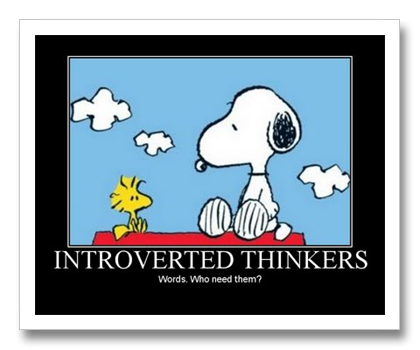
The Power of Introverts

“In a gentle way, you can shake the world.” – Gandhi

Introverted-Thinkers

At a professional development session I (Pooja) attended this week, I joined a conversation about the power of introverts. The conversation was framed around Susan Cain’s book entitled Quiet: The Power of Introverts in a World That Can’t Stop Talking. We live in a society where extroverts are the ideal; we value personality over character. This presentation, given by some of my quieter colleagues, was  powerful because it forced me to reflect on ways I engage and include introverts in the classroom. The presenters explained that introversion and extraversion is not a black or white matter; rather we all fall somewhere along the continuum depending on the situation we find ourselves in. I also learned that introversion is not to be confused with shyness- a mistake many people (including myself) make when speaking about introverts.

images

I mostly identify as an extrovert. Knowing this is important because it can influence how I design my  course to be more inclusive for all my students. As a more extroverted person, I walked out of the session with practices to consider revising in my classroom. Here are a few of the things I’ve been thinking about:

  • Mindful of airtime- I often become uncomfortable in silence, and so I will fill in silent moments with talking or engaging only the most vocal members of the class in discussion. Silence can be a powerful thing; these are the moments where reflection occurs.
  • Independent Work vs. Group Work- I try and put my students into pairs and/or groups every chance I get. I now am beginning to realize this is not the optimal working condition for all. I need to find a balance of group work and independent work.

Learn more about the power of the introverts here:

http://www.thepowerofintroverts.com


Walking for the Brain

To further our theme from earlier posts on well-being and schooling, I (Cathy) looked up the right time to exercise to help your brain.  These tips were suggested:

  • In general, anything that is good for your heart is great for your brain.
  • Aerobic exercise is great for body and brain: not only does it improve brain      function, but it also acts as a “first aid kit” on damaged brain      cells.
  • Exercising in the morning before going to work not only spikes brain activity and prepares you for mental stresses for the rest of the day, but also      produces increased retention of new information, and better reaction to      complex situations.
  • When looking to change up your work out, look for an activity that incorporates coordination along with cardiovascular exercise, such as a dance class.

http://www.positscience.com/brain-resources/everyday-brain-fitness/physical-exercise

These all made sense, but none of them identified when or why I like to exercise for my brain.  When my mind is somewhat numb after a few hours of academic writing, I need to push the refresh button.  I achieve this walking by the lake.  I am sure it is good for my lungs, my joints and my heart, but I really head to the water to recharge my neuro cells and feast my eyes.  The scenery renews me as much or more than the exercise.  Maybe just seeing what I saw yesterday will refresh your neurons…

photo 1 photo 2 photo 3 photo 4

Teaching Music Literacy – It Ain’t Easy but Must be Done

Young people spend so much of their day listening to music, yet it’s barely addressed in school. Something needs to be done about that – but it won’t be easy. I remember my (Clive’s) grade 5 teacher telling us that Bing Crosby couldn’t sing, he was just a crooner. He probably thought he was “educating” us about music, but he fed into my early prejudice against popular music.

In France there’s a lot of “music appreciation” in schools, which is great because music-making shouldn’t be all we teach. However, again the stress is on classical music.

One of the teachers in our longitudinal study (Candice) recently became a music specialist in her school and established a wonderful approach. In her seventh year she said:

I’ve become keen on the Orff method: it emphasizes improvisation and creating your own music, and leads in the teen years and adulthood to more of a jazz approach…. My focus is on teaching children in such a way that they can create music, understand it, and participate in it. So when they’re listening to pop music they understand what instruments are used, how the music is made, and what mood it creates.

But is there still too much emphasis here on performance?

A respected Toronto columnist recently wrote a rather negative article about popular music. He asked how much of interest could come from a genre where everything is a sentimental song about 3 minutes long in 4/4 time? I asked a musician in my ITE class about this and he said there’s an enormous variety and depth of structure and rhythm in popular songs. We noted that a similar argument could be made against English literature on the ground that it uses just 26 letters and a few punctuation marks (see the quote form Neil Gaiman in Lydia’s recent blog).

Teaching music literacy in schools has many pitfalls. Like the Fiddler on the Roof, teachers will have difficulty keeping their balance. But a way must be found – in many subject areas – if schooling is to be relevant.

The Power of Believing

Building on Clare’s blog from yesterday and the notion of connecting well-­‐being to schooling, I (Yiola) feel compelled to share with you the story of Simon Marcus. He is a member of my extended family and one of Canada’s top athletes in the sport of Muay Thai. In fact, Simon is a 5 time World Champion.

http://en.wikipedia.org/wiki/Simon_Marcus

Simon’s story is not uncommon: a Black, male disengaged with traditional school. As a child, he was an active boy and excelled in sports but had very little patience and interest for learning inside the classroom. He has shared his schooling story with me numerous times and the story has been consistent, “It is not that I was not capable of doing the work, I just had no interest or motivation”. As his schooling years progressed he found himself deeper and deeper in spaces of alienation and low expectation for successful schooling. And then, he met Master Suchart, a Master teacher of Muay Thai.  Through a pedagogy that engaged him (physical literacy), a teacher that knew how to connect to his well-­‐being, and a developing belief in himself as a learner and a winner, Simon went from detentions and failure to being on top of the world. The one statement that rings in my ears about Simon’s journey to success is this turning point, “I knew Master Suchart believed in me. His belief in me made me believe in myself”. The ideas of well-­‐being, trust, care and belief paved the way to Simon’s success. A teacher’s role in the well-­‐being of a student is key: the social conditions created in a classroom, the relationships fostered and the pedagogical decisions a teacher makes are key.

From my own experiences as a Muay Thai fighter, I can say it is much easier to prepare for and pass a science test at school than it is to prepare for and step into a Muay Thai ring and yet the big questions worth exploring are: how did the teaching and learning at the Muay Thai school connect well-­‐being to schooling success? What process took place for Simon to connect with the learning, embrace the teacher and believe in himself? Perhaps the kinesthetic element of the pedagogy, perhaps the content, perhaps the teacher as role model and unconditional supporter, perhaps the challenge and, very likely the overheard whisperings of his teacher: “see that  boy over there, he’s my future champion”.

yiola

Simon’s victory in Buenos Aires, Argentina against Argentina’s #1 fighter.

yiola 2

Simon with his teacher, celebrating a victory together.

Well-being and Skills Go Hand-in-Hand

We have had many blog posts about teaching for relevance. I (Clare) was reading a chapter in Martin Seligman’s book Flourish: A Visionary new Understanding of Happiness and Well-Being. http://www.amazon.ca/Flourish-Visionary-Understanding-Happiness-Well-being-ebook/dp/B0043RSK9O/ref=sr_1_1?ie=UTF8&qid=1392996735&sr=8-1&keywords=martin+seligman
Here is an excerpt from Chapter Five.

  • Question one: in one or two words, what do you most want for your children?
  • If you are like the thousands of parents I’ve polled, you responded “happiness,” “confidence,” “contentment,” “fulfillment,” “balance,” “good stuff,” “kindness,” health,” satisfaction,” “love,” “being civilized,” “meaning,” and the like. In short, well-being is your topmost priority.
    • Question two: in one or two words, what do schools teach?
      • If you are like other parents, you responded, “achievement,” “thinking skills,” “success,” “conformity,” “literacy,” “math,” “work,” ‘test taking,” “discipline,” and the like. In short, what schools teach is how to succeed in the workplace.
      • Notice that there is almost overlap between the two lists. The schooling of children has, for more than a century, paved the boulevard toward adult work. I am all for success, literacy, perseverance, and discipline, but I want you to image that schools could, without compromising either, teach both the skills of well-being and the skills of achievement. I want you to image positive education.

I found his perspective refreshing and inspiring. In my teaching, I need to be mindful to address both well-being and skills and to talk to my student teachers about the need to do both.

Semiotic Linguistic Quiz

Saussure   Ferdinand de Saussure (1857-1913)

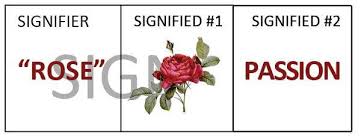
As of late, I (Cathy) have been exploring semiotic linguistics to further  my understanding of multimodality (Jewitt & Kress, 2003). Ferdinand de Saussure is considered to be one of two fathers of 20th century semiotic linguistics.  He described semiotics a as a system of signs that are created within a cultural context.  Sausuure defined a sign as being composed of:

        • a ‘signifier’ – the form which the sign takes; and
        • the ‘signified’ – the concept it represents.

On the internet I stumbled upon these diagrams which are intended to illustrate the meaning of signifier and signified.  Do you think they are both correct?

tree

rose

A multitude of communication resources

cartoon_newliteracies

When I saw this comic it made me chuckle.  I enjoyed the comic’s gentle reminder that children/youth routinely engage with and expertly navigate a variety of communication tools. Clare and I (Lydia) conducted a two-year collaborative self-study of our efforts to incorporate various technological resources (e.g. a wiki) into our pre-service literacy methods courses. This research helped us identify both the challenges and successes we encountered along the way.  Our research efforts also made us more mindful of why we chose to incorporate certain technological resources into our pedagogical practice — questioning for what purpose and to what end.   Through the analysis of our efforts we realized that we had initially seen technology as an end in itself, not as a tool to support learning. In the second year of the study, we focused much more on student learning and became more systematic in our efforts. Over the two years of the study, our identities as teacher educators shifted as our pedagogies became richer, our use of technology more fully integrated into our literacy courses, and we received validation from others and from each other.

“The Secrets of Sugar”

I (Pooja) watched an eye-opening documentary on CBC’s Fifth Estate. The documentary sugaruncovers some frightening facts about the effects of sugar and the sugar industry. Most of us are eating way too much sugar on a daily basis. Surprisingly, sugar is added in food items such as ketchup, yogurt, soy milk, and salad dressings. There was one alarming segment in particular in which I couldn’t help but think about the effect of sugar on children in school. Research was conducted on a sample of lab mice to observe how they reacted when their sugar consumption increased. The results were disturbing. Before any sugar consumption, the mice were alert and able to navigate through the set-up maze. However, as sugar consumption increased, their alertness levels decreased significantly. They moved sluggishly through the maze, bumping into the walls along the way. Some could not even make it to the end. This made me think so many of our young learners who consume high levels of sugar from their school cafeterias, vending machines, convenient stores, and/or home. Although in the past decade there has been a push towards healthier food for our school-aged children, there is a need for a deeper awareness around all the places where sugars are hidden.

Learn more about “The Secrets of Sugar” here:

http://www.cbc.ca/fifth/episodes/2013-2014/the-secrets-of-sugar

Can you understand what I am saying?

In the New York Times on the weekend, Nicholas Kristof wrote a stinging criticism of academics. http://www.nytimes.com/2014/02/16/opinion/sunday/kristof-professors-we-need-you.html?ref=nicholasdkristof
He notes that when someone utters the phrase “That’s academic” it is a very loaded comment. That retort implies scholars are irrelevant. He quotes Anne-Marie Slaughter who observed that “disciplines have become more and more specialized and more and more quantitative, making them less and less accessible to the general public.” He feels that the PhD programs “have fostered a culture that glorifies arcane unintelligibility while disdaining impact and audience.” Although I (Clare) found his comments a bit harsh there is something sobering about his analysis. Often I find myself reading a journal article on teacher education (my specialty) that I simply cannot understand. The jargon overwhelms the central points and the writing so turgid it is inaccessible. As academics our many masters (tenure review committees, funding agencies, journal reviewers) expect our work to sound “academic” so we are almost forced to employ an unnatural writing style. There is no easy solution. We may not be able to do anything in the short term but in the long-term I hope that our research can be used to inform general discourse about teacher education and public policy. Writing for different audiences is difficult but hey, we academics are quite smart. Let’s take up the challenge to make our work more accessible to many readers.