Category Archives: higher education

Can you spot a good teacher from their characteristics?


12644854_10156632304500121_7940976327917128279_nI (Clare) found this really interesting article in the Guardian newspaper about traits of effective teachers. Here is the link for the article: http://www.theguardian.com/teacher-network/2016/mar/02/can-you-spot-a-good-teacher-from-their-characteristics
I believe that the admission process is one of the most important steps in teacher education but the question that has vexed me for years is: What do you look for in an applicant? In previous posts we have talked about the admission process used in Finland which is very intense, focused, and pointed. They know what they are looking for! More to come in future blogs. And I highlighted in red a few key passages that resonated with me.

Professor Rob Klassen explores the latest research into what traits effective teachers have and how this could inform recruitment
What would you do in the following situation?
As students in your classroom begin a writing task, one of them, Kata, starts throwing paper around and distracting the others. You know from previous incidents that Kata often becomes frustrated when she does not understand how to complete activities; she often displays this by being disruptive.
Would you …
a) Ask her to leave the class?
b) Show her how to get started on the task?
c) Encourage her by telling her that she is capable of completing the task?
d) Ask a passing teacher to talk to her?

Your answer gives important clues about how you think and operate as a teacher (see below for answers). In future, similar questions could help researchers understand how prospective teachers might interact with students, and enable trainers to recruit people who are best suited to work in schools.

The debate over what makes a good teacher isn’t new – as far back as 500BC Confucius was portrayed as a model teacher. But despite this, there’s been little systematic research into how we can measure the personal characteristics that make a teacher effective – and how we can reliably select people for teacher training.
Part of the problem is that teaching is often portrayed as something that’s too magical and cryptic to decode. While there is something special about the idea of passing on knowledge, teaching is no more mystical than other professions. Research has shown that some teachers are routinely more successful than others – and science can predict who is likely to be the most effective.

A recent study by Dr Allison Atteberry from the University of Colorado followed more than 3,000 teachers over the first five years of their careers, measuring their effectiveness by looking at student outcomes. Atteberry found that even after statistically controlling for external factors such as school, family and student characteristics, teachers who were most effective tended to maintain this over time. Similarly, those in the bottom group for effectiveness stayed there, even when they moved schools.
Anecdotal experience backs this up: it’s not uncommon for someone to remember having a great – or not-so-great – teacher at school.

This indicates that multiple factors, which interact in complex ways, make some teachers consistently effective. Academic ability is one of them, hence the UK government’s introduction of tougher entry requirements for teacher training in 2013. But it’s not the only thing that matters; non-¬cognitive attributes – personal characteristics such as empathy and communication – are also essential.

A recent large-scale review of the factors associated with student achievement showed dramathat teacher-student relationships outweighed the contribution of teachers’ subject knowledge, teacher training, or home and school effects. In fact, John Hattie’s research in Australia shows that teacher characteristics, such as interpersonal skills, are more closely associated with student achievement than curriculum or teaching approach.
Our research in the UK and internationally – funded by the European Research Council – takes this further, examining how we can identify key teacher characteristics and assess them for entry into teacher training. There can be a lot of leeway in how personal characteristics are expressed, but we want all teachers to have qualities such as empathy, resilience and adaptability in the face of challenges. Our results show that these attributes are broadly the same across secondary and primary schools, although there are some variations between cultures. In Finland, for example, cooperative skills are particularly desirable because there’s a strong tradition of collaboration in schools, where teachers plan and work together.

Instead of using personality tests, we use scenario-based questions, known as situational judgment tests, to measure characteristics. These tests have more validity in predicting job performance than personality tests, which people can fake more easily. Studies in organisational psychology suggest that face-to-face interviews are also an unreliable way to gauge characteristics as interviewers are prone to hidden bias: even when we try to be open and fair, we’re inclined to select people who are a bit like us.

As teaching faces a manpower catastrophe, Holly Welham meets those failing to join the profession because of a ‘ludicrous’ math test

IMG_2508It is possible to improve some traits – such as communication or organisation – through professional development. But this may not be possible for all non¬-cognitive attributes – it’s harder to build skills such as empathy, for example. This is why it’s essential that we pay more attention to personal qualities when
recruiting prospective teachers.

That’s not to say that the goal of selecting prospective teachers is to pick candidates with only one type of personality or teaching style, but we do want to make sure the people educating our children, grandchildren, friends and family have some basic personal quality building blocks. This is already happening in fields as diverse as medicine and the military, for example.

We have already piloted situational judgment tests with universities in Cambridge, Newcastle and York, and are working with universities and education ministries in Australia, Finland, Hungary and Lithuania. After further validation of the tests, we are excited about introducing this new selection procedure nationally in some settings and an online version using video scenarios.

Back to the scenario at the beginning of this article. Although there’s no perfect response, if you chose “b” you might show adaptability in the classroom. Choose “c” and you probably have a growth mindset and believe that with effort children are capable of improving their attainment. Choosing “a” might show a lack of resilience when facing challenging situations, and “d” might show a lack of self-efficacy to engage all pupils in learning. Which quality do you have? Maybe you would be a great teacher.

Teacher Education for High Poverty Schools

Jo Lampert and Bruce  Burnett have recently edited an amazing text,Teacher Education for High Poverty Schools. The text is available from Springer.

http://www.springer.com/us/book/9783319220581Image_LampertBookcover

This volume captures the innovative, theory-based, and grounded work being done by established scholars who are interrogating how teacher education can prepare teachers to work in challenging and diverse high-poverty settings. It offers articles from the US, Australia, Canada, the UK and Chile by some of the most significant scholars in the field. Internationally, research suggests that effective teachers for high poverty schools require deep theoretical understanding as well as the capacity to function across three well-substantiated areas: deep content knowledge, well-tuned pedagogical skills, and demonstrated attributes that prove their understanding and commitment to social justice. Schools in low socioeconomic communities need quality teachers most, however, they are often staffed by the least experienced and least prepared teachers. The chapters in this volume examine how pre-service teachers are taught to understand the social contexts of education. Drawing on the individual expertise of the authors, the topics covered include unpacking poverty for pre-service teachers, issues related to urban schooling as well as remote and regional area schooling.

Our (Clare) research team contributed a chapter to the text which focused on six literacy teacher educators who purposefully prepare student teachers to work in high poverty schools. Here is the chapter: TchingforHighPovertySchools

Parent Research Night

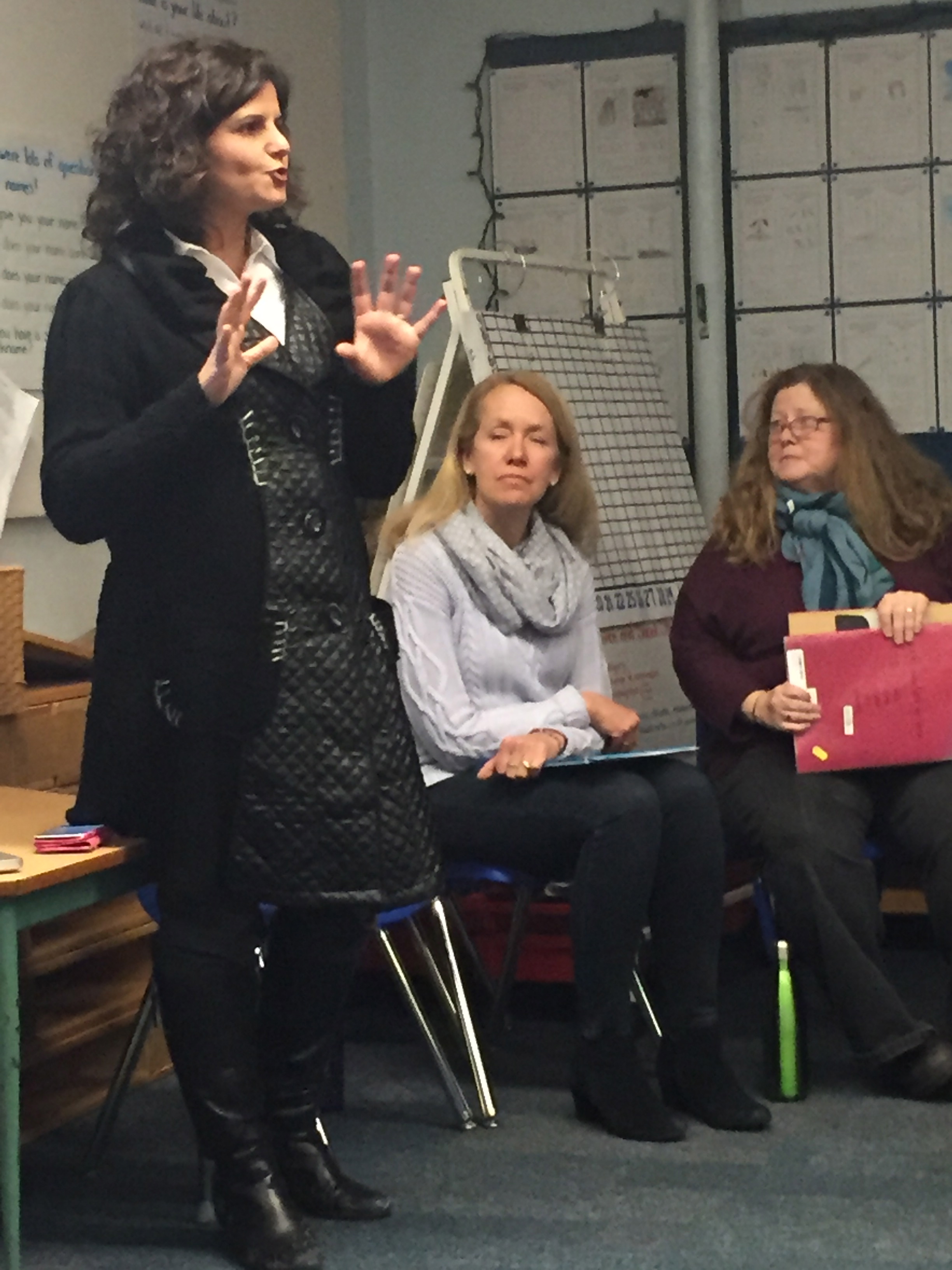
This week I (Clare) attended the Parent Research Night at the Dr. Eric Jackman Institute of Child Studies (where I am the Director). It was a truly amazing evening because the two presentations demonstrated research that was for teachers and parents, done by teachers, and inspired by teachers. It was such a beautiful form of dissemination of research. The findings are not confined to a peer-reviewed article but were shared with the public.

IMG_1147Dr. Patricia Ganea talked about the importance of shared reading with children. And she shared data on how children respond to images in children’s books – realistic (photos) vs fantastical (comic-like). Interestingly they relate much more to the latter.

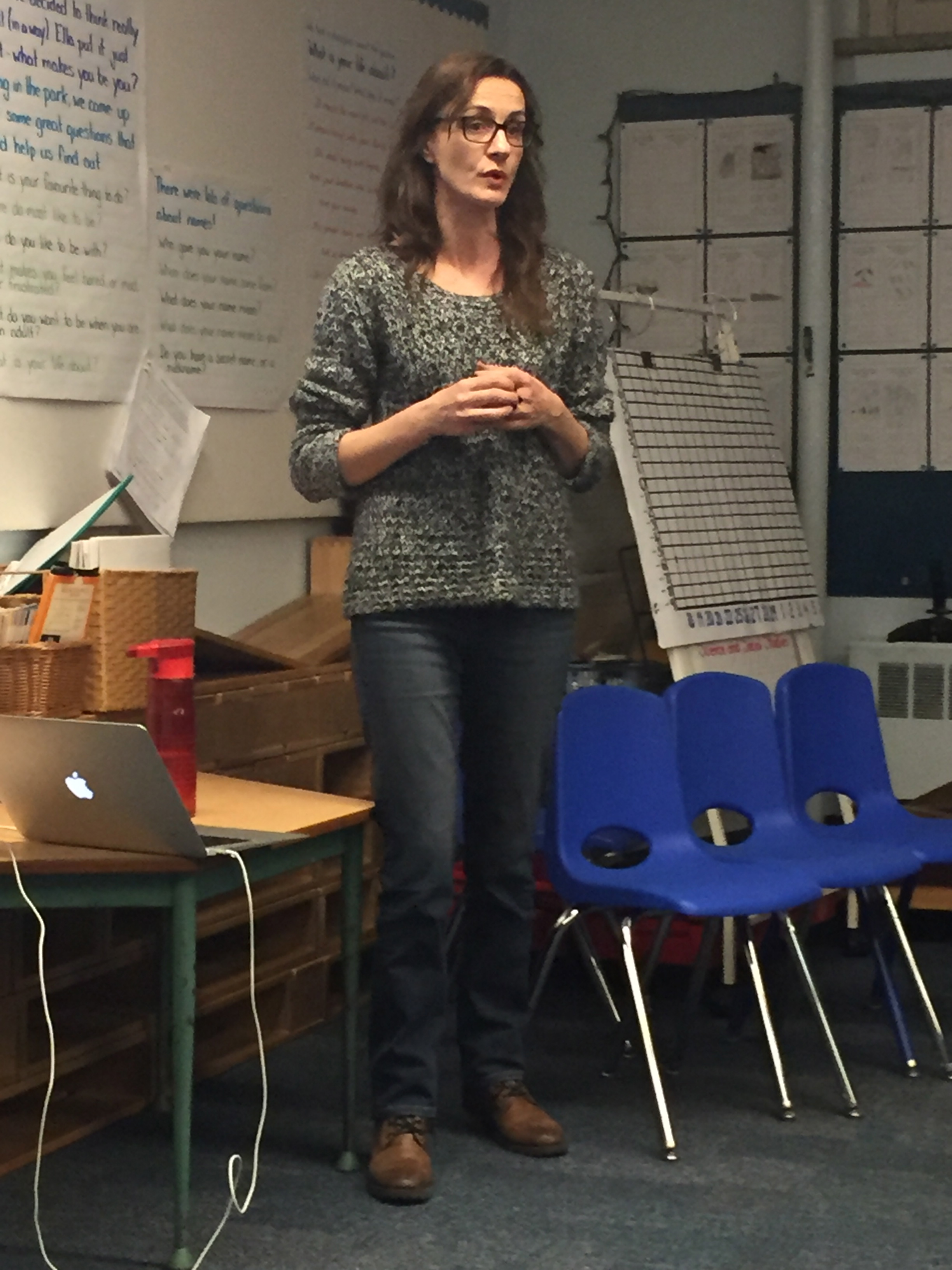
Then Dr. Yiola Cleovoulou and 3 teachers (Zoe Honahue, Cindy Halewood, and Chriss Bogert – who is now the VP) from the Lab School IMG_1153presented on their work with the children that was framed by critical literacy with an inquiry focus. They shared student work, read transcripts of actual conversations, and described activism work.

JICS has a tripartite mission: Lab school, teacher education program, and a research centre. Parent Research night truly brought all three together. http://www.oise.utoronto.ca/ics/index.html

The Teacher Curse No One Wants to Talk About

I (Clare) read this really interesting article on Edutopia

I believe it has relevance for both teachers and teacher educators. Having to unpack and remember how we learned a topic/skill is hard. How do you break down the steps to learning so that our students can acquire the knowledge and skills.  This article has some highly useful examples and suggestions.  As a teacher educator I often make assumptions about my student teachers. They all have university degrees so they should be able to master the content easily. Wrong assumption! It takes time and good teaching. Here is the link to the full article. The Teacher Curse No One Wants to Talk About 


Knowledge is a curse.
 Knowing things isn’t bad itself, but it causes unhealthy assumptions — such as forgetting how hard it was to learn those things in the first place. It’s called the Curse of Knowledge.

In this post, we’ll identify how the Curse of Knowledge affects educators. Then we’ll outline seven ways to alleviate the curse. The ultimate goal is to improve instruction.

The Curse of Knowledge

The Curse of Knowledge has been variously described in articles by Chip and Dan Heath, Carmen Nobel, and Steven Pinker, and also in books such as The Sense of Style and Made to Stick. It has been applied to a variety of domains: child development, economics, and technology are just a few.

All of the resources describe the same phenomena — that a strong base of content knowledge makes us blind to the lengthy process of acquiring it. This curse has implications for all teachers:

  • We do not remember what it is like to not know what we are trying to teach.
  • We cannot relive the difficult and lengthy process that learning our content originally took.

As a result, we end up assuming that our lesson’s content is easy, clear, and straightforward. We assume that connections are apparent and will be made effortlessly. Assumptions are the root cause of poor instruction. And acknowledgment is the first step to recovery.

Lifting the Curse

Here are seven ways to make learning easier for your students.

1. Emotion

Barbara Fredrickson, a champion in the field of positive psychology, has studied the effects of mild positive emotions on desired cognitive traits like attentiveness and ability to creatively solve problems. In what she coined the broaden-and-build theory, Fredrickson found that pleasant and mild emotional arousal before experiencing content leads to greater retention. A quick joke or humorous movie can serve as the positive emotional stimulant. So learning is easier and the Curse of Knowledge is potentially circumnavigated when injecting a bit of emotion into your lesson.

2. Multi-Sensory Lessons

Though Howard Gardner’s influential work states that we each have a preferred learning modality, new research highlights the fact that effective lessons need not be unisensory (only kinesthetic, only auditory, etc.) but multi-sensory. Multi-sensory experiences activate and ignite more of the brain, leading to greater retention. So use a multisensory approach in your lessons to make learning easier.

3. Spacing

Blocked practice is ancient and is no longer considered best practice. An example of blocked practice is cramming. Though it feels like learning, blocked practice results in learning that is shallow, and the connections quickly fade. The preferred alternative is the opposite of blocked practice: spaced practice.

Exposing yourself to content and requiring your brain to recall previously learned concepts at spaced intervals (hours, days, weeks, or months) makes the content sticky and results in deeper retention with solid neural connections. As spaced practice is the way that you learned the content you teach, it makes sense to employ the same technique with your students. So thinking of your content as a cycle that is frequently revisited makes learning easier for your students while helping alleviate the curse.

For more information on spacing content, check out Make It Stick or 3 Things Experts Say Make A Perfect Study Session.

4. Narratives

Everyone loves a great story because our ancestral past was full of them. Stories were the dominant medium to transmit information. They rely on our innate narcissistic self to be effective learning tools — we enjoy stories because we immediately inject ourselves into the story, considering our own actions and behavior when placed in the situations being described. This is how we mentally make connections, and if students are listening to a story interlaced with content, they’re more likely to connect with the ideas. So connecting with content through a story is at the heart of learning and can help alleviate the stress associated with the Curse of Knowledge.

5. Analogies and Examples

An analogy is a comparison of different things that are governed by the same underlying principles. If understanding a process is what we’re after, looking at the result of the process proves informative. An analogy compares two unlike things by investigating a similar process that produces both. Said differently, an analogy highlights a connection, and forming connections is at the core of learning.

Whereas an analogy compares similar processes that result in different products, an example highlights different processes that result in similar products. Copious use of examples forces the brain to scan its knowledge inventory, making desirable connections as it scans. So learning is easier when analogies and examples are used to facilitate mental connections.

6. Novelty

New challenges ignite the risk-reward dopamine system in our brains. Novel activities are interesting because dopamine makes us feel accomplished after succeeding. Something that is novel is interesting, and something interesting is learned more easily because it is attended to. So emphasis on the new and exciting aspects of your content could trip the risk-reward system and facilitate learning.

7. Teach Facts

Conceptual knowledge in the form of facts is the scaffolding for the synthesis of new ideas. In other words, you cannot make new ideas with out having old ideas. Disseminating facts as the only means to educate your students is wrong and not encouraged. However, awareness that background knowledge is important to the creation of new ideas is vital for improving instruction. Prior knowledge acts as anchors for new incoming stimuli. When reflecting on the ability of analogies and examples to facilitate connections, it is important to remember that the connections need to be made to already existing knowledge. So providing your students with background knowledge is a prerequisite in forming connections and can make their learning easier.

Making It Easier

The Curse of Knowledge places all of our students at a disadvantage. As educators, it’s not enough to simply recognize that we are unable to remember the struggle of learning. We need to act. By incorporating facts, highlighting novelty, liberally utilizing examples and analogies, cycling our content, telling content-related stories, making our lesson multi-sensory, and harnessing the power of emotion, we can make learning easier for our students.


By incorporating facts, novelty, examples, analogies, and emotion; and cycling content, telling content-related stories, and making lessons multisensory, we can make learning easier for our students.

Source: The Teacher Curse No One Wants to Talk About

Ideology ~ Indoctrination to Critical Thinking: The right fit in Teacher Education

Something has been weighing on my mind this year as I teach my courses in teacher education. I (Yiola) have been teaching a number of different courses in teacher education (curriculum, foundations, child development, assessment) and each one has been carefully crafted with the students in mind (some are Masters level courses and others are undergraduate).  Wherein lies the balance of teaching academic courses that are seeped in ideology and the promotion of critical thinking?

I believe it is inevitable that ideologies find there way into our course outlines, our lectures, our readings, our practice ~ after all, we are humans with perspectives and schemas. Knowing where we stand on issues that we teach, I think, is key to developing a course that is not only filled with information (content/pedagogy) for future teachers but that is accessible, inviting, and open to deeper understandings.  In my courses for example critical pedagogy is a framework. Students know that when they take my courses they will be presented with readings, discourses, case studies, and policies that are framed in critical theory.  I choose this for a number of reasons: I believe in equity and social justice education; I believe in equitable opportunity for learning; I believe in disclosing and deconstructing status quo in order to deepen our understanding of “what is going here”? and I believe that many student teachers are hearing of this ideology for the very first time.

And so, I am often left questioning: how far do I take this? how far can I go when presenting an ideology in teacher education? Is it fair to present a dominant perspective? Is it inevitable? Some would argue that by not expressing a point of view, we are simply adhering to one anyway and silencing many others.  Where and when  does ideology channel into indoctrination? Do student teachers feel imposed upon or offended when only one perspective is shared? but what about when its a perspective that is often marginalized? Is there even time to invite critical thinking about ideologies when teaching students about curriculum?

Let me provide an example: Literacy Curriculum in Teacher Education. Literacy education is taught in as many ways as there are literacy educators. We know from our research in literacy teacher education that there are powerful, effective, and varied ways of approaching literacy teacher education. And so, there is not one right way.  One teacher educator may teach with a critical stance while another teaches from an empirical psychological stance, while yet another teaches from a holistic perspective. If I could, I would love to be a student in each of these courses to catch a glimpse of the ways in which teaching literacy can be considered.  To the student teacher, is one way better than another? Is one way less indoctrinating than the next? Is there a way to prompt critical thinking while teaching subject content/pedagogical knowledge?

I am constantly thinking about the perspectives I bring to my courses, what gets included and what is omitted and why. I am constantly thinking about my tone and the messages I relay and the possibilities of interpretation from the learners in my class. I am interested in critical thinking and pushing boundaries of understanding. I am not interested in indoctrination.  This in and of itself is an ideology of sorts.


Black Professor Speaks Out About Being Racially Profiled Near Campus

I (Clare) was reading this article by Kira Brekke on the Huffington Post which I found informative. If you click on the link you will get the entire article and an interview with Steve Locke and at the end of the article is a list of 16 Books On Race That Every White Person Should Read Right Now. I have read some on the list and already downloaded a few others that I feel I must read.

http://www.huffingtonpost.com/entry/steve-locke-racially-profiled_56688025e4b009377b236c54

“A lot of my life has been organized around avoiding interactions with the police.”

Steve Locke, an assistant professor at the Massachusetts College of Art and Design, was left shaken after he was racially profiled by the police last week during his lunch break.

Locke, who wrote about his experience on his blog, recounted to HuffPost Live’s Alyona Minkovski on Wednesday that on his way to get a burrito near campus, he noticed a police car following him.

“The policeman got out of the car, said, ‘Hey, my man,'” Locke said. “He had his hand on his weapon, so I automatically knew that something had happened and he wasn’t coming to talk to me as a citizen. He was coming to talk to me as a suspect.”

Wearing his faculty ID around his neck, Locke immediately took his hands out of his pockets while the officer questioned him. The professor made it clear he was on his lunch break, but the officer — along with others who had showed up to the scene — detained Locke, telling him he matched the description of a suspected robber in the area.

“It was at this moment that I knew that I was probably going to die,” Locke wrote on his blog. “I am not being dramatic when I say this. I was not going to get into a police car.  I was not going to present myself to some victim.  I was not going let someone tell the cops that I was not guilty when I already told them that I had nothing to do with any robbery.”

Locke calmly stood still on the street corner alongside the police before being let go, sent away with apologies from the police for “screwing up your lunch break,” he wrote. But the experience recalled a lifetime of awareness about police profiling and violence.

“I am 52 years old. I grew up in Detroit, Michigan,” he explained to HuffPost Live. “A lot of my life has been organized around avoiding interactions with the police, but whenever I encounter the police, I understand that I’m encountering them differently than other citizens.”


To Device Or Not To Device: Place of Laptops in the Classroom

One of my (Clare) colleagues circulated this letter about use of laptops in the classroom. For me it is a real conundrum. I know that some students toodle around Facebook  during class but others responsibly use their laptop. I thought others might find this article interesting.

Pulling the plug on classroom laptop usage

By: Eric Andrew-Gee, The Globe And Mail | August 22, 2015

When university courses resume this September, Canadian students may find themselves learning the meaning of two new letters: HB.

The standard pencil, for many years alien to digitized lecture halls, is coming back into fashion on campus as a growing number of professors across North America ban laptops from their classrooms.

Many of these instructors are responding to a body of research showing that computer screens are distracting for people trying to learn, and that handwritten notes lead to better conceptual understanding than typed ones.

Computer-free lectures seem to mark a departure from the optimism around technology that has prevailed on many campuses in recent years, and academics who have banned laptops say they are part of a growing wave.

“It’s become pretty common now,” said Arash Abizadeh, a professor of political theory at McGill University who banished laptops from his classes in 2010.

It was about five years ago that Paul Thagard, a professor of philosophy at the University of Waterloo, started noticing a “wall” of screens in his lectures. When he installed a graduate student at the back of the classroom to spy on his plugged-in students, he learned that 85 per cent of them were using their computers for something unrelated to class.

“Since I teach cognitive science, I know how limited attention is,” he said. “Pedagogically, I thought this was a disaster.”

A 2003 study by researchers at Cornell University came to the same conclusion as Prof. Thagard’s sleuth: Students who use laptops during class also engage in “high-tech ‘doodling’ ” – sending e-mails, exchanging instant messages, surfing the Web.

The study found that these students scored significantly worse on a pop quiz about a given lesson’s content than students whose laptops were closed – a finding consistent with troves of research showing that “multitasking” is virtually impossible for most people.

Online distractions have become only more seductive in the past decade, with the advent of Facebook, Twitter and other social networks.

“Both the form and the content of a Facebook update are almost irresistibly distracting, especially compared with the hard slog of coursework,” Clay Shirky, a professor of new media at New York University, wrote in a 2014 essay for the website Medium, explaining why he, of all people, was banning laptops from his lectures.

It may be intuitive that the Internet can impede focus, but researchers have also recently come to a more surprising conclusion about the impact of laptops in classrooms.

In The Pen Is Mightier Than The Keyboard, their cleverly titled 2014 paper on the subject, Pam Mueller of Princeton University and Daniel Oppenheimer of the University of California, Los Angeles, wrote that even when students use computers only for note-taking, they retain less information than students who take notes by hand.

That is because scratching out words on a piece of paper forces students to synthesize as they write, distilling the gist of a lesson, rather than copying a professor’s words down verbatim. The joint study found that note typers were less able to answer conceptual questions about a given lecture than students who took notes longhand.

“In high school, I took typing – and so I know, as someone who can touch type, that I can type things without having any idea what I’m typing,” Prof. Abizadeh said.

Most professors who ban laptops insist that they are not grouchy Luddites and tout their use of technology in other spheres.

Pierre Martin, a political science professor at the University of Montreal with a device-free classroom, said he was the first in his department to create a website for his courses. “I’m actually a rather compulsive user of technology,” he said. “It’s because I am that I know it’s bad for the students.”

But sheer frustration with the sight of glazed student eyes is another motivating factor for professors who start anti-computer crusades. A widely watched YouTube video from 2010 shows a University of Oklahoma physics professor dunking a laptop in liquid nitrogen before smashing it to pieces. Perhaps turned off by such bellicose tactics, some students have objected to anti-laptop policies, saying that even if the devices are harmful, banning them is a paternalistic abuse of power.

Teachers such as Prof. Martin counter that doodling online distracts not just the person on Facebook, but everyone around them.

Laptops in class are like secondhand smoke, he argues.

Indeed, many now grudgingly – even gratefully – accept the bans.

“As many complaints as I get, I get compliments,” Prof. Thagard said.

Meaghan Eyolfson, a University of Ottawa law student, said her 20-person criminal law seminar is mostly laptop-free. Two students per class are allowed to type up notes and send them around to others.

She recognizes the policy’s advantages, even if it means more work. “Obviously, I pay 10 times more attention in the class,” she said. “It’s just a pain in the ass.”


This article was written by Eric Andrew-Gee from The Globe And Mail and was legally licensed through the NewsCred publisher network.


Grad school is like…

I (Clare) was at an orientation for new graduate students. And some of these metaphors about grad school were shared. Thought I would share them with you. It is worth reading the whole post because some are quite hilarious. Will only take a moment.

Rose Hendricks's avatarWhat's in a Brain

Now that I’ve survived my first full week of classes in grad school, I am clearly a grad school expert.

Kidding.

But I have been spending quite a lot of mental energy trying to figure it out – noticing how it’s similar to, and especially different from, undergrad; working to figure out what’s expected of me, by others and myself; and trying to articulate what exactly my goal(s) is/are.

This look is pretty consistently on my face. Image: http://janiebryant.com/blog/265/ This look is pretty consistently on my face.
Image: http://janiebryant.com/blog/265/

I’ve also been a bit preoccupied with metaphors, as I’m working on a metaphor-based research proposal for a fellowship application. I guess the two have become intertwined in my subconscious, because my first (coherent) thought upon waking up this morning was, “grad school isn’t a sprint; it’s a marathon!” Not long after I began giving myself credit for this clever analogy, I was racking my brain for more. As a firm…

View original post 226 more words