Category Archives: Literacy teacher educators

Teacher Education through an Ethnographic Perspective

A book that helped me (Cathy) process my observations more astutely is Ethnographic Eyes : A Teachers Guide to Classroom Observation, by Carolyn Frank.  This book describes how a teacher educator trains her student teachers to see the classrooms they visit through an ethnographic perspective.  To accomplish this, the teacher educator used the tool described below:

I used an activity called Notetaking/Notemaing to help student teachers understand the differences between their own personal perspectives and an insider, classroom perspective. Notetaking/notemaking was presented to the student teachers as an ethnographic tool to help them observe in classrooms.  The student teachers were asked to keep an observation notebook and to divide their observations into two sections: Notetaking (or descriptive fieldnotes) on one side and notemaking (interpretations of what is being observed) on the other side.  We then showed them either a photograph or a video of a classroom.  In this way, it was hoped that the student teachers would begin to reflect on how their own personal biases interfered with an objective account or differed from the classroom members’ perspective.  (p. 9)

This tool was used by this teacher educator throughout the year.  She also showed her student teachers how to use it as a means of data collection towards effective assessment.  At the close of the year, one of the student teachers stated, “[e]thnography has prepared me to think in a new way: a way that makes me think critically about everything that happens in my classroom.”

Try watching part of a classroom literacy event or a video of a class just to observe, then watch using notetaking/ notemaking.  You may be surprised by what comes up.

E eyes


Treasuring Picture Books

Like many literacy teacher educators, I (Cathy) sometimes tasked my student teachers with bringing in, or finding pictures of (if possible), their favourite picture book from childhood. My student teachers loved this task, and were excited when someone else brought in the same book.  I often saw Mr. Muggs books; Robert Munch books (especially I Love You Forever); Amelia Badelia; Madeline, and; super hero comics!  But I never saw mine.

As late as grade five, I would sneak the book home, terrified of being teased or bullied for taking it out of the library.  It was a book for little children after all, but I loved it so. It was worth the risk.   It was called, When the Root Children Wake Up.  I have searched for a hard copy to own, but have never found one.  I have discovered many newer versions (Helen Dean Fish’s, Audrey Wood’s) and as lovely as these illustrations are, they simply don’t touch me the same way. 

            Recently, however, I discovered my treasured version posted in the International Digital Children’s Library. ( http://www.childrenslibrary.org/ )  The author is listed as Sibylle von Olfers (1881–1916), and the text is in German.  I suppose the book was originally in German. I had no idea the book was so old.  The title is different than I remember, but I actually held my breath when I saw the illustrations again.  Those were the pictures I held dear: so simple, so precious.  I still love them.

What’s your favorite picture book form childhood?

wake up the root childrenroot mother

parade

How Self- Selected is Self -Selected Reading?

I (Cathy)  was touched by the following tale shared by guest bloggers Burkins and Yaris (Think Tank for 21st Century Literacy) on Brenda Power’s Choice Literacy blog site.  The post is titled, The Tyranny of Levels. It reminded me of the time I was visiting a classroom to observe my student teacher and saw two bins labelled Boy’s Books and Girl’s Books.  When I inquired about the bins, my student teacher assured me the children never dared choose from “the wrong bin.”  I was mortified.  Thankfully my student teacher also was mortified.  After that experience, the tale below did not seem very far fetched…

Daisy: A Cautionary Tale

Once upon a time, there was a third-grade girl, Daisy, who loved to read. She read all the time. While she liked to read about horses and outer space, she especially loved to read stories. She had read every single Magic Tree House, Junie B. Jones, and Amber Brown book ever written.  Recently, she had been into reading books about animals, and had devoured Shiloh and Charlotte’s Web.

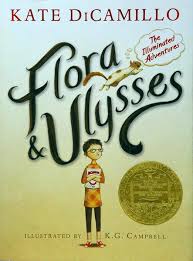
One day, as she browsed through books at the school library, she found a book with a beautiful cover of a girl wearing glasses and holding a comic book. When she saw it, she thought, “That girl looks like me!” She ran her fingers over the letters scrawled grandly across the cover and read the title aloud: Flora and Ulysses.

download

It was then that she noticed a small animal tucked up in the corner, which compelled her to read the back cover. As her eyes skimmed over the words describing a story about a squirrel who gets run over by a vacuum cleaner and strangely develops superpowers, she opened the book and began to read.

Before she knew it, the librarian was shouting a last call to check out books.  Daisy hurried to have her book scanned and joined the rest of the children lined up at the door to return to class. Ms. Wright, her teacher, walked up and down the line surveying the children’s choices. Every now and then she’d murmur things like, “Oh! Great author!” and “You’ll love this one.”  By the time Ms. Wright arrived at Daisy, she was nearly bursting with excitement.  Daisy couldn’t wait to tell her how she loved what she had read so far, and she longed to hear Ms. Wright say what a great choice she had made, choosing a book with a medal on the cover.

However, when Ms. Wright glanced at the book in Daisy’s hand, she looked between the book and Daisy and said, “Oh sweetheart, you’re going to need to return this book.”

Return this book?  Did she hear correctly? Confused, Daisy looked at her teacher who kneeled beside her, looked   her eyes, and said, “You’re a level R.  This book is much harder than that.  Run and put this back. You can choose something from the R bin when we get to the classroom.”

Crestfallen, Daisy handed the book back to the librarian. In her head, she kept hearing the echo of Flora’s voice speaking the same words she said when she witnessed Mrs. Tickham vacuum up the squirrel: Holy bagumba.

What was she going to read now?

Back in the classroom, Daisy dragged herself to the R bin and without even looking, grabbed the book that was on top.  She returned to her seat and muttered the title: Captain Underpants and the Attack of the Talking Toilets. Grudgingly, she began to read.

 Fellow teacher educators, I guess we still have much work to do… Be diligent. Our furture generations need you.

https://www.choiceliteracy.com/contributors-bio.php?id=11


Metaphors for Teaching Literacy

I (Cathy)  recently asked literacy teacher educators (LTEs) to complete this statement,  “Being a literacy teacher educator in the 21st century is like…”   As a researcher and teacher educator, I was profoundly struck by the power behind their words and the images they selected to represent them.   Before peeking at the three responses  provided below, consider how you might complete the statement.

Being a literacy teacher educator in the 21st century is like…

…“Green Eggs And Ham…it’s not what you expect, it’s a reciprocal journey, and you can’t just try it one way. Nothing tastes better than when you’ve seen them try it, like it, and beg for more!”

green eggs

“a futuristic video game – visually exciting, fast paced, limitless possibilities, not knowing what may be next, all the time wondering if you are going to be able to keep up!!”

.  Tron

…“keeping candles lit on a breezy night. Challenging but possible… delicate but powerful… romantic but necessary… not so much ‘constant work’ as it is diligent work… It requires focus and awareness of the ‘current’”.

 Candle in the wind

The literary representations of these three LTEs displayed a profound sense of excitement, overshadowed by trepidation as they enter an unknown territory, with unproven results.  The uncertainty and vulnerability of their roles were clear.  What do your words and image say about your views of teaching literacy in these fast changing and tumultuous times?


Intertwining Digital Technology Into Literacy Methods Courses

Pooja and I (Clare) did an analysis of 6 literacy teacher educators who truly intertwined digital technology into their literacy methods courses. (Book chapter will be published soon and we will post that info.) In the meantime I thought this chart might be useful for literacy teacher educators who are preparing for the upcoming school year.

Overall Goal: Teaching 2.0
Specific Goals Example
Make literacy classes participatory ·      Post comments on each other’s work (e.g., Wall Wisher, Text tagging, Voice Thread)

·      Post comments in asynchronous time

·      Provide student teachers with feedback on-line and encourage them to respond to the feedback

·      During class student teachers post questions or contribute comments to a shared space

·      Before class student teachers post comments about the readings

·      Create Wordles when analyzing a text

Create an infrastructure for accessing resources and for sharing resources ·      Develop a repository of resources on a university platform (e.g., Blackboard) or on their own website

·      Share books, videos, websites on a class Wiki

·      Use DT tools (e.g., Smartboard) to access info on the spot while teaching

·      Access materials/videos for use in teaching (e.g., Globe Theatre productions of Shakespearean plays)

Provide authentic learning experiences ·      Student teachers make an iMovie on a specific topic (e.g., on bullying)

·      Analyze videos student teachers created during their practice teaching

·      Skype with authors they are reading

·      Participate in teacher communities by contributing to blogs and Twitter feeds

·      Participate in teacher-focused events (e.g., contribute a piece to a BBC competition on current affairs/news)

·      Student teachers create podcasts on an aspect of literacy to share with broader community

·      Watch videos of authors they are reading (both scholarly articles and children’s literature)

·      Student teachers post photographs of themselves on the university platform as a way to introduce themselves to their classmates

Gain an understanding of the increasingly globalized nature of literacy

·      View videos from other countries (e.g., teachers in Japan) to see similarities and differences with their own context

·      Participate in world-wide teacher communities

·      Participate in crowd-sourcing

·      Share statistics on literacy beyond home country

·      Use visual representations (e.g., photographs) to move student teachers beyond their immediate world to unpack a range of issues (e.g., gender representation in children’s literature)

Reframe issues related to literacy and literacy teaching ·      Watch videos of teaching (exemplary or poor practice) and analyze them

·      Use videos from their practice teaching classes as “data” for their inquiry projects

·      Student teachers select a picture from a photo array and relate the action in the photograph to a theory they have been working on

Bridge practice teaching and the academic program ·      Reflect on practice teaching by sharing and analyzing photographs/videos they took

·      Use email and social media to remain connected during practice teaching and as a place for student teachers to ask questions or share concerns

·      Create a video case study of pupils which relates to a theory of literacy

We also created a graphic to capture the elements of their pedagogy:

Literacy Graphci

Their courses were fundamentally different because they had truly reconceptualized their teaching, not simply tinkering by adding glitzy DT; rather, they constructed highly participatory experiences that occurred before, during, and after the official 3-hour class. Learning occurred in multiple ways: readings, f2f discussions, online communities, viewing, analyzing, and providing feedback on texts which immersed student teachers into the issues of literacy. It went far beyond introducing “methods” to teach literacy; it was framed by learning to teach literacy as a global citizen. This ambitious goal was matched with unparalleled support by the professors. Their multimodal/technology-rich teaching practices modeled the possibilities available to teachers and students; however, they were constantly trying to balance preparing student teachers to address the traditional forms of literacy, which they will probably observe in schools, with more expansive understandings. They had not discarded typical elements of literacy methods courses such as teaching the writing process or components of a balanced literacy program.

Unlearning in Teacher Education

 Unlearned-640x199

As a literacy teacher educator, do you feel you spend a lot of time encouraging your student teachers to forget what they have previously learned?  Lortie (1975) refers to the perceptions of teaching our student teachers developed (as elementary and secondary school students) as an  “apprenticeship-of-observation”. Lortie suggests “education students have spent years assessing teachers and many enter training with strong perceptions based on firm identifications” and maintains that these strong perceptions affect student teachers’ “pedagogical decision-making”.  This makes unlearning as important as learning.  How do you get your student teachers to unlearn?

Lortie, D. C. (1975). Schoolteacher. Chicago, IL: Chicago University Press.


Practicing Situated Practice through Storytelling

As mentioned before, I (Cathy) am a committed supporter of  implementing a pedagogoy of mulitliteracies (New London Group, 1996) in the classroom.  There are many components to multiliteracies, but for this post I will highlight my use of  only one  component- situated practice.    The situated practice component suggests that pedagogy must consider “the affective and sociocultural needs and identities of all learners” (NLG, 1996, p. 85).  By the inclusion of  students’ “lifeworlds” or home-life and culture, a classroom environment is created where students feel secure and will take risks (NLG, 1996, p. 65).

In a recent storytelling workshop I delivered to ECE students (in a higher education setting), I was intrigued at how the significant situated practice became.   Prior to the class,  I asked the professor what cultures were represented, so I could reflect at least some of these cultures through my story selection.  The list was long, so I had to be selective.  I decided to tell a story from Jamaica, the US and one from India.  These represented not only a range of the participants’ cultures, but also a broad range of storytelling styles, which I thought might be useful for the students to see.   During the workshop I explained to the students that eventually being inclusive of all of the cultures and backgrounds represented in their classrooms  through the stories we tell (and books we read) was essential.  It was our responsibility to get to know our students and know what was important to them.  They agreed that this was important.  But I had a lot to learn about how important,  even when working with adults.

I knew how much the  participants  enjoyed and learned from the experience, as they were highly engaged during the workshop, but i was also treated to written feedback  as the  professor asked the students to post their critiques online.  The following comments caught my interest:

“The workshop really resonated with me… I learned about stance, gestures and facial expressions”

“I was amazed to see how storytelling could grab our attention”

“I am excited to step out of my comfort zone a little bit and try out these strategies with children”

My favourite was:

“I really enjoyed the ending of the workshop using the Urdu [story] “Ek thi Raja, ek thi Rani, doono margy khatm kahanni'” as Urdu is my mother tongue and I was able to understand this very famous [story].”

I did indeed end the workshop with a very short story in Urdu.  In case you do not understand Urdu, in this story there is a  king and a queen, they  die, so the story is over.   That’s it.  It is a traditional ending to a storytelling set.  I usually ask a participant to translate the story for the rest of the group.  Even though my Urdu is not the best, I can always tell who understood the story, because they are the only ones laughing.  Children  are usually delighted that I took the time and effort to be able to tell , regardless of how short,  a story from their culture.  But this small gesture never became more evident  to me than at the conclusion of this workshop.   I was approached by a woman wearing  a khimar (a long, cape-like veil that hangs down to just above the waist, but leaves the face clear).  The woman introduced herself and told me that she was most impressed that I told a story in Urdu.  She said she felt it made her Urdu speaking colleagues very happy.  She then asked me to do something I was not expecting.  “Would you”, she asked timidly, “consider sometimes ending your storytelling in Arabic?”  I smiled and immediately answered “of course, if you will teach me!”   She was delighted and proceed to teach me  the following traditional ending:

Touta touta.  Kelset el haa do tah.

This is now part of my repertoire.  I was never more convinced of how significant it is to honor the cultures of our students.   Young or older, it is their identity and they need us, their teachers, to validate this.  I will endeavor to enlarge my commitment to situated practice by sometimes speaking in Arabic for my students and hope my  students, whether ECE students, student teachers, or teacher educators will consider doing the same.

A New Dr. Seuss Book

I am looking forward to reading the recently released Dr. Seuss book entitled What Pet Should I Get? His widow Audrey discovered the manuscript and illustrations a few years ago, however, it is believed that Seuss originally created the work between 1958 and 1962. A New York Times review describes the book as “short and Seuss-ish” and “filled with creatures both real and zany.”  Another book to share with the student teachers in the primary division.

Link to the review:

http://www.nytimes.com/2015/07/20/books/review-what-pet-should-i-get-a-new-book-from-dr-seuss.html?_r=0

Bored? Try Mindfulness.

bored pic


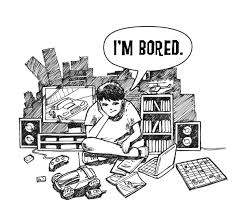
I (Cathy)  sometimes wonder if children  just need go outside and be part of nature.  Life isn’t just about about  being entertained.  In our society of things, gadgets and high tech, this is sometimes overlooked.   An experience can be  about being contemplation or just learning to listen or observe.  My high school visual arts teacher, Robert Bateman was gifted at encouraging us (his students) to practice this.  He would tell us to just go sit in a field an look at one thing and listen. Pay attention.  I think now this practice would be called “mindfulness”.  As teachers, as parents, do we do  encourage this?  Just a thought.

Blending old and new world literacies: Storytelling and Technology

I (Cathy) was recently asked to give a storytelling workshop for a third year Early Childhood Education Class. The professor felt the experience might broaden her students’ concept of literacy.   As a practitioner of multiliteracies (New London Group, 1996) I felt compelled to blend “old world literacy” which in this case would be storytelling (it is the oldest form of entertainment for our species), and new world literacy, which in this case was an online interactive learning system called Today’s Class.  (I have mentioned Today’s Class in an earlier post.  Today you get to hear how I put it into practice).

Initially, the students (a broad range of ethnicities, ages, and English language proficiencies) shared they had never previously experienced storytelling.  They had been read to and assumed this was the same thing.  Most admitted they had never heard of Todays’ Class either, but were game to give it try.  I warmed them up by delivering an old folktale (old world style, just me, them and their imaginations) which blew them away.  “I could see the story!”, and “I was captivated” were some of the responses.  The class was then arranged into small groups of three, each group having a lap top with access to the internet.  Each group was “invited” into the Today’s Class site and asked to give their group a “nick name”.  On the large screen at the front of the room, I posted questions about the storytelling experience for them to consider.  After some deliberation, the groups posted their responses, using only their nick names for identification.  I was intrigued by their reactions as the team responses popped up on the screen.  They were highly engaged.   I could have heard a pin drop they were so intent on reading the other groups’ answers.  When I used to do this kind of activity, the groups used chart paper and markers to record their answers and these were posted around the room.  I usually read out the answers because the printing was often not legible across the room.  Also, I often filtered what I read aloud, instantly deciding what the key points were and only sharing those.   However, with the big screen, it became each students’ responsibility to do the reading and the  filtering. The accountability and engagement levels were higher.

As we moved through the workshop, experiencing different forms of storytelling, the groups returned to conferencing at their computers, analyzing the responses and discussing the salient points.  Both my students and myself were delighted with the results.  Storytelling and technology were a perfect fit.  The students left with a much deeper understanding of an ancient literacy form, many vowing to use it in their child care centers, but also left with a much broader view of the usefulness of modern literacies.   Old and new world do blend.   I couldn’t help but wonder how Aesop might have felt about Today’s Meet.    I think he would have liked it.

New London Group. (1996) A pedagogy of multiliteracies: Designing social futures.  Harvard   Educational Review,1, 60-89.

https://todaysmeet.com/