Category Archives: classroom teachers

Let’s Not Forget About the Teachers

I (Clare) read this tribute to teachers in the Huffington Post. Lindsay Henry got it right. If you have a minute please send to this a teacher you know – I know that I would not be where I am today if it not for the many teachers who cared about me and worked tirelessly. I bolded a few lines in Henry’s original text.  http://www.huffingtonpost.com/lindsay-henry/this-ones-for-the-teacher_b_7555134.html

This One Is for the Teachers By: Lindsay Henry

It’s graduation season. A time where we focus our eyes and spotlights and applause on the students who successfully pushed through the exams, the essays, the sports games, the drama, to walk across a stage and receive that diploma. To graduate. Finally.

Whew.

So we celebrate. We honor the graduates with parties and families and photos and cake. Lots of cake (preferably with heaps of frosting and rosettes and plastic graduation caps.) We write “Congratulations” on cards and give “How to Succeed in the Real World” books and write “Top 10 Things I Learned When…” blog posts. Of course the graduates deserve the praise and recognition and celebrations and cake and blog posts.

But this post isn’t for the students.

This one’s for the teachers.

This one is for the teachers who stand in front of the students every day, writing on white boards and planning lessons and doing all they can to prepare youth for the rest of their lives. This one’s for the teachers who are full of nerves and anxiety on that first day of class in the fall, then bittersweet sadness as they say goodbye in the spring. The Silent Heroes who put in the work day in and day out, sometimes viewed as the antagonist by the students for assigning those group projects, required readings, difficult tests.

But teachers face their own tests, too. So this one’s for them.

This one is for the teachers who made it through another year full of hurdles. The long days and worrisome nights, the frustrated parents, the conferences. The detentions. The decisions. The reviews. The observations.

This one’s for the teachers that blur the lines because you care so much for these students, as if they are an extension of your own family. The ones that make sure the kids have full bellies and open minds. The ones that are the only constant in some of their students’ lives, filling the void as a caretaker or pseudo parent. The ones that use their own money to pour back into the classroom with materials and books and supplies.

This one’s for the teachers that are so much more than teachers. The ones that are fighters, advocators, listeners, healers, all to reach one more.

This one is for the hard days. The days that are long and the nights are longer, your mind racing and running. The days where teachers feels unsure of themselves, the ones that go home and wonder if they are making a difference, if the lessons are sticking, if they should just pack up the apples on their desks and stop trying.

You matter. The lessons stick. Trust me.

My high school days are long behind me, but the lessons live on and those who taught me. So this one’s for them, too.

This one’s for Mrs. Kochendorfer, my first-grade teacher at Patterson Elementary in St. Charles, Michigan, who’s proud, grinning face is still etched in my memory when I read her “The Rainbow Fish,” just a shy 6-year-old back then with Keds shoes and blunt bangs.

This one’s for Miss Bell, with her huge heart and booming voice shouting throughout my high school hallways: “Practice abstinence!” We laughed with her and loved her because she laughed and loved us first.

This one’s for Mr. Brownlie, with his easy-going manner and button-down shirts and soft-spoken voice. He retired this year, and his dedication and love for his students poured back to him as his former students created a hard covered book thick with pages full stories of how he impacted their lives.

This one’s for the future teachers, the college students in classrooms of their own right now, balancing the act of being a teacher and a student, observing and soaking it all in so they are ready to change lives.

Because that’s what teachers do. They do more than teach. They shape us. They lead us….until we reach the finish line and throw our caps into the hair, grinning at the idea of the future, unsure of what’s next.

But teachers know what’s next: another school year. And so they begin another season of preparation and books and lessons and worries centered around fresh faces sitting in desks.

In this season of mortar caps and gold tassels, Dr. Seuss and “Oh The Places You Go!” lines are repeated as we stare at the backs of the graduates running forward into the so-called real world. But let’s pause for a moment and thank the teachers that helped get them to this point. Because without them — sorry Dr. Seuss — we wouldn’t have a lot of places to go. We would all be a little lost.

Congratulations, students. And congratulations, teachers. You did it. All of you

What is your Munsch favorite?

Yesterday, Robert Munsch turned 70.  If you are not familiar with Robert’s work, he is one of the most famous children’s authors in North America.  Most of his books are delightfully lively and humorous.  Much like a comedian, he likes to take a simple, truthful situation in a child’s life and show the funny side to it. A delightful example of this is his book I Have to Go Pee, which depicts a child getting bundled into a snow suit and then announcing “I have to go pee!”.  His books usually unfold in a pattern that children love to anticipate and participation in.

Beyond his writing style, I love his telling style, as he is a storyteller in the true sense of the word.  He tells stories (like a performance)  and he is very good at it.  I (Cathy) have had the privilege of working with Bob (Robert is his “author” name) several times as I am also a storyteller.  He is a delight to work with. Bob’s background has always intrigued me.  He studied to become a Jesuit priest, but after working in orpahanages and daycare centers, he decided he would rather work with children. After graduating with his Masters in Education, he moved to Canada (he is American) and worked in the preschool at the university of Guelph.  That was where he started telling stories.  People encouraged him to submit the stories he told and he eventually got one published.  The rest, as they say, is history.

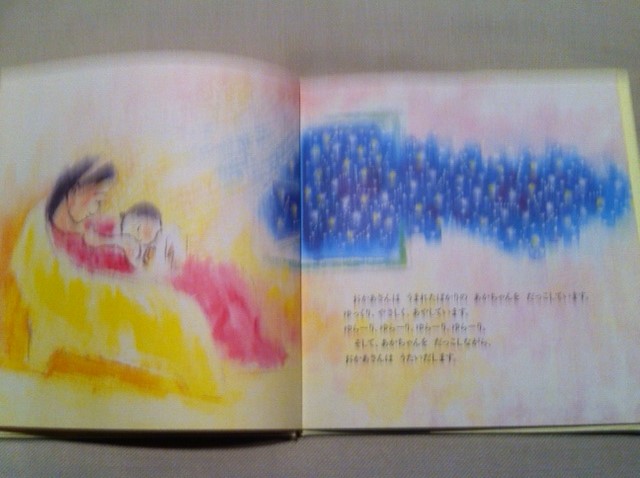
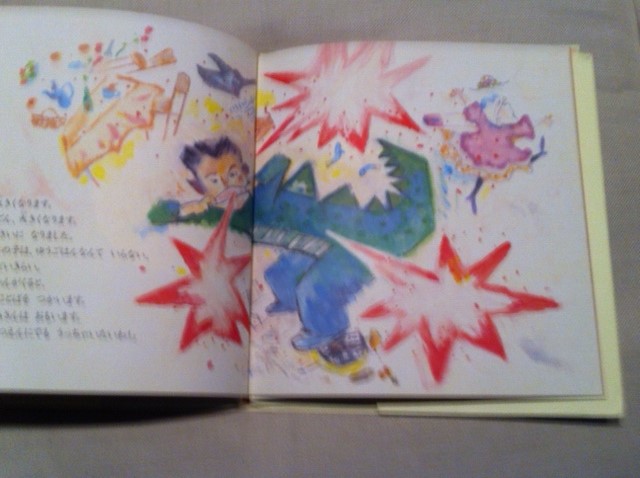
One of Munsch’s best-known books Love You Forever, was listed fourth on the 2001 Publishers Weekly All-Time Best selling Children’s Books selling 6,970,000 copies (not including the 1,049,000 hardcover copies).  In celebration of Bob’s birthday, the cbc  hosted a web page for Bob (link below) on which you can vote for your favorite Munsch book.  I suspect  Love You Forever  will win, as  I personally meet parent and educators worldwide that love that book.  I will also vote for Love You Forever but it is not the American version I love.  It is the Japanese version.  I once hosted an event in my home honoring a group of storytellers that came over from Japan.  Many Canadian storytellers and authors came to the event and, of course, Bob came too.  Graciously, these people gave away copies of their books as welcome gifts to Canada.  As there were about 15 Canadian tellers and authors, Bob just kind of blended in with the crowd, and I knew my foreign guests had no idea who he was or how well known he is.  That is-until they got home and Love You Forever was released in Japan, and became an enormous hit.  One of my guests sent me a copy of the Japanese version and a picture of her and two of her friends taken with Bob.  She was so excited and grateful to have met such an amazing/famous storyteller in person.  Bob, being Bob, would not have thought anything of it. He’s just that kind of person. Below are pictures of the book my guest sent me. I find the illustrations in this version tender and beautiful.  As Bob wrote this story in memory of one of his own children that passed away, I think the illustrations are most appropriate.   That’s my Munsch  favorite.  What’s yours? http://www.cbc.ca/books/munsch70/index.html !cid_E57F0443-35EB-47C7-8284-7385C00597B7!cid_B3FC11F1-450A-4314-8935-0DDC2310E39C!cid_8749C332-F0B7-4526-84F5-FB766894EA18!cid_B5F4DDF3-3F8F-48DE-81B7-B9F779472828

Teacher Image in the U.K.

uk

Gillian Harvey from The Telegraph argues for a shift in how teachers are viewed in the U.K. She argues:“[r]ather than heaping initiative upon initiative or effecting more change on a curriculum that is altered almost before it can be implemented, it would be better to take measures to improve the image of the profession as a whole.”

Harvey claims teachers fall victim to a culture of blame in education. Teachers are blamed for many things ranging from unprepared youth for the work force to a failure to raise standards. However, Harvey points out that the government officials often receive credit for perceived successes in education. She comments: “[y]ou can rest assured that the moment improvements happen, the praise will be placed at the doors of Nicky Morgan and David Cameron.”

In an era of educational reform driven by data, teachers are feeling pressure to do what it takes to have the data reflect their “effective” teaching. However, as result, pupils in the classroom may be suffering. Harvey says, “teachers are spending more and more time on meaningless bureaucracy and less on teaching and learning or interacting with pupils.”

An interesting read! To read the entire article click here: http://www.telegraph.co.uk/education/educationopinion/11645808/Does-teaching-have-an-image-problem.html

Intrigued by “The Farmerettes”

I (Cathy) attended a very interesting book launch recently at the Different Drummer Book Store in Burlington, Ontario.   Author, Gisela Tobien Sherman, (top left in photo) released her new book The Farmerettes.  The book was inspired by storyteller, poet, Sonja Dunn (bottom right of photo) who was a Farmerette.  At the book launch, the story of the inspiration for the book was shared.  Gisela, Sonja and a few other members of the  Canadian Society for Childrens’ Authors, Illustrators, and Performers (CANSCAIP) were having lunch together.  Sonja, now 84, (yeah, doesn’t look it!) shared one of her experiences as a Canadian Farmerette during the Second World War. Apparently during the war, with all the young men away fighting, there was not enough labor to work the farms, so teenage girls were rounded up and sent off to live on farms throughout the province.   Sonja, was one of these young women, boarded in a barn with five others.  They were taught and expected to carry out all  the heavy farm work on a daily basis.  Sonja talked about how the experience changed them.  Sonja’s story struck a chord with Gisela and she began to research this fascinating part of our history.

sonja dunn

At the book launch were three other Farmerettes (all in their 80’s), who looked quite pleased to have their stories told.  Plus, a fascinating collection of photographs,  depicting their lives during this era of Canadian history were displayed.  I was intrigued by the stories shared at the launch and deeply touched by the pride of the Farmerettes.  I bought several copies of the book to give away, and of course, one copy for myself.  Today, I will lay on my chaise lounge and treat myself to reading The Farmerettes, Second Story Press, by Gisela Tobien Sherman.  Can’t wait.

Reblogged: The Becoming Radical: Beware Grade-Level Reading and the Cult of Proficiency

I (Clare) am surprised/shocked/unsettled by the trend of  using levelled readers in classrooms. This is such a mechanistic way to approach reading. Yes we wants pupils to have success with reading but levelled readers have become the “diet” for many children. I found this article by Thomas really interesting. Here is the link: http://nepc.colorado.edu/blog/beware-grade-level-reading

Few issues in education seem more important or more universally embraced (from so-called progressive educators to right-wing politicians such as Jeb Bush) than the need to have all children reading on grade level—specifically by that magical third grade:

Five years ago, communities across the country formed a network aimed at getting more of their students reading proficiently by the end of 3rd grade. States, cities, counties, nonprofit organizations, and foundations in 168 communities, spread across 41 states and the District of Columbia, are now a part of that initiative, the Campaign for Grade-Level Reading.

However, advocating that all students must read at grade level—often defined as reading proficiency—rarely acknowledges the foundational problems with those goals: identifying text by a formula claiming “grade level” and then identifying children as readers by association with those readability formulas.

This text, some claim, is a fifth-grade text, and thus children who can “read” that text independently are at the fifth-grade reading level.

While all this seems quite scientific and manageable, I must call hokum—the sort of technocratic hokum that daily ruins children as readers, under-prepares children as literate and autonomous humans, and further erodes literacy as mostly testable literacy.

So who does this grade-level reading and proficiency benefit?

First, lets consider what anyone means by “reading.” For the sake of discussion, this is oversimplified, but I think, not distorting to the point of misleading. Reading may be essentially decoding, pronouncing words, phrases, and clauses with enough fluency to give the impression of understanding. Reading may be comprehension, strategies and then behaviors or artifacts by a reader that mostly represent (usually in different and fewer words) an accurate or mostly accurate, but unqualified, restating of the original text.

But reading may also (I would add should) be critical literacy, the investigating of text that moves beyond comprehension and places both text and “meaning” in the dynamic of reader, writer, and text (Rosenblatt) as well as how that text is bound by issues of power while also working against the boundaries of power, history, and the limitations of language.

In that framing, then, grade-level reading and proficiency are trapped mostly at decoding and comprehension, promoting the argument that all meaning is in the text only (a shared but anemic claim of New Criticism).

This narrow and inadequate view of text and reading (and readers) serves authoritarian approaches to teaching and mechanistic structures of testing, and more broadly, reducing text and reading to mere technical matters serves mostly goals of surveillance and control.

Consider first the allure of formula that masks the arbitrary nature of formula. Plug “The Red Wheelbarrow” by William Carlos Williams into a readability calculator—first in its poetic format of lines and stanzas, and then as a grammatical sentence.

As a poem, apparently, the text is about 4th grade, but as a sentence, nearly 9th grade.

The problem is that readability formulas and claims of “grade level” are entirely the function of the limitations of math (the necessity to quantify and then the byproduct of honoring only that which can be quantified)—counting word syllables, number of words in sentences.

Reducing text to numbers, reducing students to numbers—both perpetuate a static and thus false view of text and reading. “Meaning” is not static, but temporal, shifting, and more discourse or debate than pronouncement.

“The Red Wheelbarrow” is really “easy” to read, both aloud and to comprehend. But readability formulas address nothing about genre or form, nothing about the rich intent of the writer (for example, poetry often presents only a small fraction of the larger context), nothing about all that that various readers bring to the text.

And to the last point, when we confront reading on grade level or reading proficiency, we must begin to unpack how and why any reader is investigating a text.

As I have detailed, we can take a children’s picture book—which by all technical matters is at primary or elementary grade levels—and add complex lenses of analysis, rendering the same text extremely complex—with a meaning that is expanding instead of static and singular.

Text complexity, readers’ grade level, and concurrent hokum such as months or years of learning are the grand distractions of technocrats: “it is a tale/Told by an idiot, full of sound and fury,/Signifying nothing” (The Tragedy of Macbeth, 5, 5).

Grand pronouncements about grade-level reading and proficiency, then, benefit politicians, textbook companies, and the exploding testing industry. But not children, not literacy, and not democracy.

Leveled books, labeled children, and warped education policy (grade retention based on high-stakes testing) destroy reading and the children advocates claim to be serving.

Thus, alas, there is simply no reading crisis and no urgency to have students on grade level, by third or any grade.

The cult of proficiency and grade-level reading is simply the lingering “cult of efficiency” that plagues formal education in the U.S.—quantification for quantification’s sake, children and literacy be damned.

Voices Into Action

My (Clare) friend David Booth introduced me to an amazing program, Voices into Action, which helps students develop their David Booth social awareness.
Voices into Action is an online resource dedicated to providing students with access to information on issues regarding human rights, prejudice, and hatred. Designed by curriculum experts, this program utilizes a wide variety of media to present compelling information on a history of human suffering, stemming from social injustice that is still a problem today. This site will give you the knowledge and tools to speak out, and to go even further by turning your voice into action!
I have looked through some of the resources and they are fantastic – discussion questions, videos, news analysis, case studies, in-person interviews ….. There are 6 units available: human rights; genocide, understanding prejudice and discrimination, immigration; and personal action. All teachers I am confident will find these resources so useful. Here is the link: http://www.voicesintoaction.ca/Home

Larry SwartzFYI – Larry Swartz my dear friend is one of the Project Managers of Voices into Action. From my experience any project that Larry works on is outstanding!

SAMR: Bloom’s Taxonomy for technology education

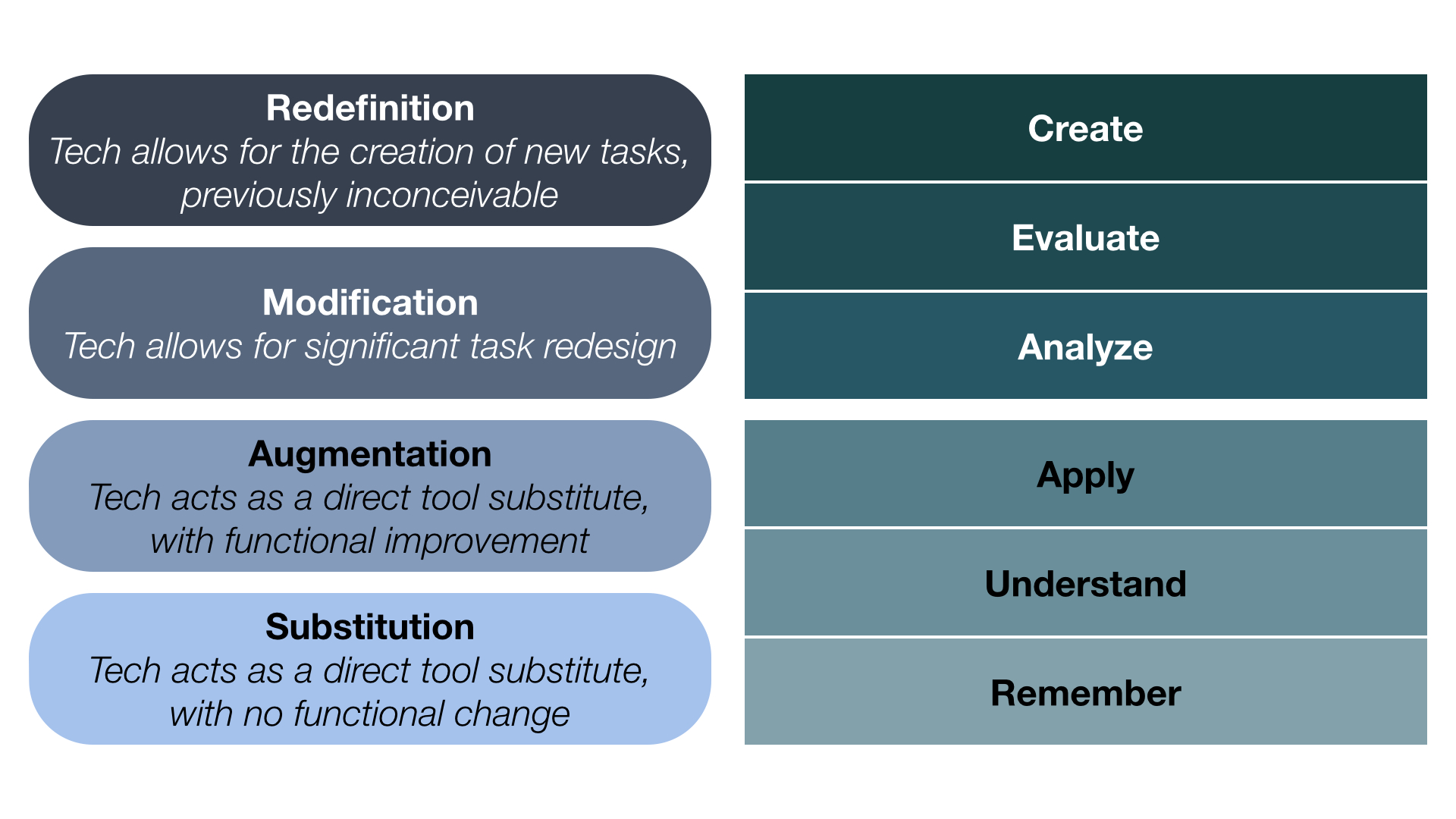
Dr. Ruben Puentedura developed the SAMR model as a way for teachers to evaluate how they are incorporating technology into their classroom practice.  Puentedura constructed his model in the form of a ladder and equates it with a student climbing the cognitive scale associated with Bloom’s Taxonomy.  (i.e. as a task moves from lower to upper levels of Bloom’s taxonomy, so does a task move from lower to upper levels of SAMR).

Below is a comparison of Bloom’s and SAMR:

diagram-puentedura

Puentedura’s model encourages educators to ask themselves if the student task is an act of substitution, augmentation, modification, or redefinition? The suggested threshold for moving from enhancing learning to transforming learning is between augmentation and modification.  As an example of this, consider a student writing a paper.  If the student writes the paper on a computer instead of on a piece of paper, this is an act of substitution.  If the student uses spell check and a formatting tool to assist with the writing process, this is augmentation as there is a slight change in the functional improvement.  Should the student publish the paper, perhaps on a wiki, blog site or through google docs, so other students can read it and give feedback, this is a modification of the process, for it now includes collaboration.  Lastly, in redefinition entirely new tasks are created which were inconceivable without computers and computer software tools.  In this level student transform their written stories into media productions using storyboards, filmed scenes and music.  Students can also publish these and receive feedback on the work.  In this level technology has redefined the task.

Working towards redefinition, is of course the goal for teachers who would like his/her students to be working in the highest thinking levels possible while using technology.

A short video introducing the SAMR model can be found at:                        https://www.commonsensemedia.org/videos/introduction-to-the-samr-model


Moving From Outsiders to Insiders: Working With a Teacher Research Group

I (Clare) have been involved in a teacher researcher group for the last 2 years. Along with Pooja and Shelley (regular IMG_2508contributors to this blog and pictured to the left) we have facilitated  a group in a secondary school. The work the teachers have done is outstanding! The three of us facilitators did a self-study of our work with this group. Since we did not know the teachers beforehand which was a bit unnerving we felt it was good to study our work. We now feel very much part of the group and feel we have become a learning community. We are presenting on our work with the teacher researcher group at AERA. Here is a draft of the paper Moving From Outsiders to Insiders: Working With a Teacher Research Group. It is still in “draft” form but if you are interested in teachers as researchers you might find this paper useful because we talk about logistics, identity, forming a community, and our learning. AERA 2015 EurekaPaperFinal

For those of you who read this blog and are at AERA I hope our paths cross.

Science Guy Becomes a Literacy Guy: Guest Post by Jason Gregor

In my (Clare) literacy grad course this past semester I had a group of amazing students — smart, experienced, caring, Jason Gregorthoughtful, and inquisitive. They were truly a joy! One of the students named us the Literacy Community. For the final product for the course the students were encouraged to do “something” meaningful for them and they could use any modality they wanted. One of the students Jason Gregor did an amazing paper which traces his journey from being a science enthusiast who did not value literacy to a strong advocate for literacy. His paper was so insightful I asked him if I could post in on our blog because those of us in teacher ed will relate to folks like Jason who slowly come to realize the place of literacy in teaching. Thanks Jason for letting me share your paper with the broader education community. Below is an excerpt from the paper and here is the link for the entire paper. Enjoy! JasonEssay

Why literacy is so important

 I never truly understood the hype around literacy. It seemed to be the biggest thing in the education system. As someone who did not like English very much and was much more focused on science, I felt that it kind of got all the limelight. Now however, I realize that I was wrong. I was dead wrong. While recently working on my final project of graduate school (I’m done much to my chagrin!) I took the opportunity to reflect on my experiences with literacy and how they have shaped the way that I viewed it (in a much skewed way). Thanks to Dr. Clare Kosnik and the two classes I took with her though, I have found that I was very wrong. Literacy is the most important area for education. Without literacy, you’ve got nothing! For this reason, I have become much more engaged with literacy education and feel very strongly towards it. Sure science is important, but without literacy, well, you wouldn’t be reading this right now! So, moral of the story, even the most disengaged, no matter what level they are at, be it student or teacher, can be motivated to re-engage with literacy. It’s never too late. Take it from me, I’ve been there.