Category Archives: classroom teachers

Reflection on My Teacher Education Program

I (Clare) am currently teaching a graduate course Current Issues in Teacher Education. The first assignment asks students to:

Write a reflection paper on your experiences in a professional program (teacher education, Teaching English as a Second Language ….). Provide a very brief description of the program. Some questions to consider are: What were the strengths/weaknesses of the program? How well did the program prepare you to assume the duties of a teacher? What were the limitations of the program? Have your views of the program changed since graduation? How could the program have been improved? Did the program prepare you to assume the duties of a teacher (or other position)? Do NOT respond to all of these questions. Select one or two and respond to them. In the fourth class of the course, you will work in small groups and share your paper with your fellow students.

Since all of the students in the course are teachers they have a good perspective on their program. Their assignments were so stellar I felt these would be of great value to share with other teacher educators. Over the next few weeks I will be sharing these papers. I learned much and I suspect you will too. I have changed the name of the university so that no school of education is identified.

In June 2011, I graduated from a 2 year Teacher Education Program at the YYY University. Freshly hired by two boards, I felt both the nervous anticipation of one traversing into uncharted waters and the confidence of one for whom the world had suddenly opened. I believed I was entirely prepared. In many ways, I was as prepared as possible after two years of training; there will always be aspects of my chosen profession that can only be learned through experience (for who could ever predict all the potential dilemmas and baffling questions raised by students, colleagues, or parents over a lifetime of teaching?). As a future teacher-educator, I can reflect in retrospect on some programming changes that may have augmented the skills and knowledge I carried with me into my first year of teaching.

Designed to Meet Current Needs

I have many accolades for my two-year teacher education program. The XXX Program was well-designed, with a clear vision to produce teachers who were reflective practitioners. To accomplish this, it had a well-balanced, thoughtful curriculum which seemed to have an equal basis in academic readings, instruction in pedagogy and learning development, courses in Ontario Curriculum subject areas, and four practice teaching blocks. Professors treated student teachers with respect and showed genuine interest for our ideas and experiences. They also drew on their own examples from time in the classroom and did not seem removed from current issues in education.

Over and above our regular courses, we could attend workshops which addressed other current educational needs, such as how to teach to English Language Learners; community-building through TRIBES; and technology in-services. The program also offered the opportunity of conducting our own Master’s Research Project, without which I would not have had the confidence to consider pursuing further graduate studies.

In addition to courses in the various subject areas of the Ontario Curriculum, the XXX Program also had a phenomenal Special Education and Adaptive Instruction course that taught me concepts and strategies I use on a daily basis in my own classroom. Having talked with many colleagues who did not have any special education training in their pre-service training, I feel this was a major boon to the XXX Program. Every teacher will encounter students who learn in different ways and will need to know how to accommodate or modify as needed.

While I have no criticisms of this course, it could easily be extended to two years, to incorporate a greater understanding of the multitude of needs teachers have to support in the classroom. A longer course may also have allowed for more detailed instruction in Individual Education Plans, which all teachers will need to write and should receive training to do so (though many of my classmates and I accomplished this by taking a Special Education Part 1 Additional Qualification offered to us at the end of the program). Then as now, I was proud to be a part of a program that saw special education as an integral part of a pre-service program design. As I return to University YYY in pursuit of my doctorate, I feel discouraged to see no courses available in this important field.

Multiple Placement Opportunities

The XXX Program offered four placements to teacher candidates, which allowed me to observe and practice my burgeoning teaching skills in different settings. Perhaps naively, I hoped I would see the innovative strategies, clear assessment criteria, and classroom community-building I was reading about play out in front of me, but that was not always the case. I was very fortunate that my first Associate Teacher (AT) was exemplary. Not only was she the only AT to teach me how to do assessments, I will never forget watching her teach a lesson that did not go as expected. She turned to me and said, “ZZZ, that’s what happens when a lesson fails. It happens to everyone and it will happen to you. Sometimes, a lesson just won’t work, no matter how much you’ve prepared. Don’t take it personally; just plan it a different way tomorrow.” Of all my practicum experiences, that day had the greatest impact on me. Had she not uttered those words, I might have been afraid to plan creative lessons and to try new approaches; and any failure may have felt like a reflection on my ability. My other practice teaching blocks did not leave the same impression on me; yet I made the most of each and asked to teach up to one-hundred percent of the time, so I could try, and fail, and reflect, and try again, open to as much or as little input as my ATs were willing to give me.

Solely by chance, I was matched with one particular teacher who instilled in me such a significant lesson. While I recognize the ethical murkiness of having a mechanism for screening possible ATs, it is critical that student teachers have the chance to observe and participate in classrooms where teachers are masters of their craft. Every teacher candidate should have the opportunity to learn from an exemplary mentor (and hopefully four). Potential ATs should be screened and offered professional development in being an effective mentor (for example, debriefing with the candidate about their lesson designs and the thought process behind each pedagogical choice, of which the student teacher may be unaware). These powerful examples should show teacher candidates not only best practices but help them to envision the potential of teaching, rather than a reiteration of the rote learning they may have experienced as students going through the system. How can any new teacher feel confident to incorporate more current pedagogical concepts into their classroom without the chance to observe in practice? I consider myself lucky that I had one such placement.

An Enhanced Education

Like most things in life, the XXX Program was what one made of it. For a tenacious person like me, it met my needs beautifully. When I encountered an assignment I felt would be too similar to another, I asked the instructor if I could do it a different way (I even wrote a play exploring educational issues for a course, rather than write another reflection). When I was determined to have a placement in a classroom for children with Autism, I found the classroom and set up the placement myself, politely self-advocating with the placement coordinator. Later, I requested and received an intermediate placement, even though I was primary-junior, because one future goal was to acquire an additional qualification in that level. Throughout my time in the program, I ensured I had opportunities that were in line with my professional goals. Many of my classmates did not know they could be proactive, and went with the flow instead. They often grumbled about assignments they did not like or placements that were not what they wanted.

I wonder whether their experience would have been improved if we had had a pro-seminar course, similar to the one in the PhD program. Such a course could walk student teachers through the program itself, but it could also help students to identify their educational goals and be assertive in taking ownership for their learning; and it could shed light on the behind-the-scenes of teaching that pre-service programs do not have time to teach, such as how to manage difficult conversations with parents, principals, and colleagues. The kids are easy; for me, dealing with the politics of other adults is definitely the hardest part of teaching.

An Emphasis on Personal & Teacher Identities

Unlike other programs, the XXX Program did not gloss over the many realities of being a teacher. My classmates and I had courses where we created our resumes and practiced interview skills; we learned about educational law and the higher standard to which teachers are held (causing us all, no doubt, to secure our Facebook settings). My instructors emphasized work-life balance, and at the time, I believed I could imagine the many long hours and the sheer emotional and physical exhaustion I would later experience. Little did I know then the extent of it; two years ago I decided to adopt my dear cat Gerrie, to help me have something besides my students’ troubles to focus on when I got home! Without those words of encouragement (and reality) from my XX teacher-educators, I may have felt I was not cut out to be a teacher, on one of those difficult days (and thank goodness for Gerrie!).

For me, the XXX Program instilled in me a mindset. One of the most invaluable concepts taught was the importance of developing a teacher identity. By the end of the program, I came to envision myself as a compassionate and reflective practitioner, who believed that all students could succeed if given the chance and supports needed. As an educator today, this identity functions as my North Star, informing all my choices and interactions, to the best of my ability.

All of our courses taught the importance of community and challenged us to collaborate and share insights and strategies. My preference before the XXX Program was to work alone; today, collaboration is the key to my success with students, as I draw on the knowledge of other teachers, parents, and a multi-disciplinary team of psychologists, speech-language pathologists, and social workers, to name a few. I spend hours every week talking with my classroom partner, an incredible child and youth worker, about what worked, what failed to work, what we observed and learned about each student, and what steps to take next for each child going forward. I cannot imagine teaching any other way.

Some Concluding Thoughts

Teacher education programs provide the compass for beginning teachers. While I am satisfied with all that I learned in the XXX Program, I also recognize it is impossible to equip beginning teachers with every tool they will ever need for their journey. Teachers continually adapt to the ebb and flow as children come and go, new policies replace old, curriculum evolves, technology changes, and so on. So too, teacher education needs to reflect the current buzzwords and the shifting seas of the classroom. While teacher education programs are obliged to teach standard subjects, they also should to be flexible enough to address individual needs; teacher candidates may expect different levels of support to map out their professional goals. At present, more attention must be given to special education in teacher education, as general education teachers take on more responsibilities for exceptional students every day and often report feeling unprepared in my discussions with them. Practicum classrooms must be carefully selected to showcase best practices, in order to expose the teacher candidate to new horizons, leaving the bleak landscape of skill and drill classrooms behind them. Perhaps most importantly, teacher educators must allow students to explore and reconceptualise what it means to be a teacher and the qualities they wish to bring to this profession. Without these elements in the XXX Program, I would not have been ready to venture off into those uncharted waters in June 2011.


Caring through Social Media

Recently, a friend of mine (Cathy) started blog site (using blogspot.com) for a colleague that is being treated for cancer.  It is called Art for Adrienne (pseudonym).   This is a use of social media I had not encountered until now.  As an invited participant, I am encouraged to contribute artifacts of anything in my everyday life that strikes me as artistic and/or meaningful:  photos, quotes, poetry (found or created) film clips, pod casts, youtube videos, snippets of conversations, photos from trips, art projects, family stories, ect.  I love to look at the posts.  They are a brilliant demonstration of insight, caring, beauty, humor, wit, meaning, and joy.  The variations are enormous.  Some posts are long, some complicated, some simply a thought or a word.

Occasionally our stricken colleague comments, but that is not expected.  We know she is weak and tired.  The purpose of the blog is to let her know she is on our minds.  Unlike flowers, the posts never wilt, and the “visits” are not taxing on her. She chooses when to go on the site, day or night.  Her few comments indicate she loves the site.  With permission, I am sharing some of the posts below:

Dear Adrienne, Greetings again from my beach in Nicaragua.  I’ve embarked on an art project I thought you might like.  Before I left, I was given candles that look like pebbles.  I brought them with me.  I have been photographing them at dawn and dusk.  I hope you like them.  Sam

candle experiement 6candle in hand 5candle in driftwood


Hi Adrienne, we have arrived in Corsica , France.  It’s beautiful here.  Thinking of you.  Jason

cave for Adelle


Dear Adrienne,

One of my friends that I met in Banff hosted a “Visioning Board Party” recently. 

The idea was to collage a collection of images that speak to what you vision for your future. Some people choose very literally, some people just choose images that attracted them without too much interpretation in the process and then they looked at the final product for meaning. I ripped out enough images to cover at least three big bristol board pages and so had much to select from when filling up just one. 

Here is what I created. What do you see in my vision?

Hugs, Nicky

big pic

Do you have a stricken or needy friend (with internet access) who may benefit from such a blog?  It costs nothing to set up, but may have very meaningful results.

Secret Teacher

The Guardian has an ongoing column titled Secret Teacher. It is a series of blogs by anonymous teacher-insiders revealing what really goes on in schools. This week the anonymous contributor wrote a short yet powerful piece on returning to the classroom after years in administration and remembering how tough  teaching is. An excerpt from the essay on the contributor’s move from admin back into the classroom:

I was certain that my move would buy me more time; no more endless piles of admin, no more mind-numbing meetings until 7pm, no more grim governors’ reports to write, no more dour disciplinary panels to attend. But I had forgotten that the windows in the ivory tower are obscured by pot plants so tall that you can’t see the stressed faces of the teachers as they race past. If you do chance to look up from your paperwork, your rose-tinted glasses made their lives look quite romantic. Oh, how the students adored them! How much fun they had together in their teams! I remembered those days …

I had forgotten that my multitudinous leadership tasks were generously accommodated by my timetable. Yes, I had a lot to do, but I was given a lot of time to do it. How did I forget that it’s impossible to plan adequate lessons in five non-contact periods a week? How did I forget that as I reluctantly sat in meetings, angry that I had failed to see any daylight for the majority of winter, my main-scale colleagues were marking and planning in their classrooms or at their dining tables? How did I think that I had it harder than them?

To read this essay or others from the Secret Teacher series, click here: http://www.theguardian.com/teacher-network/2015/oct/17/secret-teacher-school-leaders-quickly-forget-how-tough-teaching-is

How Self- Selected is Self -Selected Reading?

I (Cathy)  was touched by the following tale shared by guest bloggers Burkins and Yaris (Think Tank for 21st Century Literacy) on Brenda Power’s Choice Literacy blog site.  The post is titled, The Tyranny of Levels. It reminded me of the time I was visiting a classroom to observe my student teacher and saw two bins labelled Boy’s Books and Girl’s Books.  When I inquired about the bins, my student teacher assured me the children never dared choose from “the wrong bin.”  I was mortified.  Thankfully my student teacher also was mortified.  After that experience, the tale below did not seem very far fetched…

Daisy: A Cautionary Tale

Once upon a time, there was a third-grade girl, Daisy, who loved to read. She read all the time. While she liked to read about horses and outer space, she especially loved to read stories. She had read every single Magic Tree House, Junie B. Jones, and Amber Brown book ever written.  Recently, she had been into reading books about animals, and had devoured Shiloh and Charlotte’s Web.

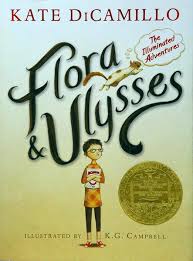
One day, as she browsed through books at the school library, she found a book with a beautiful cover of a girl wearing glasses and holding a comic book. When she saw it, she thought, “That girl looks like me!” She ran her fingers over the letters scrawled grandly across the cover and read the title aloud: Flora and Ulysses.

download

It was then that she noticed a small animal tucked up in the corner, which compelled her to read the back cover. As her eyes skimmed over the words describing a story about a squirrel who gets run over by a vacuum cleaner and strangely develops superpowers, she opened the book and began to read.

Before she knew it, the librarian was shouting a last call to check out books.  Daisy hurried to have her book scanned and joined the rest of the children lined up at the door to return to class. Ms. Wright, her teacher, walked up and down the line surveying the children’s choices. Every now and then she’d murmur things like, “Oh! Great author!” and “You’ll love this one.”  By the time Ms. Wright arrived at Daisy, she was nearly bursting with excitement.  Daisy couldn’t wait to tell her how she loved what she had read so far, and she longed to hear Ms. Wright say what a great choice she had made, choosing a book with a medal on the cover.

However, when Ms. Wright glanced at the book in Daisy’s hand, she looked between the book and Daisy and said, “Oh sweetheart, you’re going to need to return this book.”

Return this book?  Did she hear correctly? Confused, Daisy looked at her teacher who kneeled beside her, looked   her eyes, and said, “You’re a level R.  This book is much harder than that.  Run and put this back. You can choose something from the R bin when we get to the classroom.”

Crestfallen, Daisy handed the book back to the librarian. In her head, she kept hearing the echo of Flora’s voice speaking the same words she said when she witnessed Mrs. Tickham vacuum up the squirrel: Holy bagumba.

What was she going to read now?

Back in the classroom, Daisy dragged herself to the R bin and without even looking, grabbed the book that was on top.  She returned to her seat and muttered the title: Captain Underpants and the Attack of the Talking Toilets. Grudgingly, she began to read.

 Fellow teacher educators, I guess we still have much work to do… Be diligent. Our furture generations need you.

https://www.choiceliteracy.com/contributors-bio.php?id=11


Happy Teachers’ Day

I (Clare) know that many of the readers of our blog are teachers — whether in primary/secondary schools or in phone1higher education. October 5th is World Teachers’ Day. I found the articles below which I thought I would share with you.
Happy Teachers’ Day!

IMG_0038October 5 is World Teachers’ Day, a global opportunity to show appreciation for the meaningful roles teachers play in our education and lives. Celebrate World Teachers’ Day by finding an event near you (or creating your own!), sending an e-card to an inspirational teacher in your life, or sharing pictures, stories, or links with the hashtag #worldteachersday on social media. Thanks to all the educators who have inspired us and who continue to enrich the world by sparking their students’ passion for learning. For more celebratory stories, read on!
I found this inspirational letter to a teacher which I want to share with you. http://www.literacyworldwide.org/blog/literacy-daily/2013/12/04/a-love-letter-to-teachers?utm_source=TW-09292015&utm_medium=email&utm_campaign=ThisWeek&utm_content=Story-1

To Those Who Give It Their All on a Daily Basis:
Let me start by saying thank you. Thank you for showing up each and every day, not just on holidays, and giving it your all. You are magnificent and deserve a moment to celebrate YOU.
Being a teacher, particularly a teacher of reading, means sharing so much of yourself in addition to your knowledge of strategies, letter sounds, and authors. As teachers of reading, you help breathe life and joy into books during a time in education when learning can too often and too quickly become rote and lifeless. You celebrate student success and embrace their frustrations, pushing them gently to overcome obstacles that feel insurmountable in the moment. You constantly doubt yourself, wondering if you are doing enough, planning enough, reaching your students enough. But it is that doubt and self-reflection that makes you a better and stronger teacher who is able to give it your all.
You give it your all in terms of your instruction, and you also consistently give of yourself. You share your reading life and preferences with your students. You share your students’ favorite authors and books as well as their struggles when encountering an unfamiliar and challenging text. Being a teacher of reading does not just mean giving students access to instructional best practices, it means giving students some insight into who you are as a reader, a teacher, and a person.
All too often, I hear “rigorous practice” separated from discussions of “fun” activities. Yet so many of you strive every day to reconnect “fun” with “rigor” by coming up with new ways to engage your students with difficult concepts and texts. This type of instructional savvy doesn’t just happen, nor is it inherent in every curriculum. It comes from teachers who give it their all, just like our friend Pete the Cat.
So know that at least one person out there knows how hard your job is and how much of yourself you give to your students every day.
Happy Holidays!
xoxo,
Mrs. Mimi
Mrs. Mimi is a pseudonymous teacher who taught both first and second grades at a public elementary school in New York City. She’s the author of IT’S NOT ALL FLOWERS AND SAUSAGES: MY ADVENTURES IN SECOND GRADE, which sprung from her popular blog of the same name. Mimi also has her doctorate in education from Teachers College, Columbia University.

For more info on World Teachers’ Day check out the UNESCO site: UNESCO http://www.unesco.org/new/en/unesco/events/prizes-and-celebrations/celebrations/international-days/world-teachersday-2015#.VgqU1M4XqHl

Findings from a Study on Knowledge Building

Richard Messina who is the Principal of the Jackman Institute of Child Studies is the co-author of the article: Fostering sustained idea improvement with principle-based knowledge building analytic tools by Huang-Yao Hong, Marlene Scardamalia, Richard Messina, Chew Lee Teo

I (Clare) thought this might be of interest to you because of the extensive use of knowledge building tools. Here is the abstract:

The purpose of this study is to explore the use of principle-based analytic tools to improve community knowledge building in a class of Grade 5/6 students. A flexible design framework was used to engage students in use of three analytic tools a Vocabulary Analyzer, a Social Network Tool, and a Semantic Overlap Tool. These tools are built into Knowledge Forum technology so principle-based assessment is integral to knowledge work. The primary source of data was discourse generated by students in Knowledge Forum over a school semester (approximately four months). Findings based on a mixed methods analysis reveal principle-based knowledge building analytic tools to be effective in increasing the frequency with which key terms are used by individuals, in their own productive vocabulary as well as in the shared community space, thus creating a more discursively connected community. Results additionally show a shift from problem generation and breadth of inquiry to increased self-assessment, reflection, and depth of inquiry; also, students report significant ways in which knowledge building analytic tools can increase knowledge building capacity.

Here is a link to the article: Huang-Yao article[1]

In lab schools, learning in classrooms benefits students and researchers

In lab schools, learning in classrooms benefits students and researcher

In the Globe and Mail, our national newspaper in Canada, David Israelson wrote an article on the Jackman Institute of Education. I (Clare) found it captured the spirit of ICS. It would be great if every child could have an education like ICS. http://www.theglobeandmail.com/news/national/education/in-lab-schools-learning-in-classrooms-benefits-students-and-researchers/article26498016/

Six-year-old Sophia Salamon and her nine-year-old sister Anna are being watched.ICS

The Salamon sisters, in Grade 1 and Grade 4, respectively, are part of a bigger learning experience. Their school is the Dr. Eric Jackman Institute of Child Study Laboratory School, at the University of Toronto, where educators study how children learn by using the school’s classes as living models.

“When we looked up the school, we thought it sounded fantastic,” says Tracy Pryce, Anna and Sophia’s mother and a student at the University of Toronto.

“It’s in line with our educational philosophy. I compare it with my own experience when I went to school. Seeing my kids and what they’re getting from what they’re learning is such a difference from what I feel I had as a child.”

At a laboratory, or lab school, there are almost always visitors in the classroom, says Jackman’s principal Richard Messina. He laughs at the idea of his school’s 200 students being the educational equivalent of lab rats.

“It does conjure up images of mazes and exercise wheels,” he admits, “but our children become quite desensitized to having adults in the room.”

In September, for example, the school, which runs classes from nursery to Grade 6, was visited by a delegation of 24 educators from Kobe, Japan. “We have had 700 and 1,000 visitors per year,” says Principal Messina. “The children just continue with whatever they are working on and they’re used to speaking with adults about learning.”

The concept of a lab school comes from the work of educator and philosopher John Dewey, who set up the first lab school in Chicago in 1896. Prof. Dewey believed that the best way to train teachers was to have them teach and to accumulate new research and knowledge directly from the classroom.

The Jackman lab school, a few blocks from the U of T’s main downtown campus, is one of only a handful of schools of this type in North America.

The best-known lab schools in the United States are at Columbia University in New York and the original at the University of Chicago.

“Just as the physics department or the chemistry department have labs, the education department has a lab,” Mr. Messina says.

Being a lab school fulfills three functions, he adds. It produces research that can be applied to public education, it’s a forum for teachers to further their knowledge, and “we provide exemplary education to the children we are fortunate to have with us.”

“I feel very fortunate that we’re there,” Ms. Pryce says. There are 22 children in each class – half boys, half girls – and the school is committed to diversity.

To help ensure diversity in its enrolment, 13 per cent of the students receive tuition support, Mr. Messina says.

In addition to its teachers, each classroom has two Masters of Education students who are pursuing two years of graduate work while teaching.

“Almost all teachers in the school are involved in research that’s going on in their classroom,” says Julia Murray, a Grade 5-6 teacher at the school who is now on maternity leave and did her Masters at the Institute several years ago.

“The research going on is often cutting edge, and it’s about best practices in education,” she adds.

For example, Mr. Messina says scholars are researching the emerging concept of brain plasticity: “Think of the brain as a muscle that can be developed, metaphorically, so that errors should not be considered embarrassing but a natural and necessary part of learning.”

The Jackman lab school was also one of the major providers of research for developing play-based kindergarten programs and full-day kindergarten, he adds.

Ms. Pryce says she likes the school’s inquiry-based learning approach – encouraging her children’s natural inquisitiveness while maintaining classroom structure.

“There’s a strong philosophy of teaching children to ask questions, not for children to get information but to develop their own theories,” she says.

“It’s a secure environment socially, mentally, intellectually so they develop the confidence to speak out.

“The benefits for my children have really been clear.”

The school has a waiting list that parents sign up for when their children are born, he says. “We seem to draw applications through word of mouth. Many people seem to know about us even though we don’t advertise,” Mr. Messina says. Jackman evaluates its programs to make sure that students are being well educated and finds that they do well as they move toward higher education.

“We hear that our children seamlessly move on to Grade 7 and beyond, that they’re very comfortable with the inquiry process, stating opinions and knowing that these may change,” Mr. Messina says.

Robertson Program for Inquiry-Based Teaching in Math and Science

This past week I (Clare) met with the Robertson Foundation Program for Inquiry-Based Teaching in Math and Science. The program is housed at the Jackman Institute of Child Studies (JICS) and in short I was blown away with the work they are doing. The team includes: Bev Caswell, Jisoo Seo, Zach Pedersen,  Larissa Lam, Dr. Joan Moss, and Zack Hawes

Here is a short video of Dr. Bev Caswell talking about the program. https://www.youtube.com/watch?t=16&v=ROGrNfqI8_8

The purpose of the Robertson Program is to create, demonstrate, and disseminate ImageFamily-Math-Night-collageinquiry-based teaching models for mathematics and science by focusing on both teacher and student inquiry. The crux of inquiry-based learning is critical thinking- an essential skill for teachers, who strive to deepen students’ conceptual understanding of mathematics and science in authentic ways and for students, who choose to pursue academic and professional careers in the STEM professions (i.e., Science, Technology, Engineering, and Mathematics).

One of their initiatives has been a collaboration with “Rainy River District School Board (RRDSB) schools and the First Nation communites they serve.  Family Math Nights were designed collaboratively with indigenous instructional leaders, First Nation educational counsellors, school board numeracy facilitators and the Robertson Program/Jackman ICS/OISE team. 

First Nation community members and RRDSB educators developed activities  – such as canoe symmetry, creating tangram clan animals, wigwam construction, exploring number patterns through Metis jigging – that raise awareness of concepts of geometry and measurement embedded in local cultural practices. As well, school board numeracy facitlitators and OISE team offered activities that reflect current research in spatial thinking – a strong predictor of overall math achievement.

This deeply collaborative and respectful approach to planning Family Math nights – designed under the leadership of First Nation communities in collaboration with the school board – highlights a model of success being used across the RRDSB.

Hosting a Family Math Night at your school is an opportunity to build and strengthen positive relationships among home, school and community. Not only that, children of all ages get a chance to see math as an inclusive, playful, engaging and accessible endeavour.”

For more info check out their website: http://www.oise.utoronto.ca/robertson/

Strategies for Helping Students Motivate Themselves | Edutopia

I (Clare) found this interesting article on Edutopia. I thought it would be of interest to educators especially since it is the beginning of the school year. Strategies for Helping Students Motivate Themselves | Edutopia

Consider using autonomy, competence, relatedness, and relevance as practical classroom strategies to reinforce the intrinsic motivation students need for making the most of their learning.

Editor’s Note: This piece was adapted from Building a Community of Self-Motivated Learners: Strategies to Help Students Thrive in School and Beyond by Larry Ferlazzo, available March 21, 2015 from Routledge.

My previous post reviewed research on extrinsic and intrinsic motivation, and described the four qualities that have been identified as critical to helping students motivate themselves: autonomy, competence, relatedness, and relevance.

In this post, I’ll discuss practical classroom strategies to reinforce each of these four qualities.

Autonomy

Providing students with freedom of choice is one strategy for promoting learner autonomy. Educators commonly view this idea of choice through the lens of organizational and procedural choice. Organizational choice, for example, might mean students having a voice in seating assignments or members of their small learning groups. Procedural choice could include a choice from a list of homework assignments and what form a final project might take — a book, poster, or skit.

Some researchers, however, believe that a third option, cognitive choice, is a more effective way to promote longer-lasting student autonomy. This kind of cognitive autonomy support, which is also related to the idea of ensuring relevance, could include:

  • Problem-based learning, where small groups need to determine their own solutions to teacher-suggested and/or student-solicited issues — ways to organize school lunchtime more effectively, what it would take to have a human colony on Mars, strategies to get more healthy food choices available in the neighborhood, etc.
  • Students developing their own ideas for homework assignments related to what is being studied in class
  • Students publicly sharing their different thinking processes behind solving the same problem or a similar one
  • Teachers using thinking routines like one developed by Project Zero at Harvard and consisting of a simple formula: the teacher regularly asking, “What is going on here?” and, after a student response, continuing with, “What do you see that makes you say so?”

Competence

Feedback, done well, is ranked by education researcher John Hattie as number 10 out of 150 influences on student achievement.

As Carol Dweck has found, praising intelligence makes people less willing to risk “their newly-minted genius status,” while praising effort encourages the idea that we primarily learn through our hard work: “Ben, it’s impressive that you wrote two drafts of that essay instead of one, and had your friend review it, too. How do you feel it turned out, and what made you want to put the extra work into it?”

But how do you handle providing critical feedback to students when it’s necessary? Since extensive research shows that a ratio of positive-to-negative feedback of between 3-1 and 5-1 is necessary for healthy learning to occur, teachers might consider a strategy called plussing that is used by Pixar animation studios with great success. The New York Times interviewed author Peter Sims about the concept:

The point, he said, is to “build and improve on ideas without using judgmental language.” . . . An animator working on Toy Story 3 shares her rough sketches and ideas with the director. “Instead of criticizing the sketch or saying ‘no,’ the director will build on the starting point by saying something like, ‘I like Woody’s eyes, and what if his eyes rolled left?” Using words like “and” or “what if” rather than “but” is a way to offer suggestions and allow creative juices to flow without fear, Mr. Sims said.

“And” and “what if” could easily become often-used words in an educator’s vocabulary!

Relatedness

A high-quality relationship with a teacher whom they respect is a key element of helping students develop intrinsic motivation. What are some actions that teachers can take to strengthen these relationships?

Here are four simple suggestions adapted from Robert Marzano’s ideas:

1. Take a genuine interest in your students.

Learn their interests, hopes, and dreams. Ask them about what is happening in their lives. In other words, lead with your ears and not your mouth. Don’t, however, just make it a one-way street — share some of your own stories, too.

2. Act friendly in other ways.

Smile, joke, and sometimes make a light, supportive touch on a student’s shoulder.

3. Be flexible, and keep our eyes on the learning goal prize.

One of my students had never written an essay in his school career. He was intent on maintaining that record during an assignment of writing a persuasive essay about what students thought was the worst natural disaster. Because I knew two of his passions were football and video games, I told him that as long as he used the writing techniques we’d studied, he could write an essay on why his favorite football team was better than its rival or on why he particularly liked one video game. He ended up writing an essay on both topics.

4. Don’t give up on students.

Be positive (as much as humanly possible) and encourage a growth mindset.

Relevance

Have students write about how they see what they are learning as relevant to their lives. Researchers had students write one paragraph after a lesson sharing how they thought what they had learned would be useful to their lives. Writing 1-8 of these during a semester led to positive learning gains, especially for those students who had previously been “low performers.”

It is not uncommon for teachers to explicitly make those kinds of real-life connections. However, research has also found that this kind of teacher-centered approach can actually be de-motivating to some students with low skills. A student who is having a very difficult time understanding math or does just not find it interesting, for example, can feel threatened by hearing regularly from a teacher how important math is to his or her future. Instead of becoming more engaged in class, he or she may experience more negative feelings. These same researchers write:

[A] more effective approach would be to encourage students to generate their own connections and discover for themselves the relevance of course material to their lives. This method gives students the opportunity to make connections to topics and areas of greatest interest to their lives.

What other strategies do you use in the classroom to reinforce any of these four critical elements of intrinsic motivation?

Source: Strategies for Helping Students Motivate Themselves | Edutopia