Category Archives: literacy

SAMR: Bloom’s Taxonomy for technology education

Dr. Ruben Puentedura developed the SAMR model as a way for teachers to evaluate how they are incorporating technology into their classroom practice.  Puentedura constructed his model in the form of a ladder and equates it with a student climbing the cognitive scale associated with Bloom’s Taxonomy.  (i.e. as a task moves from lower to upper levels of Bloom’s taxonomy, so does a task move from lower to upper levels of SAMR).

Below is a comparison of Bloom’s and SAMR:
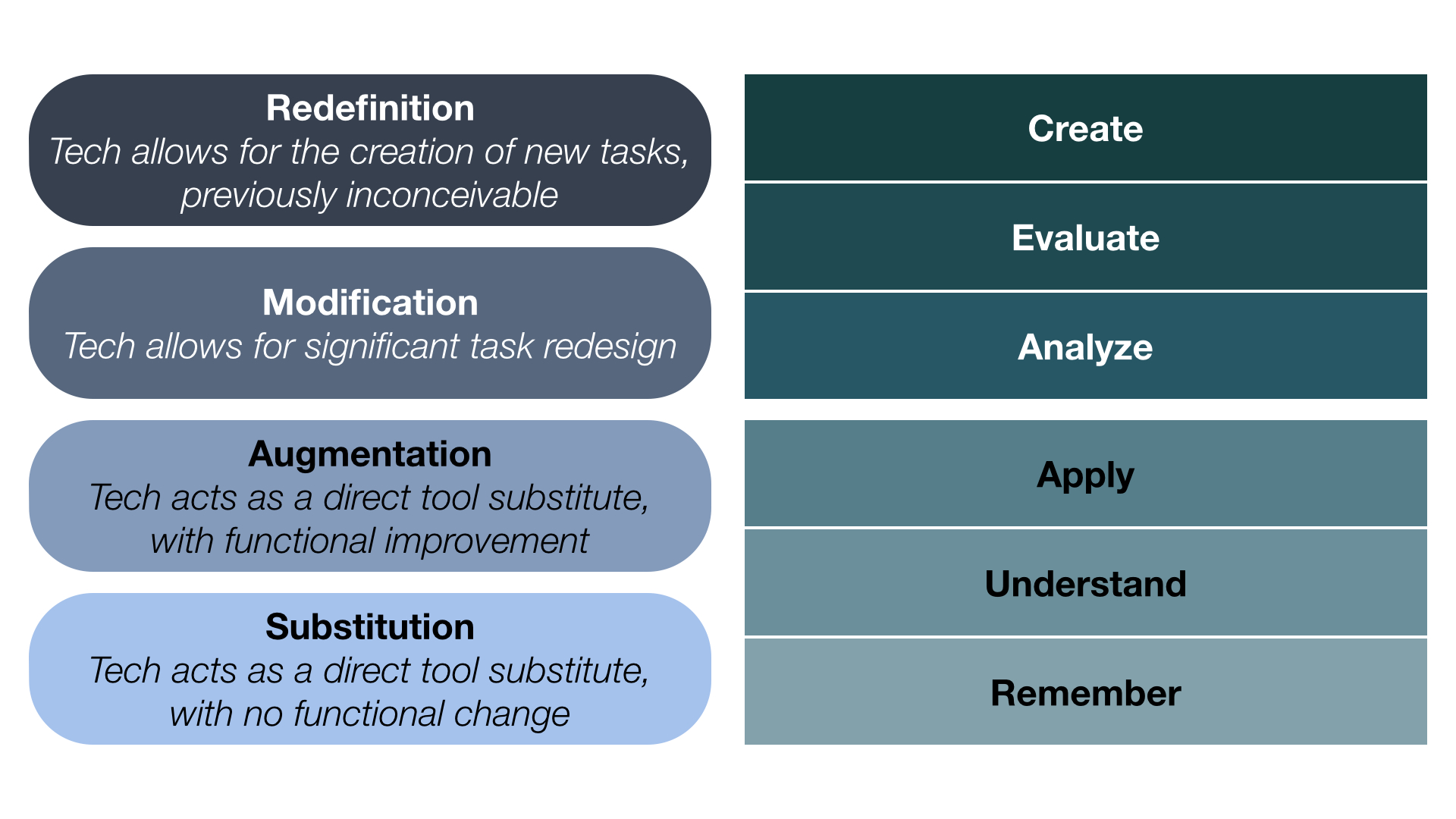
diagram-puentedura

Puentedura’s model encourages educators to ask themselves if the student task is an act of substitution, augmentation, modification, or redefinition? The suggested threshold for moving from enhancing learning to transforming learning is between augmentation and modification.  As an example of this, consider a student writing a paper.  If the student writes the paper on a computer instead of on a piece of paper, this is an act of substitution.  If the student uses spell check and a formatting tool to assist with the writing process, this is augmentation as there is a slight change in the functional improvement.  Should the student publish the paper, perhaps on a wiki, blog site or through google docs, so other students can read it and give feedback, this is a modification of the process, for it now includes collaboration.  Lastly, in redefinition entirely new tasks are created which were inconceivable without computers and computer software tools.  In this level student transform their written stories into media productions using storyboards, filmed scenes and music.  Students can also publish these and receive feedback on the work.  In this level technology has redefined the task.

Working towards redefinition, is of course the goal for teachers who would like his/her students to be working in the highest thinking levels possible while using technology.

A short video introducing the SAMR model can be found at:                        https://www.commonsensemedia.org/videos/introduction-to-the-samr-model


Educational Research: Small Scale or Large?

On Monday, Clare and I (Clive) had the privilege of attending an outstanding symposium at Brock University on self-Image Brock Symposiumstudy research on teacher education. It was organized by Tim Fletcher and Deirdre NiChroinin and funded by their respective institutions, Brock University and the University of Limerick. Highlighted speakers were Clare, Julian Kitchen, and Tom Russell. Apart from the local audience, the symposium was streamed live and will be archived for online access at : http://brockvideocentre.brocku.ca/videos/ (Under Self Study Symposium — 01:46:06).

One issue that came up was the validity of self-study inquiry versus research with a larger sample size. It was noted that there is pressure (from tenure and promotion committees as well as policy developers) to conduct research larger in scope than the typical self-study project. Some suggest that to increase the “significance” of self-study research it may be necessary to combine a number of smaller projects.

From the audience, I made a comment that was lost electronically and Tim and Deirdre have asked me to repeat it here. My comment was as follows:

Small scale research by individuals or small groups often provides a depth of understanding not available through large scale research. We must not assume that bigger is better. While large sample research is suitable for certain purposes, often something is lost when we move to a larger sample and have to ask simpler, one-shot questions, where the meaning of the questions and answers is often unclear. The typical self-study project enables us to probe in considerable depth the nature, purpose, and effectiveness of various teaching practices.

Dewey, Schon and, more recently, Zeichner, Cochran-Smith, and Lytle have emphasized how much practitioners learn on the job; and Bryk et al. in their recent book Learning to Improve (Harvard Education Press, 2015) maintain that quantitative researchers must join forces with on-site practitioner-inquirers to build a complex, publically available framework of educational concepts, principles, and practices (somewhat akin to Wikipedia). Both types of research are needed. We must not privilege one over the other.

School Board Proposes Multi-language Immersion Program

The Toronto Catholic District School Board has plans to establish a multi-language specialty school. The proposed immersion program, being considered for north Scarborough as early as this fall, would offer instruction in French, Spanish, German, and Mandarin. Michael Del Grande, chair of the TCDSB noted “my view is we’re not preparing our students for the world stage, we barely do a passing job with French, and we’re a bilingual country! So we’re asking parents if they’d like to educate their children in the languages of some of the largest economies in the world.”  What do you think about this type of immersion program? Should other languages be included in the program?

Link to the Toronto Star article: http://www.thestar.com/yourtoronto/education/2015/04/28/multi-language-elementary-school-proposed-by-toronto-catholic-board.html

Technology, inclusion, and innovation: Students design an app for literacy development

“It is estimated that only 10 per cent of blind children and adults know how to read braille. It is an illiteracy rate long ignored by technology developers who have created thousands of educational apps for the sighted”.

The above statistic is sad news however, I (Yiola) came across this most inspiring news:  students in an local middle school designed a computer app that can teach people who are visually impaired how to read braille.

How exciting for students to make such an impact in the literacy learning of others. How exciting for students to be learning about inclusion, literacy, and technology. How exciting to be engaged in the design and inquiry process in such a real way.

http://www.ctvnews.ca/mobile/sci-tech/ontario-students-braille-app-shortlisted-for-lego-innovation-prize-1.2329612

Wishing our local middle school students all the best in this endeavour.

Moving From Outsiders to Insiders: Working With a Teacher Research Group

I (Clare) have been involved in a teacher researcher group for the last 2 years. Along with Pooja and Shelley (regular IMG_2508contributors to this blog and pictured to the left) we have facilitated  a group in a secondary school. The work the teachers have done is outstanding! The three of us facilitators did a self-study of our work with this group. Since we did not know the teachers beforehand which was a bit unnerving we felt it was good to study our work. We now feel very much part of the group and feel we have become a learning community. We are presenting on our work with the teacher researcher group at AERA. Here is a draft of the paper Moving From Outsiders to Insiders: Working With a Teacher Research Group. It is still in “draft” form but if you are interested in teachers as researchers you might find this paper useful because we talk about logistics, identity, forming a community, and our learning. AERA 2015 EurekaPaperFinal

For those of you who read this blog and are at AERA I hope our paths cross.

Teaching Hybrid

In a couple of weeks, I (Cathy)  will start teaching my first hybrid course.  Also known as mediated learning, blended learning, and web-enhanced instruction, this kind of course can be considered  “the middle ground between our society’s adolescent love affair with technology and ancestral need for human contact and a sense of belonging” (Landau, 2015).

Baker College’s Instructional Technology Web site on blended instruction defines some of the advantages of hybrid or blended instruction:

  • Providing tools to facilitate communication outside of scheduled class time and office hours enhances student-student and faculty-student communication.
  • The blended learning environment supports different learning styles and methods.  Students have time for reflection when participating in online discussions and can participate at a time and place that meets their needs.
  • Online materials are available 24 hours a day, seven days a week, insuring that students always have access to assignments and other handouts.
  • On-line testing can be used for student pretests and practice.  On-line discussion between class sessions can identify areas of student difficulty that need to be addressed in class.
  • Course management and administration is simplified with an online gradebook and tools for email management.

http://www.baker.edu/departments/instructech/blended.html

The Hanover Research Council (2009) suggests the following  best practice teaching strategies for online education:  Group problem-solving and collaborative tasks;  Problem-based learning;  Discussion;Case-based strategies;  Simulations or role play;  Student-generated content;  Coaching or mentoring;  Guided learning;  Exploratory or discovery;  Lecturing or teacher-directed activities;  Modeling of the solution process; and  Socratic questioning

Yet, even though there are numerous advantages to online learning and many strategies  to make it effective learning,  I am told many students simply ignore the online material and rely on what they learn in class.  I suspect this may be because they feel it is easier to play hooky from a computer, or their schedules simply get in the way.   However, I feel my students will miss a lot if they ignore the online portion of our course. So I am collecting strategies to entice the students to engage in the online offerings;

  • offer a mark for engaging on line
  • provide enticements or teasers for what they might find online
  • review of intended learning for online work in class to ensure clarity,

and finally

  • use video streaming and/or chat rooms at designated hours so students feel connected to the site

I hope these ideas work, as I am looking forward to giving this a try.  If you have taught a hybrid course and have some more ideas, I’d really like to hear about them… online of course!

Science Guy Becomes a Literacy Guy: Guest Post by Jason Gregor

In my (Clare) literacy grad course this past semester I had a group of amazing students — smart, experienced, caring, Jason Gregorthoughtful, and inquisitive. They were truly a joy! One of the students named us the Literacy Community. For the final product for the course the students were encouraged to do “something” meaningful for them and they could use any modality they wanted. One of the students Jason Gregor did an amazing paper which traces his journey from being a science enthusiast who did not value literacy to a strong advocate for literacy. His paper was so insightful I asked him if I could post in on our blog because those of us in teacher ed will relate to folks like Jason who slowly come to realize the place of literacy in teaching. Thanks Jason for letting me share your paper with the broader education community. Below is an excerpt from the paper and here is the link for the entire paper. Enjoy! JasonEssay

Why literacy is so important

 I never truly understood the hype around literacy. It seemed to be the biggest thing in the education system. As someone who did not like English very much and was much more focused on science, I felt that it kind of got all the limelight. Now however, I realize that I was wrong. I was dead wrong. While recently working on my final project of graduate school (I’m done much to my chagrin!) I took the opportunity to reflect on my experiences with literacy and how they have shaped the way that I viewed it (in a much skewed way). Thanks to Dr. Clare Kosnik and the two classes I took with her though, I have found that I was very wrong. Literacy is the most important area for education. Without literacy, you’ve got nothing! For this reason, I have become much more engaged with literacy education and feel very strongly towards it. Sure science is important, but without literacy, well, you wouldn’t be reading this right now! So, moral of the story, even the most disengaged, no matter what level they are at, be it student or teacher, can be motivated to re-engage with literacy. It’s never too late. Take it from me, I’ve been there.

Facebook Still Popular with Teens

An article I read in the Toronto Star the other day surprised me as it reported, “Facebook remains the most used social media site among American teens ages 13 to 17.” I had expected other social media tools (e.g. Instagram) to be more popular with teens. However, according to a recent study from the Pew Research Center, “Facebook was the site teens used most frequently, at 41 per cent, followed by Instagram at 20 per cent and Snapchat at 11 per cent. Boys are more likely than girls to report they visit Facebook most often — at 45 per cent versus 36 per cent of girls.” Are you surprised to learn that Facebook is still so popular with teens?

Link to the Toronto Star article: http://www.thestar.com/life/technology/2015/04/14/facebook-still-teens-most-used-website-report.html

SocialMedia

Longitudinal Study of Teacher Continues: Multiliteracies Teaching in a Digital Age: Balancing the Old and the New

Clive and ClareClive and I (Clare) along with our amazing research team (many of whom have posted blogs) having been following 40 teachers, some for 10 years and others for 8 years. This has been incredibly rewarding research because we have seen how teachers change over time. In Growing as a teacher: Goals and pathways

Growing as a Teacher book cover
Growing as a Teacher

of ongoing teacher learning we reported on their first 8 years of teaching. We are VERY happy to report that we have received funding from the Social Sciences and Humanities Research Council of Canada (SSHRC) to continue our research for another five years. The title of our proposal was: Multiliteracies Teaching in a Digital Age: Balancing the Old and the New. Click here to see the Description of Research that we submitted to SSHRC. Final Detailed Description 2014We could not have conducted this research without the work of our research team and the cooperation of the teachers. We look forward to seeing how our teachers change and develop as mid-career to later-career teachers.