Category Archives: literacy

Newer Modes of Communication Challenging the Written Word

Facebook logoSmartphones and templates offer a newer mode of communication and slowly, it seems, a new language is taking shape. Short, incomplete sentences with alternatively spelled words are dominating the domain. Incomplete thoughts… and abbreviations http://www.netlingo.com/acronyms.php are rapidly becoming familiar.

I’ve (Yiola) bin thinking about literacies and what txt and tweets and FB mean for literacy development. IDK what to make of this. It’s interesting cuz language changes. wordz change. punctuation ceases to exist.  LOL
youth 2day use symbols, short forms, a variety of new symbols to communicate.
I’m still wondering how #hashtag came to be the symbol that it is. #justdontunderstand
The exclamation point has indicated strong emotion. now we have 🙂  😉 and 😦
Is one more correct than the other?
Plz share some insights… i’d luv 2 hear ur thoughts on the implications for teachers, teacher educators, parents. I mean, how r we to communicate and facilitate language development if we r not in tune with social media discourses of youth today? Do we ignore it? Incorporate it? Explicitly teach the differences between formal / traditional language and social text?
ttys, yiola

Professional Identity

Today I (Clive) was teaching my School and Society (social foundations) course in the preservice program. Our topic was professional identity. What a class we had! We discussed:

·      Teachers’ perception of their role

·      Motivation and satisfaction

·      Challenges of teaching

·      Work-life balance

·      Confidence

·      Stance in relation to system mandates

I selected a number of quotes from our chapter on professional identity from our upcoming text: Growing as a Teacher (Sense Publishers). The students took turns reading these quotes aloud which proved to be very powerful. We brought the “voices” of the teachers into the class. Here are a few of the quotes we read:

Classroom teachers have an enormously challenging job; I didn’t realize that when I first started teaching, but now I do. And that hasn’t made me any less effective, if anything it’s made me somewhat more; because now I’m kinder to myself. I see that basically the teacher sets the atmosphere of the classroom, and if you’re constantly stressed out and trying to attain the impossible you become a frustrated and burnt out person. (Felicity, eighth year teacher)

The most important aspects of my role are ensuring that my students develop a positive sense of self; that they acquire a love of learning; and that they develop a world perspective, with compassion and understanding for other people. Embedded in that are social skills; but it’s bigger than that, because I want them to see beyond their own life and community. This view of my role is broader than it used to be. If you’d asked me when I started teaching I would have said the world citizenship component was important, but it didn’t play into my daily practice to the extent it does now. (Tanya, eighth year teacher)

Coming out of my inner-city pre-service program, where the emphasis was on being a change-maker and inspiring every kid, I had to learn that it can often be slow going and I have to not feel defeated if I fail to accomplish everything I hoped for. Because…you really, really need to enjoy teaching to last in the profession, and it’s draining and can get frustrating. I’ve always worked in inner-city schools, so I’m mentally prepared for it…[but] I’ve had to learn not to take things personally. Otherwise you go home and things rest in your mind and you get physically sick.  (Jessica, fifth year teacher)

Basing my teaching on where the students are and where they need to be [according to the standards-based approach], I found I ended up teaching to the test; and the whole fun and love of learning went out the door. So I changed my process, and asked: What am I teaching? What skills need to be taught? How can I get that across to them in a way that they’ll enjoy? And then after reflecting on it, and seeing where it didn’t work so well, I asked: What should I change?   (Lucy, fifth year teacher)

Experimenting with Collaborative Discussion Strategies

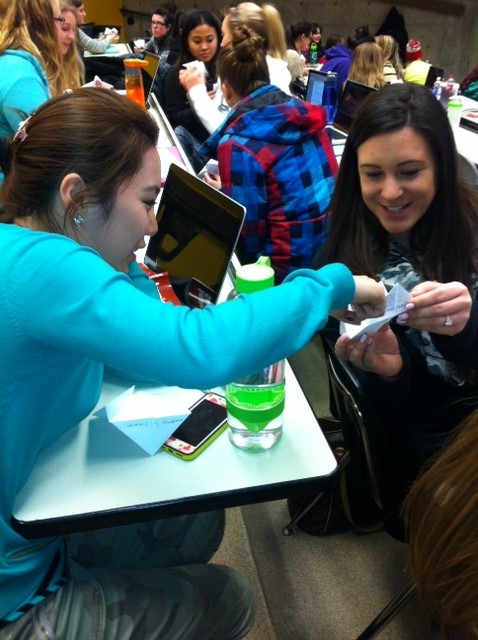
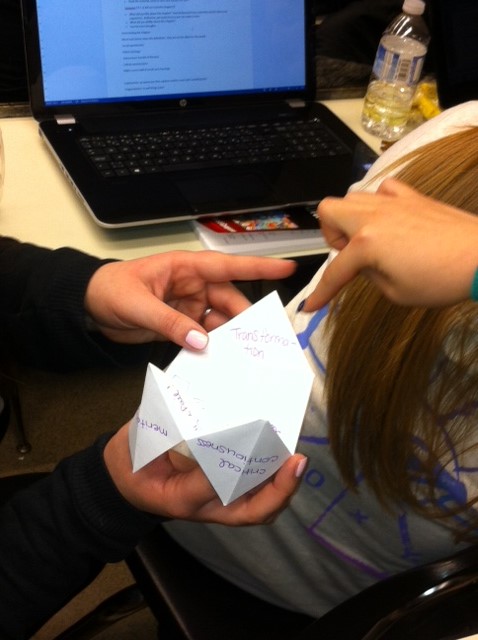
The class I (Cathy) teach for the Bachelor of Early Childhood Education program is from 7-10 in the evening.  I feel for my students as this is a demanding time to be learning something new.  To make matters worse, many of the students arrive rather fatigued having just left another class that is strictly lecture format.  I need to wake them up and get them thinking again.  So, capitalizing on my belief in a dialogical approach, for part of each class I implement a different collaborative discussion strategy (e.g. gallery walk, expert groups, four corners, placemat).  Our last class, however, was rather unique.  I was looking for a way to explore chapter summary and discussion.  Plus, I wanted to incorporate our ongoing work on metaphors in education.  Suddenly, the strangest memory came to mind… cootie catchers.   I wasn’t even sure that was the name until I found it online.  Traditionally, this is Japanese origami work, known in the paper folding world as the ‘Fortune Teller’.  How, I wondered, could I use this to motivate discussion and review?  After some tinkering with my objectives, I had the students place new/significant vocabulary from the chapter on the outside, which the origami maker had to define and spell to move the sections around.  Images representing significant ideas and concepts were drawn on the inside, which the player had to identify from the chapter.  Guesses were confirmed in writing which were under the hidden flap.  Guess what?  They loved it and played it many times with many partners, hence reviewing key concepts in the chapter with several people.  Then we discussed what happened.  Some said now they will never forget their selected words/phrases (e.g. critical consciousness, diaspora, social reproduction and juxtaposition).  They were a challenge to spell, too!  Others said the images were hard but made them think carefully about the chapter content. The most challenging images I drew on the board at the front of the lecture hall and collectively we tried to guess what they represented.  Sometimes we had to get clues from the image maker and we cheered or groaned when we finally got it.  At the conclusion of the class we left rather refreshed and interestingly, nostalgic.  Every student, no matter what the cultural background or gender, reminisced about playing this game as a child.  This was as diverse a literacy event as I have ever encountered and I don’t think I have ever enjoyed a collaborative review more.  Below is the website I used to remind the students how to create the origami form.  yes ori oop

http://www.origamiway.com/how-to-make-a-paper-fortuneteller.shtml

Narratives of Teacher Educators

Book cover

I (Pooja) recently finished reading Negotiating critical literacies with teachers: Theoretical foundations and pedagogical resources for pre-service and in-service contexts (Vasquez, V.M., Tate, S.L, & Harste, J.C., 2013). This book provides a theoretical framework, insightful examples, and pedagogical resources for ways to incorporate critical literacy practices into pre-service and in-service teacher education. The final chapter of this text entitled “Teaching and living critical literacies” especially interested me. This concluding chapter focused on the narratives of the authors who are all teacher educators. They shared early childhood memories, classroom teaching experiences, and turning points (e.g. being the first in the family to attend college; protesting the Viet Nam War). Much of what the book’s authors shared in their written narratives reflected closely what many of our critical literacy participants in our SSHRC study have expressed. Many can identify turning points and life events in their early childhood, which contributed significantly to their philosophy and stance towards teaching and learning. Maya from our study identified being placed in a low-track after immigrating to the U.S. as a defining moment. This has influenced her practice because she now focuses on having her student teachers understand multiple perspectives and interrogate their assumptions of students, curriculum, and schooling. Providing a specific example of this pedagogical stance, Maya told us about how she conducts an entire lecture in Spanish, locating student teachers as second language learners.

This final chapter reinforced how meaningful it is to create space for the voices of literacy teacher educators.  The narratives of our participants are rich with experiences that influence their practices in the classroom. Stacie L. Tate, book author and teacher educator, articulates this well: “When people ask how I decided to become a teacher and researcher, I always reply, “I was groomed for this.” (p. 99).

Family Literacy Day

Today is Family Literacy Day in Canada. http://abclifeliteracy.ca/fld/family-literacy-day
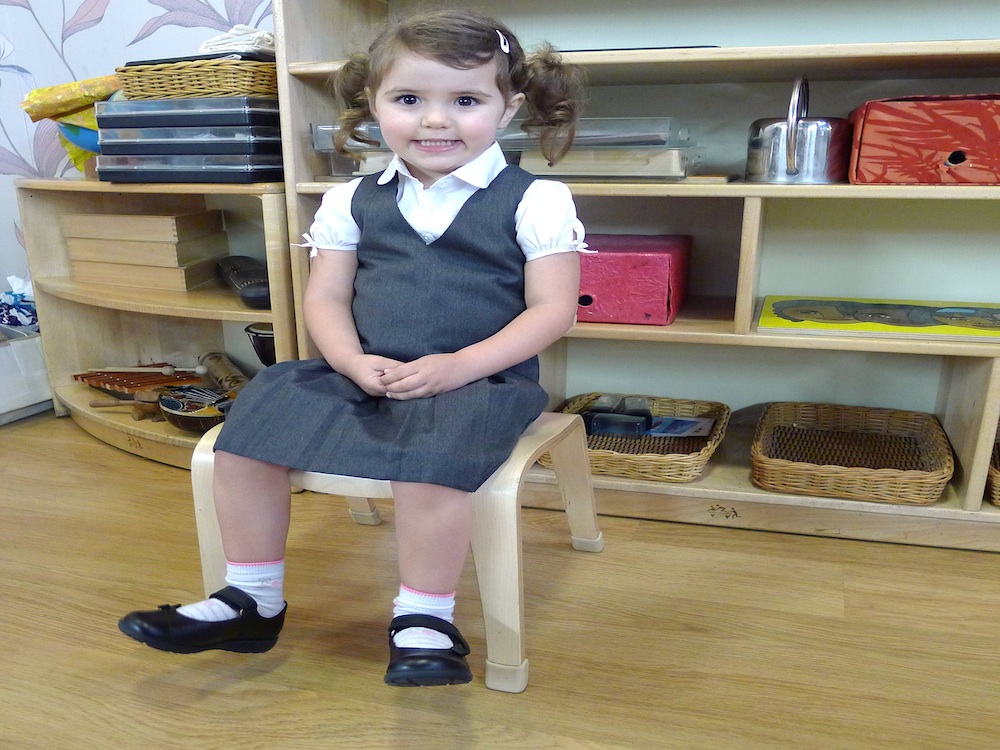
It is a day that recognizes the importance of families building literacy skills together.  Looking back, what did family literacy look like in your household? In what capacity did Young girl in schoolliteracy development occur? In my home I (Yiola) taught my parents the language of English and my parents taught me the value of English.
I find Family Literacy Day to be a very well intentioned initiative.  The ideas presented in the link on family literacy are interesting.  As a Teacher Educator who teaches from a critical perspective I cannot help but ask, how can the concept of family literacy be made accessible for all families? How do we make the concept more inclusive?  When thinking about ‘Daily Literacy Activities’ I wonder, what can we add to the list found on the website?
See: http://abclifeliteracy.ca/files/Daily_literacy_activities.pdf
I plan to share this list with my student teachers and ask them for additional activities to include that may draw in a variety of families.  I’m thinking of multilingual processes, digital opportunities, oral traditions.
Happy Family Literacy Day!
Yiola

Writing a Review Takes TIME

I (Cathy) discovered, having just submitted my first academic book review, that the process takes TIME.   The T in my acronym represents allowing for lots of time to move through the process. The I represents investigating the journal for which I am submitting.  The M is for mining the book under review. The E is for editing- of course- what would writing be without editing?  I developed my TIME acronym through both the experience of writing the review and doing some homework on review writing.  One of the suggestions I came across, which was a valuable piece of advice, was to allow one month to write the review:  two weeks to read the book; one week to write the review; and one week to edit the work.  This turned out to be true.  There was no hurrying the process.  I also spent time reading many other reviews from the same journal for which I was submitting.  This was the investigation part.  I compared five reviews for style, content and length.  One was much more academic in style than the others.  All were not hesitant to praise the work.  This was reassuring, as I liked the book a lot.  The mining part was the surprise.  As I read the book, I listed the things I liked about it and possible flaws, only to discover that when I got to the end, it was not enough information.  I had to read it again and work harder at comparing the chapters for content consistency, look for related themes and any patterns the editors may have requested.  I also spent a lot more time scrutinizing the forward and conclusion and discovered some great quotes I had missed the first time.  This was similar to reading a book in order to teach it.  Impressions are not enough.  I needed more meat.   And finally came the editing.  After several iterations, I thought it was ready for someone else to see.  I gave it to five people to read. Every one of them found corrections and made suggestions. Some I used, while others were stylistic suggestions that I let pass.  All were insightful.  The best part though, was the response.  When one of my friendly editors replied, “You really made me want to read this book!”  then I knew the review hit its mark.  Like I said, I liked the book.  Oh, and by the way, the book is called Literacy teacher educators: Preparing teachers for a changing world.  I recommend it!     BTW  The journal I submitted to is called Research in Teacher Education.  Excellent resource!  Check it out…  http://www.uel.ac.uk/rite

Mapping my morning commute

On twitter this week I (Lyida) read about a storytelling project that invited teachers to use digital tools to capture and represent dimensions of “their world”. The representations  (e.g. pictures, video, audio) were publicly shared on a blog. It would be interesting to use aspects of this idea in a teacher  education literacy course but I wanted to experiment with it first.

   Fruitstand  Subway1

Subway2  Bike  Museum

library

Critical Literacy vs Language Acquisition

Critical literacy and Language acquisition.  I (Yiola) have pondered these two concepts — what they mean, what they entail, and why they are important.  In much of the literature I have read, there appears to be distinct 2 camps:  those who study language acquisition that is, how we learn to read and write: how we develop phonemic awareness, and learn to decode, and develop syntax and those who study critical literacy: a newer approach to learning how to analyze and understand texts in a socially conscious way.  I have asked myself, are they in two distinct domains of Language discourse? They appear to be. Do you agree?  Yet, when I think about teaching literacy to children in the context of schooling and what readers and communicators need to know, then critical literacy is a form of language acquisition. Children must know how to read and analyze texts, and they must know how to read and analyze the world. Children acquire language through critical literacy. Critical literacy is then a significant part of language acquisition. In teacher education literacy courses, is the concept of critical literacy taught with the same importance and priority as the more traditional methods and means for language acquisition? Ultimately I’m wondering, what are the essential components of literacy curriculum for 21st century teacher education programs?

Telling Stories in Pre-Service

I (Cathy) instruct part-time at Brock University. Many of my mid-term evaluations from my pre-service students read, “Please, tell more stories”. It made me laugh, but it made a point. We all love stories, no matter what our age: family stories; folktales from another culture; scary stories… it doesn’t matter. So today, in our first classes for 2014 I focused on storytelling, but turned the tables somewhat and encouraged my student teachers to be the tellers. They were asked to share personal stories about their teaching practicum, which they had completed just before the winter break. I started us off by sharing a story about a disastrous placement I experienced many years ago when I was a student teacher. The flood gates were opened. My, oh my, such stories! Hilarious stories about indignant kindergardeners; touching stories about tough grade eight boys weeping because they thought they had hurt the student teacher’s feelings; frightening stories about overly demanding associate teachers; and joyous stories about building up deflated ELL students. The passion in the room was palpable; it glowed in their eyes, exuded in their hand gestures and spilled about the room with the rise in the decibel levels. Clearly, they loved working with the kids, the learning (good and bad) and the chance to make a difference. They loved teaching, and even in this climate of little prospects of obtaining a teaching position for a few years, they were exactly where they belonged. And so was I.  Cathy