
We often talk about all the new literacies that the 21st century brings and how we as educators must develop an awareness of the newer modes of communicating… I (Yiola) do agree and yet, we must be recognize there are losses too.
We often talk about all the new literacies that the 21st century brings and how we as educators must develop an awareness of the newer modes of communicating… I (Yiola) do agree and yet, we must be recognize there are losses too.
Teaching is challenging. As David Labaree (2004) says:
“[T]eaching is an extraordinarily difficult form of professional practice. It is grounded in the necessity of motivating cognitive, moral, and behavioral change in a group of involuntary and frequently resistant clients.” (pp. 55-56)
In our study of teachers, we (Clive and Clare) have been struck BOTH by the many challenges the teachers face AND how well they maintain their morale despite the challenges. Of the original cohort of 22 who began in 2004, none have quit teaching (though 2 have left the study) and none have experienced a substantial, permanent decline in motivation, though they have their ups and downs. When in 2012 we asked them explicitly about their motivation over the years, their responses were as follows:
Average Motivation of Cohort 1 (18 interviewed) Over Their First Eight Years (Scale 1-5)
| Year 1 | Year 2 | Year 3 | Year 4 | Year 5 | Year 6 | Year 7 | Year 8 |
| 4.7 | 4.4 | 4.4 | 4.4 | 4.1 | 3.8 | 3.8 | 4.2 |
Interestingly, their highest motivation was in year 1. Though they were stressed and exhausted, they were excited to be doing what they had dreamed of for so long.
As for the strategies they used to keep up their morale, we noted the following:
“Teaching is getting harder, and I’ve changed in that I would no longer recommend it to everyone…. However, I like it because I’m a doer, I enjoy being creative, and I like being challenged.” (Felicity, year 7)
“I’m happy to go to school [because] you just never know what’s going to happen; it’s always a new day.” (Jody, year 8)
“When things were going in a wrong direction [recently] with my school administration and in the school district, it brought me back to why I was there, why I wanted to be a teacher: working with the kids, dealing with their issues, getting down to the fundamentals of teaching them.” (John, year 8)
Great strategies! Good for teachers – and teacher educators too!
My (Cathy) pre-service students were assigned a multimodal aspect to a major assignment this year. If you are not familiar with the Theory of Multimodality, it is Gunther Kress’ alternative to Linguistic Theory (which only privileges reading and writing as the main modes of communication in a school curriculum). The Multimodal Theory contests that in our new age of multiple literacies, students need to be communicating, responding and expressing through many different modes of communication (e.g. speaking, music, moving, gesturing, image, and digital technology).
When I first introduced the multimodal assignment to my students, there was some trepidation and even some anger. It was suggested I did not have the right to be marking them on their artistry or on creativity. Hence, I had to teach the concepts behind Multimodality Theory so they could better understand what we need to be offering students of the 21st century. They needed to see that it would allow them the freedom to express in modes of their own choosing; that it was not graded as art but as a production of design; and, that the work could be symbolic or interpretive depending on the meaning they were portraying. The multimodal projects would also be shared in class so all could learn from them. This project was not just them regurgitating information for me, it was them designing and producing personally meaningful projects that express what they learned and what they deemed significant.
This week we finished viewing the projects. They were amazing, and the student response to these projects was encouraging. My students (concurrent students just finishing a five year educational degree) had never been given this kind of an assignment before. They loved the element of choice; working together; taking a risk; pushing their boundaries; feeling creative; and, doing something they were interested in. The modes they selected to express themselves though were sometimes more traditional (dancing, rapping, singing, writing and reciting poetry, creating 3D sculptures, puppetry, multi-sensory art installation pieces); sometimes digital (iMovies, pod-casts, prezis, Pow Toons, popplets, infographics); and, were often a combination of both.
Collectively, we were all blown away by the results. We were moved. We were inspired. My students all said they would definitely use multimodality now as teachers. Below are a few images of my students presenting their projects:
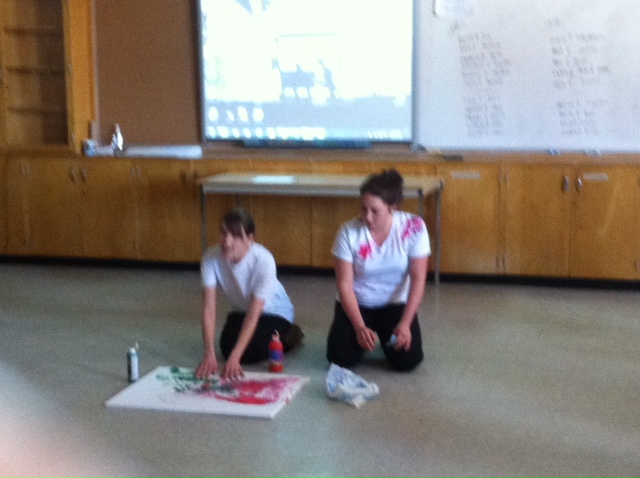

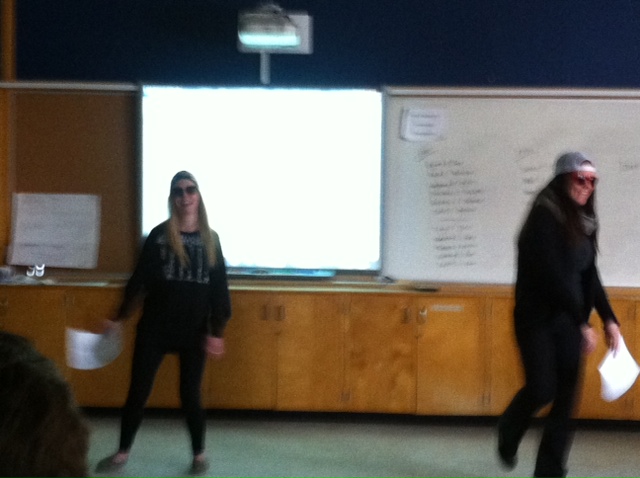

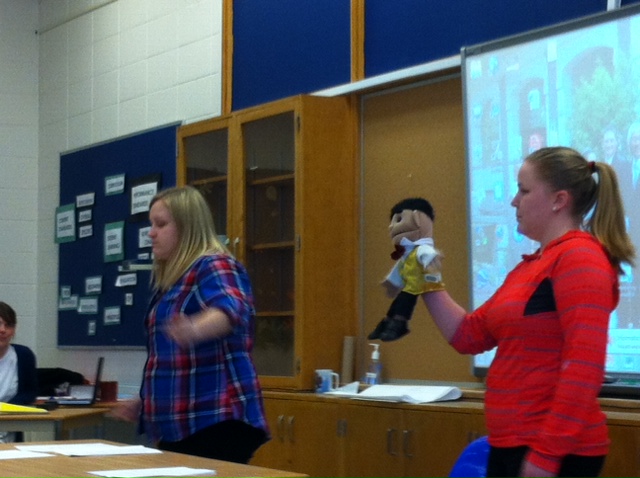
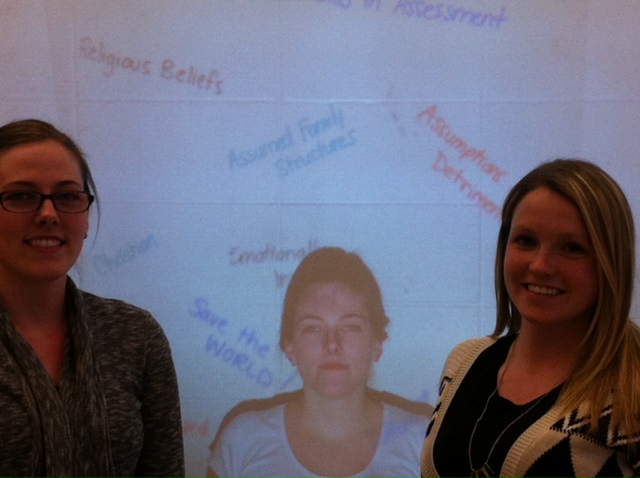
Now, I have to assess these designs… but that, dear reader, is for another blog.
Wikipedia is believed, by many, to be a democratic model of content creation because of  it’s design which allows anyone to create/edit content. While listening to CBC Radio’s Spark, I (Pooja) learned that Wikipedia suffers from a severe gender gap. In fact, a study in 2011 conducted by the Wikimedia Foundation, found that only 13% of Wikipedia contributors were women, making men the overwhelming contributors to Wikipedia.
Sue Gardner, the Executive Director of the Wikimedia Foundation, uses comments posted by women on articles related to the wiki gender gap to explain reasons women do not contribute more to Wikipedia:
1) Some women don’t edit Wikipedia because the editing interface isn’t sufficiently user-friendly.
2) Some women don’t edit Wikipedia because they are too busy.
3) Some women don’t edit Wikipedia because they aren’t sufficiently self-confident, and editing Wikipedia requires a lot of self-confidence.
4) Some women don’t edit Wikipedia because they are conflict-averse and don’t like Wikipedia’s sometimes fighty culture.
5) Some women don’t edit Wikipedia because the information they bring to Wikipedia is too likely to be reverted or deleted.
6) Some women don’t edit Wikipedia because they find its overall atmosphere misogynist.
7) Some women find Wikipedia culture to be sexual in ways they find off-putting.
8) Some women whose primary language has grammatical gender find being addressed by Wikipedia as male off-putting.
9) Some women don’t edit Wikipedia because social relationships and a welcoming tone are important to them, and Wikipedia offers fewer opportunities for that than other sites.
Like many, when I want to learn the basics about anything, Wikipedia is often the first place I go. However, before listening to the Spark radio show on Sunday, it never crossed my mind to edit or contribute to a Wikipedia page. Some of the reasons Gardner presented resonate with me, while others not at all. So what is it that’s keeping me (and you) from Wiki’ing?
Listen to CBC Radio Spark on the Wikipedia Gender Gap:
http://www.cbc.ca/spark/blog/2014/03/16/wiki-gender-gap/
Read Sue Gardner’s blog here:
http://suegardner.org/2011/02/19/nine-reasons-why-women-dont-edit-wikipedia-in-their-own-words/
Today is St. Patrick’s Day – an Irish holiday. St. Patrick’s day is a significant day here in Toronto and includes a big parade, people wear Green, restaurant and pubs turning themselves into Green enterprises, classrooms talking about and celebrating all that is Green and Irish. What began as a religious holiday is now a festive c  elebration in many parts of the world.
St. Patrick’s Day is about St. Patrick, the Apostle of Ireland. St. Patrick is credited for bringing Christianity to Ireland. The shamrock is what St. Patrick used to illustrate the Holy trinity. March 17th is believed to be the day St. Patrick died.
Thinking about schools and classrooms, should we teach St. Patrick’s Day from a perspective other than a festive celebration? Why is it a prominent celebration here in Canada? How is it that Irish and other ethnicities alike rejoice in St. Patrick’s Day? When I taught in the public schools we encouraged students to dress in Green, we had a parade through the halls of the school, we read books about St. Patrick’s day and Ireland, and had several activities (arts, crafts, writing) to honour the celebration. Yet not once do I recall and inquiry or examination of what the Day represents both historically and for today. What are the roles and responsibilities of teachers when it comes to celebrations and religious based traditions? In Toronto, Christmas has been the hotly debated and accommodated celebration for decades. What about the celebrations that are not framed in religion and yet are still entrenched in identity and power? Do we blindly and happily engage in the happiness and celebration without thought to the messages of exclusion and power we send when we honour one group and not another? Or do we engage in the often burdensome experience of exposing the inequities of such celebrations? Or, do we do nothing at all?
In an interesting article by Sallie Marston (1989), “Public rituals and community power: St. Patrick’s day parades in Lowell, Massachusetts, 1841–1874”, Marston states, “parades and other forms of mass public ritual are better characterized as demonstrations of community power and solidarity and serve as complex commentaries on the political economy of urban-industrial social relations”. Perhaps a safe and productive space for exploring the ‘power’ of celebrations is better served in teacher education classrooms. Teacher educators who take a critical stance in their practice raise consciously engaging issues and connect social theories to classroom practice and student learning. Yiola
Yiola’s post yesterday commented on the positive impact of a children’s book. Today I  (Clare) want to talk about negative images in children’s books. I came across Melissa Terras’ fabulous research on how academics are illustrated in pictures books. Oh goodness! Academics are typically presented in a very unflattering light (old, male, a bit mad). These stereotypes do damage to our reputation with the general public and are definitely not a positive image we want to present to children. Below are some of the findings from her extensive research which I found to be frightening and discouraging. Check out Melissa’s blog for the entire article: http://melissaterras.blogspot.co.uk/2014/02/male-mad-and-muddleheaded-academics-in.html
The 108 academics found consist of 76 Professors, 21 Academic Doctors, 2 Students, 2 Lecturers, 1 Assistant Professor, 1 Child, 1 Astronomer, 1 Geographer, 1 Medical Doctor who undertakes research, 1 researcher, and 1 lab assistant. In general, the Academic Doctors tend to be crazy mad evil egotists (“It’s Dr Frankensteiner – the maddest mad scientist on mercury!”), whilst the Professors tend to be kindly, but baffled, obsessive egg-heads who dont quite function normally.
The academics are mostly (old, white) males. Out of the 108 found, only 9 are female: 90% of the identified academics are male, 8% are female, and 2% have no identifiable gender (there are therefore much fewer women in this cohort than in reality, where it is estimated that one third of senior research posts are occupied by women). They are also nearly all caucasian: only two of those identified are people of colour: one Professor, and one child who is so smart he is called The Prof: both are male: this is scarily close to the recent statistic that only 0.4% of the UK professoriat are black. 43% of those found in this corpus are are elderly men, 33% are middle aged (comprising of 27% male and 6% female, there are no elderly female professors, as they are all middle age or younger). The women are so lacking that the denoument of one whodunnit/ solve the mystery/ choose your own adventure book for slightly older children is that the professor they have been talking about was actually a woman, and you didn’t see that coming, did you? Ha!
Most of the identified academics work in science, engineering and technology subjects. 31% work in some area of generic “science”, 10% work in biology, a few in maths, paleontology, geography, and zoology, and lone academics in rocket science, veterinary science, astronomy, computing, medical research and oceanography.
The names given to the academics are telling, with the majority being less than complimentary: Professor Dinglebat, Professor P. Brain, Professor Blabbermouth, Professor Bumblebrain, Professor Muddlehead, Professor Hogwash, Professor Bumble, Professor Dumkopf, Professor Nutter, and two different Professor Potts. There is the odd professor with a name that alludes to intelligence: Professor I.Q, Professor Inkling, Professor Wiseman, but those are in the minority.
Academics are routinely shown as individuals obsessed with one topic who are either baffled  and harmless and ineffectual, or malicious, vindictive and psychotic, and although these can be affectionate sketches (“bless! look at the clueless/psychopathic genius!”) academics routinely come across as out of touch wierdos – and what is that teaching kids about universities? In this age of proving academic “impact”, it might be not so bad for us to be able to show we were relevant to society? That there is more to academia than science? Or for the kids books I show my kids to have more positive and integrated representations of professors and academics? Perhaps this is not the role of kids books though, and I should just be telling my kids my own tales of academic derring-do.
I think these images of professors can undermine our identity as academics. I certainly do not see myself as the mad professor!
In a blog in January, I (Clive) argued against teaching multiculturalism in a way that leads to  stereotyping, thus undermining students’ individual identity and well-being. In interviews this weekend after giving the 2014 Bluma Lecture, author and NYU professor Irshad Manji spoke eloquently of the dangers of a misguided approach to “multiculturalism,” expressing preference for terms such as “diversity,” “global citizenship,” and “individual identity.” In the Toronto Star she said:
Multiculturalism is about preserving a group mindset, which amounts to labelling. Diversity, on the other hand, is about…different points of view…. If you listen seriously to a new generation of Torontonians, multiculturalism’s time is done. Enough of hyphenated identities. The next stage in our city’s evolution is this: global citizenship. http://www.thestar.com/news/gta/2014/03/07/qa_irshad_manji_on_multiculturalism.html
Manji would like to see more emphasis on individual identity. In the Globe and Mail she commented:
[Mr. Trudeau] basically said national unity must be founded in one’s own confidence in one’s individual identity and from that we can begin to engage with others…. We don’t have that kind of multiculturalism today, in my view. What we have is more a fear of engaging based very much on feeling intimidated that I’m going to say something wrong or that somebody is going to be offended.
She is especially concerned about the impact of prevailing approaches to multiculturalism on vulnerable community members, notably women and children. In the Star she stated that “the vast majority of the world’s known cultures are patriarchal,” and in the Globe she said:
By giving rights to cultures, not just to individuals, what we wind up doing…is giving more power to those who are already powerful within certain communities. We give them more power to dictate what customs are to be respected and which customs are untouchable. The next time you’re told you must respect such and such a custom, ask yourself, “What does my respect for this custom do for the most vulnerable in that community?” And the most vulnerable tend to be women and children.
Whether or not the term “multiculturalism” has outlived its usefulness is something we should ponder; and if we’re too afraid to say it has, we prove Manji’s point. But whatever words we use, we can support Manji’s approach in teaching and teacher education by stressing the diversity and power differences within cultural communities, the commonalities across communities, and the importance of individual identity and well-being.
I (Clive) am a great believer in whole-class and small-group discussion. However, three and four years ago I was terrorized by a series of individual students who dominated discussion in class, speaking at least 50% of the time – they would have talked 90% if I’d let them. I’m sure they did the same in their small group, if I wasn’t in the group.
This forced me to develop a set of techniques for giving everyone a turn. They’re simple but effective. Most students appreciate them, and they’ve enabled me to relax and not always be cutting people off (though I still have to be firm). I wish someone had introduced me to them long ago.
The techniques assume the class is no larger than 35 (I have any bigger class divided up) and is seated in a large circle (I arrange the seating before the students come in). They also assume that students get a lot of “air time” in class, otherwise it’s impossible for everyone to have a turn.
Here are the techniques:
I find students are very glad to be called on in these ways: no one has ever declined. And the approach greatly strengthens community as we hear from and get to know everyone, including many who’ve been largely “voiceless” throughout their school and university career. It fosters oral literacy and results in truly inclusive education.
If anyone has other strategies, please let me know!
I (Pooja) work at a higher ed. institute with a population that is very diverse. I have many mature students, with a history of interrupted education, who are looking to make a fresh start with school after work many years in unfulfilling jobs. Even though school has failed them in the past, they come in hoping to form a new relationship with school. This cartoon and this quote are taped up above the photocopier in our office. It is a daily reminder of my work and the students I serve.

Everybody is a Genius. But If You Judge a Fish by Its Ability to Climb a Tree, It Will Live Its Whole Life Believing that It is Stupid. –Einstein
Monica McGlynn-Stewart who is part  of our research team on the longitudinal study of teachers is our first guest blogger. For more information on Monica click on the tab About our Research then click on Meet the Team.
I (Monica) gave my 16-year-old daughter I am Malala by Malala Yousafzai for Christmas and now I am getting a chance to read it. It is the memoir of a 16-year-old girl who was shot by the Taliban for speaking out about girls’ right to education. I find it fascinating for many reasons, not least of which is what I am learning about life in the Swat Valley in Pakistan. As an educator, I am always interested in learning about different systems of education and different pedagogical practices. Malala is the daughter of a school 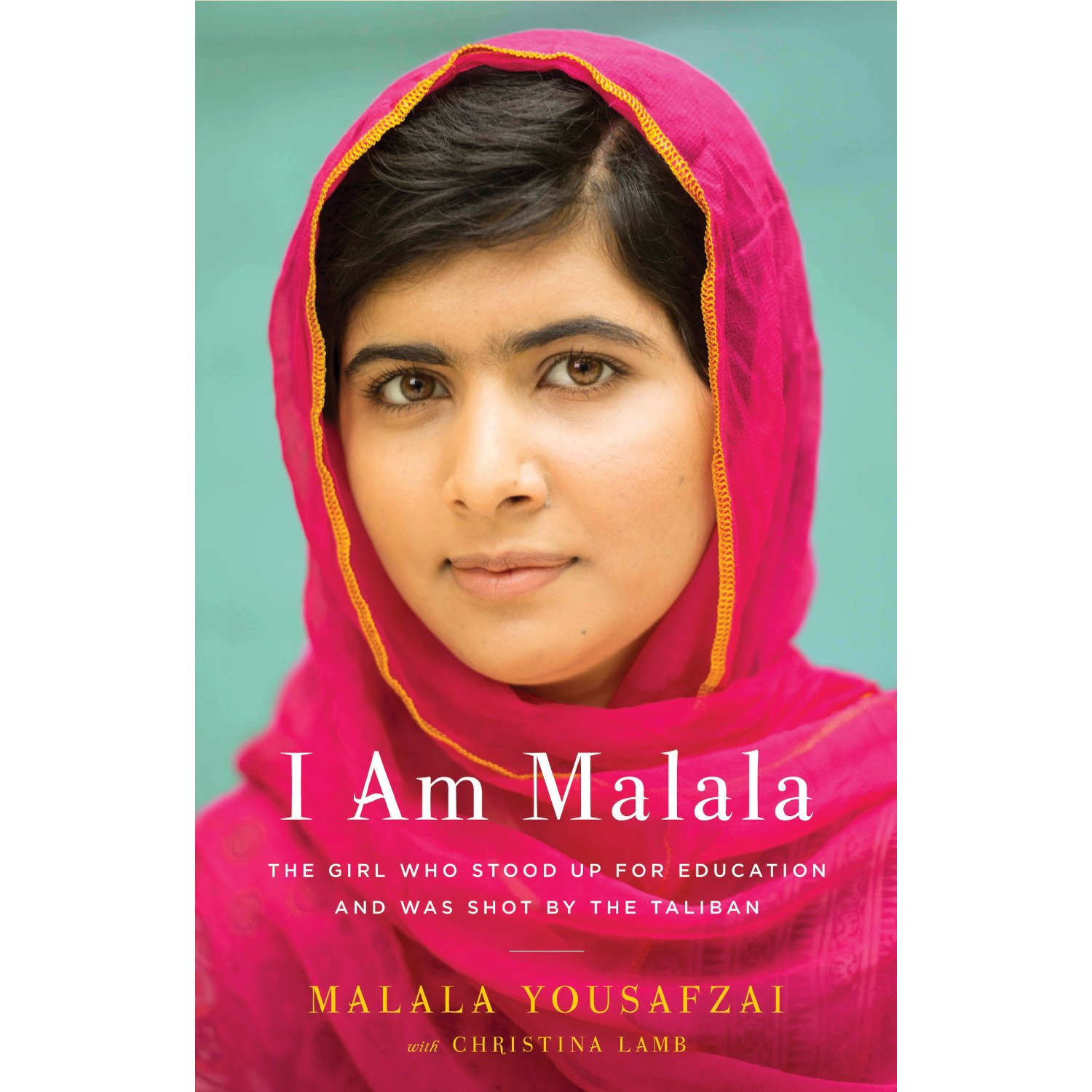 principal and had access to formal education except for a brief period when schools were closed by the Taliban, but many girls in the Swat Valley do not have access to education. In her descriptions of her studies, she relates how she memorized and recited religious texts, poetry, history, and even chemistry formulas. Her mother, who did not learn to read and write, can also recite many texts that she learned through hearing them. When I went to elementary school in the 70’s, we sometimes had to memorize a poem and recite it, but it was a rare occurrence. As an elementary teacher, I never asked my students to memorize texts, but they would learn many poems by authors such as Dennis Lee or Shel Silverstein because we read them out loud so often. For young students, “memory reading” a text that they had memorized was an important step in learning to read. So I am wondering, what role does memorization and recitation play in literacy learning? And can we consider someone illiterate who has memorized and can purposely refer to a large body of literature?
 Literacy Teaching and Teacher Education