Category Archives: Reflections

The Power of Introverts

“In a gentle way, you can shake the world.” – Gandhi
Introverted-Thinkers

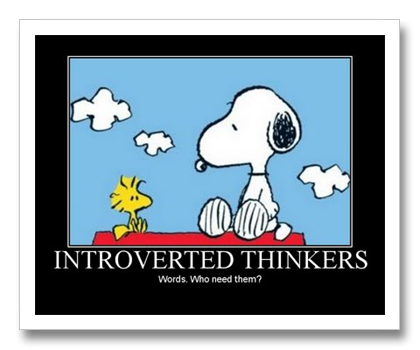
At a professional development session I (Pooja) attended this week, I joined a conversation about the power of introverts. The conversation was framed around Susan Cain’s book entitled Quiet: The Power of Introverts in a World That Can’t Stop Talking. We live in a society where extroverts are the ideal; we value personality over character. This presentation, given by some of my quieter colleagues, was  powerful because it forced me to reflect on ways I engage and include introverts in the classroom. The presenters explained that introversion and extraversion is not a black or white matter; rather we all fall somewhere along the continuum depending on the situation we find ourselves in. I also learned that introversion is not to be confused with shyness- a mistake many people (including myself) make when speaking about introverts.

images

I mostly identify as an extrovert. Knowing this is important because it can influence how I design my  course to be more inclusive for all my students. As a more extroverted person, I walked out of the session with practices to consider revising in my classroom. Here are a few of the things I’ve been thinking about:

  • Mindful of airtime- I often become uncomfortable in silence, and so I will fill in silent moments with talking or engaging only the most vocal members of the class in discussion. Silence can be a powerful thing; these are the moments where reflection occurs.
  • Independent Work vs. Group Work- I try and put my students into pairs and/or groups every chance I get. I now am beginning to realize this is not the optimal working condition for all. I need to find a balance of group work and independent work.

Learn more about the power of the introverts here:

http://www.thepowerofintroverts.com


“The Secrets of Sugar”

I (Pooja) watched an eye-opening documentary on CBC’s Fifth Estate. The documentary sugaruncovers some frightening facts about the effects of sugar and the sugar industry. Most of us are eating way too much sugar on a daily basis. Surprisingly, sugar is added in food items such as ketchup, yogurt, soy milk, and salad dressings. There was one alarming segment in particular in which I couldn’t help but think about the effect of sugar on children in school. Research was conducted on a sample of lab mice to observe how they reacted when their sugar consumption increased. The results were disturbing. Before any sugar consumption, the mice were alert and able to navigate through the set-up maze. However, as sugar consumption increased, their alertness levels decreased significantly. They moved sluggishly through the maze, bumping into the walls along the way. Some could not even make it to the end. This made me think so many of our young learners who consume high levels of sugar from their school cafeterias, vending machines, convenient stores, and/or home. Although in the past decade there has been a push towards healthier food for our school-aged children, there is a need for a deeper awareness around all the places where sugars are hidden.

Learn more about “The Secrets of Sugar” here:

http://www.cbc.ca/fifth/episodes/2013-2014/the-secrets-of-sugar

The Past – A Movie That Leaves You Wondering — What would I do?

Movie Poster The Past

We (Clare and Clive) went to see the movie, The Past which has been called a “domestic drama with all the tension of a thriller.” It is the latest movie by Asghar Farhadi the Iranian director.The movie is fantastic because it is well directed, you can relate to the characters, it captures the complexity of life, shows how decisions we make are often based on incomplete information, and the story is captivating. The quality of the acting is good you cannot believe the actors are actually acting. Below is a summary of the story:
·     
Coming back France to complete the divorce procedure, Ahmad an Iranian man, arrives in Paris after four years to meet his ex-wife and her daughters from her previous marriage. He notices his ex is in a relationship with an Arab named Samir who also has a son and a wife in a coma. The relationship of the older daughter and her mother is deteriorating because the daughter thinks her mother is the cause of Samir’s wife comatose state. The affairs get more complicated when the older daughter discloses something heinous she has done. From IMDB http://www.imdb.com/media/rm456776960/tt2404461?ref_=tt_ov_i#
·     
For a full review of the movie go to the Globe and Mail link:http://www.theglobeandmail.com/arts/film/film-reviews/the-past-domestic-drama-with-all-the-tension-of-a-thriller/article16435003/

·      Here is the linkfor a conversation with Asghar Farhadi who said, “All the films I’ve made … I have faith in.”

http://www.theglobeandmail.com/arts/film/a-conversation-with-asghar-farhadi-all-the-films-ive-made-i-have-faith-in/article16467505/
By the way, Farhadi directed The Separation which won an academy award for best foreign film a few years ago.
If you are looking for a non-Hollywood movie which captures day-to-day life and leaves you wondering what you would do when faced with certain dilemmas, I would highly recommend The Past.

Book Clubs + Canada Reads

As a Ph.D. student and an educator, I (Pooja) find myself mostly reading academic journal articles or student writing these days. While I enjoy reading both types of text, I miss reading for pure pleasure; in particular, I miss reading novels. Novels are a commitment of both time and energy, but when you read a truly great novel it is totally worth it.somethingfierce

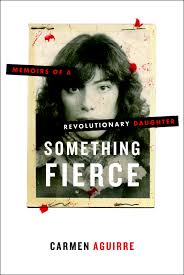
I recently formed a book club with some colleagues/fellow educators. Although I have a lot of my plate already (don’t we all?!), I thought this would be a great opportunity to connect with colleagues on a more personal and informal level, (not to mention being pulled into the world of a fascinating  novel). We selected Something Fierce: Memoirs of a Revolutionary Daughter by Carmen Aguirre. This book, written by a Canadian author, was the official selection of the 2012 Canada Reads initiative. I’m currently reading the final pages of this gripping memoir, and I highly recommend it to anyone looking for a great read while supporting a Canadian author. I made time for reading this book during every opportunity I could: riding the subway, sitting in the doctor’s office, waiting for my oatmeal to cook in the morning. I was surprised to find how many of those small moments I had each day, which would usually be taken up by scrolling through my smartphone. Our book club meets for the first time tomorrow evening at a colleague’s home.  I’m looking forward to discussing the book in a relaxing atmosphere.

Learn more about the Canada Reads project:

http://www.cbc.ca/books/canadareads/

A Short Summary of the book:This dramatic, darkly funny narrative, which covers the decade from 1979 to 1989, takes the reader inside war-ridden Peru, dictatorship-run Bolivia, post-Malvinas Argentina and Pinochet’s Chile. Writing with passion and deep personal insight, Carmen Aguirre captures her constant struggle to reconcile her commitment to the resistance movement with the desires of her youth and her budding sexuality. Something Fierce is a gripping story of love, war and resistance and a rare first-hand account of revolutionary life.

Source: (http://www.amazon.ca/Something-Fierce-Memoirs-Revolutionary-Daughter/dp/1771000368)

Defining Literacy

Literacy in the 21st century. What does it mean? Or perhaps the better question to ask is, what does it mean TO YOU?Children reading

  • If you are a writer, editor, public relations manager perhaps literacy means the the ability to read and write.
  • If you are a financial advisor perhaps literacy means the ability to understand “how money works in the world” (financial literacy).
  • If you are a journalist, analyst, or film maker perhaps literacy means the ability to “analyze, evaluate and create messages in a wide variety of media modes…” (media literacy).
  • If you are weather analyst, forest ranger, or environmentalist perhaps literacy means the ability to “understand ecological principals and the ways society  affects, or responds to environmental conditions” (environmental literacy).
  • In keeping with the Winter Olympics, if you are an athlete, perhaps literacy means the ability to “move with competence and confidence in a wide variety of physical activities in multiple environments” (physical literacy).
  • If you are an elementary school educator, literacy means all of the above. If you are a elementary school student, literacy means all of the above.
  • If you are a literacy teacher educator, literacy means… By Yiola
    * definitions taken from online google searches, mainly wikipedia.

Beatles, Popular Culture, Relevance, Perspective …

the Beatles

I (Clare) was reading in the newspaper that Sunday marks the 50th anniversary of the Beatles’ performance on “Ed Sullivan.” http://www.thestar.com/entertainment/2014/02/08/beatlemania_a_moment_in_time_never_to_be_repeated.html

 I probably should not admit it but I clearly remember the event. My entire family was gathered around the TV. “Nielsen says 45 percent of all TV sets in use at the time were tuned into the broadcast, with fans and the uninitiated alike gathered shoulder to shoulder in their living rooms.” The article on the Beatles commented that they “landed on a trigger point when they hit America. It was a pop culture sonic boom spurred by talent, timing and luck that’s still rattling the windows.”
So I had a few thoughts when I read the article about the Beatles:
·      For me there are a few key events in my youth that gripped the national (and often) world stage. Events where I remember so clearly where I was sitting when I heard the news, how I felt … . For example, I remember so vividly when the school principal announced on the PA (something rarely used) that JFK had been assassinated and I can recall as if it was yesterday sitting with my family watching the live footage of the first walk on the moon … I wonder what will be key events for our youth today?
·      In our highly diverse world, events in one culture/country can be viewed very differently in another (on a small scale, my grandmother was appalled by the Beatles and their long hair). As a classroom teacher I used to bring current events into the classroom because I felt it was important for the curriculum to go beyond the classroom walls. As a teacher educator who teaches literacy courses I spend a lot of time on non-fiction, in particular perspective in newspaper and news reporting. How can we prepare student teachers to bring current events (and global events) into the classroom for discussion and interrogation when there are such different views? (The current Olympics would be a good springboard for discussion). I know as an experienced teacher the skill and diplomacy needed to handle discussions that can be controversial. Current events need to be in the curriculum if we want to be relevant but it is not a simple task.
And for those of a certain age, listen to your favourite Beatles song today and sing along as if you are a teenager.  Clare

Olympics: Focus on the Athletes or Putin

I (Clare) always love watching the Olympics but this year is different. Olympic RingsActually, I was not even sure what day they began. The travesty of the Putin Games has really been off-putting: the $50 billion cost, the impact on the environment, the anti-homophobia rants and  …. The cost of the games is staggering when you think of the millions of Russians living below the poverty line. Is this a good way to spend so much money? I saw a little feature on the Olympic Village that left me shaking my head. The beds for the athletes are only cots. The athletes have devoted years to preparing for the games and have sacrificed so much but they will not even have a proper bed. Sorry to sound so simplistic but I think the focus should be on the athletes. I watched a few minutes of the parade of athletes in the opening ceremonies that further cemented my view that the focus of the games seems a bit misplaced. The women leading in each contingent are dressed in skin-tight white outfits with a very revealing slit. I live in a cold climate and you do not see women parading around in such revealing outfits. Do we really need sexy, hot babes at the opening ceremony?  All that said, I hope these games go off without any incidents and each athlete has a personal best. Clare

Reflecting on Our Strengths and Weaknesses

I (Cathy) was reading a literacy newsletter yesterday and was intrigued by an article by literacy educator, Clare Landrigan.  She reminisced about a saying her father used to share with her, “Everyone’s greatest strength is their greatest weakness and their greatest weakness is their greatest strength.” I have heard this before and tend to agree with it.  I have referred to it often while exploring Brookfield’s critical incidences with my student teachers.  We would reflect on the possibility of how our greatest strength could be holding us from recognizing our own literacy assumptions.

What intrigued me about Landrigan’s article was the educational perspective she introduced that I simply had not entertained before.  She asked her readers to look at the weaknesses of her students and try to see them as their greatest strength.  For example, the student who cannot sit still . . . has the potential to be incredibly productive and he student who takes forever to do something . . . is attentive and thoughtful.   What a wonderfully productive way to look at the students we teach, regardless of age.  It also might help us recognize positive aspects in ourselves when we are feeling particularly critical.  What is your greatest weakness?

More Winter … Trying to Keep a Sense of Humour

We have had yet another huge snowstorm in Toronto. It is beautiful but the walking is treacherous and it is bone-chillingly cold. We have had too much weather. I (Clare) am trying to keep a sense of humour as this winter goes on and on. Here is a little cartoon from a local newspaper!

Two dogs in a snowstorm

Newer Modes of Communication Challenging the Written Word

Facebook logoSmartphones and templates offer a newer mode of communication and slowly, it seems, a new language is taking shape. Short, incomplete sentences with alternatively spelled words are dominating the domain. Incomplete thoughts… and abbreviations http://www.netlingo.com/acronyms.php are rapidly becoming familiar.

I’ve (Yiola) bin thinking about literacies and what txt and tweets and FB mean for literacy development. IDK what to make of this. It’s interesting cuz language changes. wordz change. punctuation ceases to exist.  LOL
youth 2day use symbols, short forms, a variety of new symbols to communicate.
I’m still wondering how #hashtag came to be the symbol that it is. #justdontunderstand
The exclamation point has indicated strong emotion. now we have 🙂  😉 and 😦
Is one more correct than the other?
Plz share some insights… i’d luv 2 hear ur thoughts on the implications for teachers, teacher educators, parents. I mean, how r we to communicate and facilitate language development if we r not in tune with social media discourses of youth today? Do we ignore it? Incorporate it? Explicitly teach the differences between formal / traditional language and social text?
ttys, yiola