Category Archives: Reflections

A Model Blog: Nick Burbules


   Nick BurbulesMy (Clive) recent experiences writing blogs and discussing them with my ITE class have made me think more about blogging as a writing and communication form. This in turn has led me to look more closely at the blogs posted at Progressive Blog Digest by my friend Nick Burbules, who I know through the Philosophy of Education Society. http://pbd.blogspot.ca/2014_02_01_archive.html
So far as I know, Nick established this site – and maintains it – on his own. (I’ll try to entice him to give us some back story.) It must take up a great deal of his time: it appears almost every day and is extraordinarily informative. It focuses mainly on US politics, taking a “progressive” approach to issues, while not avoiding all criticism of Democratic icons such as President Obama. The tone reminds me of Rachel Madow of MSNBC. http://www.msnbc.com/rachel-maddow-show
What is distinctive and so valuable about the site is that while Nick obviously has strong views, he doesn’t use it as a soap-box. His one-liners (often one-worders) are clever, funny and pointed. But they are followed by anywhere from one to half-a-dozen links that give followers immediate access to relevant information, examples and articles. I can imagine people spending a lot of time at this site, loving it, and learning a great deal. Which presumably is just what Nick wants.

Message to Researchers: Do Research But Do Not Expect Funding

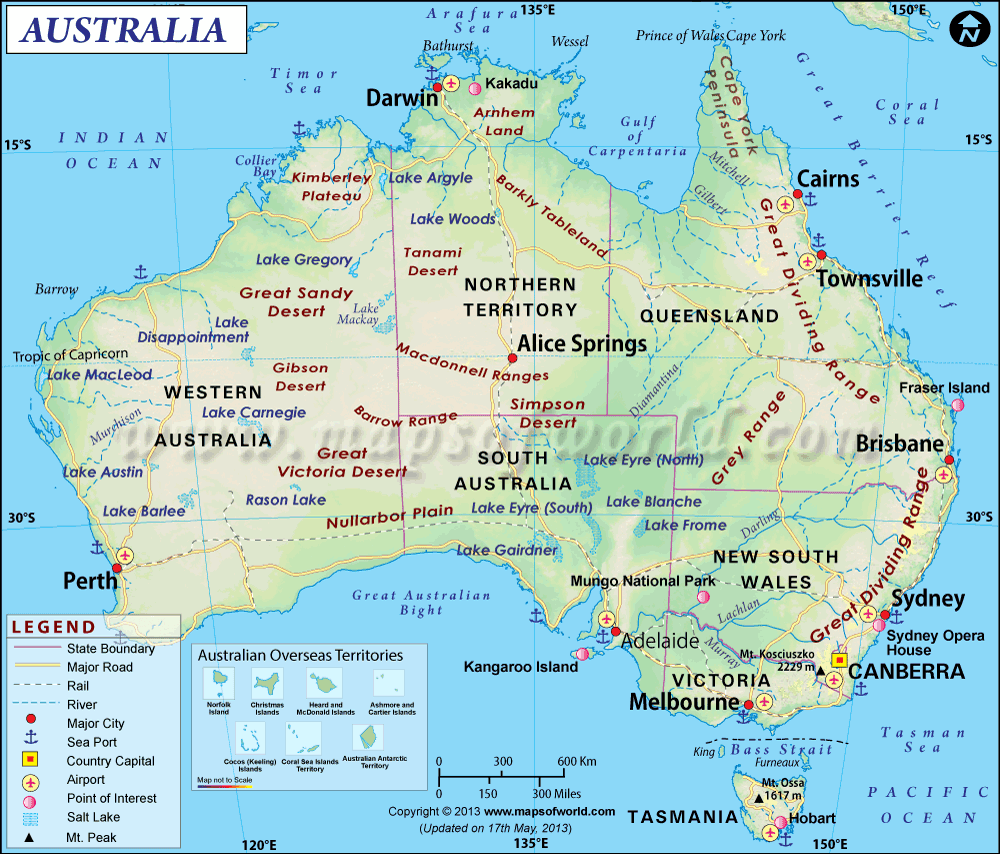
Australia Map 

                       Those of us in higher education know there is steadily increasing pressure to secure research grants. Ironically, at the same time access to funding is decreasing. In my own context, Canada, receiving a grant from our central funding agency, Social Sciences and Humanities Research Council (SSHRC), is getting more difficult. It is not just the increased competition but also, the pool of money seems to be shrinking. I (Clare) read with interest and some sadness about the challenges my colleagues in Australia are facing. The University World News reported:

·      In his speech, Hockey [Australian Federal Treasurer] shocked the nation’s scientists by announcing that the key independent research granting body, the Australian Research Council or ARC, would lose A$61 million from its “discovery programme” and A$42 million from its “linkage programme”.
·      Dr Ross Smith, president of Science and Technology Australia, which represents 68,000 scientists, said cutting A$103 million from the ARC’s budget would further limit its capacity to fund fundamental and applied research – at a time when the success rates for applications for world-class grants are already below 25%.
·      “Australian scientists are afraid this will lead to fewer jobs and training opportunities for our best and brightest. We are also concerned about funding for important humanities and social science research, given the cuts,” Smith said.
http://www.universityworldnews.com/article.php?story=20140109095651863 
My colleagues in the UK are facing untold difficulties securing research grants. It is ironic that federal governments fail to recognize that conducting quality research requires funding and that it is absolutely necessary. Many researchers are in a Catch 22 – show you are an active researcher but do not expect money to conduct research. The short-term effect of reduced research funding is being felt throughout universities world-wide. The long-term effect is yet to be tabulated but I suspect it will be significant. We need research to investigate issues/phenomena/topics because the findings deepen our knowledge on a vast range of topics (which in turn can guide policy decisions). Conducting research is hard work. (Not to mention the time involved in writing a grant proposal — usually 2-3 months.) Let’s not make it so difficult that our research base erodes. Clare

Narratives of Teacher Educators

Book cover

I (Pooja) recently finished reading Negotiating critical literacies with teachers: Theoretical foundations and pedagogical resources for pre-service and in-service contexts (Vasquez, V.M., Tate, S.L, & Harste, J.C., 2013). This book provides a theoretical framework, insightful examples, and pedagogical resources for ways to incorporate critical literacy practices into pre-service and in-service teacher education. The final chapter of this text entitled “Teaching and living critical literacies” especially interested me. This concluding chapter focused on the narratives of the authors who are all teacher educators. They shared early childhood memories, classroom teaching experiences, and turning points (e.g. being the first in the family to attend college; protesting the Viet Nam War). Much of what the book’s authors shared in their written narratives reflected closely what many of our critical literacy participants in our SSHRC study have expressed. Many can identify turning points and life events in their early childhood, which contributed significantly to their philosophy and stance towards teaching and learning. Maya from our study identified being placed in a low-track after immigrating to the U.S. as a defining moment. This has influenced her practice because she now focuses on having her student teachers understand multiple perspectives and interrogate their assumptions of students, curriculum, and schooling. Providing a specific example of this pedagogical stance, Maya told us about how she conducts an entire lecture in Spanish, locating student teachers as second language learners.

This final chapter reinforced how meaningful it is to create space for the voices of literacy teacher educators.  The narratives of our participants are rich with experiences that influence their practices in the classroom. Stacie L. Tate, book author and teacher educator, articulates this well: “When people ask how I decided to become a teacher and researcher, I always reply, “I was groomed for this.” (p. 99).

Just Call Me Paul: The Ethnicity Saga Continues

On Monday I (Clive) shared my previous blog on multicultural education and stereotyping with my social foundations class. This proved to be a great literacy activity on blogging as a writing form that both teachers and students need to master, one that helps us clarify our ideas and make our communication more precise. It also renewed our conversation about how to approach ethnicity in the classroom. We went round the whole class, each person commenting in turn on the blog. No one chose to pass and everyone was interested in what others had to say. A couple were struck by my profile of “Mike”: they had no idea that people of Irish and Scots background might look down on each other. On the whole people liked the blog, but they continued to refine points and add personal stories.
We heard a new story of complex ethnicity from a class member of Indian ancestry who grew up in Madagascar, lived in a French-speaking environment for several years and became fluent in French, spent time in India where she was told she spoke Hindi with an accent, and then moved to Canada where she hopes to teach French as a second language. What is her ethnicity?
Then on Tuesday the wonderful personal essay “Just Call Me Paul” appeared in one of our local newspapers. http://www.theglobeandmail.com/life/facts-and-arguments/changing-my-name-doesnt-mean-im-betraying-my-identity/article16406166/

G. Paul Sileika’s grandparents migrated to Canada from Lithuania over 50 years ago. In the 1970s when multiculturalism was on the rise his parents decided to give him a name that “reflected their ancestral origins.” They named him Gintaras and called him Gint for short. With rich humor, no self-pity, and trenchant common-sense he talks about the impact of this decision on his life. The whole article is well worth reading.


What struck me especially was how he felt his identity was lost. “Before I can even begin to build rapport with someone or connect on a common interest, my name catches his or her attention. Before I can share my personal story one is already written for me.” Because the name was unfamiliar and difficult to pronounce correctly (the “G” is hard), many called him “you” or simply nothing. Long after finishing university he finally decided to switch to using his middle name – Paul – and hasn’t looked back. He says he believes in multiculturalism and is proud of his heritage, but wants to go by Paul in informal contexts and G. Paul in formal ones; if anyone asks what the G. stands for, he’s “happy to tell them.”


Of course, although you can change your name you can’t change your accent or physical appearance. But Paul’s story illustrates well how we should often move beyond such markers, rather than dwelling on them unduly – as so often happens in multiculturalism classes. While prejudice and discrimination must be studied in depth and actively opposed, there’s so much more to a person than the ethnicity of their parents and grandparents. We must also explore and celebrate their constantly emerging individual identity, of which their complex ethnic identity is just one part. Otherwise, like Paul, much of their identity may be lost.


International Baccalaureate symbol

IB schooling in Mumbai

While in Mumbai, I (Pooja) had some candid conversations with my cousins (who now have school-aged children) about schooling. The International Baccalaureate (IB) has quickly become the new standard. My cousins spoke highly about the IB curriculum, noting that it encouraged students to view themselves as “global citizens.”  The curriculum, they commented, deviated away from that of traditional schooling in India. The skills were now focused on: critical thinking; intercultural awareness; independent learning; evaluating and constructing arguments; and independent learning.

The pressures to get their children into an International Baccalaureate (IB) program were high. My cousins already had aspirations of sending their young children to top-performing universities outside of India (mostly in the U.S., Canada, and U.K.).   A major concern I heard was that if they did not get into an IB program, how would they compete in this highly globalized world? I understood this to mean that in order to be competitive one had to be complete their formal education outside of India. This  was concerning  because competition aside, IB schools are extremely expensive, and so, not available to the vast majority of families in India. While very few are privileged to apply and possibly attend IB schools in India, most school children in India still attend public school. I am interested in learning more about the public school curriculum in Mumbai? How are public schools currently preparing their students to be  “global citizens?” or is this a notion that is still intangible for most? Pooja

Unsung: Behind the Glee: A MUST Watch Video

There is an amazing documentary, Unsung: Behind the Glee, which chronicles the journey of two rival Toronto high school glee clubs as they gear up for a musical showdown at the annual Show Choir Canada National Championship.Musical Notes

http://ww3.tvo.org/video/196690/unsung-behind-glee

 This documentary is fascinating because
·      it has incredible music and dance;
·      shows the value of the arts in the lives of some adolescents;
·      and clearly demonstrates the commitment of teachers.
Yes it is a competition (and many of the students are elite singers/dancers) but it is an inside look at the work and enthusiasm of teachers and students alike. For some students their involvement in music and dance literally “saved” them. For some of the teachers, their music/dance groups are like their family (they scold, praise, encourage, laugh, cry). There are powerful stories of kids overcoming huge adversity through their involvement in these musical groups.
Clive and I watched it last night and I was moved to tears. It is only available until January 27th so give yourself an hour (stop preparing for class or marking or doing housework ….) and watch it.
For those of you not in the arts (like me) it was very informative. For those of you in the arts you will probably relate to the stories and unfolding events. Whether students are elite or just enjoy music and dance (for appreciation), the arts have a very important place in the curriculum and should be well funded. The arts are not a frill but are part of the basics of life.
Clare

Happy New Year

 Today is New Year’s Eve and newspapers are full of descriptions of resolutions for 2014. I am not one for making resolutions (maybe because I know that I will not keep them) but this year I am motivated to make a few.

Balloons

  • ·      Keep blogging. Much to my surprise this has been a fabulous activity. I hope that our readers are enjoying the blogs as much as we have enjoyed writing them.
  • ·      Do not push myself so hard – in other words, relax a bit. Everything does not need to be done ASAP. Emails and work can wait.
  • ·     Keep learning about digital technology.  Time to take a few more steps integrating DT into my teaching.  Time to learn how to use Twitter!
  • ·      Stay connected to family, friends, and colleagues. They keep me grounded.

Best wishes to all of our readers for a happy and healthy 2014. Clare

Ice Storm

Our blog has been a bit quiet for the last few days because I did not have internet. Southern Ontario and thCar with tree limb resting on it e east coast of Canada and US have been hit by a huge ice storm. The storm raged for a few days which knocked down power lines and has devastated some communities. Attached is a picture of a tree limb that fell on a car parked in front of our home. Luckily, we had power but no internet, phone, or cable TV. Interestingly, when our system went down, I stood in the kitchen and just looked around, somewhat like a lost soul. The internet is so integrated into my daily life, I felt like part of me was missing. I do not want to say that I am “dependent” on the internet because that seems to have a negative connotation; rather, digital technology is just part of my day to day life. Wanting to check the progress of the storm, remaining current with the advisories from the government (re: power outages), and being able to check on family and friends were suddenly not available. Eventually, it dawned on me to switch my phone and IPad over to 3G which I did so I was semi “back in business.” But the experience reminded me how much my communication patterns have changed in just a decade. We need to be preparing teachers and students for 21st century communication processes and patterns. For those of you who experienced this major ice storm, I hope that you are safe and that your home was not damaged. Clare