Category Archives: teacher educators

Treasuring Picture Books

Like many literacy teacher educators, I (Cathy) sometimes tasked my student teachers with bringing in, or finding pictures of (if possible), their favourite picture book from childhood. My student teachers loved this task, and were excited when someone else brought in the same book.  I often saw Mr. Muggs books; Robert Munch books (especially I Love You Forever); Amelia Badelia; Madeline, and; super hero comics!  But I never saw mine.

As late as grade five, I would sneak the book home, terrified of being teased or bullied for taking it out of the library.  It was a book for little children after all, but I loved it so. It was worth the risk.   It was called, When the Root Children Wake Up.  I have searched for a hard copy to own, but have never found one.  I have discovered many newer versions (Helen Dean Fish’s, Audrey Wood’s) and as lovely as these illustrations are, they simply don’t touch me the same way. 

            Recently, however, I discovered my treasured version posted in the International Digital Children’s Library. ( http://www.childrenslibrary.org/ )  The author is listed as Sibylle von Olfers (1881–1916), and the text is in German.  I suppose the book was originally in German. I had no idea the book was so old.  The title is different than I remember, but I actually held my breath when I saw the illustrations again.  Those were the pictures I held dear: so simple, so precious.  I still love them.

What’s your favorite picture book form childhood?

wake up the root childrenroot mother

parade

Reflections on My Teacher Education Program

I (Clare) am currently teaching a graduate course Current Issues in Teacher Education. The first assignment asks students to:

Write a reflection paper on your experiences in a professional program (teacher education, Teaching English as a Second Language ….). Provide a very brief description of the program. Some questions to consider are: What were the strengths/weaknesses of the program? How well did the program prepare you to assume the duties of a teacher? What were the limitations of the program? Have your views of the program changed since graduation? How could the program have been improved? Did the program prepare you to assume the duties of a teacher (or other position)? Do NOT respond to all of these questions. Select one or two and respond to them. In the fourth class of the course, you will work in small groups and share your paper with your fellow students.

Since all of the students in the course are teachers they have a good perspective on their program. Their assignments were so stellar I felt these would be of great value to share with other teacher educators. Over the next few weeks I will be sharing these papers. I learned much and I suspect you will too. I have changed the name of the university so that no school of education is identified.

I obtained my Bachelor of Education at XXX in 2012, a program I applied to because of its reputation in teacher education. My cohort was a new cohort, to the best of my knowledge, whereby sixty students met daily at a site in North YYY, rather than driving downtown to campus every day. The professors mostly came to this site, although we did go downtown once per week for other courses.

How well did the program prepare me to assume the duties of a teacher?

The XXX program consisted of several subject-specific courses and three practicums of one-month length. I will first discuss the effectiveness of the courses as preparation for teaching, then analyze each practice teaching experience.

Courses:

Although I only graduated from XXX four years ago, I do not hold a great memory of much course material, rather I hold a memory of how engaging the individual professors were. Similar to the article WHY TEACHER EDUCATION IS IMPORTANT, my assessment of the extent to which the courses prepared me for teaching is highly dependent on the individual course and the professor teaching it. Professors that relayed advice and shared knowledge in a manner that was relatable and relevant for my certification were most effective in helping me acquire the skills I needed. As I reflect, I realize that my memories and perceptions lie more with the professors than the course material itself. Professors such as AAA, BBB and CCC left me feeling content with the program, as I had a lot of priceless learnings from our time together.

The professors who were most effective in preparing me were the ones that presented scenarios that could be used in everyday classrooms. For example, BBB impressed me each week with different ways to engage students in mathematics, as did AAA for history. I have since used many of both their ideas quite successfully in my own classroom. In fact, I still refer back to my notes from my time with them, in search of useful ideas and ways in which I can improve my lessons. I hold them both in high regard because their ability to give me practical, subject-specific tools to use in the classroom helped not only to prepare me to teach, but continues to impact my teaching today.

Another individual professor that helped prepare me to teach was CCC. I highly enjoyed the Teacher Education Seminar course, because she was engaging, realistic, and down-to-earth. She told stories of her experiences as a principal, and how she dealt with challenging situations. I am confident I can speak on the behalf of our entire cohort, who immediately felt like we could relate to her and learn from her. She taught us very important practical lessons for the classroom; her anecdotal discussions served as eye-openers to some strategies on dealing with behavioural students. My colleagues’ appreciation for her was universal; she had a lot to share, and we knew that our time with her was valuable.

On the other hand, I recall professors that taught courses that I dreaded attending. One in particular I remember vividly. The main reason I feel that she was ineffective was that I could not use her strategies or relate to them. She seemed to have such a vast experience in the kindergarten/primary grades, so much so that all her ideas and resources were geared towards teachers who were attaining their primary/junior (K-6) certification. Because my group was junior/intermediate grade 4-10), we would listen and walk away knowing we could never use her strategies, as they were not appropriate for older grades. So, that particular course did nothing to prepare me for my upcoming career. As a result, when I began teaching grade 7 subject JJJ, I had no idea where to start. How do I engage my readers? How do I teach them how to write? All this knowledge I then learned from the famous Internet and from my peers. I walked away from that language course with minimal knowledge and confidence on how to teach language to intermediate students.

Practicums

I consider myself very lucky as I had wonderful supervisory teachers for two of my practicums. I will discuss the three experiences separately.

Practicum 1

In my very first practicum, I was paired with a grade 7 teacher in a Catholic school. I instantly noticed that although she was stern with the students, and demanded respect and good behaviour from them, she was also very well-liked. I realized that although these intermediate students need strict boundaries and structure, they also need to feel that they can relate to their teacher; it is such a fine balance. This particular practicum taught me about the teacher-student relationship, as well it prepared me to deal with the wide range of student abilities in one the classroom, as it was my first time working with students with learning disabilities and IEPs. My experience at this school taught me about the socioeconomics in the classroom, and that each and every student has a story, many heartbreaking. These learning experiences were priceless and definitely shaped my empathy for students and my knowledge that each student’s individual needs must be identified and met, which absolutely helped prepare me for the duties of a teacher.

Practicum 2

My second practicum was with an equally talented teacher with a lot to offer. She was highly respected in the school, and in fact, by the last week of my practicum, had been promoted to vice principal. She took teaching very seriously and strived to optimize her students’ learning. Although she did not have the bond with the students that my first supervisor did, she gave me endless, practical classroom advice that I apply to this day. For instance, I am a quick-thinker; I do not need time to process things, however that does not mean that students think the same way. It was her that brought to my attention that when I ask a question from the class, I need to wait to give all students the time to process the question. By opening up the doors for everyone to think, and I then optimize participation and opportunities for all students. This was a huge learning experience for me, because it made me realize that I was not being equitable by rushing and calling on the first student. She taught me other invaluable lessons such that boys tend to be more dominant than girls, and teachers tend to choose boys more often to respond to questions, so one must be conscious to balance the opportunities. Amongst other reasons, I believe that I am a more effective teacher because of my experience with her.

Overall, my experiences are consistent with The Limits of Socialization findings that my teaching was definitely influenced by my practice teaching supervisors, and I do hold them in special regard.

Practicum 3

My third practicum was one of my choice. I chose to return to the school of my first practicum as I was given the advice that to optimize job opportunities, it is best to get better acquainted by one principal, who could then influence the hiring process. My third practicum was in May, which was just prior to the dreaded EQAO testing (standardized math/literacy test). So for that month, I rotated between a grade 5/6 classroom and a grade 2/3 classroom. While the homeroom teachers taught the 5s and 2s respectively, I spent time with the 6s and 3s, helping them prepare for EQAOs. Yes, the preparation for EQAO defeats the purpose of the testing, but I had a job to fulfill.

My experience in the 2/3 classroom was quite eye-opening. Unlike my other practicums, where I witnessed the strengths of my supervisors and internalized their approaches, in this situation, I saw the weaknesses of the classroom teacher, but equally learned from this experience what I do NOT wish to emulate. This teacher spoke of students as ‘dumb’ and ‘clueless’; she labelled some as ‘lost causes’, and instead of offering them support and trying to learn how best to teach them according to their needs, she degraded them. I walked away each day thinking that she did not deserve her job, and that there were so many patient teachers looking for a job, that it is unfair that she should keep hers.

Similar to the other practicums, this experience also helped prepare me to be a teacher. I recall learning an invaluable lesson on test anxiety. While the grade 3 students were writing a test, I noticed one boy kept looking around the room; he seemed concerned with the speed that others were going and looked overwhelmed. So I went over to him, and I covered up every question on his paper except the one he was working on. I told him to read it carefully, and take his time. Each time he completed one question, I uncovered another, until we were done. Unlike all his other assessments, he performed phenomenally on this one. I did not give him any advantage; I did not read the questions or give him clues when he was right or wrong. I simply asked if he was ready to move on each time. When I told the classroom teacher about his success, she said he was “low” and that I would have to write on his paper that he achieved that mark with teacher support. My only support was recognizing his anxiety and helping him work through it. This was so upsetting to me that she could not see that he had a simple need that could be easily met. Suffice it to say that this experience in her classroom was invaluable to me, as I will never forget how she treated those wonderful young children and I vowed never to do the same.

How the program could be improved

There are only minor suggestions I would have to make the program more effective.

With respect to the course component of teacher education, I recommend that the university continue to have the student teachers evaluate their professors, so that the professors can reflect on this feedback and do their best to improve their practice. I do recognize though, that one cannot please everyone, but still feel it is a beneficial exercise.

As for the practicums, I suggest that the practicums should be longer in duration and/or more frequent, and that supervisory teachers be given some sort of duty release, so they could spend more time mentoring the student teachers. One of the challenges of my practicums involved the limited time the supervising teachers had to spend with me when the students were not present. This is also mentioned in The Limits of Socialization article: supervisory teachers are not given any reduction in workload or compensation for their role. I am a person who is full of questions, and there was so much I wanted to know, yet so little time! We were so busy during the day with teaching and lesson planning that there was no time for discussion. So, although my practice teaching experiences were invaluable, had the supervisory teachers been given some relief from duties, I would have benefitted from more one-on-one ‘pick your brain’ time together. I also think that the supervisory teachers should be carefully chosen to be exceptional teachers, to ensure an optimal experience.

Conclusion

Overall, the extent to which my program prepared me to assume the duties of a teacher rested greatly on the specific expertise and teaching styles of the individual professors and supervisory teachers, independent of the course material.

I must include that I was not the typical teacher education student, as this is not my first career. My experience and corporate training in preparation for teaching/training roles outside of education helped make the transition to teaching seamless, and definitely played a role in preparing me. However, I recognize that most young students do not have those experiences to call upon, and must rely solely on teacher education to prepare them.   So my evaluation of my teacher education program would probably vary drastically from that of a twenty year old.

I feel it is important to mention that the same aspects that I liked about my program would often be the subject of the complaints of others in my program, which leads me to conclude that teachers’ appreciation of any program stems from their own perceived needs as learners, and whether or not the program meets those individual needs. However, I must add that until reading about the Curry School of Education, I did not think a universally effective system could exist. Now, I find myself thinking that that article was either the best sales pitch I have ever read for a teaching university, or the Curry School truly has managed to achieve all that a program should embody!


How Self- Selected is Self -Selected Reading?

I (Cathy)  was touched by the following tale shared by guest bloggers Burkins and Yaris (Think Tank for 21st Century Literacy) on Brenda Power’s Choice Literacy blog site.  The post is titled, The Tyranny of Levels. It reminded me of the time I was visiting a classroom to observe my student teacher and saw two bins labelled Boy’s Books and Girl’s Books.  When I inquired about the bins, my student teacher assured me the children never dared choose from “the wrong bin.”  I was mortified.  Thankfully my student teacher also was mortified.  After that experience, the tale below did not seem very far fetched…

Daisy: A Cautionary Tale

Once upon a time, there was a third-grade girl, Daisy, who loved to read. She read all the time. While she liked to read about horses and outer space, she especially loved to read stories. She had read every single Magic Tree House, Junie B. Jones, and Amber Brown book ever written.  Recently, she had been into reading books about animals, and had devoured Shiloh and Charlotte’s Web.

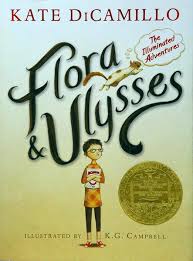
One day, as she browsed through books at the school library, she found a book with a beautiful cover of a girl wearing glasses and holding a comic book. When she saw it, she thought, “That girl looks like me!” She ran her fingers over the letters scrawled grandly across the cover and read the title aloud: Flora and Ulysses.

download

It was then that she noticed a small animal tucked up in the corner, which compelled her to read the back cover. As her eyes skimmed over the words describing a story about a squirrel who gets run over by a vacuum cleaner and strangely develops superpowers, she opened the book and began to read.

Before she knew it, the librarian was shouting a last call to check out books.  Daisy hurried to have her book scanned and joined the rest of the children lined up at the door to return to class. Ms. Wright, her teacher, walked up and down the line surveying the children’s choices. Every now and then she’d murmur things like, “Oh! Great author!” and “You’ll love this one.”  By the time Ms. Wright arrived at Daisy, she was nearly bursting with excitement.  Daisy couldn’t wait to tell her how she loved what she had read so far, and she longed to hear Ms. Wright say what a great choice she had made, choosing a book with a medal on the cover.

However, when Ms. Wright glanced at the book in Daisy’s hand, she looked between the book and Daisy and said, “Oh sweetheart, you’re going to need to return this book.”

Return this book?  Did she hear correctly? Confused, Daisy looked at her teacher who kneeled beside her, looked   her eyes, and said, “You’re a level R.  This book is much harder than that.  Run and put this back. You can choose something from the R bin when we get to the classroom.”

Crestfallen, Daisy handed the book back to the librarian. In her head, she kept hearing the echo of Flora’s voice speaking the same words she said when she witnessed Mrs. Tickham vacuum up the squirrel: Holy bagumba.

What was she going to read now?

Back in the classroom, Daisy dragged herself to the R bin and without even looking, grabbed the book that was on top.  She returned to her seat and muttered the title: Captain Underpants and the Attack of the Talking Toilets. Grudgingly, she began to read.

 Fellow teacher educators, I guess we still have much work to do… Be diligent. Our furture generations need you.

https://www.choiceliteracy.com/contributors-bio.php?id=11


Blending old and new world literacies: Storytelling and Technology

I (Cathy) was recently asked to give a storytelling workshop for a third year Early Childhood Education Class. The professor felt the experience might broaden her students’ concept of literacy.   As a practitioner of multiliteracies (New London Group, 1996) I felt compelled to blend “old world literacy” which in this case would be storytelling (it is the oldest form of entertainment for our species), and new world literacy, which in this case was an online interactive learning system called Today’s Class.  (I have mentioned Today’s Class in an earlier post.  Today you get to hear how I put it into practice).

Initially, the students (a broad range of ethnicities, ages, and English language proficiencies) shared they had never previously experienced storytelling.  They had been read to and assumed this was the same thing.  Most admitted they had never heard of Todays’ Class either, but were game to give it try.  I warmed them up by delivering an old folktale (old world style, just me, them and their imaginations) which blew them away.  “I could see the story!”, and “I was captivated” were some of the responses.  The class was then arranged into small groups of three, each group having a lap top with access to the internet.  Each group was “invited” into the Today’s Class site and asked to give their group a “nick name”.  On the large screen at the front of the room, I posted questions about the storytelling experience for them to consider.  After some deliberation, the groups posted their responses, using only their nick names for identification.  I was intrigued by their reactions as the team responses popped up on the screen.  They were highly engaged.   I could have heard a pin drop they were so intent on reading the other groups’ answers.  When I used to do this kind of activity, the groups used chart paper and markers to record their answers and these were posted around the room.  I usually read out the answers because the printing was often not legible across the room.  Also, I often filtered what I read aloud, instantly deciding what the key points were and only sharing those.   However, with the big screen, it became each students’ responsibility to do the reading and the  filtering. The accountability and engagement levels were higher.

As we moved through the workshop, experiencing different forms of storytelling, the groups returned to conferencing at their computers, analyzing the responses and discussing the salient points.  Both my students and myself were delighted with the results.  Storytelling and technology were a perfect fit.  The students left with a much deeper understanding of an ancient literacy form, many vowing to use it in their child care centers, but also left with a much broader view of the usefulness of modern literacies.   Old and new world do blend.   I couldn’t help but wonder how Aesop might have felt about Today’s Meet.    I think he would have liked it.

New London Group. (1996) A pedagogy of multiliteracies: Designing social futures.  Harvard   Educational Review,1, 60-89.

https://todaysmeet.com/


Teasting your Knowledge of Semiotic Linguists

My (Cathy’s) research focus is on multiliteracies. Understanding the history and conceptual development of multiliteracies demanded I grasp a basic understanding of semiotics, or semiology.  Semiotics is a branch of linguistics that studies signs, symbols, and signification.  However, it is the study of how meaning is created, not what it is.

Sassureimages

Ferdinand de Saussure is generally credited as the father of semiotics.  His book Course in General Linguistics, was published posthumously by his former students Bally and Sechehaye.  It was through this work that Saussure’s Semiology Theory was made public.  His theory was based on the study of signs; a sign being anything that represented something else.  Saussure proposed that communication is a system of signs that convey meaning, but limited his work to the use of words, spoken and written.  Sassure’s most recognized semiotic terms are signifier, signified, sign and symbolic.  (Glossary at bottom of page)

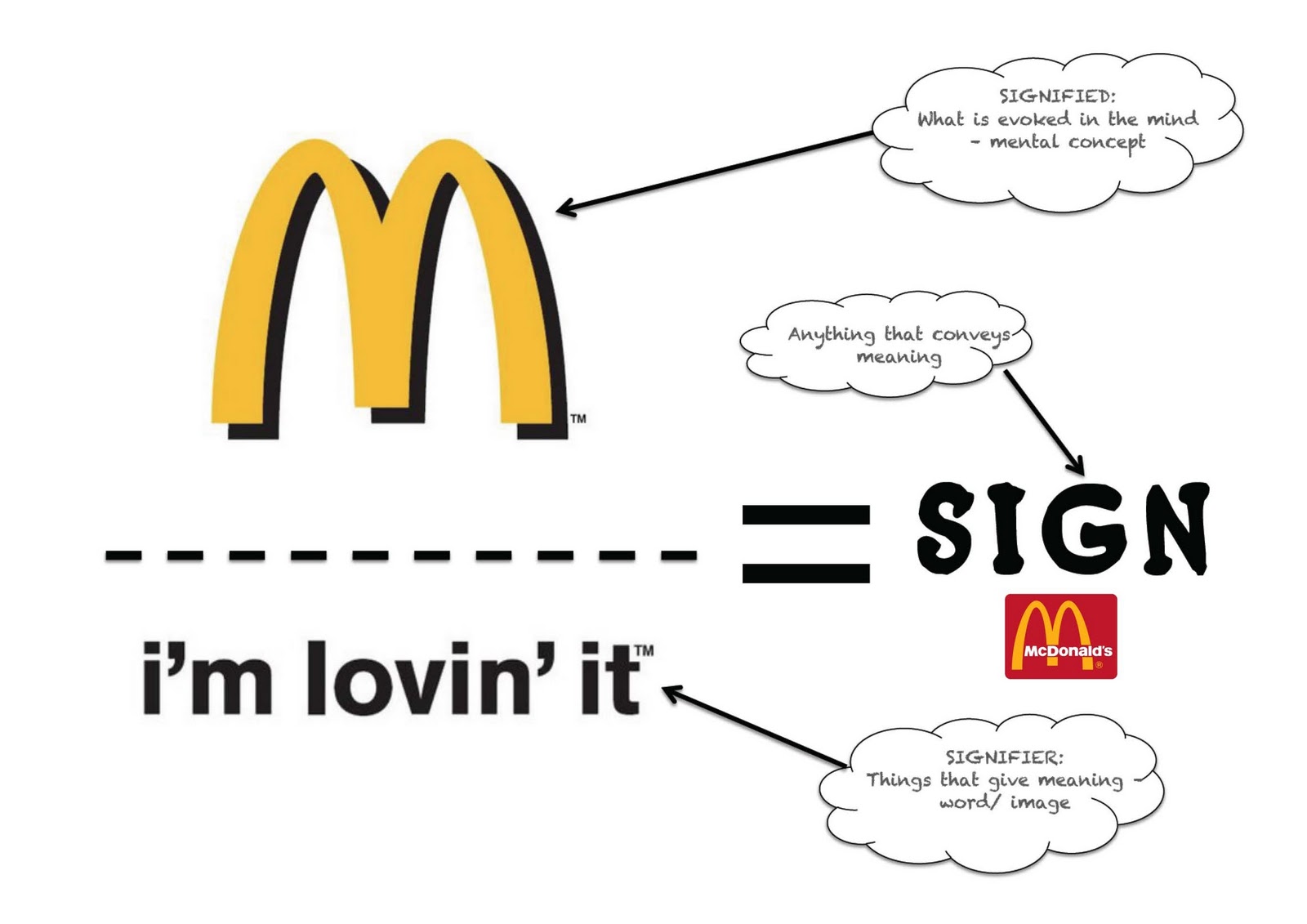
To test our knowledge of these terms, I share the following three graphics. Does their signifier representation signify anything symbolic to you?

Lighthearted Semiotics


 M semiotics-copy

signs


Signifier: any material thing that signifies, e.g., words on a page, a facial expression, an image.

Signified: the concept that a signifier refers to.

Together, the signifier and signified make up the:

Sign: the smallest unit of meaning. Anything that can be used to communicate.

Symbolic (arbitrary) signs: signs where the relation between signifier and signified is purely conventional and culturally specific, e.g., most words.


http://www.uvm.edu/~tstreete/semiotics_and_ads/terminology.html


Cyber -Seniors

“A humorous and heartwarming documentary feature, Cyber-Seniors chronicles the extraordinary journey of a group of senior citizens as they discover the world of the internet through the guidance of teenage mentors.”                                                                                                      Business Insider

Directed by Saffron Cassady, the idea for the Cyber-Seniors documentary began with a high school project that was launched by two sisters. The sisters had the support of their mom, Brenda Rusnak, who had worked her entire career with seniors. After a successful first year, Brenda helped continue the Cyber-Seniors program, expanding it to a second retirement home and helping to engage more youth mentors. Over the next ten months, Saffron and her film crew captured over 120 hours of footage and many memorable moments.  Of this film, the Washington Post reports:

Kerstin Wolgers made it through almost 82 years on this Earth without ever once checking an e-mail, watching a YouTube clip or sending a tweet. But last week, as part of a crash course that introduced her to the Internet for the first time, the former Swedish actress did all three — plus Googled, Instagrammed, Wikipedia-ed, shopped, video-gamed … even online-dated, eventually. “Lots going on here,” she says of Tinder. “It’s really exciting, if you asked me.”

Understanding how significant this program is to the lives of seniors was captured for me (Cathy) in a single moment when I watched one senior weep while he viewed his grandson play the piano via Skype. The differences technology makes in their lives, is remarkable.

Under the Getting Started heading of the web page for this documentary (link below) you can learn how to begin such a project in your community.  It also will let you know when the documentary is coming to a theatre near you.  Personally, I (Cathy) can’t wait to see it.

http://cyberseniorsdocumentary.com/

A delightful trailer for this film can be viewed at:

www.cyberseniorsdocumentary.com.


A Message to Graduates:  Choose Love or Choose Fear

I (Cathy) was deeply moved by a key note address presented at Maharishi University in Iowa that was captured on Youtube (link below).  The convocation address was delivered by funny man Jim Carey who, quite unexpectedly, revealed a rarely witnessed serious and profound side of his personality. During the speech, Carey unveiled a compelling 20 foot-high painting that he claimed took him thousands of hours to complete.  He said he was “weeks and weeks alone on the scaffolding” painting the picture. The painting depicted the metaphoric players in our lives (and in our minds) that drag us down or keep us from reaching our dreams (e.g. misery, the party host, the clinger).  Carey told the graduates that “painting is one of the ways I free myself from concern.  A way to stop the world through total mental, physical, and spiritual involvement.”

Beyond the painting, Carey’s words were also stirring.  Carey stated:

“As far as I can tell it’s about letting the universe know what you want and working towards it while letting go of how it comes to pass. Your job is not to figure out how it’s gonna happen for you, but to open the door in your head and when the door opens in real life, just walk through it.  And don’t worry if you miss your cue, because there are always doors opening.  They keep opening. And when I say life doesn’t happen to you, it happens for you, I don’t really know if that’s true.  I’m just making a conscious choice to perceive challenges as something beneficial, so that I can deal with them in the most productive way.”

Cary concluded the speech by challenging the students to choose between fear or love to guide them in their life choices when they left the auditorium.

Thank you, Jim Carey.

http://omeleto.com/199433/

Teacher Educators’ Perspectives

At AERA this past year, Division K dramatically changed their Business Meeting. Rather than do “administrivia” they used the time to get feedback from teacher educators. In the Division K Summer Newsletter they reported on the feedback. I have copied and pasted some of the report below and included one chart on the most warranted criticisms of teacher educators. Here is the link to the newsletter so that you can read the entire report which provides good feedback for teacher educators. DivKSummer2015-1 Thanks Lin Goodwin our Division K Vice President for moving the discussion forward.

Teacher Educators Talk By: Roxanne Greitz Miller

Division K Program Co-Chair

Chapman University

At our Division K business meeting, we took things to the next level on last year’s theme – Not Business As Usual – and embarked on some original research with the members in

attendance as well additional ones who responded after the meeting electronically. Prior to the meeting, the following questions were posed by our Vice President, Lin Goodwin, as points to consider:

 Of the many criticisms leveled against university-based teacher education/teacher

educators, which do you feel is most warranted?

 Of the many criticisms leveled against university-based teacher education/teacher

educators, which do you feel is least warranted?

 What is one thing you think we should do to address the negative perceptions of university-based teacher education/teacher educators?

During our meeting, attended by 269 people (thank you!), members considered these questions and were able to enter their open ended responses via electronic polling, using either URL or QR code. After the meeting, the URL was distributed to the entire Division K membership for additional participation, and it was posted to our social media links as well. Polls were left open for a week after AERA, and, once closed, the open-ended responses were categorized into common themes and tabulated.

Most warranted criticisms of TE, poll results

DivisionKPieChart

New Faculty Preconference: An Amazing Community

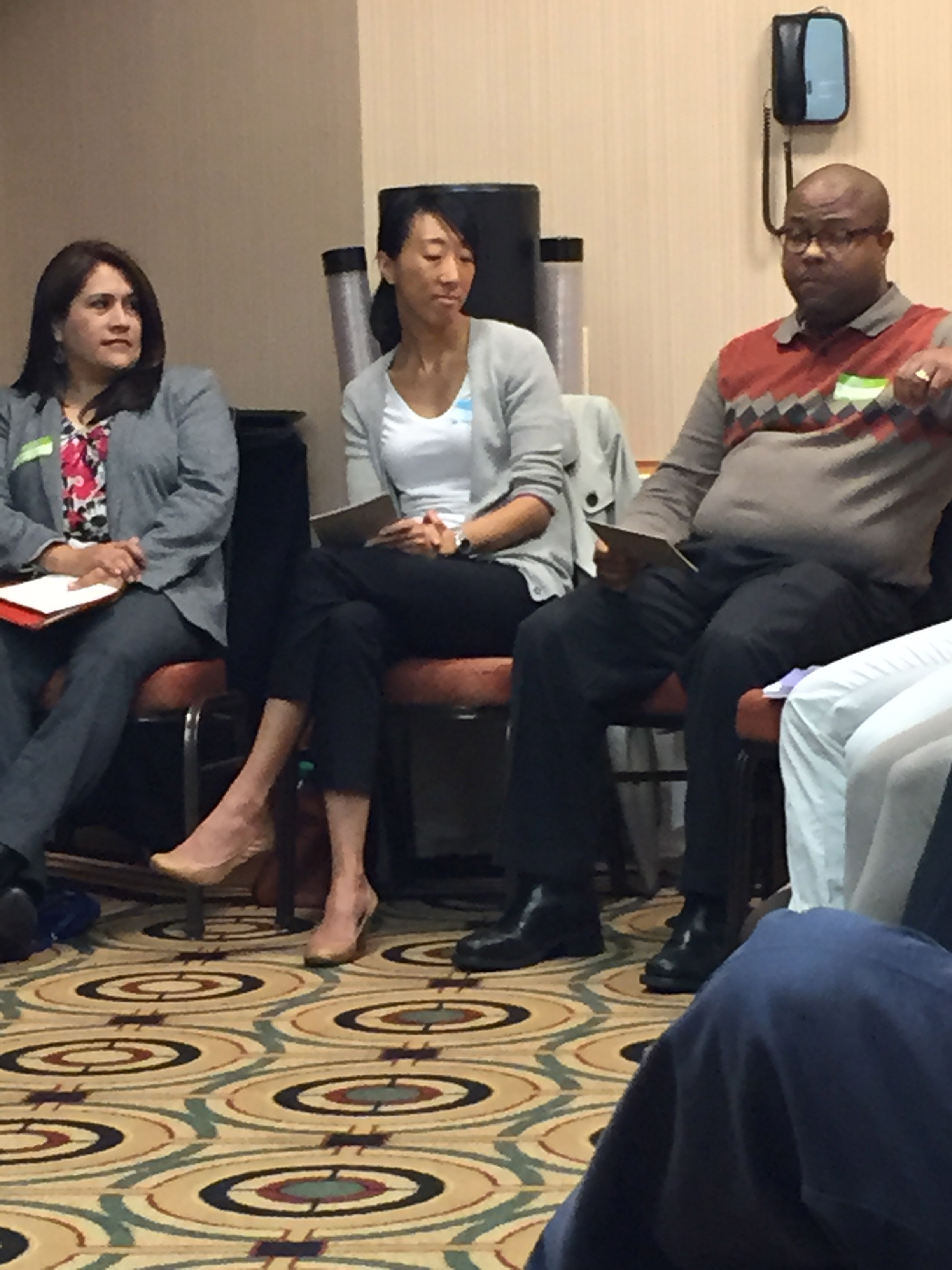
IMG_0304I (Clare) have just returned from AERA. One of the highlights of the conference for me was my work with new faculty. Division K (Teaching and Teacher Education) offers a preconference for new faculty and I was one of the organizers for it. Along with my fellow facilitators, Renee Clift, Rich Milner, Tom Dana, and Valerie Kinloch, we worked with 30 IMG_0289new faculty. On the first day of the preconference we began with the Facilitators sharing their stories – successes and challenges – which helped create an open environment. The participants then shared their stories. It was clear that all were committed to being the best faculty they could be, all had some successes the past year, and the transition to their new role has had some bumps. On the second day we broke into small groups where we addressed: mentoring (finding a mentor and/or academic community); tenure and promotion process; research and publishing; and balancing work and family life. We concluded with each person sharing a “take away” that is something they plan to work on over the next few months.

divknewfacI have been involved in the Division K Preconference for a number of years and this year was particularly special. The IMG_0297Facilitators had so much to share but they created space for the participants. We came together as a community and connections were made among all of us. This kind of support for new faculty is so important because as the literature reveals (e.g., Murray and Male’s work) that the transition from classroom teacher/graduate student to an academic position is not straightforward. There are issues of identity, workplace norms, pedagogy for higher education, academic community, pressure to publish, and …. I know that as a new faculty I would have appreciated having a mentor, a place to ask questions, and to know that what I was experiencing is “typical”.

It was great meeting these wonderfully talented new faculty who are the future of teacher education. I wish them all the best with their various endeavours. I feel that I have made 30 new friends!divknewfac2