Category Archives: teacher educators

Assessing Multimodal Projects

You may remember, in a former post on Mar. 21, 2014, I (Cathy) shared some of my pre-service students’ multimodal projects.  The dilemma facing me after these wonderful creations were submitted, was how to assess them.  As these were only part of a larger assignment, I already had a rubric in place for whole project, but after seeing the brilliance of the multimodal aspect, I felt these alone warranted more thought and introspection on my part.  Having a background in the arts, I was used to assessing creative process and final product, but this was different.  Although artistic and expressive, this wasn’t “art”.  Hence, I looked up a number of sources on assessing multimodal work and discovered a few different opinions.

Kalantzis, Cope & Harvey (2003) argued that a multimodal assessment needs to measure the creative process and the collaborative skills demonstrated.   Jacobs(2013) suggested it wasn’t about the final product, but “watching and noticing what students are doing and then using that information to guide the students toward new skills and knowledge”.  In the end I sought out the opinion of Gunther Kress, the founder of the Multimodalities Theory.  Kress (2003) explained that representation and communication were an affective/cognitive semiotic process and this must be taken into account in the assessment. He suggested that I, as the teacher [educator] should not ask “How does this project match what I wanted or expected?”, but instead should ask, “How does this project give me insight into the interests and motivations of my learner?”  I found this question quite insightful. In the end, I used Kress’ question to guide my feedback, which will hopefully guide the students toward new insights and knowledge.  The required ‘grade’ was based on a combination of the learners’ expressed interests from within the context of the whole project (which was on diversity), the creative process and the collaborative nature of the work.

Through this process I discovered that assessing in the new age of multimodality demands mindfulness, insight and the ability to make many connections.  To be effective, it also requires that the teacher educator, or teacher, know his/her students well.  This type of assessment takes time, but it is much more meaningful. I have to admit, as much as the students loved doing these multimodal projects, I loved assessing them in this “new” way.  We all got more out of the process.  Below is a link to one more student project expressed as POW TOON digital creation.  How would you assess it?

POW TOON Link

http://www.youtube.com/watch?v=9uM68P2rk24&feature=share&list=UUdKEvJ3G8Z-W-geAhhsX9IA
Multimodal Literacy

My (Cathy) pre-service students were assigned a multimodal aspect to a major assignment this year.  If you are not familiar with the Theory of Multimodality, it is Gunther Kress’ alternative to Linguistic Theory (which only privileges reading and writing as the main modes of communication in a school curriculum).  The Multimodal Theory contests that in our new age of multiple literacies, students need to be communicating, responding and expressing through many different modes of communication (e.g. speaking, music, moving, gesturing, image, and digital technology).

When I first introduced the multimodal assignment to my students, there was some trepidation and even some anger.  It was suggested I did not have the right to be marking them on their artistry or on creativity.  Hence, I had to teach the concepts behind Multimodality Theory so they could better understand what we need to be offering students of the 21st century.  They needed to see that it would allow them the freedom to express in modes of their own choosing; that it was not graded as art but as a production of design; and, that the work could be symbolic or interpretive depending on the meaning they were portraying.  The multimodal projects would also be shared in class so all could learn from them.  This project was not just them regurgitating information for me, it was them designing and producing personally meaningful projects that express what they learned and what they deemed significant.

This week we finished viewing the projects.  They were amazing, and the student response to these projects was encouraging.  My students (concurrent students just finishing a five year educational degree) had never been given this kind of an assignment before.  They loved the element of choice; working together; taking a risk; pushing their boundaries; feeling creative; and, doing something they were interested in.  The modes they selected  to express themselves though were sometimes more traditional (dancing, rapping, singing,  writing and reciting  poetry, creating 3D sculptures, puppetry, multi-sensory art installation pieces); sometimes digital (iMovies, pod-casts, prezis, Pow Toons, popplets, infographics);  and, were often a combination of both.

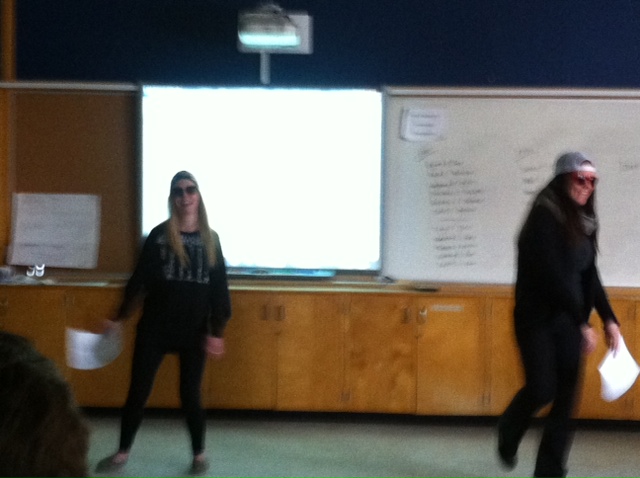
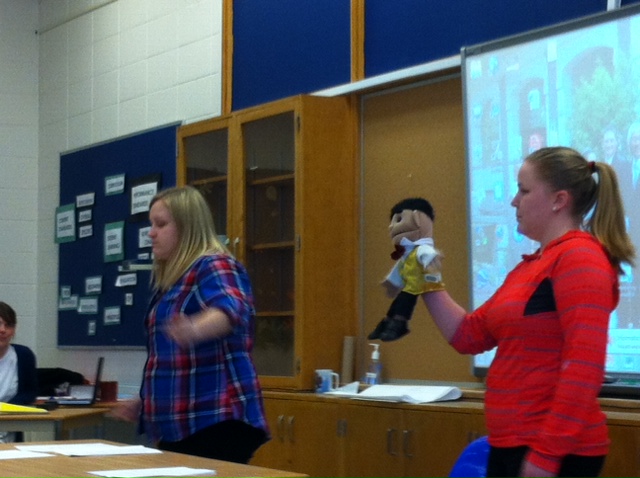
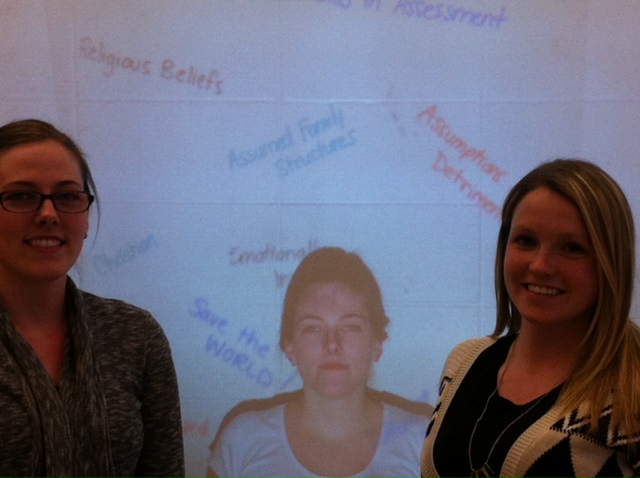
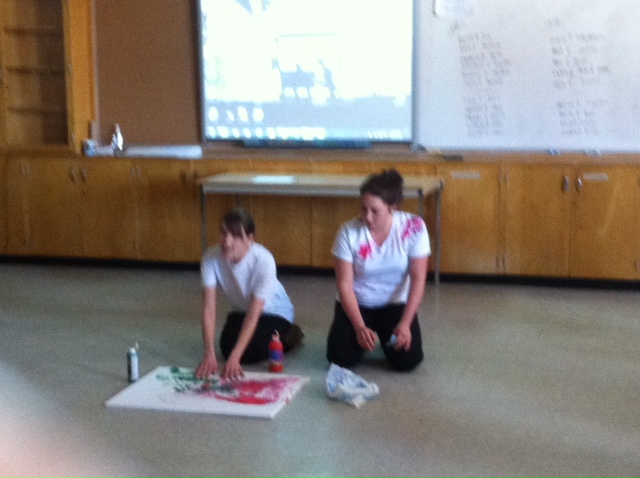
Collectively, we were all blown away by the results.  We were moved.  We were inspired.  My students all said they would definitely use multimodality now as teachers.  Below are a few images of my students presenting their projects:

role play poemfish bowlRAPguitarpuppet photo (13)

Now, I have to assess these designs… but that, dear reader, is for another blog.

Academics in Picture Books: Mad Scientist Stereotype

Yiola’s post yesterday commented on the positive impact of a children’s book. Today I Mad scientist(Clare) want to talk about negative images in children’s books. I came across Melissa Terras’ fabulous research on how academics are illustrated in pictures books. Oh goodness! Academics are typically presented in a very unflattering light (old, male, a bit mad). These stereotypes do damage to our reputation with the general public and are definitely not a positive image we want to present to children. Below are some of the findings from her extensive research which I found to be frightening and discouraging. Check out Melissa’s blog for the entire article: http://melissaterras.blogspot.co.uk/2014/02/male-mad-and-muddleheaded-academics-in.html

What are academics in children’s books like?

The 108 academics found consist of 76 Professors, 21 Academic Doctors, 2 Students, 2 Lecturers, 1 Assistant Professor, 1 Child, 1 Astronomer, 1 Geographer, 1 Medical Doctor who undertakes research, 1 researcher, and 1 lab assistant. In general, the Academic Doctors tend to be crazy mad evil egotists (“It’s Dr Frankensteiner – the maddest mad scientist on mercury!”), whilst the Professors tend to be kindly, but baffled, obsessive egg-heads who dont quite function normally.
The academics are mostly (old, white) males. Out of the 108 found, only 9 are female: 90% of the identified academics are male, 8% are female, and 2% have no identifiable gender (there are therefore much fewer women in this cohort than in reality, where it is estimated that one third of senior research posts are occupied by women).  They are also nearly all caucasian: only two of those identified are people of colour: one Professor, and one child who is so smart he is called The Prof: both are male: this is scarily close to the recent statistic that only 0.4% of the UK professoriat are black. 43% of those found in this corpus are are elderly men, 33% are middle aged (comprising of 27% male and 6% female, there are no elderly female professors, as they are all middle age or younger). The women are so lacking that the denoument of one whodunnit/ solve the mystery/ choose your own adventure book for slightly older children is that the professor they have been talking about was actually a woman, and you didn’t see that coming, did you? Ha!
Most of the identified academics work in science, engineering and technology subjects. 31% work in some area of generic “science”, 10% work in biology, a few in maths, paleontology, geography, and zoology, and lone academics in rocket science, veterinary science, astronomy, computing, medical research and oceanography.
The names given to the academics are telling, with the majority being less than complimentary: Professor Dinglebat, Professor P. Brain, Professor Blabbermouth, Professor Bumblebrain, Professor Muddlehead, Professor Hogwash, Professor Bumble, Professor Dumkopf, Professor Nutter, and two different Professor Potts. There is the odd professor with a name that alludes to intelligence: Professor I.Q, Professor Inkling, Professor Wiseman, but those are in the minority.
Academics are routinely shown as individuals obsessed with one topic who are either baffled Mad scientistand harmless and ineffectual, or malicious, vindictive and psychotic, and although these can be affectionate sketches (“bless! look at the clueless/psychopathic genius!”) academics routinely come across as out of touch wierdos – and what is that teaching kids about universities?  In this age of proving academic “impact”, it might be not so bad for us to be able to show we were relevant to society? That there is more to academia than science? Or for the kids books I show my kids to have more positive and integrated representations of professors and academics? Perhaps this is not the role of kids books though, and I should just be telling my kids my own tales of academic derring-do. 

I think these images of professors can undermine our identity as academics. I certainly do not see myself as the mad professor!


Yiola Cleovoulou wins OISE Teaching Award

Congratulations to Yiola Cleovoulou a member of our research Yiola Cleovoulouteams who has just received the OISE teaching award for Excellence in Initial Teacher Education. She was nominated by her students which in itself is  an honour. This is a very competitive award so to win it is a real  accomplishment. I have team taught with Yiola and know that she is a truly outstanding literacy teacher educator. For more info on Yiola click on the link About Our Research then click on Meet the Research Team. Clare

Teaching Music Literacy – It Ain’t Easy but Must be Done

Young people spend so much of their day listening to music, yet it’s barely addressed in school. Something needs to be done about that – but it won’t be easy. I remember my (Clive’s) grade 5 teacher telling us that Bing Crosby couldn’t sing, he was just a crooner. He probably thought he was “educating” us about music, but he fed into my early prejudice against popular music.

In France there’s a lot of “music appreciation” in schools, which is great because music-making shouldn’t be all we teach. However, again the stress is on classical music.

One of the teachers in our longitudinal study (Candice) recently became a music specialist in her school and established a wonderful approach. In her seventh year she said:

I’ve become keen on the Orff method: it emphasizes improvisation and creating your own music, and leads in the teen years and adulthood to more of a jazz approach…. My focus is on teaching children in such a way that they can create music, understand it, and participate in it. So when they’re listening to pop music they understand what instruments are used, how the music is made, and what mood it creates.

But is there still too much emphasis here on performance?

A respected Toronto columnist recently wrote a rather negative article about popular music. He asked how much of interest could come from a genre where everything is a sentimental song about 3 minutes long in 4/4 time? I asked a musician in my ITE class about this and he said there’s an enormous variety and depth of structure and rhythm in popular songs. We noted that a similar argument could be made against English literature on the ground that it uses just 26 letters and a few punctuation marks (see the quote form Neil Gaiman in Lydia’s recent blog).

Teaching music literacy in schools has many pitfalls. Like the Fiddler on the Roof, teachers will have difficulty keeping their balance. But a way must be found – in many subject areas – if schooling is to be relevant.

A multitude of communication resources

cartoon_newliteracies

When I saw this comic it made me chuckle.  I enjoyed the comic’s gentle reminder that children/youth routinely engage with and expertly navigate a variety of communication tools. Clare and I (Lydia) conducted a two-year collaborative self-study of our efforts to incorporate various technological resources (e.g. a wiki) into our pre-service literacy methods courses. This research helped us identify both the challenges and successes we encountered along the way.  Our research efforts also made us more mindful of why we chose to incorporate certain technological resources into our pedagogical practice — questioning for what purpose and to what end.   Through the analysis of our efforts we realized that we had initially seen technology as an end in itself, not as a tool to support learning. In the second year of the study, we focused much more on student learning and became more systematic in our efforts. Over the two years of the study, our identities as teacher educators shifted as our pedagogies became richer, our use of technology more fully integrated into our literacy courses, and we received validation from others and from each other.

Can you understand what I am saying?

In the New York Times on the weekend, Nicholas Kristof wrote a stinging criticism of academics. http://www.nytimes.com/2014/02/16/opinion/sunday/kristof-professors-we-need-you.html?ref=nicholasdkristof
He notes that when someone utters the phrase “That’s academic” it is a very loaded comment. That retort implies scholars are irrelevant. He quotes Anne-Marie Slaughter who observed that “disciplines have become more and more specialized and more and more quantitative, making them less and less accessible to the general public.” He feels that the PhD programs “have fostered a culture that glorifies arcane unintelligibility while disdaining impact and audience.” Although I (Clare) found his comments a bit harsh there is something sobering about his analysis. Often I find myself reading a journal article on teacher education (my specialty) that I simply cannot understand. The jargon overwhelms the central points and the writing so turgid it is inaccessible. As academics our many masters (tenure review committees, funding agencies, journal reviewers) expect our work to sound “academic” so we are almost forced to employ an unnatural writing style. There is no easy solution. We may not be able to do anything in the short term but in the long-term I hope that our research can be used to inform general discourse about teacher education and public policy. Writing for different audiences is difficult but hey, we academics are quite smart. Let’s take up the challenge to make our work more accessible to many readers.

Multimodal Valentines

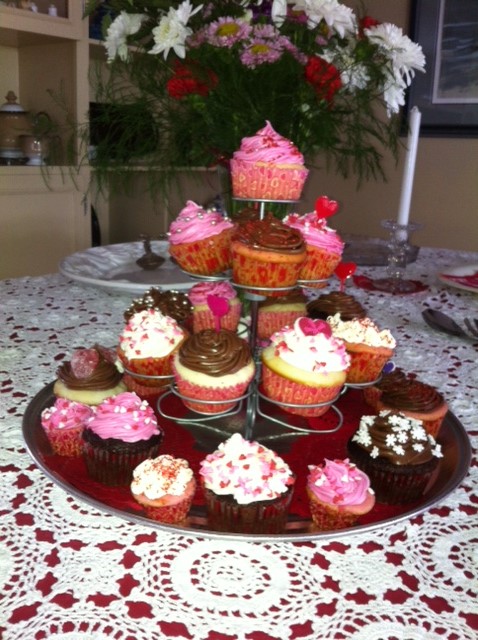
I (Cathy) love special occasions.  Just give me a theme and I suddenly have an opportunity to be creative.  Lately, my outlet is a three dimensional mode of expression- cupcakes!  I can experiment with my designs using colour, texture, size, shape, and taste.  For my Valentine’s cupcakes, aside from the cake and icing choices, there were a multitude of affordances (decorative toppings) to choose from. For this dozen, I decided on a range of tastes and textures:  cinnamon heart candies, red and white jube jubes, tiny snowflake hearts, red sugar sprinkles, silver balls and message hearts.  Remember those tart tasting message hearts?  They say things like “hug me”, “I love you”, “kiss me”, and now there is one that says “text me”- so new literacies!  This is truly a multimodal sensory experience for me (the designer) and everyone that gets one (the receiver of my communication). I see this as a perfect example of my Western culture influences channeling through me to create a social semiotic representation of my caring.  But I won’t tell that to my husband.  All he will see a pretty cupcake that is “Mmmmm, delicious!”  And that’s fine too.  I am not sure if this is what Gunther Kress had in mind when he created the Centre for Multimodal Research, but it works for me.   Happy Valentine’s Day all!photo

Writing a Review Takes TIME

I (Cathy) discovered, having just submitted my first academic book review, that the process takes TIME.   The T in my acronym represents allowing for lots of time to move through the process. The I represents investigating the journal for which I am submitting.  The M is for mining the book under review. The E is for editing- of course- what would writing be without editing?  I developed my TIME acronym through both the experience of writing the review and doing some homework on review writing.  One of the suggestions I came across, which was a valuable piece of advice, was to allow one month to write the review:  two weeks to read the book; one week to write the review; and one week to edit the work.  This turned out to be true.  There was no hurrying the process.  I also spent time reading many other reviews from the same journal for which I was submitting.  This was the investigation part.  I compared five reviews for style, content and length.  One was much more academic in style than the others.  All were not hesitant to praise the work.  This was reassuring, as I liked the book a lot.  The mining part was the surprise.  As I read the book, I listed the things I liked about it and possible flaws, only to discover that when I got to the end, it was not enough information.  I had to read it again and work harder at comparing the chapters for content consistency, look for related themes and any patterns the editors may have requested.  I also spent a lot more time scrutinizing the forward and conclusion and discovered some great quotes I had missed the first time.  This was similar to reading a book in order to teach it.  Impressions are not enough.  I needed more meat.   And finally came the editing.  After several iterations, I thought it was ready for someone else to see.  I gave it to five people to read. Every one of them found corrections and made suggestions. Some I used, while others were stylistic suggestions that I let pass.  All were insightful.  The best part though, was the response.  When one of my friendly editors replied, “You really made me want to read this book!”  then I knew the review hit its mark.  Like I said, I liked the book.  Oh, and by the way, the book is called Literacy teacher educators: Preparing teachers for a changing world.  I recommend it!     BTW  The journal I submitted to is called Research in Teacher Education.  Excellent resource!  Check it out…  http://www.uel.ac.uk/rite

Mapping my morning commute

On twitter this week I (Lyida) read about a storytelling project that invited teachers to use digital tools to capture and represent dimensions of “their world”. The representations  (e.g. pictures, video, audio) were publicly shared on a blog. It would be interesting to use aspects of this idea in a teacher  education literacy course but I wanted to experiment with it first.

   Fruitstand  Subway1

Subway2  Bike  Museum

library