Category Archives: Uncategorized

Technology in Teacher Education: Using Program Resources to Build Capacity

Last week I (Yiola) ran a “mini” Technology Day Conference in our teacher education program. At first I felt it was a large feat given that, while I value and try to model good use of technology, I am a novice digital technology user.  I quickly realized that my own knowledge of digital technology use was of less importance. What was more important was my vision for sharing good information about technology use in the classroom. I sought colleagues within the program who know much more than I do and together we set to work.

The Vision

I named the conference Technology in and for Learning.  The vision was to provide practical sessions on how to use digital technology effectively in the elementary classroom. I wanted these practical sessions to be framed in a theoretical context so students would have deeper understandings for how and why good practice is what it is.  At our institute we work in a tripartite:  the teacher education program, the laboratory school, and our research/tenure faculty.  I set out to find colleagues in each branch of our institute to contribute in some way to the conference.

The People

I found my colleagues were excited to participate in the development and execution of the conference:

Teacher Education — The students were the participants, Members of the practicum team were presenters, and the staff helped organize the event

Tenure Faculty / Research Team — The Presenters

Laboratory School teachers — The Presenters

The Details

A member of the research team designed a professional and stylish website for the Conference where students gathered the information and were able to register. Upon check-in students received name-tags with their sessions and room numbers conveniently recorded.
The afternoon ran smoothly with a thoughtful introduction shared by a research team member on the frameworks for using technology in the classroom. She shared the SAMR http://www.educatorstechnology.com/2013/06/samr-model-explained-for-teachers.html and the TPaK http://en.wikipedia.org/wiki/Technological_Pedagogical_Content_Knowledge models. The introduction brought scholarship to the forefront. Then, the laboratory school teachers shared interesting, informative and practical sessions on a variety of topics related to using digital technology in the classroom. These sessions included the following:

Smart Pedagogy using “Smart technology”

Effective ways to use Interactive White Boards in the ClassroomMore and more classrooms are equipped today with “Smartboards”, making the thoughtfulness and effectiveness with with teachers use them, an increasingly important task.  In this workshop, you will learn the fundamentals of using interactive white boards (IWB’s) in your classroom, but also how to combine the use of this amazing technology with a student-led and inquiry based community and curriculum.

iPads in the Classroom

We will discuss various ways to use iPads in the classroom for a whole group and small groups. We will highlight apps – especially free ones – that are both fun and useful, focussing on supporting different learners. We will touch on both positive aspects and drawbacks of integrating iPads in the classroom.

Technology to Support the 4 C’s

Communication, Collaboration, Creativity, and Critical ThinkingThis session will explore several ​examples of technological tools which can be used in the classroom to foster communication, collaboration, creativity, and critical thinking. Some of the tools considered will include Edublogs, Zydeco, Earth Tours, Plickers, Minecraft, and Twitter.

Knowledge Forum

Knowledge building is the process by which new knowledge is created. In one sentence, it can be described as “giving students collective responsibility for idea improvement.” Knowledge building starts with the natural tendency to play with ideas, but extends to the unnatural tendency to deliberately improve them. Knowledge building is a collaborative process, and moves forward through a collective effort to advance frontiers of knowledge, as these are perceived by the community.Knowledge Forum is a multimedia environment that supports emergent idea development and sustained, collaborative dialogue, helping learning communities capture their thoughts and questions, connect and organize their ideas, and build knowledge together.

In this hands-on workshop you will learn the fundamentals of using Knowledge Forum to support the learning in your classrooms.

Teachers Using Technology in Literacy
Classrooms

This session will look at various ways of engaging students with technology in the literacy classroom. Examples of using technology to promote reading and writing skills, and motivation for literacy will be discussed and shared.
The conference concluded with a panel discussion and question/answer.
It appeared that the students enjoyed the sessions. The goal was to provide an opportunity to think more deeply about the value of and use of technology in learning.  We have sent out a feedback survey so we will know what students liked and what suggestions they will have for improvement.
I am glad that I took the risk and designed a mini conference for our students.  It was a good start. The use of digital technology in the classroom is not my area of expertise but it is certainly an area I want to have more fluency. Working with my colleagues who do have more experience in the area was not only provided benefits for our students, I too learned a great deal!

FDK update: Language and the Arts

Today is a holiday in Ontario and in several Canadian provinces: Family Day. A day to spend much needed time with family. Family Day comes at a good time since temperatures are beyond unbearable to many (me! ~ Yiola!) and the winter blahs bring a natural insistence to just take an extended break.

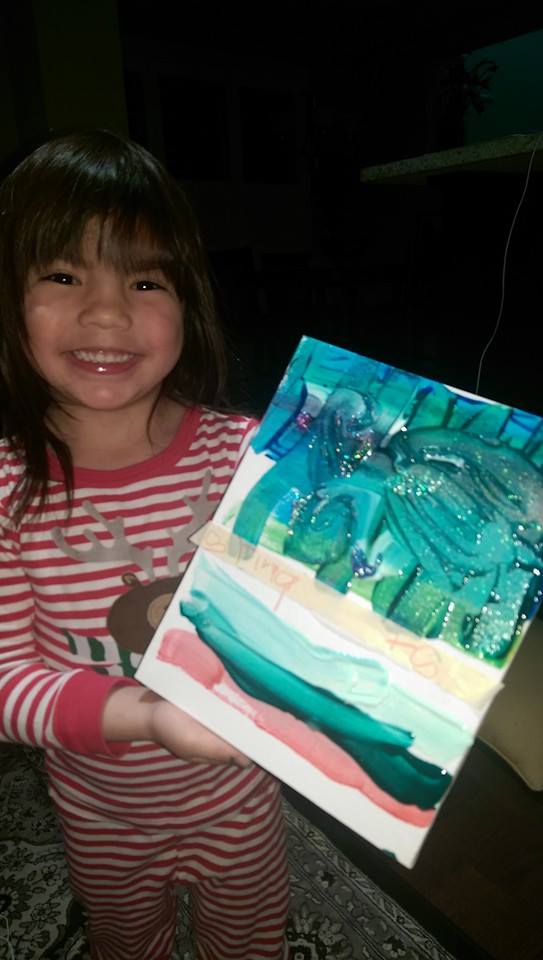
In honour of Family Day I would like to share a story about my family and how my Sylvia Clare (my four year old) is getting along in FDK.  About one week ago, while at home Sylvia Clare decided to paint. This was not unusual as she often paints at home. What was new was her language and ideas about art and herself.  She ushered me to the playroom, took the lead and began to explain that we were going to explore lines.  Lines I thought? So Sylvia Clare understands an element of art?  I sat in silence with what I imagine was a curious look on my face as she continued with confidence: “I’m an artist”.  Those words screamed at me with sheer joy and power. I had never called Sylvia Clare an artist… it was not something I thought of doing, although of course in my heart and mind I believed my child was an artist and a scholar and an athlete and a…..   ”

“Now mommy, you need to wear a smock so your clothes stay clean and roll up your sleeves. Please get the paints”.I followed her instructions.  Next thing I saw was Sylvia Clare carefully dividing the canvas. She began at the bottom and drew careful lines across the canvas using primary colours. Then on the upper part of the canvas she created thick textured, almost bubble like “scribble” where she mixed the colours. The entire time she was talking about her art: “Here mommy I am painting straight lines with primary colours, you see? And up here (top of the canvas) I am trying to see what scribble is like and I added some sparkle”.  She spent a lot of time working on her art and I sat and watched in amazement. Here are some pictures of Sylvia Clare from that day:

sylsmock

sylpaint

paint


Days passed and I wondered how Sylvia Clare was able to develop such clear language about the arts and conceptually understand the elements and most importantly to see herself as an artist. And then, the FDK newsletter came home.  The teachers shared the following in the newsletter:

The students have also been learning about a modern artist names Piet Mondrian from the Netherlands, who used primary coloured shapes and black lines to create famous pieces. They have used his method to create their own line designs. We have also experimented with bubble wrap. Some of the children are referring to themselves as “artists” now…

How one perceives oneself is often how one becomes. Sylvia Clare sees herself as an artist. She can talk about the arts and she confidently engages in art work.  So, on Family Day today I am certain we will be back in the playroom painting and playing and reading and doing… and I am sure that I will be the one who will learn the most.

Happy Family Day!

Using Improvisation Techniques in the Classroom

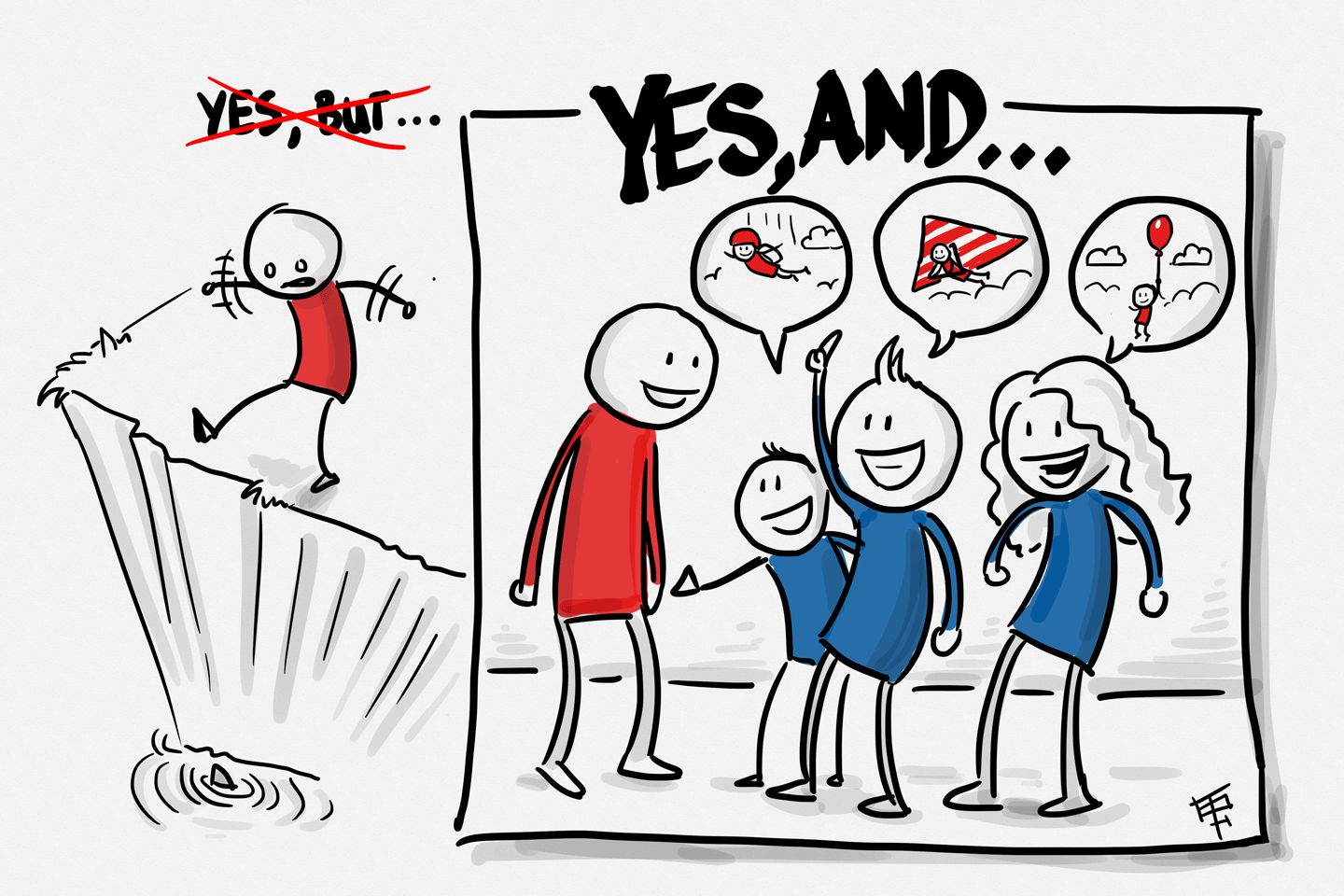
Image source: Mindshift.org

I’ve been to a few improv shows in my life, and whenever I walk away I am always in total awe of the performers. Their ability to think on their feet AND be funny while doing it is so impressive. That’s why when I came across the idea of using improv techniques in the classroom I was intrigued. Linda Flanagan from the blog Mindshift describes how the four pillars of improv(creativity, critical thinking, collaboration, and communication) are developed by following one simple rule: “Yes, and…” This means that any idea or suggestion is welcomed without judgment. This unconditional support helps improv students overcome fears and act without inhibition. It is no wonder why many educators are using tenets of improv in their classrooms.

Flanagan says:

Improv enthusiasts rave about its educational value. Not only does it hone communication and public speaking skills, it also stimulates fast thinking and engagement with ideas. On a deeper level, improv chips away at mental barriers that block creative thinking — that internal editor who crosses out every word before it appears on a page …

 The article suggests both beginner and experienced improv activities for teachers of all levels to try. Read the link below to find out more:

http://blogs.kqed.org/mindshift/2015/01/how-improv-can-open-up-the-mind-to-learning-in-the-classroom-and-beyond/


What counts as a “real” word?

Last week Clare shared a TED talk exploring how texting is affecting language (If you haven’t read that post, here it is: https://literacyteaching.net/2015/01/22/txtng-is-killing-language-jk/ ). In a follow-up to her blog post, I am sharing another fascinating talk on “What Makes a Word Real?”

English Professor, Anne Curzan, poses questions to the audience which intend to challenge what makes a word “real” and who gets to decide. She asks: “Who writes dictionaries?”; “Are you bothered by language change?”; and “Who has the authority to make a world real?”

Curzan believes words are made “real” when a “community of speakers” use a word often and for a long time. She makes the point that these words “fill a gap” in the English language. Funny examples of words she’s seen gain traction recently:

                    Screen shot taken from TED Talk

Curzan argues dictionaries have been viewed as a book of truths not to be critiqued for too long. In fact, she points out that dictionary editors look to us to decide what words are “real.” In conclusion, she states:

 “Dictionaries are a wonderful guide and resource, but there is no objective dictionary authority out there that is the final arbiter about what words mean. If a community of speakers is using a word and knows what it means, it’s real. That word might be slangy, that word might be informal, that word might be a word that you think is illogical or unnecessary, but that word that we’re using, that word is real.”

TED Talk Link:

How to Use Current Events in the Classroom

Discussing current events in the classroom was always my favourite part of the day as a student. Having the opportunity to express my opinions on world issues and hear others’ opinions was important. During other parts of my day, talking about world issues was usually reserved for the adults in the room.

ce

Discussing events happening outside of the school made me feel like were we were part of something larger than our classroom; we were part of the larger global community.

The New York Times put together a wonderful list of 50 ways to incorporate current events into the classroom. I have included the link to all 50 suggestions below. I have also highlighted some of the suggestion in which I have had great success or am keen on trying out in the classroom.

  1. Compare News Sources:Different papers, magazines and websites treat the news differently. You might have students compare lead stories or, via theNewseum’s daily gallery, front pages. Or, you might just pick one article about a divisive topic (politics, war, social issues) and see how different news sources have handled the subject. 
  1. Analyze Photographs to Build Visual Literacy Skills:On Mondays we ask students to look closely at an image using the three-question facilitation method created by our partners at Visual Thinking Strategies:What’s going on in this picture? What do you see that makes you say that? What more can you find? Students can participate in the activity by commenting in our weekly “What’s Going On In This Picture?” moderated conversation.
  1. Say What’s Unsaid:Another option is assigning students toadd speech and thought bubbles(PDF) to a Times photograph to communicate something they learned by reading an article.

Link to all 50 suggestions:


Cultivating Empathy in Schools

There has been a lot written about the importance of empathy within schools. As an educator, being able to relate and connect with our students is so important because it allows the classroom to become a community; a place where people feel safe and valued. In a classroom or a school which is centred around empathy, students are unafraid to express themselves and try out new things.

empathy2In a 10-part journal series a school Principal, Michelle Hughes, from New York writes about her experiences in cultivating empathy within her students, teachers, and staff. Hughes speaks about the importance of not only cultivating empathy with the students, but with teachers. Here is an excerpt from the first journal entry:

Schools are a microcosm of the universal human experience.  I could choose (and much as I hate to admit it, there are times I wish I had it in me) to disregard the personal lives of staff and make the work of school my only priority.  But that approach would be contrary to the central ethos of the school, and it would no doubt relegate the cultivation of empathy and holistic teaching practice to the fringes of the classroom experience. To teach the whole child, the whole teacher needs to be considered.

 To read the journal entries click on the link below:

http://startempathy.org/real-life-im-principal

empathy1

The Power of Children’s Voices

My (Yiola) first blog post of the year. Happy new year friends and readers. Over the course of the holidays I developed a list of interesting topics and ideas that I am excited to share here on the site. Just as I was about to select one of my ideas to share, a student teacher sent this video my way today and it took precedence.  The messages may be imperfect yet the voices of children ~ of young adolescent women ~ make it so incredibly powerful for me. The energy and the passion and the inspiration rising from literacy make it a worthwhile share.  The rhythm alluring, the tone inspiring, the messages thought-provoking, the effort immense.  If literacy inspires young people to speak in such passionate ways about such timely issues, then I say BRING ON LITERACY TEACHING.

Enjoy.

Inspiration from Pinterest

I (Cathy) find one of the most popular social media sites used by my student teachers is Pinterest.  They rave about the interesting and engaging ideas they find on the site for lessons.  I saw evidence of this just recently while visiting a school.   My student teacher, Melissa, had found a writing exercise on the site entitled, If I Was  Trapped in a Snow Globe.  It involved the students creating a snow globe scene inside of a white plastic container and then describing the adventure in writing.   The associate teacher was so excited by the results, she lead me into the hallway to see what  her young students had accomplished.  The associate declared, “This student never writes anything, but look at this!  Two pages!  They loved this writing assignment.”

Often, good writing results by students are the results of a good inspirational ideas. Luckily educators have many more resources to access now, due to social media.  I highly recommend Pinterest for many ideas in variety of subjects.

http://primarypunch.blogspot.ca/2013/01/thank-you-pinterest.html

globesstory

Re-visiting My Early Childhood Literacy Practices

My (Pooja) parents’ basement recently flooded. So, they had to quickly clear out whatever was in there. They came across a huge container labeled “Pooja’s school stuff” and dropped it off to me the following day. I was overcome with emotion as I rifled through its contents. My parents had held on to every single one of my report cards from from JK-Grade 12;  they even had my university acceptance letter. They had neatly filed all of the documents in plastic folders to avoid damage (like a flooding basement!). In the container, I also found many artifacts from elementary school: reading logs, projects, letters to fictional characters and pen pals, and books I wrote and illustrated. I don’t remember even writing/completing most of what was in the container but it was like taking a glimpse back into some of my early childhood literacy practices. As an adult, I got to see myself as a kid.

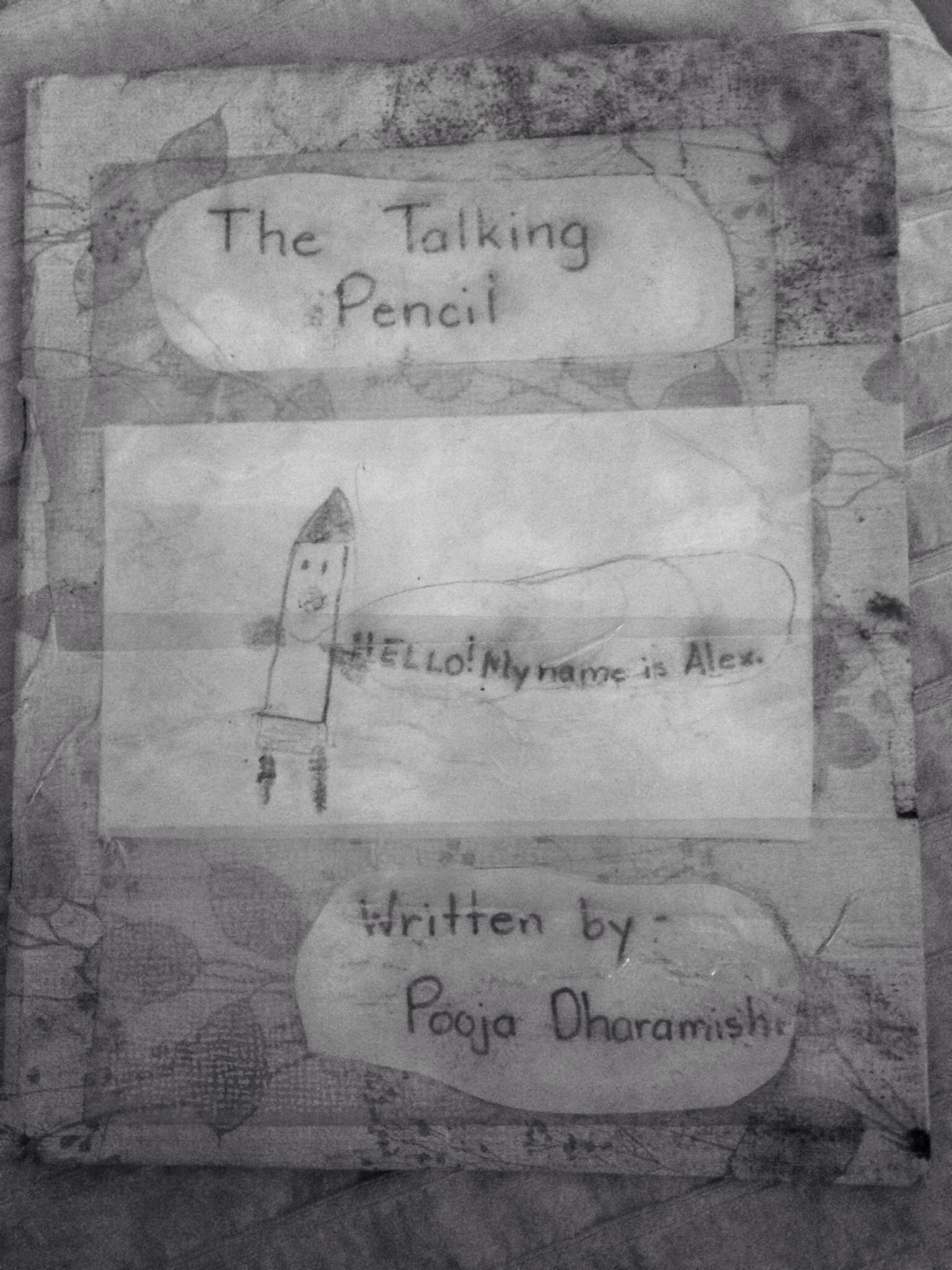
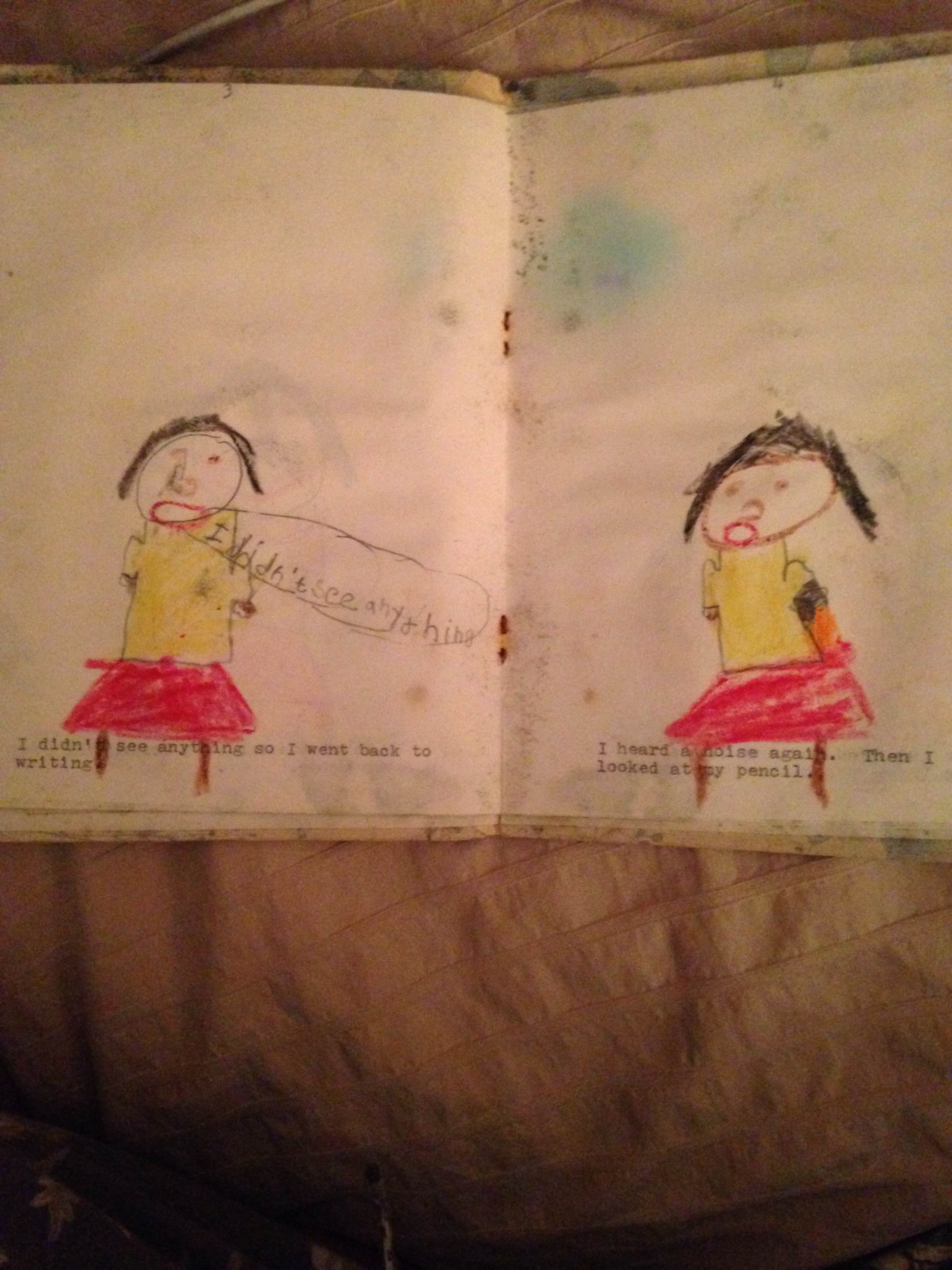
Here are some photos from a book I published in Grade 2, The Talking Pencil. I love how our books became part of the school library, so other children were able to sign them out to take home and read. What a great idea!

IMG_7799 IMG_7800 IMG_7801 IMG_7802 IMG_7803