Category Archives: Uncategorized

Photo Journal of my Experience @ AERA

Here are some snapshots and highlights of my experience at AERA this year. If I (yiola) could name the experience I would call it:  Goosebumps and Inspirations… it was just that good.

  1.  I attended a Round Table session (this is where presenters gather at a “round table” and share their research). The Round table is a great opportunity to not only share your work but hear from others in a less formal manner.  This round table was hosted by the  Writing and Literacies special interest group (SIG) and the focus of the round table was critical literacy.  Dr. Barbara Comber from the University of South Australia presented on critical literacy pedagogy in the early years. Her work and my work are closely aligned.

2.I attended a presidential talk that was a tribute to the life and work of Dr. Phil Jackson. The focus of the talk was on the question of education.  I really like what this panel did: each panel member selected a passage from a text written by Dr. Jackson and talked about its significance to them. A paragraph was read from The Practice of Teaching and the idea of transformative teaching… such an important and central idea in progressive education. A piece was read from Handbook of Research on Curriculum: Conceptions of Curriculum and the the idea that school is systematically harming children… and how can we work against that?  Linda Darling-Hammond read a passage from his famous book Life in Classrooms and spoke of the “multi-dimensionality and simultaneously nature of teaching” and the essential relationships associated with teaching. And, one panel member shared from Dr. Jackson’s last book published in 2012, What is Education and spoke of education as pure and simple; something we must rededicate ourselves too over time.
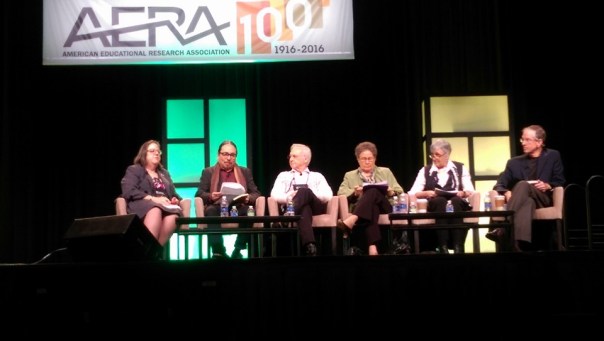
13001211_10156947381755121_1868962252431060235_n

3. I was very fortunate to have the opportunity to listen to the presidential lecture  for Division K hosted by Dr. Lin Goodwin, Teachers College Columbia University.  A remarkable speaker who not only inspires with her words but truly challenged me to think about what quality teacher education requires. What I like most about Dr. Goodwin is her genuine nature. A distinguished academic and also a beautiful human being. Here are some pictures from her talk including slides from her presentation.
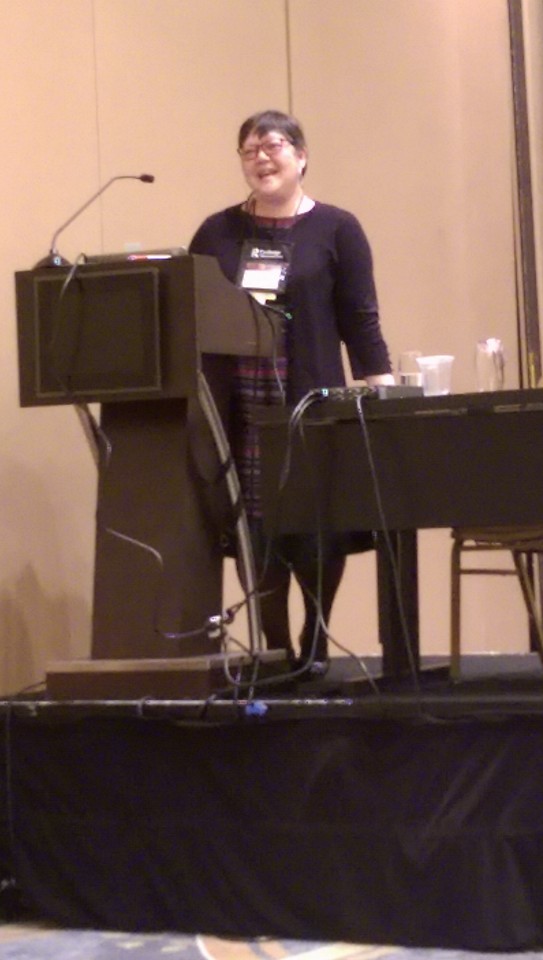
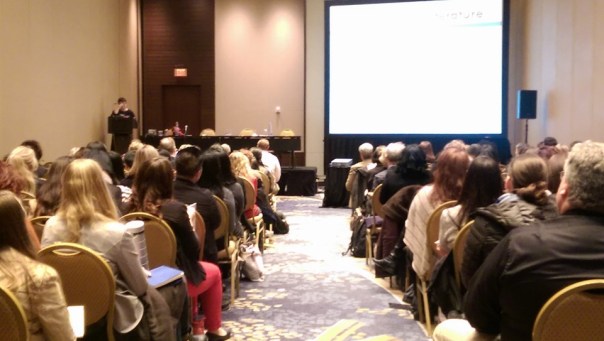
12998610_10156947381220121_6198746793740451746_n

13015255_10156947381525121_6392246007407300412_n13043368_10156947381450121_231103480067251929_n12994363_10156947381300121_7467634140817060326_n13012864_10156947381375121_7210803705214951729_n

4. Yet another interesting Presidential session with Wayne Au, Marilyn Cochran-Smith, Kevin Kumashiro (and others) that explored policy and standards in Teacher Education. Laden with some controversial findings for the testing systems for new teachers and teacher education programs, the presentations were provocative and interesting:

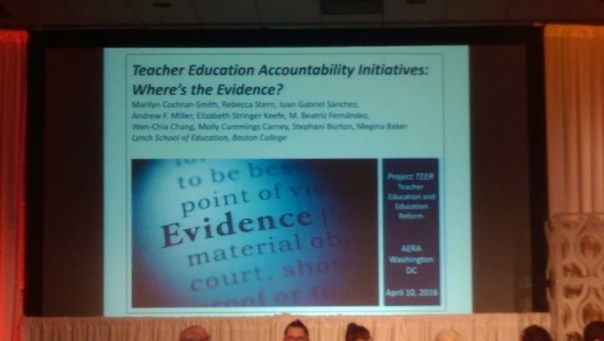
13055504_10156947381160121_3248944785834068614_n13012858_10156947381050121_2214069562201491393_n

5. The last session I would like to share is one where we presented at the Constructivist SIG. A lovely group of people from across North America, we exchanged ideas of what it means to teach in constructivist ways. Our team leader Dr. Clare Kosnik presented work from the Literacy Teacher Education research and presented on a group of literacy teacher educators who had strong constructivist pedagogies.

Finally, AERA is held at such interesting places. One has to take some time to enjoy the beauty of the district and take in some of the sights.

Understanding the communities our students are from

I (Pooja) have just returned from AERA 2016. I always leave AERA feeling inspired to continue my research and motivated to get back into the classroom. This year was no different. This year I learned about the work of Dr. Christopher Emdin, a recipient of the Early Career Award at AERA 2016. Dr. Emdin’s work considers  the relationships between Hip-Hop, urban education, and science education. Curious to learn more I about his work, I ordered his latest book entitled For White Folks Who Teach in the Hood… And the Rest of Y’All Too (2016).

An article in NPR reviewing Emdin’s book highlights some of Emdin’s main arguments he makes. His arguments are completely in line with what my own research (literacy teacher educators with a critical stance) has found: in order to effectively teach, we must understand the communities from which our students come. Below is an excerpt from the article outlining Emdin’s arguments along with some examples of practice:

  1. Teachers can’t be colorblind. It does their students a disservice.

“People who perceive themselves to be colorblind often times have biases that are hidden by their colorblindness,” Emdin says. Young people in urban spaces have different linguistic and cultural realities, like the gun shots that Emdin experienced.

If teachers recognize that difference, they can help their students deal with issues such as PTSD. If the trauma of their day-to-day life goes untreated, students won’t be able to learn effectively.

But, if they heal, “then they can learn. And if they can learn, then they can be successful.”

2. Urban schools tend to be authoritarian places, which doesn’t help kids heal or learn.

If it wouldn’t be acceptable in a white, suburban school, Emdin says, it shouldn’t be acceptable in an urban classroom.

That goes for metal detectors, searches, zero tolerance policies and bars on their classroom windows. “Those things don’t happen in places where students are from a higher socioeconomic status and are not overwhelmingly black and brown.”

Emdin acknowledges that it can be hard to avoid falling into this kind of teaching. He even found himself slipping into authoritarian teaching methods, a fact which, he says, only proves that these techniques have become deeply ingrained in certain school systems.

But he says we only need to look at the statistics — college completion rates or the increased need for remedial learning — to understand that this military approach to teaching isn’t working.

3. Schools need to celebrate students and their talents, even if those talents aren’t familiar.

In his book, Emdin lays out some of the ways that teachers can rethink their classrooms without spending money.

They can create a sense of community by eating with their students, making up a school handshake and bringing in community members — including people who have not graduated from high school — as liaisons.

Emdin also suggests that teachers go to churches and barbershops, both to better understand the community and to learn teaching strategies from the people their students admire.

And teaching should not be seen as a tug-of-war between enjoyment and hard work.

Emdin, for example, folds hip-hop into the curriculum. He has worked with GZA, a rapper from the Wu-Tang Clan, to host a science hip-hop battle for New York City high school students.

“If you give young people the opportunity to be able to express their academic brilliance on their own terms, they take the initiative to study,” he says. “They take the initiative to research, and they perform and they showcase that they’re brilliant.”

Read NPR article here: http://www.npr.org/sections/ed/2016/04/10/473500018/want-to-teach-in-urban-schools-get-to-know-the-neighborhood

Preparing for AERA

I (yiola) along with the research team and many other colleagues are preparing for the American Educational Research Association (AERA) conference that will be held in Washington DC this year. The conference begins on Thursday April 7th until Tuesday April 12th.

An enormous conference that attracts thousands of educational researchers from around the world and across disciplines and methodologies in the area of education. Each year the conference has a theme. This year the theme is Public scholarship to educate diverse democracies.  Here is a link to the site and more information about the conference:

http://www.aera.net/EventsMeetings/AnnualMeeting/2016AnnualMeetingTheme/tabid/15861/Default.aspx

The team and our close colleagues will be presenting at AERA.  We will be sure to post pictures and updates from the various sessions we attend. We hope to see you there. If you are not attending this year be sure to check out out blog for highlights next week.


Using Snapchat in Higher Ed

snapchat

I (Pooja) have always been somewhat of a late adopter to the latest technologies, but I know when things are shifting because of what learners in my class and my more technologically-inclined friends are using on  their phones. What I’ve noticed is that Facebook and Instagram are quickly becoming the social media tools of yesterday. Growing in popularity is Snapchat, a social media application known for its short-lived videos. On Snapchat, your followers can view the photos or videos you “snapped” for 10 seconds before they disappears for good. Started in 2011, Snapchat now has 100 million users and is gaining users at a rapid speed, especially post-secondary students.

It is for this reason I am curious to know how (and if) teachers are using Snapchat in their classrooms. I came across an article on NPR written by Jacquie Lee that highlights the work of one professor, Michael Britt using the app in his introductory psychology course. He uses the tool to post 10-second videos which relate to the theory and concepts discussed in class. For example, to help students connect to a lesson on the biology of the brain, Brit snapped his niece in during her ballet class standing on one leg. He “used the snap as an example of how the cerebellum in the brain controls balance” (Lee, 2016). Britt notes that approximately 90% of his students check his “snaps.” That is a significant number considering how many students don’t do/complete course readings. Snapchats seem to “reach” the students in a way perhaps course readings can’t.

I still do not have a Snapchat account. I can’t imagine people being interested in the details of my day. Perhaps I should reconsider. Perhaps Snapchat is an entry point into bridging the divide between theory and practice in our courses.

To read the entire article click here:

http://www.npr.org/sections/ed/2016/03/29/467091289/how-teachers-are-using-snapchat

Global Conversations in Literacy Research

One of the amazing things about our research team is we share common interests in literacy teaching and teacher education while at the same time we explore our own avenues of research. My areas of interest are in critical literacy pedagogy and teacher development.  I (yiola) have been enjoying and learning a great deal from another amazing literacy research based website and would like to share it with you.

Here is the link: https://globalconversationsinliteracy.wordpress.com

Global Conversations in Literacy Research (GCLR) is a series of interactive open access web seminars that feature cutting-edge literacy research conducted by international literacy researchers. GCLR is grounded in critical literacy, and sees as its mission to use networked technologies to connect global audiences in a virtual space that allows participants to exchange ideas on literacy theory, research, and practice. Each year, GCLR features scholars whose work addresses a range of literacy areas of interest to international audiences.

Some of my favourite researchers in critical literacy have shared webinars on the site.  I appreciate the global nature of the site and the sense of shared understandings through varied contexts.

An inspiring site — enjoy!

Butterfly Books: An amazing resource

It is common to find educators and parents in search of good books for children.  What makes a book good? What is a worthwhile read? What kinds of books do we want children to read? Why?  I have discovered a resource for thinking about and finding children’s books and am excited to share it with you.

Helen Antoniades, founder and operator of Butterfly Books, has embarked on a most inspiring journey in search of great books for children.

A front line social worker in Toronto, Ontario Canada, Helen has spent her adult life counselling children and adults from all walks of life. The  last 4 years of her practice was at the Hospital for Sick Children.  After 17 years of social work Helen, feeling burned out,  decided to start something new and explore her passion for healing others in an alternative way. Always passionate about books, she chose to share her knowledge of and experience with using books to help children understand and deal with issues in their lives.

Helen began her search by asking a lot of social worker colleagues for their go to books. Then she began asking friends in related fields. This interest grew into the blog, where she alternated “regular” pictures books with therapeutic books as suggested readings for children. As her journey continued Helen began exploring the “regular” books she was coming across and has broadened her scope to quality books that are reflective of diversity.  You can find Helen’s website at:

http://www.butterflychildrensbooks.com

Butterfly Book’s mission statement:

Butterfly Books is a children’s book subscription service whose goal is to make receiving a new book an eagerly anticipated, joyful event with an aim to foster and sustain a love of reading in children.
In addition to creating excitement about reading, the service will give children the opportunity to explore other worlds and experiences through books.  Part of the focus will therefore be on ensuring diversity of characters and topics within the books chosen.
This service is also a way to make giving books as a gift more inviting.  This personalized approach will connect families through the love of books and the satisfaction of a quality gift given and received. 
There is also a handy Facebook page with wall postings that share a book per week. It is an efficient and helpful way to access interesting books and gain insight to how they can be explored with children, often including book reviews.
Check out the website, like the FB page, and get connected with Butterfly Books!

Happy International Women’s Day!!!

Today is International Women’s Day (IWD)/ IWD  is a global event that celebrates women’s achievements, from the political to the social to the cultural, while reminding us all of the work to be done to arrive at gender equality. The theme for this year’s celebration is a  “Pledge for Parity.” The International Women’s Day official website encourages us to celebrate today by Pledging for Parity:

Everyone – men and women – can pledge to take a concrete step to help achieve gender parity more quickly – whether to help women and girls achieve their ambitions, call for gender-balanced leadership, respect and value difference, develop more inclusive and flexible cultures or root out workplace bias. Each of us can be a leader within our own spheres of influence and commit to take pragmatic action to accelerate gender parity.

Google has also dedicated today’s Google Doodle to IWD. Check out the the video below:


Re-blog: Educators Who Inspire Spotlight Series

greenschoool

Today, I (Pooja) wanted to share a new online series created by my friend. Curious by international educational reform, her series aims to shed light on the insights and work of “educators who inspire” form around the globe. Her first spotlight introduces us to an educator, Aaron Eden, from the Green School in Bali. Eden is the Director of Entrepreneurial  Enterprise Learning at the Green School. Watch the interview and hear Eden’s thoughts on educational reform.


http://www.edumodels.ca/blog/educators-who-inspire-spotlight-series-aaron-eden-the-green-school-bali


Finnish Schools Breaking All the Rules

I wanted to share this op-ed piece written by William Doyle, a Fulbright Scholar and author who enrolled his 8-year old son in a rural school in Finland. Throughout his essay, he describes the practices and pedagogies of his son’s fourth grade teacher, Jussi Hietava.

Doyle addresses several trends in educational reform in today’s world, including control, competition, stress, standardized testing, screen-based schools and loosened teacher qualifications and describes how Finnish schools do the exact opposite.

Below is an excerpt from Doyle’s essay. I highly encourage anyone interested in educational reform matters to take a few moments to read the essay in its entirety.


Here, as in any other Finnish school, teachers are not strait-jacketed by bureaucrats, scripts or excessive regulations, but have the freedom to innovate and experiment as teams of trusted professionals. Here, in contrast to the atmosphere in American public schools, Hietava and his colleagues are encouraged to constantly experiment with new approaches to improve learning.

Hietava’s latest innovations are with pilot-testing “self-assessments,” where his students write daily narratives on their learning and progress; and with “peer assessments,” a striking concept where children are carefully guided to offer positive feedback and constructive suggestions to each other.

Link to the op-ed piece: http://hechingerreport.org/how-finland-broke-every-rule-and-created-a-top-school-system/