In this fast paced world of technology and change, do you ever feel you couldn’t get by without the Help Desk? I (Cathy) came across this delightful vignette while searching for Help Desk tips. It reveals how Help Desk support was utilized in the middle ages. This original skit was first performed on the show “Øystein og jeg”, a Norwegian Broadcasting (NRK) production. Øystein Backe plays the helper and the desperate monk is portrayed by Rune Gokstad. The piece was written by Knut Nærum. The version below is the original skit with English subtitles. I also discovered a different version, performed in English, but trust me, the original version is much funnier. Enjoy!
Category Archives: Uncategorized
Digital Technology Tools for the Classroom
Popular educational website Mindshift compiled a list of useful technology tools for the classroom. I have heard/used a few of the tools identified, however most are new to me. The article describes how these tools can be useful for social studies classrooms, but I think most tools can be used across a variety of subjects.
Below are a few I am most interested in exploring:



Read entire article here: http://ww2.kqed.org/mindshift/2015/05/21/favorite-tech-tools-for-social-studies-classes/
High Levels of Stress, Low Levels of Autonomy
The Washington Post recently reported on a survey conducted by the American Federation of Teachers (AFT) of approximately 30,000 teachers. Survey results reported teachers felt high levels of stress and low levels of autonomy. The rise of government initiatives such as the Common Core Standards were identified as a source of stress for teachers. The article reported: “Teachers said they feel particularly anxious about having to carry out a steady stream of new initiatives — such as implementing curricula and testing related to the Common Core State Standards — without being given adequate training, according to the survey. “

The AFT website reports some key findings from the survey:
- Only 1 in 5 educators feel respected by government officials or the media.
- Only 14% strongly agree with the statement that they trust their administrator or supervisor.
- More than 75 % say they do not have enough staff to get the work done.
- 78% percent say they are often physically and emotionally exhausted at the end of the day.
- 87% percent say the demands of their job are at least sometimes interfering with their family life.
- Among the greatest workplace stressors were the adoption of new initiatives without proper training or professional development, mandated curriculum and standardized tests.
Randi Weingarten, president of the AFT, noted stress could be a result of teachers wearing multiple hats in the classroom:
“We ask teachers to be a combination of Albert Einstein, Mother Theresa, Martin Luther King Jr….We ask them to be Mom and Dad and impart tough love but also be a shoulder to lean on. And when they don’t do these things, we blame them for not being saviors of the world. What is the effect? The effect has been teachers are incredibly stressed out.”
Read more about this issue at: http://www.aft.org/news/survey-shows-need-national-focus-workplace-stress#sthash.mryeqegY.dpuf
61 Years Later…
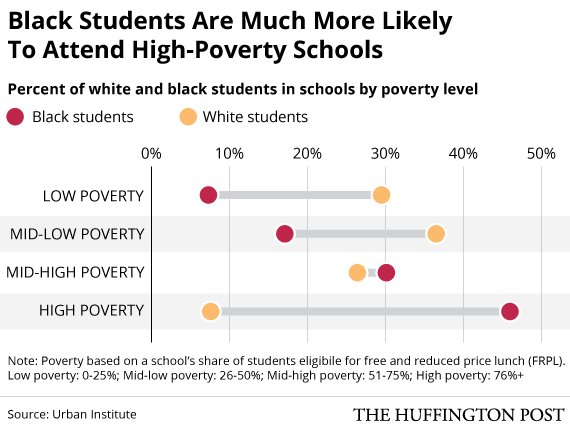
Sunday marked the 61st anniversary of the landmark case in the U.S.: Brown vs. Board of Education. The supreme court case declared segregated schooling unconstitutional. However, 61 years later many schools remain separate and unequal. Often students in low socio-economic neighbourhoods, which tend to have a more diverse population, remain at a disadvantage compared to their counterparts in more affluent neighbourhoods . Rebecca Klein, author at the Huffington Post, put together six powerful graphs which illustrate how far we still have to go for a truly equitable educational system. Below are a couple graphs from Klein’s article:


To read the entire article click here:
http://www.huffingtonpost.com/2015/05/17/brown-v-board-61-anniversary_n_7293344.html
Happy Victoria Day
For our Canadian readers, Happy Victoria Day! For our international readers, Happy Victoria Day! and let me (Yiola) tell you about our federal holiday.
Since 1845 (which is before confederation!)Canada has recognized Victoria Day. Queen Victoria’s (of England) birthday is celebrated here in Canada; in fact we are the only country to celebrate her birthday as an official federal holiday. Following her death in 1901, the holiday was made to be known as Victoria Day, a day to remember the late Queen who was deemed the “Mother of Confederation”.
We now informally call Victoria Day “May 2-4” and this holiday marks the beginning of our summer. Locally, people begin their gardening, cottagers open their cottages, and fireworks abound. It is a happy time and great way to welcome the coming of a new season.
This year, Monday May 18th marks the holiday which left me confused because May 24th is a Sunday… and so I wondered why May 2-4 was not celebrated next Monday? The link below explains why:
http://www.thestar.com/news/gta/2015/05/15/why-victoria-day-isnt-on-the-24th-this-year.html
I hope where ever you are, the sun is shining and there are fireworks in your soul. Enjoy today!
Language and Literacy and Connecting Community
I (Yiola) am sitting in a Tim Horton’s, sipping on a double double with milk, and very (yes I just used the word very when it was completely unnecessary!) suddenly feel inspired. I was in the midst of writing about this terrible “work to rule” strike happening in our public schools when a topic far more inspiring came to mind… the power of language and its connection to community.
Moments ago, as I had my head buried in the lap top focused on my blog, out of the corner of my eye I saw a group of older men chatting in their native language… a language that happens to be my own native language, Greek. I felt a sweet spring of inspiration and connection to these men who gather around the table, sipping their coffees and socializing. It brought back the stories my parents shared of my grandfather walking 2 kilometres each day to the local “cafenio” where he would meet his friends and chat the afternoon away. I visualized the cobble stone road that led from my Papous’ (grandfathers) house in his village (Yermasoyia); the narrow, hilly road that was lined with small villas and heritage homes. The more I heard the Greek phrases channel through their discourse the more at home I felt in this generic Tim Horton’s shop. I tried not to stare at them as they spoke. What occurred to me, and what may seem obvious and yet not entirely understood until felt, was the intensity of connection and understanding I experienced simply based on my understanding of language. I felt empowered because I knew their language. I felt connected. It felt familiar and safe.
Shortly after another group of men entered the Tim Horton’s and they too began socializing over coffee. This time I did not recognize the language spoken and yet I deeply appreciated the value of their connection. How wonderful to have people in your life that you are able to connect to through shared language. Shared language = understanding.
I look behind me. A couple sits in the booth in silence, each reading a section of the newspaper. Again, a strong sense of literacy at play; a strong sense of cultural connection.
Language and literacy is everywhere. Our language identifies us and connects us to the world. How magnificently simple and yet so directly relevant to literacy and language development. Immersion in language, opportunities for sharing, talking, communicating, relevant reasons for reading and writing… a simple class field trip to Timmy’s may be in order…
Words to Avoid
As a doctoral student, I aim to write very clearly. This is not always easy and often takes several revisions. However, there are some words we have just become so used to saying/writing that we hardly notice they aren’t saying much at all.
In the listicle (listing article) “15 Words You Should Eliminate From Your Vocabulary to Sound Smarter”Jennie Haskamp identifies vague and often meaningless words most of us are guilty of using. Below are a few of the words, along with explanations taken directly from the article, I am most guilty of using (as demonstrated above). I’m trying my best to eliminate them from my vocabulary:
- That
It’s superfluous most of the time. Open any document you’ve got drafted on your desktop, and find a sentence with “that” in it. Read it out loud. Now read it again without “that.” If the sentence works without it, delete it. Also? Don’t use “that” when you refer to people. “I have several friends that live in the neighborhood.” No. No, you don’t. You have friends who. Not friends that.
- Very
Accurate adjectives don’t need qualifiers. If you need to qualify it? Replace it. “Very” is intended to magnify a verb, an adjective, or another adverb. What it does is makes your statement less specific. If you’re very happy? Be ecstatic. If you’re very sad, perhaps you’re melancholy or depressed. Woebegone, even. Very sad is a lazy way of making your point. Another pitfall of using very as a modifier? It’s subjective. Very cold and very tall mean different things to different people. Be specific. She’s 6’3″ and it’s 13 degrees below freezing? These make your story better while also ensuring the reader understands the point you’re making.
- Amazing
The word means “causing great surprise or sudden wonder.” It’s synonymous with wonderful, incredible, startling, marvelous, astonishing, astounding, remarkable, miraculous, surprising, mind-blowing, and staggering. You get the point, right? It’s everywhere. It’s in corporate slogans. It dominated the Academy Awards acceptance speeches. It’s all over social media. It’s discussed in pre-game shows and post-game shows.
Newsflash: If everything is amazing, nothing is.
- Just
It’s a filler word and it makes your sentence weaker, not stronger. Unless you’re using it as a synonym for equitable, fair, even-handed, or impartial, don’t use it at all.
To read the entire list click here:
Rules for Writing
There are many rules to writing and as quickly as new genres are entering the literary scene, so too are the rules changing.
Here is an interesting explanation of a rule of writing and its evolution:
I see two big issues at play: 1) the rules of writing 2) writing with genre and audience in mind
It seems to me (Yiola) the rules are changing and this is in large part because genres are so rapidly evolving and being introduced.
There is much to be said for the traditional forms and genres of literary expression. And, it is the traditional forms I believe we still teach in schools. And yet with digital literacy there are many new forms being implemented and introduced in classrooms too.
I (Yiola) see writing as an art. The crisper the writing the more vivid the message. The clearer the writing the more opportunity for complex ideas.
The big question is… how to best teach writing in the elementary classroom? I remember teaching writing in the Junior grades (4th, 5th, 6th grades) with the audience, purpose and genre in mind… Now however all 3 elements (audience, purpose and genre) have grown to include several (more) possibilities.
No Reading on the School Bus!
Literacy advocates, beware. This news story might break your heart.
Eight-year-old Sarah Auger, from St-Jean-sur-Richelieu, Quebec, was told she was no longer allowed to read books on the school bus. The bus driver thinks it poses ” a safety risk to the other students”.
When the child’s father challenged the rule, the school board conceded that “obviously” reading was not dangerous. Yet, Mario Champagne, the general secretary and director of communications for the Hautes-Rivière school board, said, “The responsibility of a school bus driver is to transport students safely”. And since the bus driver makes the rules- No Reading!

A focus on digital literacy practices at AERA 2015

I just returned from another American Educational Research Association (AERA) conference. While in Chicago, I attended several sessions focused around literacy education, teacher education, and critical pedagogy and noticed digital literacy practices were discussed in all sessions. Interestingly, in the studies discussed digital technology was used not only as a tool to teach but a tool to re-imagine the definition and uses of literacy practices. Interesting sessions I attended included:
*Digital Storytelling as Method and Narrative Assemblage (Korina Jocson, University of Massachusetts)
*Digital Storytelling as Racial Justice: Digital Hopes for Deconstructing Whiteness in Teacher Education (Cheryl Matias, University of Colorado & Tanetha Grosland, Morgan State University)
*Digital Authoring: Negotiations of Identity, Agency, and Power Among Girls Resettles as Refugees from Thailand (Delila Omerbasic, University of Utah)
*Digital Storytelling in Preservice Teacher Education: Diverse Understandings of Writing, Pedagogy, and Meaning Making (Sandra Schamroth Abrams, Saint John’s University)
Benjamin Herold from the Education Week blog noticed a similar trend at this year’s conference. On his blog he said, “Digital reading and early literacy were among the hot topics at the annual meeting of the American Education Research Association, held here last week.” He describes the findings of four studies which study digital reading and early literacy. He noticed a common thread which ran through many of these papers: “It’s important to look at how digital devices, apps, and e-books are actually being used in classrooms, and the most promising literacy practices with these new tools involve lots of human-to-human interaction.”
Read Herold’s blogpost here:
http://blogs.edweek.org/edweek/DigitalEducation/2015/04/ipads_e-readers_literacy_research.html
 Literacy Teaching and Teacher Education