Congratulations to our friend and colleague Tim Fletcher on the publication of Self-Study in Physical Education Teacher Education which he co-edited  with Alan Ovens. Tim has a long-time commitment to the practice and study of health and physical education. Teaching at Brock University where he is an Assistant Professor and conducting research on the preparation of teachers to teach phys ed, he understands the complexity of the issues facing teachers and teacher educators. Helping children and youth acquire the skills and attitudes to lead a healthy and active lifestyle is not easy but is critically important. This text will help us think differently about preparing teachers to teach health and physical education.
Here is a description of the book: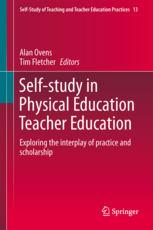
In this in-depth examination of self-study as a research methodology, an international selection of physical education scholars share their ideas and experiences and consider the value of self-study as a vector for highlighting the emerging conflicts, dilemmas, and debates currently developing in teaching and teacher education pedagogies. A vital new addition to Springer’s series Self-Study of Teacher Education Practices, the volume is divided into three sections assessing the significance of the approach itself, offering detailed subject-relevant case studies, and exploring the nuances and controversies attending the evolution of the methodology. The contributors show how self-study enables reflexivity in pedagogical practice, a notable lacuna in current critical research, and at the same time they make the technique accessible to scholars of physical education wanting a practicable introduction to the subject. The analysis also explores the implications of applying self-study to pedagogy itself, to the curriculum, and to human movement and educational practice more generally. By embracing more organic, emergent notions of research practice and learning, the book achieves a broader and more inclusive survey of pedagogical work in physical education teacher education that fully acknowledges the complexities of the field. http://www.springer.com/education+%26+language/learning+%26+instruction/book/978-3-319-05662-3


 As the participants in the symposium talked about the state of teacher education in our 4 countries, I (Clive) was dismayed at the rapid movement toward requiring everyone (teachers and teacher educators) to teach the same things in the same way.
 s problematic to publicly describe standardization as madness, since conservatives have presented their position in terms of raising or maintaining standards, and we may be seen as being soft on standards.
 point.
 I (Clare) was in my department yesterday and ran into a number of colleagues. Most were bemoaning their heavy marking load. This is the end of the semester and most seemed snowed under with the grading papers. A few weeks ago I observed a number of student teachers submitting their assignments. They too looked tired and were complaining about their assignments and workload. Yes assignments are work. Yes as instructors we need to grade student work. But there is something wrong with this picture. Many of the student teachers do not find their assignments useful (as a few commented – “they are just make- work projects”) and faculty spend huge amounts of time marking projects their student teachers found wanting. We definitely need to have assignments but I think it is time to discuss what are useful assignments for student teachers. The corollary issue is how can marking assignment be useful for faculty?
 Literacy Teaching and Teacher Education