
To all of our friends in the U.S. who are digging out from that massive storm. Good luck.
To all of our friends in the U.S. who are digging out from that massive storm. Good luck.
In the Toronto Globe & Mail on January 15th I (Clive) read an interesting excerpt from a book by Leonard Sax called The Collapse of Parenting. According to Sax, young people are  increasingly looking to friends for support rather than their parents; and the problem with that is whereas parents tend to stick by their children through thick and thin, many young people just drop their friends after a dispute or perceived minor infraction. As a result, children are becoming more vulnerable and anxious (a phenomenon others have noticed).
I think teachers should discuss this set of issues with their students as part of ongoing way of life education (and also introduce them to children’s books or young adult novels that deal with friendship, family life, etc.). Why do young people turn to friends rather than parents? Are they taking this too far? Do they realize the dangers (whatever they are)? Are friends less supportive than family? Support from friends often comes at a price (loyalty, obedience, etc.), but does family support also have a price? Should we go to friends for some things and parents for others? These are tricky questions, but I think exploring issues in a safe environment is always better than leaving young people to grapple with them on their own. And we will learn a lot through the discussions too!
I (Yiola) have been building in how to embed creativity in classroom practice in my Teacher Education course for a number of years. This year I invited Lina Pugsley, a graduate of the Creativity and Change Leadership Program and Masters of Science in Creativity student from SUNY Buffalo State, to share with us what creativity means and how to teach creatively and teach for creativity through weaving creativity skills into our classroom lessons.
Our class consisted of information sharing about what creativity is and its complexity. I appreciated that we took time to unpack some of the misconceptions (a major one being creativity equals the visual arts) and to solidify some of its characteristics (creativity is problem solving, its innovation, its incubation, its idea generating, its colourful, etc.)

Lina presented us with a number of models and frameworks to think about ways of thinking about, teaching, and embedding creativity into our classroom practice.
Several great resources were shared and a number or creativity scholars introduced. From E. Paul Torrance to Ronald Beghetto, we were inspired!

Once the theoretical and conceptual foundations were laid students in the class began to think more practically about what skills and strategies nurture creativity. This video set our curiosity in motion:
And, in creative fashion students explored, talked about and shared ways of bringing creativity skills into their teaching and lessons. We examined E. Paul Torrance’s 18 thinking skills from his book “Making the Creative Leap Beyond”
Some of the skills:
Be Original
Be Open
Visualize it Rich and Colourfully
Combine and Synthesize
Look at it Another Way
Produce and Consider Many Alternatives
Playfulness and Humour
Highlight the Essence
Make it Swing! Make it Ring!
Be Aware of Emotions
Be Flexible


The energy in the room was high. Students were interested and engaged. They were encouraged to consider their personal teaching philosophy and to make creative thinking a priority in their teaching. It was an inspiring experience. This particular teacher education course looks at methods in education. We explore planning, the learning environment, pedagogies and practices. Creativity, now in the 21st century, is a skill that students must acquire. It is not an innate skill that some are born with while others are not. Everyone has the capacity to develop their creativity skills and as teachers we need to learn how to create classrooms that foster, encourage, and celebrate creative thinking.in I believe the MA students gained a solid sense of what this is about.
For more information on Lina’s focus and work check out here website at:
http://www.keepingcreativityalive.com
I (Cathy) finished an audio book the other day. New author for me; Kate Morton. The book was The Lake House.

I dreaded the conclusion because I was really enjoying listening to the book. But it finally dawned on me, it wasn’t just the story I was enamored with, it was the voice. The narrator was superb. Her accent was clearly British, which of course was perfect for the book , a Victorian tragedy, but I loved how she could capture the differences between the ‘old British class system’ by changing her dialect. Her pacing, tone and characterizations were also quite wonderful. I enjoyed her performance so much, I Googled her:
Caroline Lee
Caroline Lee is a gifted actor and narrator who has worked extensively in theatre, film and television. She has performed for various theatre companies including the Melbourne Theatre Company, Hildegard and Playbox, and she received the Green Room Award for Best Actress in Fringe/Independent Theatre for her roles in Alias Grace and Ordinary Misery. Caroline’s film and television credits include the internationally popular drama Neighbours, as well as Blue Heelers, Halifax FP and Dogs in Space. In 1998 she won the Sanderson Young Narrator of the Year award.

I have listened to dozens of audio books, but this was the first time I felt the narrator added tremendously to the storyline. A perfect marriage between author and actor. As a result, I am already listening to another Kate Morton book, The Shifting Fog, but for the first time, I checked the name of the narrator first.
Only on chapter two and already delighted!
.
This week I (Clare) attended the Parent Research Night at the Dr. Eric Jackman Institute of Child Studies (where I am the Director). It was a truly amazing evening because the two presentations demonstrated research that was for teachers and parents, done by teachers, and inspired by teachers. It was such a beautiful form of dissemination of research. The findings are not confined to a peer-reviewed article but were shared with the public.
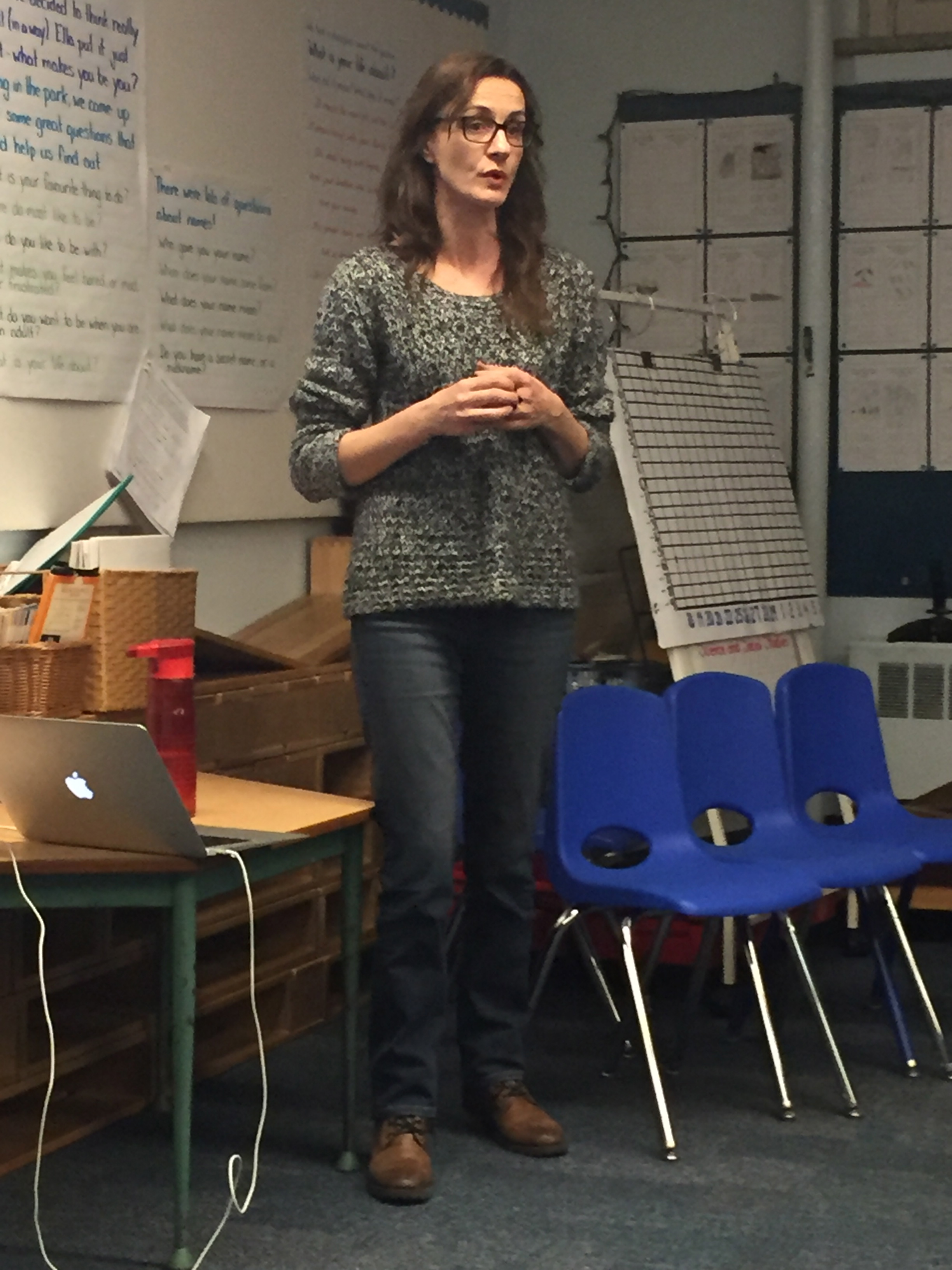 Dr. Patricia Ganea talked about the importance of shared reading with children. And she shared data on how children respond to images in children’s books – realistic (photos) vs fantastical (comic-like). Interestingly they relate much more to the latter.
Then Dr. Yiola Cleovoulou and 3 teachers (Zoe Honahue, Cindy Halewood, and Chriss Bogert – who is now the VP) from the Lab School 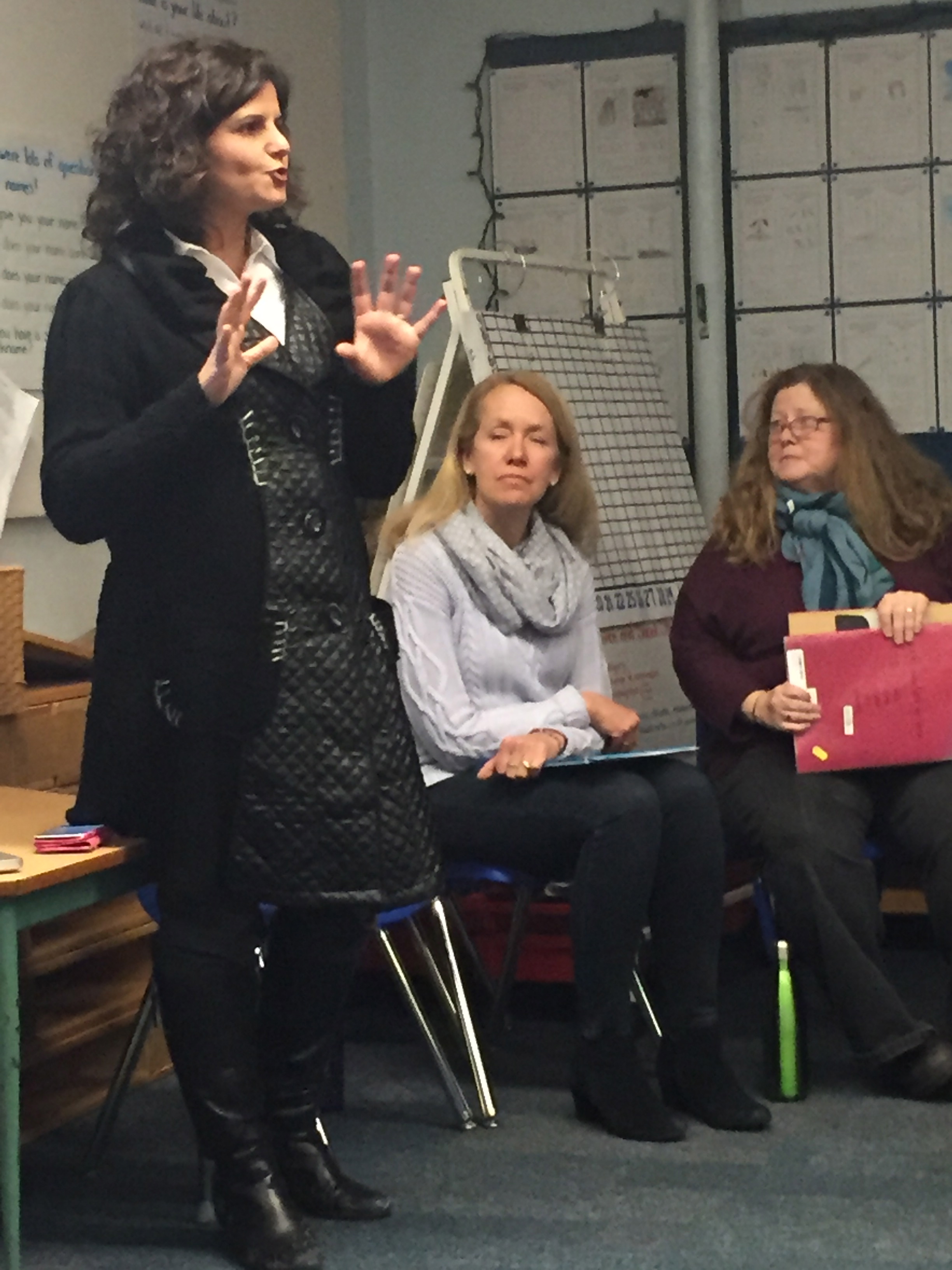 presented on their work with the children that was framed by critical literacy with an inquiry focus. They shared student work, read transcripts of actual conversations, and described activism work.
JICS has a tripartite mission: Lab school, teacher education program, and a research centre. Parent Research night truly brought all three together. http://www.oise.utoronto.ca/ics/index.html
I (Clare) read this really interesting article on Edutopia
I believe it has relevance for both teachers and teacher educators. Having to unpack and remember how we learned a topic/skill is hard. How do you break down the steps to learning so that our students can acquire the knowledge and skills. This article has some highly useful examples and suggestions. As a teacher educator I often make assumptions about my student teachers. They all have university degrees so they should be able to master the content easily. Wrong assumption! It takes time and good teaching. Here is the link to the full article. The Teacher Curse No One Wants to Talk About
Knowledge is a curse. Knowing things isn’t bad itself, but it causes unhealthy assumptions — such as forgetting how hard it was to learn those things in the first place. It’s called the Curse of Knowledge.
In this post, we’ll identify how the Curse of Knowledge affects educators. Then we’ll outline seven ways to alleviate the curse. The ultimate goal is to improve instruction.
The Curse of Knowledge has been variously described in articles by Chip and Dan Heath, Carmen Nobel, and Steven Pinker, and also in books such as The Sense of Style and Made to Stick. It has been applied to a variety of domains: child development, economics, and technology are just a few.
All of the resources describe the same phenomena — that a strong base of content knowledge makes us blind to the lengthy process of acquiring it. This curse has implications for all teachers:
As a result, we end up assuming that our lesson’s content is easy, clear, and straightforward. We assume that connections are apparent and will be made effortlessly. Assumptions are the root cause of poor instruction. And acknowledgment is the first step to recovery.
Here are seven ways to make learning easier for your students.
Barbara Fredrickson, a champion in the field of positive psychology, has studied the effects of mild positive emotions on desired cognitive traits like attentiveness and ability to creatively solve problems. In what she coined the broaden-and-build theory, Fredrickson found that pleasant and mild emotional arousal before experiencing content leads to greater retention. A quick joke or humorous movie can serve as the positive emotional stimulant. So learning is easier and the Curse of Knowledge is potentially circumnavigated when injecting a bit of emotion into your lesson.
Though Howard Gardner’s influential work states that we each have a preferred learning modality, new research highlights the fact that effective lessons need not be unisensory (only kinesthetic, only auditory, etc.) but multi-sensory. Multi-sensory experiences activate and ignite more of the brain, leading to greater retention. So use a multisensory approach in your lessons to make learning easier.
Blocked practice is ancient and is no longer considered best practice. An example of blocked practice is cramming. Though it feels like learning, blocked practice results in learning that is shallow, and the connections quickly fade. The preferred alternative is the opposite of blocked practice: spaced practice.
Exposing yourself to content and requiring your brain to recall previously learned concepts at spaced intervals (hours, days, weeks, or months) makes the content sticky and results in deeper retention with solid neural connections. As spaced practice is the way that you learned the content you teach, it makes sense to employ the same technique with your students. So thinking of your content as a cycle that is frequently revisited makes learning easier for your students while helping alleviate the curse.
For more information on spacing content, check out Make It Stick or 3 Things Experts Say Make A Perfect Study Session.
Everyone loves a great story because our ancestral past was full of them. Stories were the dominant medium to transmit information. They rely on our innate narcissistic self to be effective learning tools — we enjoy stories because we immediately inject ourselves into the story, considering our own actions and behavior when placed in the situations being described. This is how we mentally make connections, and if students are listening to a story interlaced with content, they’re more likely to connect with the ideas. So connecting with content through a story is at the heart of learning and can help alleviate the stress associated with the Curse of Knowledge.
An analogy is a comparison of different things that are governed by the same underlying principles. If understanding a process is what we’re after, looking at the result of the process proves informative. An analogy compares two unlike things by investigating a similar process that produces both. Said differently, an analogy highlights a connection, and forming connections is at the core of learning.
Whereas an analogy compares similar processes that result in different products, an example highlights different processes that result in similar products. Copious use of examples forces the brain to scan its knowledge inventory, making desirable connections as it scans. So learning is easier when analogies and examples are used to facilitate mental connections.
New challenges ignite the risk-reward dopamine system in our brains. Novel activities are interesting because dopamine makes us feel accomplished after succeeding. Something that is novel is interesting, and something interesting is learned more easily because it is attended to. So emphasis on the new and exciting aspects of your content could trip the risk-reward system and facilitate learning.
Conceptual knowledge in the form of facts is the scaffolding for the synthesis of new ideas. In other words, you cannot make new ideas with out having old ideas. Disseminating facts as the only means to educate your students is wrong and not encouraged. However, awareness that background knowledge is important to the creation of new ideas is vital for improving instruction. Prior knowledge acts as anchors for new incoming stimuli. When reflecting on the ability of analogies and examples to facilitate connections, it is important to remember that the connections need to be made to already existing knowledge. So providing your students with background knowledge is a prerequisite in forming connections and can make their learning easier.
The Curse of Knowledge places all of our students at a disadvantage. As educators, it’s not enough to simply recognize that we are unable to remember the struggle of learning. We need to act. By incorporating facts, highlighting novelty, liberally utilizing examples and analogies, cycling our content, telling content-related stories, making our lesson multi-sensory, and harnessing the power of emotion, we can make learning easier for our students.
By incorporating facts, novelty, examples, analogies, and emotion; and cycling content, telling content-related stories, and making lessons multisensory, we can make learning easier for our students.
ClassDojo (the animated classroom management tool) has partnered with Stanford University’s Project for Education Research That Scales (PERTS) to help educators weave a growth mindset into their courses. Growth mindset has become a buzz term recently and refers to our ability to understand that our knowledge and ability is not static; rather, our “brains are malleable and their abilities can be developed” (Schwartz, 2016). Research shows that once we understand our brain’s ability to develop, we approach learning as a challenge we can face.
ClassDojo has created a series of five free videos for educators to use. Each video is 2-3 minutes in length and builds upon one another in a sequence. The videos are titled:
Video 1: A secret about the brain
Video 2: The magic of mistakes
Video 3: The power of “yet”
Video 4: The mysterious world of neurons
Video 5: Little by little
Read more here: http://ww2.kqed.org/mindshift/2016/01/19/what-classdojo-monsters-can-teach-kids-about-growth-mindset/
Something has been weighing on my mind this year as I teach my courses in teacher education. I (Yiola) have been teaching a number of different courses in teacher education (curriculum, foundations, child development, assessment) and each one has been carefully crafted with the students in mind (some are Masters level courses and others are undergraduate). Wherein lies the balance of teaching academic courses that are seeped in ideology and the promotion of critical thinking?
I believe it is inevitable that ideologies find there way into our course outlines, our lectures, our readings, our practice ~ after all, we are humans with perspectives and schemas. Knowing where we stand on issues that we teach, I think, is key to developing a course that is not only filled with information (content/pedagogy) for future teachers but that is accessible, inviting, and open to deeper understandings. In my courses for example critical pedagogy is a framework. Students know that when they take my courses they will be presented with readings, discourses, case studies, and policies that are framed in critical theory. I choose this for a number of reasons: I believe in equity and social justice education; I believe in equitable opportunity for learning; I believe in disclosing and deconstructing status quo in order to deepen our understanding of “what is going here”? and I believe that many student teachers are hearing of this ideology for the very first time.
And so, I am often left questioning: how far do I take this? how far can I go when presenting an ideology in teacher education? Is it fair to present a dominant perspective? Is it inevitable? Some would argue that by not expressing a point of view, we are simply adhering to one anyway and silencing many others. Where and when does ideology channel into indoctrination? Do student teachers feel imposed upon or offended when only one perspective is shared? but what about when its a perspective that is often marginalized? Is there even time to invite critical thinking about ideologies when teaching students about curriculum?
Let me provide an example: Literacy Curriculum in Teacher Education. Literacy education is taught in as many ways as there are literacy educators. We know from our research in literacy teacher education that there are powerful, effective, and varied ways of approaching literacy teacher education. And so, there is not one right way. One teacher educator may teach with a critical stance while another teaches from an empirical psychological stance, while yet another teaches from a holistic perspective. If I could, I would love to be a student in each of these courses to catch a glimpse of the ways in which teaching literacy can be considered. To the student teacher, is one way better than another? Is one way less indoctrinating than the next? Is there a way to prompt critical thinking while teaching subject content/pedagogical knowledge?
I am constantly thinking about the perspectives I bring to my courses, what gets included and what is omitted and why. I am constantly thinking about my tone and the messages I relay and the possibilities of interpretation from the learners in my class. I am interested in critical thinking and pushing boundaries of understanding. I am not interested in indoctrination. This in and of itself is an ideology of sorts.
In the New York Times on January 3, I (Clive) came across a fascinating column by Vicki Abeles (Sunday Review section) about the negative impact current school “reforms” are having on children. According to her, they are undermining the health of students, both rich and poor and from kindergarten to high school.
Abeles has written a book (which I plan to get asap) aptly titled “Beyond Measure: Rescuing an Overscheduled, Overtested, Underestimated Generation,” and has produced documentaries “Race to Nowhere” (as distinct from Race to the Top) and “Beyond Measure.” But in the column her focus is on research conducted by Stuart Slavin at Irvington High School in Fremont, California, “a once-working-class city that is increasingly in Silicon Valley’s orbit.” In cooperation with the school, he anonymously surveyed two-thirds of Irvington’s 2,100 students and found that “54 percent of students showed moderate to severe symptoms of depression [and] 80 percent suffered moderate to severe symptoms of anxiety.” The school is trying to address the problem, for example by re-examining homework demands and counseling students on achieving a manageable course load.
Based on her own inquiries and reflections, Abeles attributes much of this anxiety and depression to the enormous pressure young people are under today to climb the ladder of schooling, with a view to getting into a good college and/or job. “Even those not bound for college are ground down by the constant measurement in schools under pressure to push through mountains of rote, impersonal material as early as preschool.” Apart from opposing this general approach to schooling, Abeles sees practical lessons that can be learned from Irvington’s approach. Toward the end of the article she suggests:
“Working together, parents, educators and students can make small but important changes: instituting everyday homework limits and weekend and holiday homework bans, adding advisory periods for student support, and providing students opportunities to show their growth in creative ways beyond conventional tests.”
I (Cathy), my family, and friends have been playing many different kinds of ‘party’ games as of late . Some have boards, in some you create the board as you play, and with others there are just cards. One of my favorites is a game called Codenames.
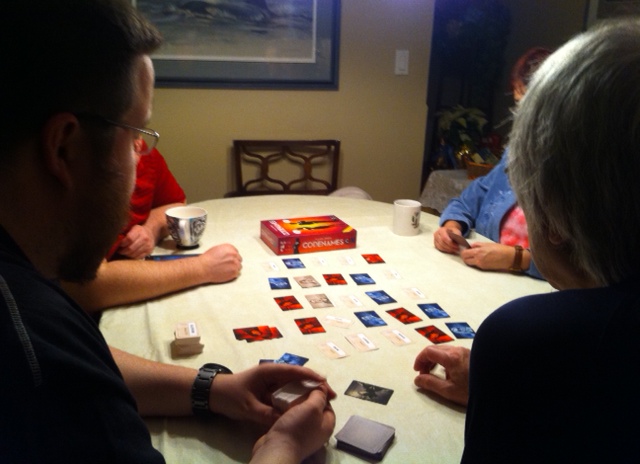
This game intrigues me because it is similar to coding data in a study as it’s about making associations between words, categorizing, and/or generalizing. (There is a narrative component to the game where everyone is considered a spy, but we just ignore all that). It can be played in teams or individually.
In this game many word cards are laid out in a grid across the table (25). One person is designated the clue giver and gives his/her team (or other person) a word and a number. The clue word might be ‘flight’ and the number might be ‘2’. The team then has to identify two words in the word grid they think are associated with flight. The challenge for the clue giver is they may not pick just any words they want in the grid to associate. They may only use certain assigned words and sometimes it is very difficult to make associations. The challenge for the team is, if they pick the wrong word, the point goes to the opposition.
Let’s have a trial run… Your clue is ‘weapons, 2”

If you guessed pistol and missile, you just won two points for your team. Let’s try one more, but a little bit more challenging this time! Your clue is ‘Olympics, 3’
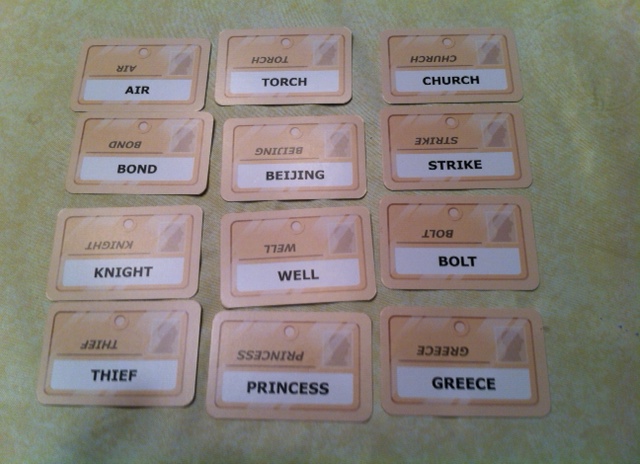
If you guessed Bolt, Greece, and Beijing, you earned another three points. (If this is mystifying to you, Usain Bolt set the world record for the 100 m dash at the Beijing Olympics, and Greece is the birth place of the Olympics).
This is a wonderful means of exploring word meanings and associations. It is also interesting how so many words can be both verbs and nouns, or connected as possible compound words, or have special meaning depending on culture and context. (Knowing your teammates well also helps, as I find I can understand my husband’s clues better than other people can). On many levels it is a great pass time with friends and also a great language game for the classroom. It is also, on many levels, literacies in action!
*****
 Literacy Teaching and Teacher Education