I (Clare) came across this amazing infographic on cyberbullying. The stats are frightening.

I (Clare) came across this amazing infographic on cyberbullying. The stats are frightening.
I (Cathy) was touched by the following tale shared by guest bloggers Burkins and Yaris (Think Tank for 21st Century Literacy) on Brenda Power’s Choice Literacy blog site. The post is titled, The Tyranny of Levels. It reminded me of the time I was visiting a classroom to observe my student teacher and saw two bins labelled Boy’s Books and Girl’s Books. When I inquired about the bins, my student teacher assured me the children never dared choose from “the wrong bin.” I was mortified. Thankfully my student teacher also was mortified. After that experience, the tale below did not seem very far fetched…
Daisy: A Cautionary Tale
Once upon a time, there was a third-grade girl, Daisy, who loved to read. She read all the time. While she liked to read about horses and outer space, she especially loved to read stories. She had read every single Magic Tree House, Junie B. Jones, and Amber Brown book ever written. Recently, she had been into reading books about animals, and had devoured Shiloh and Charlotte’s Web.
One day, as she browsed through books at the school library, she found a book with a beautiful cover of a girl wearing glasses and holding a comic book. When she saw it, she thought, “That girl looks like me!” She ran her fingers over the letters scrawled grandly across the cover and read the title aloud: Flora and Ulysses.
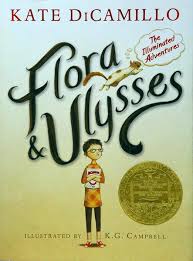
It was then that she noticed a small animal tucked up in the corner, which compelled her to read the back cover. As her eyes skimmed over the words describing a story about a squirrel who gets run over by a vacuum cleaner and strangely develops superpowers, she opened the book and began to read.
Before she knew it, the librarian was shouting a last call to check out books. Daisy hurried to have her book scanned and joined the rest of the children lined up at the door to return to class. Ms. Wright, her teacher, walked up and down the line surveying the children’s choices. Every now and then she’d murmur things like, “Oh! Great author!” and “You’ll love this one.” By the time Ms. Wright arrived at Daisy, she was nearly bursting with excitement. Daisy couldn’t wait to tell her how she loved what she had read so far, and she longed to hear Ms. Wright say what a great choice she had made, choosing a book with a medal on the cover.
However, when Ms. Wright glanced at the book in Daisy’s hand, she looked between the book and Daisy and said, “Oh sweetheart, you’re going to need to return this book.”
Return this book? Did she hear correctly? Confused, Daisy looked at her teacher who kneeled beside her, looked her eyes, and said, “You’re a level R. This book is much harder than that. Run and put this back. You can choose something from the R bin when we get to the classroom.”
Crestfallen, Daisy handed the book back to the librarian. In her head, she kept hearing the echo of Flora’s voice speaking the same words she said when she witnessed Mrs. Tickham vacuum up the squirrel: Holy bagumba.
What was she going to read now?
Back in the classroom, Daisy dragged herself to the R bin and without even looking, grabbed the book that was on top. She returned to her seat and muttered the title: Captain Underpants and the Attack of the Talking Toilets. Grudgingly, she began to read.
Fellow teacher educators, I guess we still have much work to do… Be diligent. Our furture generations need you.
https://www.choiceliteracy.com/contributors-bio.php?id=11
Last year, I (Yiola) wrote several blogs about my Sylvia Clare’s first year of kindergarten. In Canada children begin school at four years of age, sometimes three, and they enter Junior Kindergarten (JK). The following year they are in Senior Kindergarten. So, my Sylvia Clare is in SK this year and my son, Gallaway, has begun JK. The school year started well. The children are happy. A few of my favourite things about early years schooling:
I know children learn enormous amounts in the early years — vocabulary, numeracy, inquiry, motor skill development — so much happens in a kindergarten classroom. For me, as a parent, what I am most concerned about is my child’s well being. That is, their happiness.
The other day, Sylvia Care brought a note home that was written by a classmate. It was an apology note. Sylvia Clare was teased at school and the child wrote her an apology. My initial reaction was that it was somewhat funny. I did not really think it was significant. The following day when I picked the children up from school I spoke to one of Sylvia Clare’s teachers and brought up the note. First I said, “Hysterical” and then I paused when I noticed the teacher not laughing. I asked the teacher if Sylvia Clare was genuinely upset. In a serious tone the teacher explained that she was. It was in that moment that I recognized how much respect the teacher had for her student. Acknowledging Sylvia Clare’s feelings and addressing her hurt made me appreciate her teacher even more. Valuing young learners and appreciating their feelings is just so very important. The problem was quickly resolved; Sylvia Clare felt her feelings were validated, and her dignity restored. And only then, when a child feels secure, can learning occur.
And so we begin our second year of the Early Years with confidence, resilience and excitement. I look forward to sharing, every now and then, the nuances of one FDK experience.

Gallaway and Sylvia Clare during their first week of school.
I (Pooja) am taking a course at U of T this term which focuses on the practice and theory of teaching in higher education. When discussing approaches to teaching, the professor displayed Edgar Dales’ Cone of Learning graphic. Although this was something I was aware of, it served as a good reminder in how I design my courses and lessons each class.

I (Clare) know that many of the readers of our blog are teachers — whether in primary/secondary schools or in  higher education. October 5th is World Teachers’ Day. I found the articles below which I thought I would share with you.
Happy Teachers’ Day!
 October 5 is World Teachers’ Day, a global opportunity to show appreciation for the meaningful roles teachers play in our education and lives. Celebrate World Teachers’ Day by finding an event near you (or creating your own!), sending an e-card to an inspirational teacher in your life, or sharing pictures, stories, or links with the hashtag #worldteachersday on social media. Thanks to all the educators who have inspired us and who continue to enrich the world by sparking their students’ passion for learning. For more celebratory stories, read on!
I found this inspirational letter to a teacher which I want to share with you. http://www.literacyworldwide.org/blog/literacy-daily/2013/12/04/a-love-letter-to-teachers?utm_source=TW-09292015&utm_medium=email&utm_campaign=ThisWeek&utm_content=Story-1
To Those Who Give It Their All on a Daily Basis:
Let me start by saying thank you. Thank you for showing up each and every day, not just on holidays, and giving it your all. You are magnificent and deserve a moment to celebrate YOU.
Being a teacher, particularly a teacher of reading, means sharing so much of yourself in addition to your knowledge of strategies, letter sounds, and authors. As teachers of reading, you help breathe life and joy into books during a time in education when learning can too often and too quickly become rote and lifeless. You celebrate student success and embrace their frustrations, pushing them gently to overcome obstacles that feel insurmountable in the moment. You constantly doubt yourself, wondering if you are doing enough, planning enough, reaching your students enough. But it is that doubt and self-reflection that makes you a better and stronger teacher who is able to give it your all.
You give it your all in terms of your instruction, and you also consistently give of yourself. You share your reading life and preferences with your students. You share your students’ favorite authors and books as well as their struggles when encountering an unfamiliar and challenging text. Being a teacher of reading does not just mean giving students access to instructional best practices, it means giving students some insight into who you are as a reader, a teacher, and a person.
All too often, I hear “rigorous practice” separated from discussions of “fun” activities. Yet so many of you strive every day to reconnect “fun” with “rigor” by coming up with new ways to engage your students with difficult concepts and texts. This type of instructional savvy doesn’t just happen, nor is it inherent in every curriculum. It comes from teachers who give it their all, just like our friend Pete the Cat.
So know that at least one person out there knows how hard your job is and how much of yourself you give to your students every day.
Happy Holidays!
xoxo,
Mrs. Mimi
Mrs. Mimi is a pseudonymous teacher who taught both first and second grades at a public elementary school in New York City. She’s the author of IT’S NOT ALL FLOWERS AND SAUSAGES: MY ADVENTURES IN SECOND GRADE, which sprung from her popular blog of the same name. Mimi also has her doctorate in education from Teachers College, Columbia University.
For more info on World Teachers’ Day check out the UNESCO site: UNESCO http://www.unesco.org/new/en/unesco/events/prizes-and-celebrations/celebrations/international-days/world-teachersday-2015#.VgqU1M4XqHl
Richard Messina who is the Principal of the Jackman Institute of Child Studies is the co-author of the article: Fostering sustained idea improvement with principle-based knowledge building analytic tools by Huang-Yao Hong, Marlene Scardamalia, Richard Messina, Chew Lee Teo
I (Clare) thought this might be of interest to you because of the extensive use of knowledge building tools. Here is the abstract:
The purpose of this study is to explore the use of principle-based analytic tools to improve community knowledge building in a class of Grade 5/6 students. A flexible design framework was used to engage students in use of three analytic tools a Vocabulary Analyzer, a Social Network Tool, and a Semantic Overlap Tool. These tools are built into Knowledge Forum technology so principle-based assessment is integral to knowledge work. The primary source of data was discourse generated by students in Knowledge Forum over a school semester (approximately four months). Findings based on a mixed methods analysis reveal principle-based knowledge building analytic tools to be effective in increasing the frequency with which key terms are used by individuals, in their own productive vocabulary as well as in the shared community space, thus creating a more discursively connected community. Results additionally show a shift from problem generation and breadth of inquiry to increased self-assessment, reflection, and depth of inquiry; also, students report significant ways in which knowledge building analytic tools can increase knowledge building capacity.
Here is a link to the article: Huang-Yao article[1]

Embedded within my passion for literacy is my love for developmental drama. I do love theatre as well (I as a professional actress for a couple of years), but developmental drama is fundamentally different than theatre. Theatre is about performance. Developmental drama is about developing human potential, and that is my heart song.
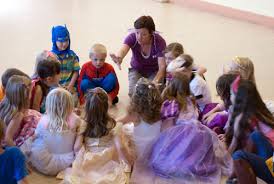
I was recently asked to present a Literacy Workshop for the Royal Conservstory’s new Smart Start Programme . This Early Childhood Education (ECE) programme uses a multiple arts approach to develop four specific cognitive skills: attention, memory, perception, cognitive flexibility. It was my role to model and lead a group of ECE leaders through creative drama experiences so they could experience first-hand how developmental drama can and does develop cognitive skills. We explored many drama strategies in the workshop: storytelling; role play; group drama; teacher-in-role; voice over narration; hot seat; tableaux, and; story drama. My favourite of the eight listed is story drama which uses the events and characters in a story to stimulate the drama experiences, plus, I got to use my storytelling skills. We became the characters; good and bad. We learned about a culture from the other side of the world. We asked questions. We problem solved. We also had fun. The participants left with many practical ideas and felt they were inspired to explore this world with the children they are responsible for. But, in all honesty, I think I was the one who left with the most insight.
I used to present this kind of workshop regularly, but have not done one in a few years. Due to my dissertation work in multiliteracies (Cope & Kalantzis, 2000), I discovered I was seeing the experiences through new eyes. I was identifying modes instead of arts disciplines and using critical discernment instead of point of view. The experience was a literacy event that we constructed within a social paradigm and the participants contributed their own knowledge and expertise in an environment that supported situated practice. It wasn’t just a new set of vocabulary; it was a much more informed and theoretical perspective of the work. Vygotsky, Luke, Peabody, Vasquez, Kress, Cope and Kalantzis occupied every corner of the room. I was well supported. I recognized a noticeable difference between my role as intuitive drama leader and informed theoretical guide. It was progress and it felt good.
Cope, B. & Kalantzis, M. (Eds.) (2000). Multiliteracies: Literacy Learning and the Design of Social Futures. New York: Routlage
I (Clare) read this amazing article on Salon.com about school reform. I suspect many many of us in education will resonate with the findings. It is so refreshing/hopeful that teachers and teacher educators are not being blamed for the problems in schools. You will find some of the stats/findings truly unsettling. Thank you David Sirota for your fine piece of journalism. Here is the link to the article: http://media.salon.com/2011/03/paranoid_michelle_rhee_blames_her.jpg
Monday, Jun 3, 2013 12:30 PM EDT
In the great American debate over education, the education and technology corporations, bankrolled politicians and activist-profiteers who collectively comprise the so-called “reform” movement base their arguments on one central premise: that America should expect public schools to produce world-class academic achievement regardless of the negative forces bearing down on a school’s particular students. In recent days, though, the faults in that premise are being exposed by unavoidable reality.
Before getting to the big news, let’s review the dominant fairy tale: As embodied by New York City’s major education announcement this weekend, the “reform” fantasy pretends that a lack of teacher “accountability” is the major education problem and somehow wholly writes family economics out of the story (amazingly, this fantasy persists even in a place like the Big Apple where economic inequality is particularly crushing). That key — and deliberate — omission serves myriad political interests.
For education, technology and charter school companies and the Wall Streeters who back them, it lets them cite troubled public schools to argue that the current public education system is flawed, and to then argue that education can be improved if taxpayer money is funneled away from the public school system’s priorities (hiring teachers, training teachers, reducing class size, etc.) and into the private sector (replacing teachers with computers, replacing public schools with privately run charter schools, etc.). Likewise, for conservative politicians and activist–profiteers disproportionately bankrolled by these and other monied interests, the “reform” argument gives them a way to both talk about fixing education and to bash organized labor, all without having to mention an economic status quo that monied interests benefit from and thus do not want changed.
Meanwhile, despite the fact that many “reformers’” policies have spectacularly failed, prompted massive scandals and/or offered no actual proof of success, an elite media that typically amplifies — rather than challenges — power and money loyally casts “reformers’” systematic pillaging of public education as laudable courage (the most recent example of this is Time magazine’s cover cheering on wildly unpopular Chicago Mayor Rahm Emanuel after he cited budget austerity to justify the largest mass school closing in American history — all while he is also proposing to spend $100 million of taxpayer dollars on a new private sports stadium).
In other words, elite media organizations (which, in many cases, have their own vested financial interest in education “reform”) go out of their way to portray the anti-public-education movement as heroic rather than what it really is: just another get-rich-quick scheme shrouded in the veneer of altruism.
That gets to the news that exposes “reformers’” schemes — and all the illusions that surround them. According to a new U.S. Department of Education study, “about one in five public schools was considered high poverty in 2011 … up from about to one in eight in 2000.” This followed an earlier study from the department finding that “many high-poverty schools receive less than their fair share of state and local funding … leav(ing) students in high-poverty schools with fewer resources than schools attended by their wealthier peers.”
Those data sets powerfully raise the question that “reformers” are so desperate to avoid: Are we really expected to believe that it’s just a coincidence that the public education and poverty crises are happening at the same time? Put another way: Are we really expected to believe that everything other than poverty is what’s causing problems in failing public schools?
Because of who comprises it and how it is financed, the education “reform” movement has a clear self-interest in continuing to say yes, we should believe such fact-free pabulum. And you can bet that movement will keep saying “yes” — and that the corporate media will continue to cheer them as heroes for saying “yes” — as long as public education money keeps being diverted into corporate coffers.
But we’ve now reached the point where the economics-omitting “reform” propaganda has jumped the shark, going from deceptively alluring to embarrassingly transparent. That’s because the latest Department of Education study isn’t being released in a vacuum; it caps off an overwhelming wave of evidence showing that our education crisis has far less to do with public schools or bad teachers than it does with the taboo subject of crushing poverty.
In 2011, for instance, Stanford University’s Sean Reardon released a comprehensive study documenting the new “income achievement gap.” The report proved that family income is now, by far, the biggest determining and predictive factor in a student’s educational achievement.
A few months later, Joanne Barkan published a groundbreaking magazine report surveying decades worth of social science research. Her conclusions, again, came back to non-school factors like family economics and poverty:
Out-of-school factors—family characteristics such as income and parents’ education, neighborhood environment, health care, housing stability, and so on—count for twice as much as all in-school factors. In 1966, a groundbreaking government study—the “Coleman Report”—first identified a “one-third in-school factors, two-thirds family characteristics” ratio to explain variations in student achievement. Since then researchers have endlessly tried to refine or refute the findings. Education scholar Richard Rothstein described their results: “No analyst has been able to attribute less than two-thirds of the variation in achievement among schools to the family characteristics of their students.”
Then, just a few months ago, Reardon chimed in again to contextualize all of this. In a follow-up New York Times article, he noted that it is no coincidence that these out-of-school factors — and in particular economic conditions — have created the “income achievement gap” at the very moment economic inequality and poverty have exploded in America.
Taken together with the new Department of Education numbers, we see that for all the elite media’s slobbering profiles of public school bashers like Mayors Rahm Emanuel and Michael Bloomberg, for all of the media’s hagiographic worship of scandal-plagued activist-profiteers like Michelle Rhee, and for all the “reform” movement’s claims that the traditional public school system and teachers unions are to blame for America’s education problems, poverty and economic inequality are the root of the problem.
One way to appreciate this reality in stark relief is to just remember that, as Barkan shows, for all the claims that the traditional public school system is flawed, America’s wealthiest traditional public schools happen to be among the world’s highest-achieving schools. Most of those high-performing wealthy public schools also happen to be unionized. If, as “reformers” suggest, the public school system or the presence of organized labor was really the key factor in harming American education, then those wealthy schools would be in serious crisis — and wouldn’t be at the top of the international charts. Instead, the fact that they aren’t in crisis and are so high-achieving suggests neither the system itself nor unions are the big factor causing high-poverty schools to lag behind. It suggests that the “high poverty” part is the problem.
That, of course, shouldn’t be a controversial notion; it is so painfully obvious it’s amazing anyone would even try to deny it. But that gets back to motive: The “reform” movement (and its loyal media outlets) cast a discussion of poverty as taboo because poverty and inequality are byproducts of the same economic policies that serve that movement’s funders.
To understand this pernicious bait and switch that writes economics out of the education story, simply think through the motives.
Think first about how the dominant policy paradigms in America — tax cuts for the rich, deregulation and budget cuts to social services — exacerbate inequality and poverty, but also benefit the major corporations that fund the “reform” movement. Then think about how it isn’t a coincidence that the “reform” movement’s goal is to divert the education policy conversation away from anything having to do with poverty and economic inequality.
You can tell that’s not a coincidence because unlike other issues, the topics of poverty and economic inequality will inevitably prompt a conversation about changing the underlying economic policies (regressive taxes, deregulation, etc.) that create crushing poverty and inequality. For corporations served by the existing economic paradigm and for the politicians and activists those corporations underwrite, such a conversation is simply unacceptable because changing the policies that create poverty and inequality potentially threatens their existing financial power and privilege. Thus, those corporations, politicians and activists in the “reform” movement do whatever they can — bash teachers, scream strong-but-meaningless words like “accountability,” criticize public school structures, etc. — to shift the education conversation away from poverty and inequality.
Reality, though, is finally catching up with the “reform” movement’s propaganda. With poverty and inequality intensifying, a conversation about the real problem is finally starting to happen. And the more education “reformers” try to distract from it, the more they will expose the fact that they aren’t driven by concern for kids but by the ugliest kind of greed — the kind that feigns concerns for kids in order to pad the corporate bottom line.
I (Pooja) read a blog post I wanted to share with you all. Lee Bessette, a college instructor, shared an experience of how technology was used as a tool to “re-reading, re-teaching, realizing.” Bissette, while teahcing the works of Thomas King (Indigenous writer), had students use their laptops, smartphones, and tablets to make real-time connections with the text. She explained:
…all of my students have laptops or tablets or smartphones, so instead of me telling them who the actors are and why it matters, I have them use google. And find pictures. And look at the shows and history. And who W.P. Kinsella is and why he is being referenced. And then they can collaboratively annotate the text.
We didn’t come up with any hard answers, but just explored theories, including one reference to the first lines of Paradise Lost that a student found by googling “garden, heaven, seat, Eden.” And many of my students are still struggling with this level of discourse around literature. But, as I told them today in an email (I know, SO OLD SCHOOL OF ME), that these readings that we did today around the setting of the garden were completely new to me, too, even after reading and teaching this story countless times. And that it has taken 20 years of practice to have a DUH moment like that one I had before class about said garden.
But the moment wouldn’t have come if it hadn’t been for the integration of technology in active and productive ways in my classroom practice. I could have the students find and collect the information needed to begin to make meaning in the text and focus on taking that process of meaning-making to the next level. They still don’t believe me when I tell them to “google it” and require them to annotate together, but I think after today we are all finally heading in the right direction.
Bessette demonstrates how all the smart technology brought into class on a daily basis could be used in a truly meaningful way. She used technology to enhance student learning by digging into a text in multimodal ways. By having student collaboratively annotate the text, she had them learn from one another and in turn gain deeper insights. A great model for using digital technology to re-imagine literacy!
Read the whole blog post here:
Hmmmm….
How does/can this fit into our current educational systems? Should it?
 Literacy Teaching and Teacher Education