Rules for Writing

There are many rules to writing and as quickly as new genres are entering the literary scene, so too are the rules changing.
Here is an interesting explanation of a rule of writing and its evolution:

http://writerscircle.com/2015/03/straight-from-the-editors-mouth-the-verdict-on-ending-sentences-with-prepositions.html

I see two big issues at play: 1) the rules of writing 2) writing with genre and audience in mind

It seems to me (Yiola) the rules are changing and this is in large part because genres are so rapidly evolving and being introduced.

There is much to be said for the traditional forms and genres of literary expression. And, it is the traditional forms I believe we still teach in schools. And yet with digital literacy there are many new forms being implemented and introduced in classrooms too.

I (Yiola) see writing as an art. The crisper the writing the more vivid the message. The clearer the writing the more opportunity for complex ideas.

The big question is… how to best teach writing in the elementary classroom? I remember teaching writing in the Junior grades (4th, 5th, 6th grades) with the audience, purpose and genre in mind… Now however all 3 elements (audience, purpose and genre) have grown to include several (more) possibilities.


Jo Lampert: National Exceptional Teachers for Disadvantaged Schools Program

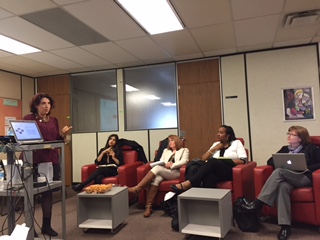
IMG_0339I (Clare) invited Jo Lampert from Queensland University of Technology to talk to our research group about IMG_0340the National Exceptional Teachers for Disadvantaged Schools Program which she and Bruce Burnett direct. This is an amazing program which aims to prepare student teachers to work in high needs schools.

The Faculty of Education developed the National Exceptional Teachers for Disadvantaged Schools (NETDS) program in 2009 to address the significant social issue of educational disadvantage through a teacher education program that explicitly focused on the preparation of high-quality teacher graduates. NETDS ensures that the best suited pre-service teachers are equipped to teach and encouraged to select employment in low socio-economic status school settings.

Each year we identify our highest-quality pre-service teachers who participate in a specialised curriculum that better prepares them to teach within low socio-economic status schools. We’ve partnered with the Queensland Department of Education, Training and Employment and key low socio-economic status schools to help channel these exceptional pre-service teachers into sites where they can have the greatest impact.

Jo LampertWe learned:

  • Approximately 90% of NETDS graduates have secured employment with schools below the Australian mean Index of Community Socio-Educational Advantage level of 1,000.
  • Many graduates secure full-time employment in low socio-economic status schools before they graduate.
  • School partners have grown from 3 in 2009 to approximately 50 in 2014.
  • We’ve developed distinctive workshops focusing on ‘real world’ issues related to disadvantage.

For more information go to their website: https://www.qut.edu.au/education/about/projects/national-exceptional-teachers-for-disadvantaged-schools

No Reading on the School Bus!

Literacy advocates, beware.  This news story might break your heart.

Eight-year-old Sarah Auger, from St-Jean-sur-Richelieu, Quebec,  was told she was no longer allowed to read books on the school bus.  The bus driver thinks it poses ” a safety risk to the other students”.

When the child’s father challenged the rule,  the school board conceded that “obviously” reading was not dangerous.  Yet, Mario Champagne, the general secretary and director of communications for the Hautes-Rivière school board, said, “The responsibility of a school bus driver is to transport students safely”.  And since the bus driver makes the rules- No Reading!

school-bus-cameras

http://www.cbc.ca/news/canada/montreal/quebec-girl-told-to-stop-reading-book-by-school-bus-driver-1.3043652


New Faculty Preconference: An Amazing Community

IMG_0304I (Clare) have just returned from AERA. One of the highlights of the conference for me was my work with new faculty. Division K (Teaching and Teacher Education) offers a preconference for new faculty and I was one of the organizers for it. Along with my fellow facilitators, Renee Clift, Rich Milner, Tom Dana, and Valerie Kinloch, we worked with 30 IMG_0289new faculty. On the first day of the preconference we began with the Facilitators sharing their stories – successes and challenges – which helped create an open environment. The participants then shared their stories. It was clear that all were committed to being the best faculty they could be, all had some successes the past year, and the transition to their new role has had some bumps. On the second day we broke into small groups where we addressed: mentoring (finding a mentor and/or academic community); tenure and promotion process; research and publishing; and balancing work and family life. We concluded with each person sharing a “take away” that is something they plan to work on over the next few months.

divknewfacI have been involved in the Division K Preconference for a number of years and this year was particularly special. The IMG_0297Facilitators had so much to share but they created space for the participants. We came together as a community and connections were made among all of us. This kind of support for new faculty is so important because as the literature reveals (e.g., Murray and Male’s work) that the transition from classroom teacher/graduate student to an academic position is not straightforward. There are issues of identity, workplace norms, pedagogy for higher education, academic community, pressure to publish, and …. I know that as a new faculty I would have appreciated having a mentor, a place to ask questions, and to know that what I was experiencing is “typical”.

It was great meeting these wonderfully talented new faculty who are the future of teacher education. I wish them all the best with their various endeavours. I feel that I have made 30 new friends!divknewfac2

A focus on digital literacy practices at AERA 2015

aera2015

I  just returned from another American Educational Research Association (AERA) conference. While in Chicago, I attended several sessions focused around literacy education, teacher education, and critical pedagogy and noticed digital literacy practices were discussed in all sessions. Interestingly, in the studies discussed digital technology was used not only as a tool to teach but a tool to re-imagine the definition and uses of literacy practices. Interesting sessions I attended included:

*Digital Storytelling as Method and Narrative Assemblage (Korina Jocson, University of Massachusetts)

 *Digital Storytelling as Racial Justice: Digital Hopes for Deconstructing Whiteness in Teacher Education (Cheryl Matias, University of Colorado & Tanetha Grosland, Morgan State University)

*Digital Authoring: Negotiations of Identity, Agency, and Power Among Girls Resettles as Refugees from Thailand (Delila Omerbasic, University of Utah)

 *Digital Storytelling in Preservice Teacher Education: Diverse Understandings of Writing, Pedagogy, and Meaning Making (Sandra Schamroth Abrams, Saint John’s University)

Benjamin Herold from the Education Week blog noticed a similar trend at this year’s conference. On his blog he said, “Digital reading and early literacy were among the hot topics at the annual meeting of the American Education Research Association, held here last week.” He describes the findings of four studies which study digital reading and early literacy. He noticed a common thread which ran through many of these papers: “It’s important to look at how digital devices, apps, and e-books are actually being used in classrooms, and the most promising literacy practices with these new tools involve lots of human-to-human interaction.”

Read Herold’s blogpost here:

http://blogs.edweek.org/edweek/DigitalEducation/2015/04/ipads_e-readers_literacy_research.html


Technology, inclusion, and innovation: Students design an app for literacy development

“It is estimated that only 10 per cent of blind children and adults know how to read braille. It is an illiteracy rate long ignored by technology developers who have created thousands of educational apps for the sighted”.

The above statistic is sad news however, I (Yiola) came across this most inspiring news:  students in an local middle school designed a computer app that can teach people who are visually impaired how to read braille.

How exciting for students to make such an impact in the literacy learning of others. How exciting for students to be learning about inclusion, literacy, and technology. How exciting to be engaged in the design and inquiry process in such a real way.

http://www.ctvnews.ca/mobile/sci-tech/ontario-students-braille-app-shortlisted-for-lego-innovation-prize-1.2329612

Wishing our local middle school students all the best in this endeavour.

Moving From Outsiders to Insiders: Working With a Teacher Research Group

I (Clare) have been involved in a teacher researcher group for the last 2 years. Along with Pooja and Shelley (regular IMG_2508contributors to this blog and pictured to the left) we have facilitated  a group in a secondary school. The work the teachers have done is outstanding! The three of us facilitators did a self-study of our work with this group. Since we did not know the teachers beforehand which was a bit unnerving we felt it was good to study our work. We now feel very much part of the group and feel we have become a learning community. We are presenting on our work with the teacher researcher group at AERA. Here is a draft of the paper Moving From Outsiders to Insiders: Working With a Teacher Research Group. It is still in “draft” form but if you are interested in teachers as researchers you might find this paper useful because we talk about logistics, identity, forming a community, and our learning. AERA 2015 EurekaPaperFinal

For those of you who read this blog and are at AERA I hope our paths cross.

Teaching Hybrid

In a couple of weeks, I (Cathy)  will start teaching my first hybrid course.  Also known as mediated learning, blended learning, and web-enhanced instruction, this kind of course can be considered  “the middle ground between our society’s adolescent love affair with technology and ancestral need for human contact and a sense of belonging” (Landau, 2015).

Baker College’s Instructional Technology Web site on blended instruction defines some of the advantages of hybrid or blended instruction:

  • Providing tools to facilitate communication outside of scheduled class time and office hours enhances student-student and faculty-student communication.
  • The blended learning environment supports different learning styles and methods.  Students have time for reflection when participating in online discussions and can participate at a time and place that meets their needs.
  • Online materials are available 24 hours a day, seven days a week, insuring that students always have access to assignments and other handouts.
  • On-line testing can be used for student pretests and practice.  On-line discussion between class sessions can identify areas of student difficulty that need to be addressed in class.
  • Course management and administration is simplified with an online gradebook and tools for email management.

http://www.baker.edu/departments/instructech/blended.html

The Hanover Research Council (2009) suggests the following  best practice teaching strategies for online education:  Group problem-solving and collaborative tasks;  Problem-based learning;  Discussion;Case-based strategies;  Simulations or role play;  Student-generated content;  Coaching or mentoring;  Guided learning;  Exploratory or discovery;  Lecturing or teacher-directed activities;  Modeling of the solution process; and  Socratic questioning

Yet, even though there are numerous advantages to online learning and many strategies  to make it effective learning,  I am told many students simply ignore the online material and rely on what they learn in class.  I suspect this may be because they feel it is easier to play hooky from a computer, or their schedules simply get in the way.   However, I feel my students will miss a lot if they ignore the online portion of our course. So I am collecting strategies to entice the students to engage in the online offerings;

  • offer a mark for engaging on line
  • provide enticements or teasers for what they might find online
  • review of intended learning for online work in class to ensure clarity,

and finally

  • use video streaming and/or chat rooms at designated hours so students feel connected to the site

I hope these ideas work, as I am looking forward to giving this a try.  If you have taught a hybrid course and have some more ideas, I’d really like to hear about them… online of course!