I came across the graphic below on Twitter entitled Helping Students Find the Right Book. It reminded me of our pre-service P/J and J/I literacy courses yesterday in which we discussed the place of the novel study in the classroom and the importance of engaging students in the reading of a variety of genres.
Visiting the Rishi Valley School… Part 1
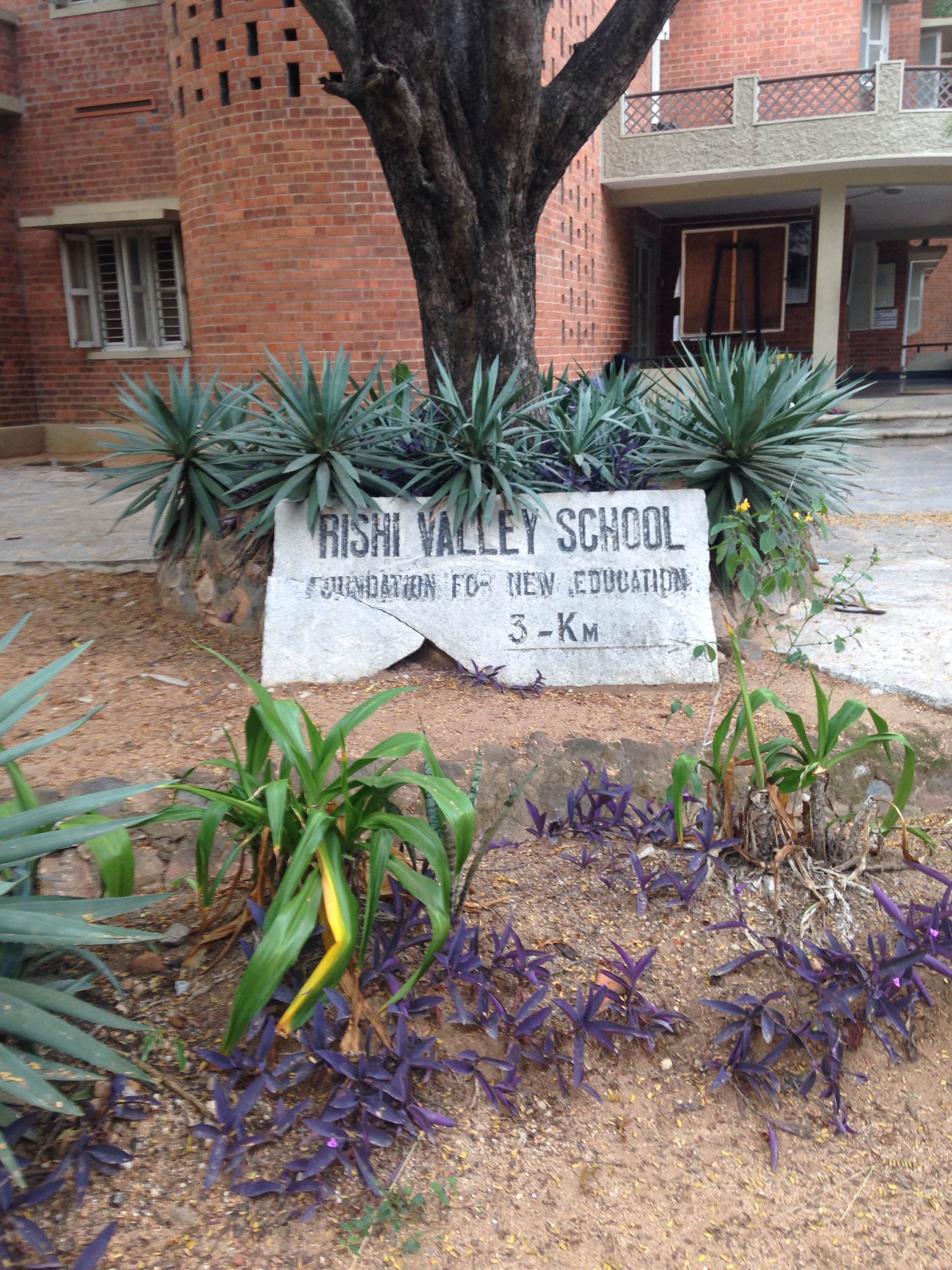
I (Pooja) have just returned from an extraordinary two days at the Rishi Valley School in India.There is simply too much for one blog post, so I will share my experiences over a few blog posts. In this blog, I will focus on the principles which guide the school along with a photos of the campus.
The alternative school is guided by principles of holistic education which aim for the growth of student’s intellectual, emotional, physical, artistic, creative, and spiritual potential. The educational philosophies of the Rishi Valley School include:
- To educate students so that they are able to explore both the world and their inner being
- To inculcate a love for nature and respect for all forms of life
- To create an atmosphere of affection, order and freedom without either fear or license
- Not to condition the students in any particular belief, either religious, political or social, so that their minds may remain free to ask fundamental questions, enquire and learn. (http://www.rishivalley.org/school/aims.htm)
The philosopher Jiddu Krishnamurti established the Rishi Valley School in 1962. There are now Krishnamuti schools across India and the world, but this was the first educational site. The school is located “in a sheltered valley in the interior of rural Andhra Pradesh…about 140 km north-east of Bangalore.” (http://www.rishivalley.org/school/aims.htm) When we first arrived we met with the school principal. He listened to us attentively, and when he spoke it was softly and always with purpose. He said something in that meeting that has stuck with me. He said that although the teachers differed in teaching approach, the important quality was that they approached their teaching from a place of care and love. By walking around the campus, speaking with teachers and students, and observing classes I witnessed this in so many ways. For example, each morning the students gather in an open-air auditorium for an assembly. My experiences with assemblies have usually included announcements, performances, or guest speakers. At the Rishi Valley school, the assembly is dedicated to singing. The students and faculty gather in a circle and sing for half an hour. At the end of the school day, after dinner, we gathered in the auditorium again to watch an absorbing documentary on particle physics called Particle Fever.
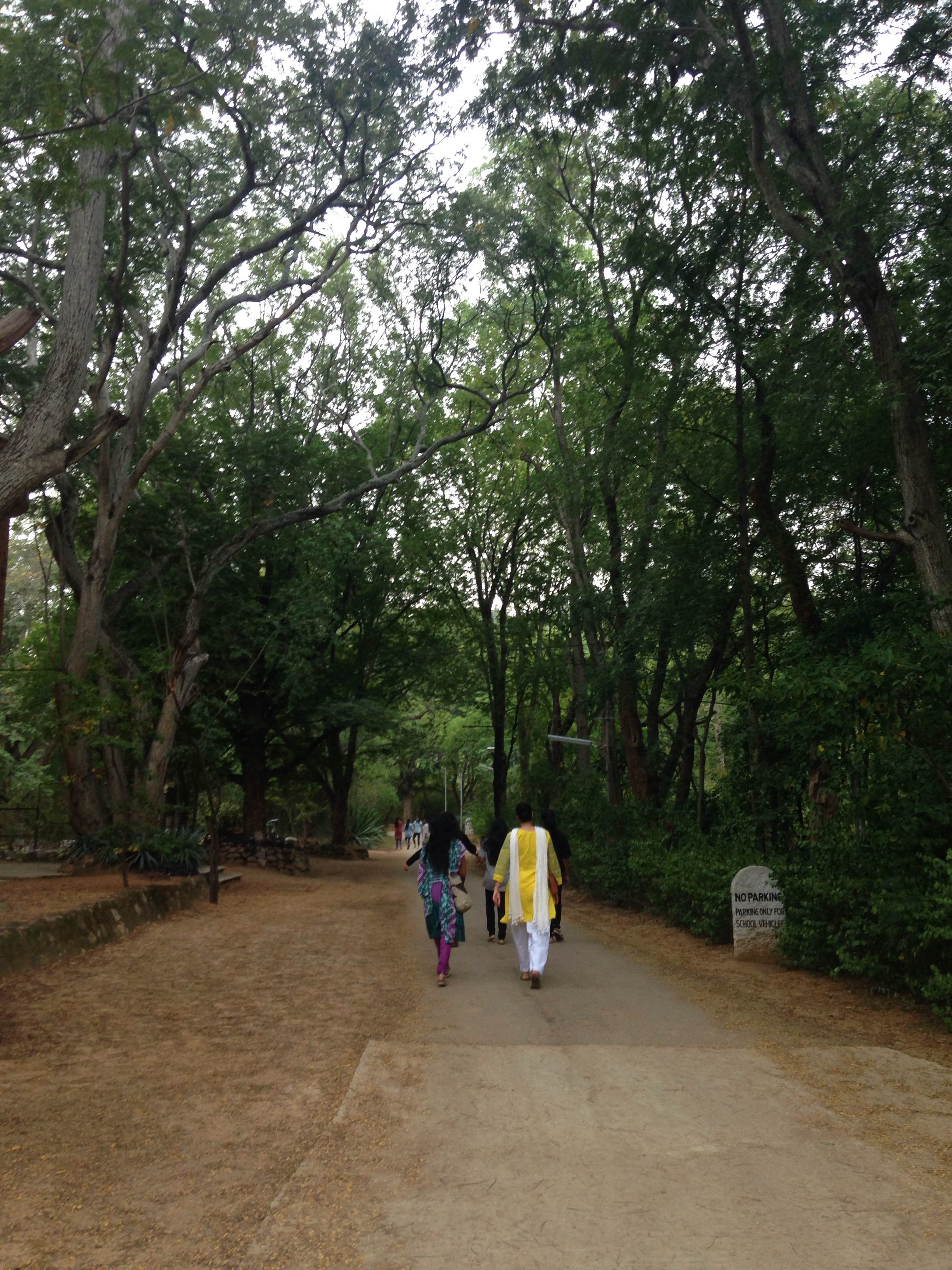
The following are a few photos of the campus and school activities. I believe they speak volumes about the principles from which the Rishi Valley School runs.
The Rishi Valley School is a boarding school serving student from grade 4-12. There are approximately 325 students and 60 faculty members who live on campus.
The morning all-school assembly. Students and faculty are seated on the ground.
One of the many outdoor classrooms. My friend, a spoken-word artist, had the opportunity to facilitate a class here (More about that in the next blog!).
The student art gallery. It was common to see students around the campus working on their art; fine art, poetry, and music permeated the student culture.
Walking to class is a meditative experience. The campus is spacious, situated on approximately 360 acres of land. There have been over 200 species of birds identified, with the Indian Government officially declaring the school a bird sanctuary.
To read more about the Rishi Valley School: http://www.rishivalley.org/default.html
Publish or Perish: The Rise of Predatory journals
In the past year, on a regular basis, an email would pop up in my (Clare) inbox about a new journal and invite submissions. I would scan the email and wonder – is this legit or is it a boondoggle? I usually deleted the email because I was not sure if it was spam but I have often thought that I might be missing a great publishing opportunity. Am I being old-fashioned and not using social media? Mark Kingwell, Professor at the University of Toronto, wrote a GREAT column about “predatory journals” which answered my question. So new scholars, do not get fooled. Press the delete button! And all academics will find his stats about acceptance rates at top journals a bit disheartening. Here is an excerpt from his column and at this bottom of this blog is a link to the entire article.
Predatory journals take a bite out of scholarship by Mark Kingwell
The academic imperative “publish or perish” is so well known that people with no intention of entering scholarly life are familiar with it – no tenure for you, my friend, without at least a handful of citations. The journals should be reputable and selective, as all the best ones are, but in the crunch quantity might just trump quality. Alas, now comes this new storm on the horizon of university careerists: predatory journals.
Nobody inside academic life will consider it news that the number of journals, in almost every field, has risen in the post-print era. The good ones remain, and sometimes even retain a print version, but they are now flanked by opportunistic newcomers who prey on the desires of tenure-seeking scholars.
That, in itself, is no big deal. A new journal can publish work as accomplished as an established one, assuming the usual practices of double-blind peer review: The reviewers, assumed to be experts in the field, don’t know the identity of the author, and the author doesn’t know who the reviewers are. In my field, philosophy, acceptance rates at good journals run to about 5 per cent, or one in 20 of submitted pieces, and rare is the article that goes into print without extensive revisions suggested by the reviewers.
Predatory journals are a whole different beast. Instead of you seeking their grudging approval, they come after you. And then they demand money.
2014 in review
Hello Readers of Our Blog,
I (Clare) got a summary from WordPress about our activities this year. Wow! For a little educational blog we are proud of our efforts. Thank you readers for taking the time to read our posts, post comments, and share our work with your network.
The WordPress.com stats helper monkeys prepared a 2014 annual report for this blog.
Here’s an excerpt:
The concert hall at the Sydney Opera House holds 2,700 people. This blog was viewed about 16,000 times in 2014. If it were a concert at Sydney Opera House, it would take about 6 sold-out performances for that many people to see it.
Happy Holidays
A recently published article on the pedagogical nuances of one teacher’s critical literacy practice
In addition to the amazing work our research teams explore on literacy teacher educators and the longitudinal study of classroom teachers, I (Yiola) am interested in the pedagogical work of teachers. In particular, I am interested in teachers’ work related to critical literacy: What do teachers do? How do they do it? What challenges do they face? How do they overcome those challenges? Why do they choose to teach critical literacy?
I have spent many hours in classrooms observing teachers’ work to see first hand their practices. I have interviewed the teachers to hear first hand their perceptions and understandings of their work. From this research we have begun to share some of the findings.
In our article entitled: An Inquiry-Based Approach to Critical Literacy: Pedagogical Nuances of a Second Grade Classroom we share the details of second grade teacher Sarah’s practices during her “Selfology Project”. The Selfology Project is a literacy project that required students to explore their identities, histories, families while thinking about issues of race and equity. How the teacher constructed critical literacy learning through an inquiry-based pedagogical framework is shared. Below is the abstract for the article:
This case study explores the pedagogy and practices of an elementary school teacher who combines inquiry pedagogy and critical literacy. The authors gathered data for this analysis by conducting two interviews with a classroom teacher and observing classroom practices 12 times over a 6 month period. Through a general inductive approach to analysis, trends emerged that showed the classroom teacher used practices that combined traditional inquiry pedagogy for critical literacy development. This research provides insight into how this elementary teacher negotiated and connected inquiry to critical literacy. Furthermore, the findings can inform scholars and teacher educators of successful teaching strategies as they prepare future generations of elementary teachers.
For access to the article please go to: http://www.ajer.ca
Several elementary classrooms were observed over the course of one school year. I look forward to sharing more from this study soon.
Supporting Teacher Educators for Better Learning Outcomes
The European Commission on Teacher Education has done some amazing work looking at teacher educators. “The European Commission’s Thematic Working Group on ‘Teacher Professional Development’ brings together national experts from 26 countries. It is recognised that Peer Learning activities between Member States can provide opportunities to share knowledge about current policy and to exchange best practice.” In 2013 they produced the document Supporting Teacher Educators for Better Learning Outcomes. I (Clare) found the document quite systematic and informative because in considers a number of issues and provides examples from various countries. Here is a link to the entire document. European Commision on Tchr Ed
Here are some findings you might find interesting.
Member States increasingly acknowledge the need to define clearly what those who teach teachers should be expected to know, and be able to do; they acknowledge that great care needs to be taken in recruiting and selecting
teacher educators, and in facilitating their career-long professional development. By stimulating and supporting the development of explicit frameworks and policies, national and regional education authorities can assist teacher educators to be as effective as possible.
Given the influence that teacher educators have on the learning of (student)teachers, ensuring that their work is of high quality is extremely important (Snoek et al. 2011). Raising teacher educators’ quality and formal qualification requirements can lead to wider improvements in education (Buchberger et al.2000, European Commission 2012b). In European countries, however, there seems to be little explicit policy, either to define what quality means in teacher education, or to define the formal education and professional development required of teacher educators.
Professional ownership seems to be promoted also by Dutch teacher educator standards (Koster and Dengerink 2008); on the other hand, teacher educators can see standards linked with assessment systems (such as in England) mainly as external quality assurance tools, and therefore perceive them as constraints on professional autonomy (Morley 2003). Policies in European countries which show growing interest in these aspects can provide examples for reflection. In some countries, teacher educator competences are already defined by the government and specified in law (e.g. in Portugal), or they are being developed (e.g. in Austria and Germany).
In the Netherlands, a set of professional standards for teacher educators is in place, developed by the relevant professional body through dialogue with stakeholders.
In Belgium (Flanders), a developmental profile for teacher educators was devised by one regional teacher education network, in consultation with other networks; it is now disseminated on a national scale by the professional association of teacher educators. The definition of minimal levels of competence in this professional profile is considered as important; the Ministry can have a facilitating and supporting role.
The Netherlands have had a complete set of teacher educator standards for more than ten years now; it has been revised to include school-based teacher educators, and currently, competence levels. This is complemented by a specific knowledge base that describes the key elements of being a teacher educator, undertaken jointly by the professional association VELON and the VU University Amsterdam (in place since 2011).
In Luxembourg, following up recent educational policy for teaching and learning improvement in schools, a university working group has the task of defining competences for teacher educators in primary education, facilitating collaboration between university faculty and school mentors. A university research project has also been launched to develop a handbook for secondary school teacher educators, who all receive specific training.
In Estonia, guidelines about competences of teacher educators (mentors) in induction are used for their selection in schools: they underline the importance of first and second order competences, but also of professional attitudes –commitment, responsibility, willingness to support and supervise. There are also interesting initiatives in academic institutions. The categorisation of teacher educators aims to develop professional career models in teaching practice schools, where teacher educators can express multiple identities and competences – teaching, supervising and carrying out action research
In Germany, national standards for teacher education offer guidelines for teachers’ and teacher educators’ quality, defining specific knowledge requirements for teacher educators. Those working in University Colleges of teacher education (Ausbilder) are generally expected to have the competences mapped above – including intercultural, collaborative, supervision and pedagogical competences. In most Länder there are special regular offers of CPD for teacher educators, within regional partnerships and cooperation structures with teacher educators from Universities.
In Austria, legislation on the duties and responsibilities of teacher educators in University Colleges will provide a point of reference for the description of necessary competences, working in parallel with a Quality Act recommending the competence requirements of teacher educators working in schools and continuing professional development (CPD). The profile of CPD trainers, for instance, focuses on competences about counselling, process management and implementation, communication, and so on.
In some countries of the cited survey, formal qualification requirements for teacher educators have been introduced, focusing on specific groups (e.g. in Sweden, Hungary and Finland). Other countries have approached this issue in the context of the accreditation of institutional providers of teacher education, as in Ireland (Caena 2012).
In Sweden, all teacher educators working at universities are required to have a PhD, with the development of intensive support programmes for those teacher educators that need to achieve a PhD qualification.
In Hungary, formal university education programmes for school-based teacher educators (mentors) are being introduced.
In Finland, the requirements for teacher educators working in teacher education institutions include MA qualifications and advanced Education studies (at least 90 ECTS).
In Ireland, the Teaching Council has developed revised criteria for teacher education providers, which now express requirements for staff responsible for student teachers’ learning. They include:
- a qualification at a higher level than the one being taught;
- teaching experience in the relevant sector (primary or post-primary);
- research activity as for supporting theory-practice integration; and
- registration with the Teaching Council (it is recognised that all these criteria might not be met by all staff).
The Teaching Council has also begun to identify some of the competences needed by school-based teacher educators, within a pilot model of induction/probation. Such teacher educators should:
- be fully registered and have at least five years’ experience as such;
- be good communicators, sensitive to the viewpoints of others;
- be committed to providing professional as well as personal support and
challenge;
- be good role models, with a wide repertoire of teaching styles;
- be committed to high standards of professional practice and conduct;
- be willing to commit time and effort in the interest of developing newly
qualified teachers as well as their own practice;
- be open to being observed in their practice by other teachers.
Consideration is being given to developing similar sets for teacher educators
involved in facilitating induction workshops.
Inspiration from Pinterest
I (Cathy) find one of the most popular social media sites used by my student teachers is Pinterest. They rave about the interesting and engaging ideas they find on the site for lessons. I saw evidence of this just recently while visiting a school. My student teacher, Melissa, had found a writing exercise on the site entitled, If I Was Trapped in a Snow Globe. It involved the students creating a snow globe scene inside of a white plastic container and then describing the adventure in writing. The associate teacher was so excited by the results, she lead me into the hallway to see what her young students had accomplished. The associate declared, “This student never writes anything, but look at this! Two pages! They loved this writing assignment.”
Often, good writing results by students are the results of a good inspirational ideas. Luckily educators have many more resources to access now, due to social media. I highly recommend Pinterest for many ideas in variety of subjects.
http://primarypunch.blogspot.ca/2013/01/thank-you-pinterest.html
The Most Popular Teacher Tools Used in 2014
As regular readers of this blog know, I (Clare) am very interested in using digital technology. Although I am not a techie I am always keen to learn more. The fabulous website Edudemic has a great list of the top technology tools for 2014. Very interesting and informative. I thought I would share it with others. The article can be found at: http://www.edudemic.com/10-popular-teaching-tools-2014/
By Edudemic Staff on December 11, 2014
Last year, Edudemic published a list of the most essential and popular educational tools used in modern classrooms across the globe. While many of 2013′s contenders retain top spots for 2014, there are a few new and noteworthy tools that made it onto this year’s list, and some of last year’s mentions have shifted in the rankings. We highly recommend taking a look at these “battle-tested” teaching tools; some of them may be a perfect fit for your modern classroom.
1. Google Apps for Education
It’s no surprise that Google once again reigns supreme. Google claims that more than 40 million students and educators use its suite of free apps. And why wouldn’t they? Google Apps for Education include tools like Google Docs, which helps student and teachers collaborate, and a calendar that helps students and teachers stay organized. The customizable security settings lend peace of mind, and it’s all ad-free. This suite of tools retains its top-dog position from 2013, thanks to its utility and because it continues to be so wildly popular with educators on a worldwide scale.
2. Twitter
Twitter stays planted firmly in its number two spot primarily because it has evolved into a legitimate place for growing a personal learning network (PLN) among educators. More and more teachers, in fact, are realizing just how handy this social network is when it comes to stimulating thought-provoking discussions. Educator Chris Bonke, whose story appeared on The Atlantic’s website, says he initially hesitated to use Twitter for his Freshman English class at North High School in Downer’s Grove, Illinois. However, Bonke explains that he found it helped his students engage in conversation about their assigned reading material.
3. YouTube
What student wouldn’t choose to watch YouTube rather than read a textbook? This video-sharing platform is a universe in itself, with myriad channels that can help educators. Among the most popular channels that are bound to capture students’ attention is Shots of Awe, which presents fascinating facts about a range of scientific topics. For its ever-growing usefulness, YouTube moved up a spot in the rankings from last year’s list.
4. Edmodo
Edmodo, like Google, boasts more than 40 million members. This all-in-one learning platform gives teachers the power to easily schedule homework and assignments, read about the latest trends in education, network with other teachers, and monitor student progress. The best part? Unlike other industry-leading learning management systems, Edmodo is free. Last year, Edmodo came in at number seven, but its booming popularity has secured the number four spot in 2014.
5. Remind
The most popular upstart to break into this year’s list is Remind. One in four teachers use the app, according to a recently published article by NPR. “Think of it as a combo of sticky note and class newsletter for the digital age,” writes nprED reviewer Elissa Nadworny. “Remind allows teachers to send messages — via email, cellphone, iPad or Android device — to an entire class with the push of a button.” Businessweek says that about one million teachers and 17 million students and parents use Remind. The app is particularly popular in Texas, Georgia, and Alabama, where between 40 and 50 percent of teachers use it. Remind is a newcomer on our list of popular teaching tools, but its star is clearly rising.
6. WordPress (and other Blogging Software)
Last year, WordPress came in at number nine on our list, but this year we moved this platform (and all of its associated blogging tools) to the number six spot because of its value to educators. Teachers can start a classroom blog that all students can contribute to; this encourages them to think deeply about what they are learning and engage in discussions. It also serves as a fun way to help them hone their writing skills.
7. Evernote
Evernote proudly points out that it has more than 100 million users. A good number of those users are teachers. They make use of the app to share information with students and substitute teachers, organize lesson plans, and jot down ideas. The tags and reminders features can help you stay on schedule and on top of all your material. Last year, Evernote came in at number five on the list, and the only reason it dropped a few places is because there are so many other awesome teaching tools that merit a mention. See Edudemic’s recent walkthrough on using Evernote to build student portfolios to get an idea of this tool’s potential for your classroom.
8. EDpuzzle
EDpuzzle is another newcomer on the list, and its spot is well-deserved, thanks to its ability to transform any video into a real lesson. With EDpuzzle, you can add your voice to videos or even insert questions. You can also search for useful videos across multiple platforms including YouTube and LearnZillion. If you want your students to slow down and digest the material, you can disable skipping on a video.
9. Easel.ly
Easel.ly is a relatively new tool; it stepped onto the scene in 2012, and since then, it has welcomed more than 300,000 users. This free gem lets you create custom infographics. Whether you want to break down a complex idea using charts and images or just want to highlight some main points, Easel.ly lets you do it — well, easily. As Easel.ly continues to evolve, we wouldn’t be surprised to see it climb a few spots on this list.
10. Dropbox
Dropbox is another cloud storage service that gives you easy access to your documents at any time and any place. All you have to do is drag a file or folder into Dropbox, and it syncs across all your devices. Even though it was number six on our list last year, this app has fallen to the 10th spot because Google Drive has usurped much of its functionality.
Honorable Mentions
The following are some teaching tools that we showcased on last year’s list. They still have undeniable value to educators, but were bumped off the list because they’ve become more stagnant in popularity than the exciting newcomers that have supplanted them:
- Skype: This communication service lets you collaborate with colleagues or students around the world. Skype took the number three spot on last year’s list.
- Socrative: Socrative came in at number 10 last year. It is a platform that encourages student discussion by allowing teachers to create assessments and activities and keep an eye on how students perform.
- Class Dojo: This app was in the number eight spot on last year’s list. It is a perfect fit for elementary school classrooms because it lets you instantly reward good behavior and point out less-than-ideal behavior. A little more than 2 million teachers use Class Dojo.
We don’t blame you if all the teaching tools available to educators leave you feeling a tad overwhelmed. Try them out one at a time and see what works for your classroom!
Clifford the Big Red Dog
Norman Bridwell the writer and illustrator of the Clifford the Big Red Dog books passed away Friday, at the age of 86. The popular children’s books have sold more than a 120 million copies worldwide. I have fond memories of borrowing Clifford books from my primary school library and reading about the loveable giant dog’s adventures. Initially publisher Scholastic only “offered the Clifford story through book clubs and school fairs.” The Clifford books eventually became available in stores in the 1980s. Bridwell suggested “Clifford’s imperfections were part of his appeal, making kids more forgiving of their own mistakes.”
Link to Toronto Star article to learn more about Norman Bridwell: