I (Cathy) instruct part-time at Brock University. Many of my mid-term evaluations from my pre-service students read, “Please, tell more stories”. It made me laugh, but it made a point. We all love stories, no matter what our age: family stories; folktales from another culture; scary stories… it doesn’t matter. So today, in our first classes for 2014 I focused on storytelling, but turned the tables somewhat and encouraged my student teachers to be the tellers. They were asked to share personal stories about their teaching practicum, which they had completed just before the winter break. I started us off by sharing a story about a disastrous placement I experienced many years ago when I was a student teacher. The flood gates were opened. My, oh my, such stories! Hilarious stories about indignant kindergardeners; touching stories about tough grade eight boys weeping because they thought they had hurt the student teacher’s feelings; frightening stories about overly demanding associate teachers; and joyous stories about building up deflated ELL students. The passion in the room was palpable; it glowed in their eyes, exuded in their hand gestures and spilled about the room with the rise in the decibel levels. Clearly, they loved working with the kids, the learning (good and bad) and the chance to make a difference. They loved teaching, and even in this climate of little prospects of obtaining a teaching position for a few years, they were exactly where they belonged. And so was I. Cathy
Winter Clothing is a Basic
 Many of us in North America are enduring the coldest weather in decades. This morning it is -39 Celsius (= -40 F). Bone chilling does not even begin to describe the experience of being out in this weather. Whenever we have frigid weather like this I recall my time as a classroom teacher. I taught in very high needs schools and when winter roared in, many of the children suffered terribly because they did not have adequate winter clothing. Last night on Chris Matthews’ show, Hardball, on MSNBC http://www.msnbc.com/hardball/watch/the-need-to-sustain-the-social-safety-net-108521539760
there was talk about the American Congress wanting to end welfare benefits. All those politicians who vote to end or reduce welfare benefits they should visit an urban school in the depths of winter and tell some children that they do not deserve a winter coat and mittens.
When I was a teacher, every year I would go to children’s clothing stores and beg for winter gear (coats, mittens, boots) for my students who were so inadequately dressed. Never once did I leave a store empty-handed. Many of the teachers on staff engaged in similar missions and many who were moms or dads would bring in winter clothes that their own children had out-grown. So those politicians who want to micro-manage teachers and impose an array of standards should accompany those teachers to children’s stores to beg for donations. I am sure this reality-check would have a real influence because they would learn what teaching is all about. Their view that teachers need to be told what to do and should be penalized for not focusing solely on the “basics” might change. Aren’t winter clothes a basic? I think so. Stay warm! Clare
Social Justice through Activism in Mumbai
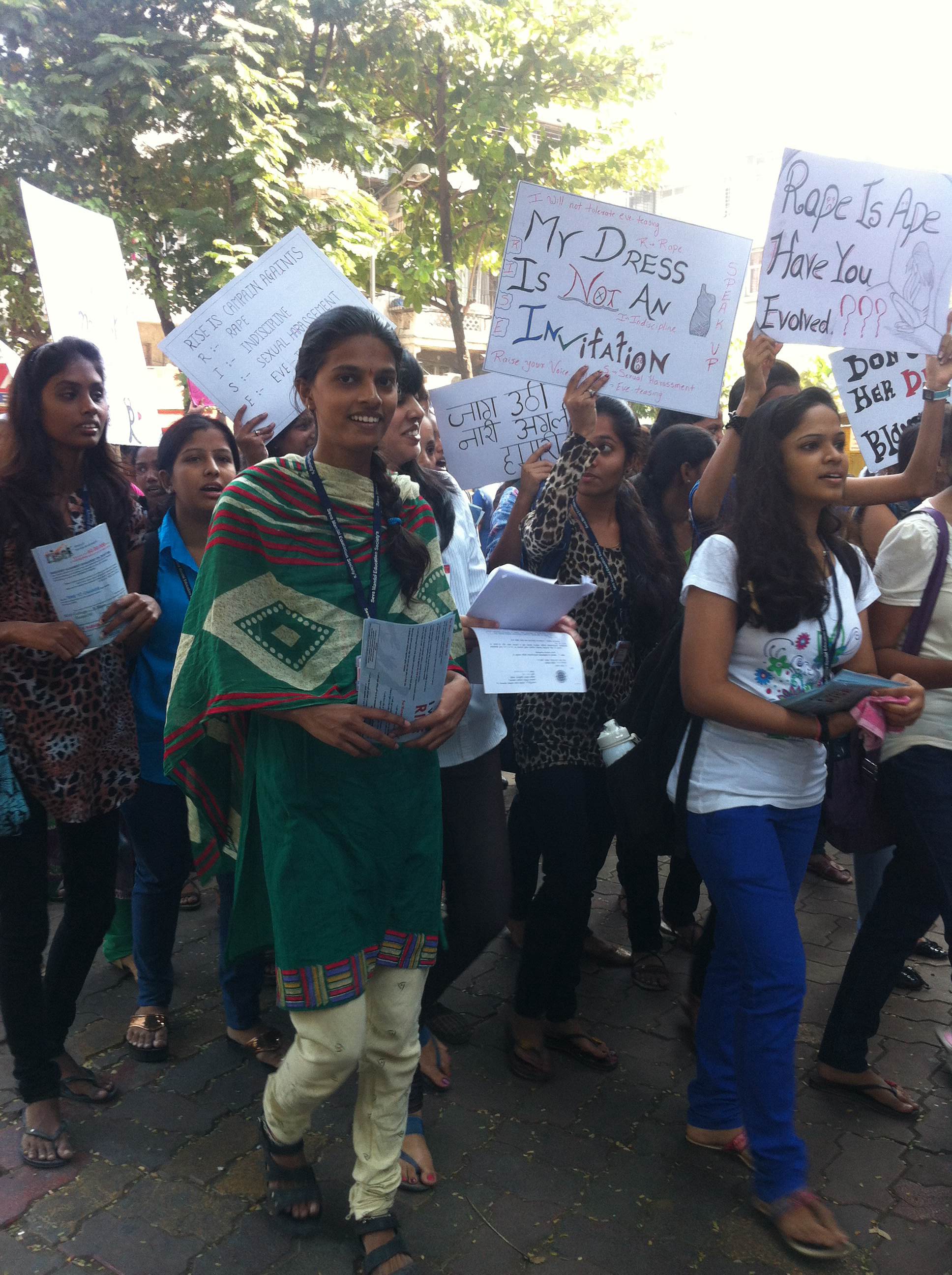 While I (Pooja) was only in Mumbai, India for two short weeks, I was able to observe (and participate in!) acts of social justice through activism. I was pleased to notice so many young women in organizational and leadership roles.
A week before I had arrived the Indian Supreme Court had reinstated a law criminalizing acts of homosexuality (Section 377 in the Indian Penal Code). I, along with many others, was shocked. This was a huge step backwards for India and its people, in my opinion. Within a matter of days rallies were organized all over India to protest. One of the major rallies was held in the park around the corner from where I was staying. Although the news of Section 377 was truly saddening, I was uplifted to see the youth organize themselves so poignantly. This rally received a lot of coverage and gave hope back to many who had been personally affected by this decision. Below is a link with some images capturing the spirit of the protest in Matunga, Mumbai:
A few days later, while taking a morning walk, I passed by a large group of young girls  protesting against the treatment of women in India. Over the past year, media sources in India had shed light on a few horrific rape cases from around India. I asked one of the young women protesting what had inspired them to take this injustice upon themselves. She told me they had organized themselves because they wanted to have their voices heard and their message conveyed: “We are not going to stand for the mistreatment of any woman, anywhere.” For the past week they got together, outside of school hours, to make signs and spread the word. In total there were about 100 young women protesting. They had made there message clear. They stood in solidarity with women all across India. Pooja
New Business Model for Education: Respecting Teachers
There is a great article in the New York Times magazine today, A Ready-To-Assemble Business Plan Adam Davidson
http://www.nytimes.com/2014/01/05/magazine/thinking-outside-the-big-box.html?ref=magazine&_r=0
It reports on studies done on “how to make low-paid work more rewarding for employees and employers alike.” Zeynep Ton argues that “Even the most coldhearted, money-hungry capitalists ought to realize that increasing their work force, and paying them and treating them better, will often yield happier customers, more engaged works, and – surprisingly – larger corporate profits.” Although the article is about workers in big box stores, we think that there is relevance for the way we treat teachers. If we treated teachers with more respect (as they do in countries like Finland), have more fully-staffed schools, and pay teachers a decent (competitive) salary rather than trying to “teacher proof” the curriculum and impose draconian measures on them (pay raises linked to student achievement on standardized test) we may actually improve education! Perhaps, it is time to flip the approach from controlling teachers to respecting and supporting them. Let’s try this experiment in 2014! Clive and Clare
Happy Birthday Clive

Happy New Year
Today is New Year’s Eve and newspapers are full of descriptions of resolutions for 2014. I am not one for making resolutions (maybe because I know that I will not keep them) but this year I am motivated to make a few.

- · Keep blogging. Much to my surprise this has been a fabulous activity. I hope that our readers are enjoying the blogs as much as we have enjoyed writing them.
- · Do not push myself so hard – in other words, relax a bit. Everything does not need to be done ASAP. Emails and work can wait.
- · Keep learning about digital technology. Time to take a few more steps integrating DT into my teaching. Time to learn how to use Twitter!
- · Stay connected to family, friends, and colleagues. They keep me grounded.
Best wishes to all of our readers for a happy and healthy 2014. Clare
Is Alternative Certification Really an Option?
Our blog has included a number of posts about our longitudinal research on teachers. All of the teachers in our study completed a full teacher certification program yet many faced real struggles. Although we know that teaching is a very demanding profession, the clamor for Alternative Certification programs seems to be increasing. Alt Cert programs are flourishing in many countries which to me defies reason. I read a really interesting blog about a young teacher who was part of Teach for America (TFA) corps – her TFA program had 5 weeks of training. The title of the blog captured my interest: Tell-All From A TFA and KIPP Teacher: Unprepared, Isolation, Shame, and Burnout. Here the link to it: http://cloakinginequity.com/2013/12/29/tell-all-from-a-tfa-and-kipp-teacher-unprepared-isolation-shame-and-burnout/
The blog by reflections, video clips of TFA recruitment, and some stats. It is really interesting. Here are two excerpts from the new teacher’s reflections which I found heartbreaking:
Unpreparedness for the Classroom
The 5-week summer session at Rice University was a fast-paced, well-run training session, but it was not enough to prepare me to lead my own classroom in my first year. While I learned valuable techniques and tools to become a teacher, it certainly did not equip me for creating systems in my classroom, writing unit plans, and creating valuable assessment. Five weeks was not enough to create the type of magic that Teach For America describes in its vision. Training was like leading us to the top of a cliff before we had to jump off into the reality of our own classrooms. All I can say is the mountain was high and the fall was hard.
Shame
Shame has a terrible place in this organization. I never believed that shame would become a motivator in my Teach for America experience, but shame holds onto the necks of many Corps members. Placing young college graduates in some of the toughest teaching situations with 5 weeks of training has negative repercussions on the mind, body, and soul of Corps members. The message is “If only I were stronger, smarter and more capable, I could handle this. I would be able to save my students.” Unfortunately, TFA intentionally or unintentionally preys on this shame to push Corps members to their limits to create “incredible” classrooms and “transformative” lesson plans. Would these things be good for our students? Of course. Is shame a sustainable method for creating and keeping good teachers in the classroom? Absolutely not. It is defeating and draining.
Thanks Julian for your blog. After reading the blog can anyone actually say, that Alt Cert is a viable option? I think not. Clare
What To Do Until the Evidence Arrives
A common refrain internationally today is that teaching should be evidence-based, and certainly, that is the ideal. However, it will be a long time before all the evidence is in. It can take millions of dollars and many years to test the impact of just a few teaching strategies; yet teachers must daily use a large repertoire of strategies. So what to do in the meantime?
Teachers must rely largely on their judgment about what is most likely to have a positive impact (drawing of course on their training, PD, and years of experience). This isn’t ideal, but it’s better than waiting until the evidence is complete.
We commonly use our judgment in evaluating teachers and teacher candidates. We say things like “So and so is one of the best teachers I’ve seen,” without having detailed student outcome data. Equally, we must let teachers exercise judgment about what and how to teach. We should give them our advice, evidence-based or not; but it should build on their current judgment and practices. Clive
Teaching in a Digital Age
 As an instructor of literacy methods courses in preservice teacher education, one of the challenges is remaining current. I feel that I must have current knowledge of research on literacy and literacy development, current knowledge of curriculum resources and government initiatives, and be current with ever-changing social media trends. The last point is one that is often overlooked but equally important. To prepare my student teachers to be effective literacy teachers, I need to know them and this entails knowing the social media they are using. If I do not have some working knowledge of their communication patterns they might view me as a dinosaur which in turn can create a barrier to me understanding where they are coming from. Also, both student teachers and I need to know what pupils are using if we want to connect home and school literacy practices. Not having a teenager makes it difficult to stay current – many adolescents are far more in tune than me. So what to do? I found this website http://www.commonsensemedia.org/educators/blog which is helpful. I am not sure who sponsors it but there is a treasure trove of info for those of us trying to figure out what adolescents and young adults are using. One page that was very useful lists11 sites that kids go to after Facebook http://www.commonsensemedia.org/educators/blog/11-sites-and-apps-kids-are-heading-to-after-facebook . I liked the thumbnail sketches of each site and the pros and cons of each site.
Another page identified top digital citizenship bloggers.
http://www.commonsensemedia.org/educators/blog/our-favorite-digital-citizenship-bloggers-to-follow-in-2014
These bloggers identify issues that are often invisible to me.
Knowing popular culture I feel is essential to being a literacy professor. Clare
Perils of Proofreading
We had a wonderful Christmas and now back to work. Clive and I have the proofs for our upcoming t ext Growing as a Teacher: Goals and Pathways of Ongoing Teacher Learning. This step of the publishing process is mixed: it is so exciting to see the page proofs but then there is the painstaking step of proofreading. Clive is the best proofreader – me, I am the worst. I think this is because I read so quickly that I skim over the mistakes. I just do not pick them up. When I was a classroom teacher, I used to teach my students strategies for proofreading knowing full well that there are readers like me who just do not see the errors. Thankfully Clive is such a careful reader that he spots each one. Next we will place electronic post-it notes on the manuscript flagging each correction. This step I find nerve-wracking because this process is quite finicky. Sometimes I get the post-it note placed in the exact spot, other times, I fiddle and fiddle with the placement of it.
We want to give a shout-out to Sense Publishers https://www.sensepublishers.com/catalogs/authors/auth-clare-kosnik-/who are publishing this book. This is the third book that I have done with them and they are an absolute joy with whom to work. Consistently, they have great project managers and the page proofs tend to be fairly clean. Wish us luck! Clare
 Literacy Teaching and Teacher Education