Tag Archives: 21st century literacy

Expectations for Teachers in the 21st Century

Between working in a time of increasing digital technology, high-stakes testing, diverse classrooms, the 21st century teacher needs to wear more hats than ever before. Jeff Dunn from Edudemic.com has put together the following chart outlining 8 essential characteristics for teachers of the 21st century.

8char

Dunn emphasizes that teachers do not have to embody all of these characteristics all the time. Rather, he explains: “What you do need to do, though, is be able to pull from experience and be a leader, a collaborator, a communicator at a moment’s notice. That’s what (to me) a 21st century teacher does.”

Are there characteristics you think are not included? Is it realistic to expect all teachers to be experts in multiple areas? To be able to wear multiple hats at any time? And wear them well?

The Interactive Resume

I have never seen something like this before, so I thought I would share it! If any of you are familiar with the Mario Brothers games, this interactive resume will seem very familiar to you. I had so much fun “reading” this resume! 

http://www.rleonardi.com/interactive-resume/

digresume

Little Free Libraries

“The “take a book, return a book” boxes are catching in even on places where Kindles and brick-and-mortar books abound.”

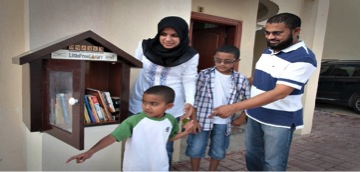
 I love the concept of the Little Free Library! The Little Free Library movement operates from a universally understood “take a book, return a book” policy. The first Little Free Library was built in 2009 in Hudson, Wisconsin. Since then, Little Free Libraries have been popping up all over the world:

There are now 18,000 of the little structures around the world, located in each of the 50 states and in 70 countries—from Ukraine to Uganda, Italy to Japan. They’re multiplying so quickly, in fact, that the understaffed and underfunded nonprofit struggle to keep its world map up to date.”

qatar

Little Free Library in Qatar

stclair

Little Free Library in Toronto (St. Clair Ave)


Find a Little Free Library near you!

 http://littlefreelibrary.org/ourmap

How do you Know What To Blog About?

I (Clare) recently did a presentation to a group of teachers on a self-study I conducted with Connecting PeopleLydia Menna and Shawn Bullock on our efforts to integrate digital technology into my literacy methods courses. (Here is the powerpoint from that presentation. BERA + ECER-DT 2013in Dropbox) I talked about my initiatives which led to me showing how my efforts in my literacy teaching led to a greater use of digital technology in other parts of my life (e.g., using NVivo for data analysis). The success of my initiatives with my teaching gave me the confidence to take the plunge to do a website. My technical skills had improved and my identity shifted so that I now see myself as “digitally competent.” During the presentation I showed our website and one of the participants raised an interesting question: How do you get ideas for your blog? He recounted how he wanted to do a blog but did not know what to write about. I told him to just start! I believe that writing a blog is a different genre – it requires different writing skills than other forms of writing. Since we started this blog, I feel that my blog-writing skills have improved. I now focus on one topic in a blog; I am more comfortable sharing my insights; I will raise questions; I make links to other resources; and I no longer feel the blog needs to be perfect  (so what if there is a typo. We will survive.)  Blogging seems to have captured my interest and is a good match for me ( I have lots to say about education) and it is fun.  I keep a Word document with blog ideas which is always plentiful and when I come across something “interesting” one of my first thoughts is – Would that make an interesting blog? This thought is followed by – Would others be interested in this topic/issue? Doing our blog as a “team” has truly been the way to go. I have learned so much from the posts by my team (Cathy, Lydia, Pooja, Clive and our guest bloggers) about them personally and professionally. And their blogs give me ideas about what to write about.

I really see our blog as connecting with the broader education community which is social media at its best. Blogging is good for me because it gets me thinking critically and hopefully, our posts are of use to our readers.

Just for Fun- A Literacy Word Search

In the word search below, can you find…

1. The name of the theorist generally accredited with the origins of Social Constructivist Theory

2. The term used to identify a branch of linguistics which contends that meaning-making manifests through human interpretations of sign systems

3. The names of the two researchers accredited with constructing the four resource model

4. The term assigned to multiple modes of communication

5. The Literacy Theory that purports literacy and language are not neutral but political.

6. The name of a pedagogical approach designed by 10 scholars known as the New London Group in 1996

Scroll down for answers- but no peeking!


Z C X B N O L M R T Y Y I O P K
A C V N Q W R U T U J L A S D F
B V M N W E F L A S D F G H H J
Q Y W E M U L T I M O D A L O P
A G D G J K O I M N B V C X Z A
W O E T Y P U L U K J H G F D S
Z T X C V B N I M L H F D S A E
C S T G H K L T O U Y T E R W Q
V K N N L H O E I T R E W A Q P
R Y T Y U I P R I Z X C V B N M
Z L U K E M V A O P U Y T R E W
C X B N M L Q C R I T I C A L Q
Q W E R T Y U I I O P L K J H G
H G F D S A S E R T Y U I O M N
D F G H J K L S E M I O T I C S
Q S D C F R E E B O D Y C A T Y


Answers:  1.  VYGOTSKY 2.  SEMIOTICS  3.  LUKE, FREEBODY  4.  MULTIMODAL  5.  CRITICAL  6.  MULTILITERACIES


Learning and Handwriting and the 21st Century

I (Yiola) have shared a number of posts that consider the changes and loss of  all that 21st century literacies bring.  I have shared media clips and links to spoken word poetry on the demise of social media.

It’s funny because I myself am an avid user of new literacies; most digital, critical, social… you name it, I  engage with it.  Yet, I strongly feel a sense of loss in communication, social consideration, and a certain kind of creativity and thinking.  Then, I came across this article:

An interesting article that reports handwriting — traditional handwriting – has benefits far surpassing penmanship. I am interested in the art of handwriting… its skill building potential… its power to foster literacy, communication and creative thinking. I am inspired.  For developing my children’s language and literacy I will use iPad Apps for building phonemic awareness but I will also continue to encourage and be excited about handwriting well into their young adult years and I will encourage my student teachers to do the same. What do you think?

Consequences for our Fast Communication Mistakes

The recent phenomena of quick texting is providing us with accelerated communication opportunities, but is it always working to the best of our advantage? I (Cathy) brought this up at a dinner party the other day and was amazed at how many had experienced major communication faux pas. One colleague confessed to texting his boss instead of his intended friend- about the boss. Luckily, there were no consequences as he still has his job.

Another colleague- a writer- sent a text off to her publisher inquiring about her overdue contract. She received a text back that was intended for another editor in the publishing house stating they should hold off sending the contract so they could “offer her less”. She consequently forwarded the text to her agent and luckily she was not “offered less”.

And then there was my own experience. I texted my son suggesting I pick up a few work shirts for him while at Costco. Shortly afterward I received a text from him- intended for his sister- complaining about my taste in clothes. I texted him back that I would not pick up the shirts after all. He thought this mistake was hilarious and immediately sent a text to his sister telling her what he had done. Many LOL texts followed to which I was included. This incident became a family joke and I have consequently learned to refrain from buying clothes for my son. Luckily, I just buy something for myself instead!

Teacher Educators, Literacy Educators, and Digital Technology Experts Working Together

Making ConnectionsI (Clare) am pleased to share some good news. We submitted a proposal to the Social Sciences and Humanities Research Council of Canada (SSHRC) to fund the project Rethinking Literacy Teacher Education for the Digital Era: Teacher Educators, Literacy Educators, and Digital Technology Experts Working Together. One of the main activities of the project will be bringing together 16 experts from three fields and 4 countries (Canada, US, UK, and Australia) to address the following questions.

  • How is our understanding of literacy evolving in light of the new ways we communicate?
  • How can literacy/English teacher educators (LTEs) prepare student teachers to develop and implement literacy programs that capitalize on digital technology (DT)?
  • What teacher education curriculum changes are required to better prepare future teachers to integrate technology in their own teaching?
  • What professional learning support do LTEs need to develop courses that will integrate and make greater use of DT?

As a team we are going to work together to:

  • develop a statement on literacy teacher education that offers direction on how to integrate digital technology into teacher education literacy courses;
  • extend our website http://www.literacyteaching.net to include video interviews of all the participants discussing their views and current research and their course outlines and supplementary course materials;
  • produce an edited book Crossing Boundaries: Literacy/English Teacher Educators Incorporating Digital Technology in Their Courses

 Click here to read the summary of the proposal. Final Summary of Proposal

As academics we tend to work in our “silo” which although allows us to specialize it has Connecting Peoplelimitations. The symposium will provide an opportunity to work in an inter-disciplinary manner which may help us move forward the field of literacy teacher education. My co-applicants for the proposal are Lin Goodwin (Teachers College), Simone White (Monash University), Bethan Marshall (King’s College UK), Jean Murray (University of East London), and Clive Beck (University of Toronto). I will continue to provide updates on our work.

21st Century Learning and the Need to Shift Our Thinking

Several of our posts refer to 21st century learning, technology, multi-literacies and thinking about today’s student and world. I (Yiola) found this article from the Huffington post called: The Global Search for Education: Education and Jobs quite interesting. The article talks about the need for drastic changes to our Educational systems in order to meet the growing demands of the market place in the 21st century. Bottom line, technology is taking over many of the jobs people currently do and so we need to reconsider the skills we are providing to students. The article goes on to say that our traditional and current systems continue to develop linear thinkers and producers but what we really need to develop are individuals with:

the ability to initiate, discern, persevere, collaborate, and to solve problems creatively are the qualities most in demand today and will be increasingly important in the future. The problem is that our education system was designed, primarily, to teach the three R’s and to transmit content knowledge. We need to create schools that coach students for skill and will, in addition to teaching content. If we don’t make this transition quickly, a growing number of our youth will be unemployable at the same time that employers complain that they cannot find new hires that have the skills they need.

I tend to agree with the article however I raise two points for discussion:
1)   Teacher education programs do teach to the creative, inquiry-based modes of pedagogy. I certainly cannot speak for all programs but I am familiar with several and teacher educators do work hard to teach pedagogies that meet the needs of today’s learners. So, why then are classroom teachers not teaching in these ways? Or, are they?
2)   I have seen time and time again policies and actual changes take place at the Government level but once changes happen in schools it is often society at large that is in an uproar. For example, here in Ontario we have implemented Full Day Kindergarten (early years) and the program is designed to develop higher level thinking right from the start. This transition, while happening, has not been without significant reluctance from the general public. What then do we do?

For more considerations here is the full article:  http://www.huffingtonpost.com/c-m-rubin/the-global-search-for-edu_b_5084761.html?utm_hp_ref=email_share