Tag Archives: Digital technology

Symposium: Day One Reflections

Lin GoodwinThe first day of our Symposium was a smashing success! The large group discussion of “where we are” revealed the extreme pressure on teachers and teacher educators. We heard about the fast and furious rate of reform in some countries – non-stop initiatives coming from the government. These are so prolific that there are often contradictory messages (e.g., be inquiry-based but focus on skills development). The mini presentations addressed a range of issues: what happens when standards are implemented; student teacher expectations for courses versus the teacher Lydia and Cliveeducators’ goals; problems of teacher retention; the vast number of pathways into teaching creates confusion; and teacher educators having different emphases in their courses even when there is a common syllabus. A problem that arose is lack of control over the implementation of standardization. It can take a very different form from the envisaged use of the standards. The place of digital technology in literacy/English education still eludes and needs much more discussion of what to do and how to do it so that technology is used to support learning.
Cathy MiyataThe discussion was rich and far-ranging. A number of participants commented that we rarely have an opportunity to discuss “big issues” in education and teacher education.
Today promises to be another day full of lively discussion.

 

International Symposium: Digital Technology and Literacy/English Teacher Education

Making ConnectionsAs many of our blog followers know we are hosting the Symposium : Rethinking Literacy Teacher Education for the Digital Era: Teacher Educators, Literacy Educators, and Digital Technology Experts Working Together. One of the main activities of the project is bringing together 17 experts from three fields and 4 countries (Canada, US, UK, and Australia) to address the following questions.
• How can literacy/English teacher educators (LTEs) prepare student teachers to develop and implement literacy programs that capitalize on digital technology (DT)?
• What teacher education curriculum changes are required to better prepare future teachers to integrate technology in their own teaching?
• What professional learning support do LTEs need to develop courses that will integrate and make greater use of DT?
The Symposium will be held over two days: June 5 and 6 in London England. We will send updates daily.

As academics we tend to work in our “silo” which although allows us to specialize it has limitations. The symposium will provide an opportunity to work in an inter-disciplinary manner which may help us move forward the field of literacy teacher education. The participants are:

Canada
Clare Kosnik (P.I.)
Clive Beck – Co-applicant – OISE/University of Toronto
Pooja Dharamshi – OISE/University of Toronto
Cathy Miyata – OISE/University of Toronto
Lydia Menna – OISE/University of Toronto
Shawn Bullock – Simon Fraser University

England
Jean Murray – Co-applicant – University of East London
Bethan Marshall – Co-applicant – King’s College
John Yandell – Institute of Education, University of London
Sue Dymoke – University of Leicester
Sam Twiselton – Sheffield Hallam University
Alison Baker – University of East London

U.S.
Lin Goodwin – Co-applicant – Teachers College
Peter Williamson – University of San Francisco

Australia
Simone White – Co-applicant – Monash University
Graham Parr – Monash University
Neil Selwyn – Monash University
Scott Bulfin – Monash University

The Symposium is being held at Tug Agency:
Tug is a search marketing led agency, specialising in pay per click
advertising, biddable display, search engine optimisation, affiliates and 
social media marketing. We’re called Tug because we believe that pull
marketing is the most cost effective way to drive traffic to our clients’ websites,
and the best way to drive ROI positive online conversions.http://www.tugagency.com

Consequences for our Fast Communication Mistakes

The recent phenomena of quick texting is providing us with accelerated communication opportunities, but is it always working to the best of our advantage? I (Cathy) brought this up at a dinner party the other day and was amazed at how many had experienced major communication faux pas. One colleague confessed to texting his boss instead of his intended friend- about the boss. Luckily, there were no consequences as he still has his job.

Another colleague- a writer- sent a text off to her publisher inquiring about her overdue contract. She received a text back that was intended for another editor in the publishing house stating they should hold off sending the contract so they could “offer her less”. She consequently forwarded the text to her agent and luckily she was not “offered less”.

And then there was my own experience. I texted my son suggesting I pick up a few work shirts for him while at Costco. Shortly afterward I received a text from him- intended for his sister- complaining about my taste in clothes. I texted him back that I would not pick up the shirts after all. He thought this mistake was hilarious and immediately sent a text to his sister telling her what he had done. Many LOL texts followed to which I was included. This incident became a family joke and I have consequently learned to refrain from buying clothes for my son. Luckily, I just buy something for myself instead!

Teacher Educators, Literacy Educators, and Digital Technology Experts Working Together

Making ConnectionsI (Clare) am pleased to share some good news. We submitted a proposal to the Social Sciences and Humanities Research Council of Canada (SSHRC) to fund the project Rethinking Literacy Teacher Education for the Digital Era: Teacher Educators, Literacy Educators, and Digital Technology Experts Working Together. One of the main activities of the project will be bringing together 16 experts from three fields and 4 countries (Canada, US, UK, and Australia) to address the following questions.

  • How is our understanding of literacy evolving in light of the new ways we communicate?
  • How can literacy/English teacher educators (LTEs) prepare student teachers to develop and implement literacy programs that capitalize on digital technology (DT)?
  • What teacher education curriculum changes are required to better prepare future teachers to integrate technology in their own teaching?
  • What professional learning support do LTEs need to develop courses that will integrate and make greater use of DT?

As a team we are going to work together to:

  • develop a statement on literacy teacher education that offers direction on how to integrate digital technology into teacher education literacy courses;
  • extend our website http://www.literacyteaching.net to include video interviews of all the participants discussing their views and current research and their course outlines and supplementary course materials;
  • produce an edited book Crossing Boundaries: Literacy/English Teacher Educators Incorporating Digital Technology in Their Courses

 Click here to read the summary of the proposal. Final Summary of Proposal

As academics we tend to work in our “silo” which although allows us to specialize it has Connecting Peoplelimitations. The symposium will provide an opportunity to work in an inter-disciplinary manner which may help us move forward the field of literacy teacher education. My co-applicants for the proposal are Lin Goodwin (Teachers College), Simone White (Monash University), Bethan Marshall (King’s College UK), Jean Murray (University of East London), and Clive Beck (University of Toronto). I will continue to provide updates on our work.

21st Century Learning and the Need to Shift Our Thinking

Several of our posts refer to 21st century learning, technology, multi-literacies and thinking about today’s student and world. I (Yiola) found this article from the Huffington post called: The Global Search for Education: Education and Jobs quite interesting. The article talks about the need for drastic changes to our Educational systems in order to meet the growing demands of the market place in the 21st century. Bottom line, technology is taking over many of the jobs people currently do and so we need to reconsider the skills we are providing to students. The article goes on to say that our traditional and current systems continue to develop linear thinkers and producers but what we really need to develop are individuals with:

the ability to initiate, discern, persevere, collaborate, and to solve problems creatively are the qualities most in demand today and will be increasingly important in the future. The problem is that our education system was designed, primarily, to teach the three R’s and to transmit content knowledge. We need to create schools that coach students for skill and will, in addition to teaching content. If we don’t make this transition quickly, a growing number of our youth will be unemployable at the same time that employers complain that they cannot find new hires that have the skills they need.

I tend to agree with the article however I raise two points for discussion:
1)   Teacher education programs do teach to the creative, inquiry-based modes of pedagogy. I certainly cannot speak for all programs but I am familiar with several and teacher educators do work hard to teach pedagogies that meet the needs of today’s learners. So, why then are classroom teachers not teaching in these ways? Or, are they?
2)   I have seen time and time again policies and actual changes take place at the Government level but once changes happen in schools it is often society at large that is in an uproar. For example, here in Ontario we have implemented Full Day Kindergarten (early years) and the program is designed to develop higher level thinking right from the start. This transition, while happening, has not been without significant reluctance from the general public. What then do we do?

For more considerations here is the full article:  http://www.huffingtonpost.com/c-m-rubin/the-global-search-for-edu_b_5084761.html?utm_hp_ref=email_share


A multitude of communication resources

cartoon_newliteracies

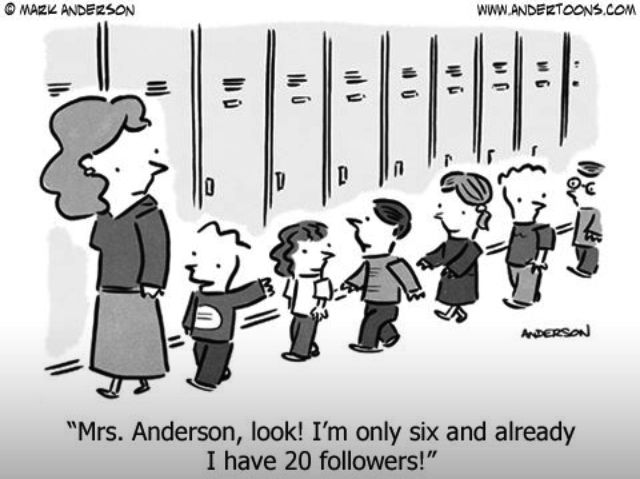
When I saw this comic it made me chuckle.  I enjoyed the comic’s gentle reminder that children/youth routinely engage with and expertly navigate a variety of communication tools. Clare and I (Lydia) conducted a two-year collaborative self-study of our efforts to incorporate various technological resources (e.g. a wiki) into our pre-service literacy methods courses. This research helped us identify both the challenges and successes we encountered along the way.  Our research efforts also made us more mindful of why we chose to incorporate certain technological resources into our pedagogical practice — questioning for what purpose and to what end.   Through the analysis of our efforts we realized that we had initially seen technology as an end in itself, not as a tool to support learning. In the second year of the study, we focused much more on student learning and became more systematic in our efforts. Over the two years of the study, our identities as teacher educators shifted as our pedagogies became richer, our use of technology more fully integrated into our literacy courses, and we received validation from others and from each other.