Tag Archives: higher education

A Foot in Many Camps: Literacy Teacher Educators Acquiring Knowledge Across Many Realms and Juggling Multiple Identities

research teamFor those of you have been following this blog, you know we are conducting a study of literacy/English teacher educators in four countries (Canada, U.S., Australia, and UK). Our first paper from the study has recently been published in Journal of Education for Teaching 39(5), 534-540. The paper A Foot in Many Camps: Literacy Teacher Educators Acquiring Knowledge Across Many Realms and Juggling Multiple Identities is available through this link:  Foot In Many Camps

In the paper we describe how the teacher educators had a range of classroom teaching experience which they drew on in many ways. Most went far beyond simply telling stories about their previous work. All were heavily influenced by their own childhood experiences, which continue to affect their current work. Many felt that they needed to hold dual identities, teacher and academic, because they were still heavily involved in schools through their research and in-service activities. Several felt that there was a hierarchy in their department with those most removed from schooling at the highest tier. Most saw themselves in the field of literacy not teacher education and gravitate towards literacy-focused conferences and journals rather than those in teacher education. I (Clare) hope you find the paper interesting. We certainly have found this entire study fascinating.

A Daily Reminder

I (Pooja) work at a higher ed. institute with a population that is very diverse. I have many mature students, with a history of interrupted education, who are looking to make a fresh start with school after work many years in unfulfilling jobs. Even though school has failed them in the past, they come in hoping to form a new relationship with school. This cartoon and this quote are taped up above the photocopier in our office. It is a daily reminder of my work and the students I serve.

comic

Everybody is a Genius. But If You Judge a Fish by Its Ability to Climb a Tree, It Will Live Its Whole Life Believing that It is Stupid. –Einstein

Studying Beyonce… in Higher Ed?

Lately, Beyonce has been in the news a lot more than usual. Recently, without any warning(or PR), she released a self-titled  album to the public. She was also, debatably, the most talked about performance at the 2014 Grammy’s a few weeks ago. However, the most interesting news I (Pooja) have recently read about Beyonce has to do with the world of academia.

Rutgers University now offers a course called “Politicizing Beyonce,” in which her musical career is used as a lens to investigate“race, gender, and sexual politics.”  The instructor of the course, a Ph.D. student, says “he’s seeking to help students think more critically about media consumption.”

I am intrigued by this course, yet not sure what to make of it. Is this a relevant and contextualized way of studying issues of race and gender or is this normalizing our (society’s) idolization of celebrities by creating a place for it in higher education?

What do you think?

Read more about this course:

http://www.huffingtonpost.com/2014/01/30/rutgers-beyonce-course_n_4697541.html

http://newsfeed.time.com/2012/01/27/rutgers-beyonce-course-5-potential-lessons-on-the-syllabus/

Source: www.policymic.com
Source: http://www.policymic.com

Message to Researchers: Do Research But Do Not Expect Funding

Australia Map 

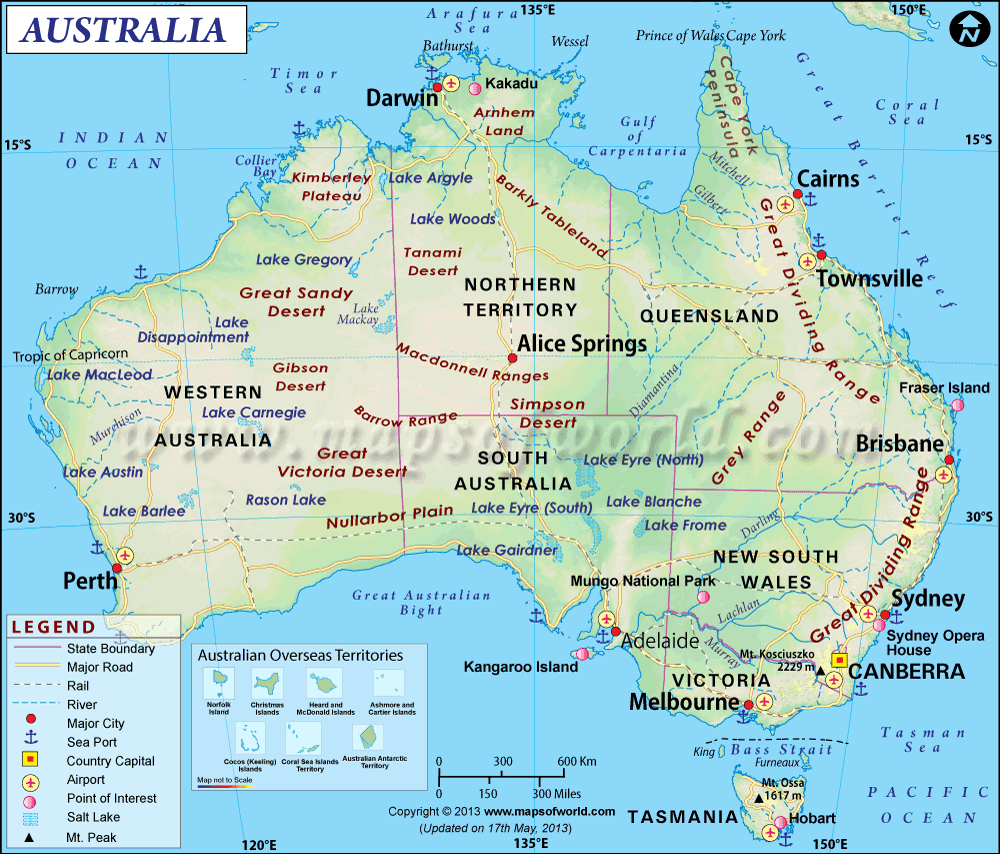
                       Those of us in higher education know there is steadily increasing pressure to secure research grants. Ironically, at the same time access to funding is decreasing. In my own context, Canada, receiving a grant from our central funding agency, Social Sciences and Humanities Research Council (SSHRC), is getting more difficult. It is not just the increased competition but also, the pool of money seems to be shrinking. I (Clare) read with interest and some sadness about the challenges my colleagues in Australia are facing. The University World News reported:

·      In his speech, Hockey [Australian Federal Treasurer] shocked the nation’s scientists by announcing that the key independent research granting body, the Australian Research Council or ARC, would lose A$61 million from its “discovery programme” and A$42 million from its “linkage programme”.
·      Dr Ross Smith, president of Science and Technology Australia, which represents 68,000 scientists, said cutting A$103 million from the ARC’s budget would further limit its capacity to fund fundamental and applied research – at a time when the success rates for applications for world-class grants are already below 25%.
·      “Australian scientists are afraid this will lead to fewer jobs and training opportunities for our best and brightest. We are also concerned about funding for important humanities and social science research, given the cuts,” Smith said.
http://www.universityworldnews.com/article.php?story=20140109095651863 
My colleagues in the UK are facing untold difficulties securing research grants. It is ironic that federal governments fail to recognize that conducting quality research requires funding and that it is absolutely necessary. Many researchers are in a Catch 22 – show you are an active researcher but do not expect money to conduct research. The short-term effect of reduced research funding is being felt throughout universities world-wide. The long-term effect is yet to be tabulated but I suspect it will be significant. We need research to investigate issues/phenomena/topics because the findings deepen our knowledge on a vast range of topics (which in turn can guide policy decisions). Conducting research is hard work. (Not to mention the time involved in writing a grant proposal — usually 2-3 months.) Let’s not make it so difficult that our research base erodes. Clare

Women in Leadership Positions in Higher Education

In our study of literacy/English teacher educators we asked participants about their career path. They did a timeline (personal and professional) of turning points. A number have held administrative positions in the university but many found the workload crushing. So I (Clare) was very interested in the recent study, Lost leaders – Women in the Global Academy, which studied females in administrative positions in higher education. http://www.universityworldnews.com/article.php?story=20140108162154821
It showed that “[g]ender equality legislation, socio-economic and de-traditionalisation factors have all played a part in this welcome trend [increase in female students in higher education], yet so far they appear to have had relatively little impact on opportunities for women to reach senior management and academic leadership positions in the sector.”  Why are women under-represented in senior leadership positions in universities? In the study they found that “[m]any women … discussed the benefits of gaining power and influence in organisations to effect change. However, leadership was frequently constructed as loss – loss of status and self esteem in the case of unsuccessful applications, but loss of independence, autonomy, research time and well-being when applications were successful.”
I believe there is a real loss not only to women themselves when they choose to not pursue leadership positions but also to institutions when women are under-represented at the decision-making table. I have held a number of senior administrative positions and I can relate to feelings of loss but I also felt there were much higher expectations for me than for my male counter-parts. As a result the position became untenable.  I felt it was a loss to me definitely. Was it a loss to the institution?  Hhhhmmm….. Clare