Tag Archives: literacy

Spoken Word: Life, Literacy and Communications

I (Yiola)  remember watching the news  in the mid ’80s and listening to the news anchors describe the possibilities and implications of the internet.  I had no idea of the magnitude of change this new form of literacy would bring. Could anyone really imagine the changes we would experience in our daily interactions?  Online communication, information sharing, cellular technology and social media have completely changed the way we operate in the world today.

I came across this interesting link — a spoken word (poem) — about the impact new literacies  has on our lives.

The message I find most powerful is the irony that social media connects us  and yet in some ways we have never been more isolated or at a loss for opportunity… community companionship a sense of inclusion yet when you step away from this device of delusion… you awaken to see a world of confusion… 

From an educator and parents point of view the poem’s message that struck a cord: We’re surrounded by children who since they were born, watched us living like robots and think its the norm.  What is our cultural norm? Compared to pre-online technology are we behaving like robots?

I tend to agree with much of what the poet shares and enjoyed this spoken word. I hope you enjoy it too.


“What, exactly, is an Anchor Chart?”

I (Cathy) remember one of my student teachers asking me this at the beginning of the school year. So we made them in our university class: plastered the walls with chart paper summaries, reminders and tips about many different literacy events and grammars. I suspected my student teachers thought they may be mildly useful. But that attitude changed when they got into their first practicum. The student teachers not only saw their mentor teachers using them, they began to see how their students consistently accessed them. They reported to me after their practicum that anchor charts were practical. Their students used the charts to help them remember things and using them (instead of constantly asking the teacher for the answer) helped the students gain independence as learners.

During the second practicum, much to my delight, the anchor charts started to become somewhat of an art form. Justine, especially, excelled at them. “My anchor charts never looked like this!” her mentor teacher declared. I am not sure how much the students appreciated the visual dynamics, but they certainly used them. I watched them look things up on the walls that surrounded them. Useful? Yes! Visually exciting? Absolutely! How useful and interesting can you make yours?Justine's anchor chartsmore anchor charts

Reading Circles

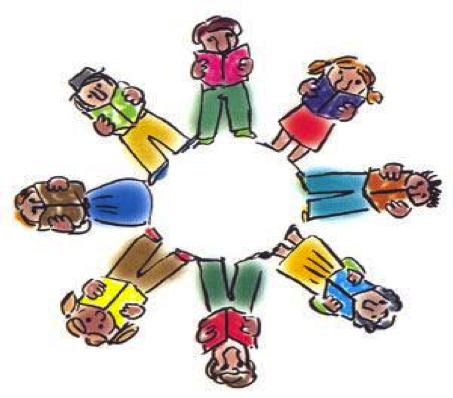
Last week CBC news profiled the organization Literature for Life, which offers weekly Reading Circle programs to young mothers in various shelters and community centres across the Greater Toronto Area (GTA). The Literature for Life website explains that the program is committed to helping young moms in high-needs neighborhoods across the city “develop a practice of reading in order to access opportunities and achieve economic stability”. The moms participating in the Reading Circles meet weekly, along with a program facilitator, to engage in discussions and writing activities about books that are relevant to their lives. The program also hopes that participating moms will share their enthusiasm for reading with their children. To date, approximately “2,200 moms have participated in the Reading Circles and more than 20,000 books have been distributed” (http://www.literatureforlife.org).

Reading Circles2

Electricity and the Joy of Learning

One of the greatest joys of my (Cathy’s) job is observing student teachers in their teaching practicums. In my next few blogs I will be happily sharing some of the highlights from these visits.

Yesterday I was observing a student teacher instruct a grade six science class exploring electrical currents. The student teacher wisely arranged his students into collegial groups and then gave each group a paper bag full of various parts (batteries, wires, light bulbs, switches etc.). The students were expected to find a way to put the put the parts together that would create an electrical current, hence lighting up the light bulb. It was fascinating watching the students trouble shoot their way through the process. They were so engaged. I was proud of the student teacher for setting up the investigation so well. Suddenly there was a squeal from the corner group. One of the boys was holding up a lit light bulb. His smile was brighter than the bulb. “What did you do?” I asked him. He was silent for a few seconds, staring in amazement at the lit bulb. Then he said, “I have no idea.” Everyone laughed. The process of deduction then began as the group tried to figure out why it worked. And next week I get to observe completely different classes, making entirely new discoveries. Lucky me.

circuit


A Few Words From Oliver Jeffers

Clare and I (Lydia) have enjoyed sharing the creative and clever picture books of Oliver Jeffers with the student teachers in our literacy methods courses. Jeffers, an artist, illustrator and writer, notes, “my books are all about telling stories, and a lot of my art is about asking questions…They’re an excellent platform,” he says of picture books, “With novels, things are spelled out for you. And films, things are spelled out for you a lot more. Whereas picture books, it’s up to you how much you sit on a page, sit on an image, move at your own pace. And then you’ve got two distinct and varying sets of tools at your disposal, that weave in and out of each other to create this middle ground. That’s the secret ingredient, I think, that’s what makes them such a fantastic vehicle for storytelling.” (National Post Feb 2013). OliverJeffers

Remembering My Favorite Comedian

My (Cathy’s) favorite comedian passed away last week.   I was saddened to learn this.  It takes such skill to make people laugh: writing the content; sensing the timing; massaging the audience.  His name was John Pinette.  I was amazed by his talent. During his stand-up acts, he often broke into song depicting an amazing singing voice.  I eventually learned that he  played the matronly Edna in the hit musical Hairspray on Broadway.  Wish I’d seen that.   His jokes were usually self- deprecating about his size.  Ah, to laugh at oneself.  One of my favorite clips was of him being told he should be gluten-free.  As I live a gluten-free life I have always found this particularly amusing.  The link to this clip is below.  Remember him when you laugh.

John Pinette 1964-2014pinette1


A Compelling Novel

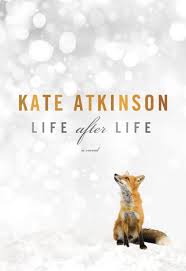
I (Lydia) have been reading and enjoying the novel Life After Life by Kate Atkinson. The novel invites readers to consider the question: What if you could live again and again until you got it right? This premise is explored through the experiences of the Todd family set against the backdrop of two world wars. Atkinson plays with narrative structure and time by repeatedly re-ordering the past and the present, as protagonist Ursula Todd and others supporting characters experience deaths, near deaths, and frequent chances to begin life anew. Each time the author reimagines one of these lives, the reader is provided with a glimpse into how the alternate choices made by a character can profoundly shift circumstances and outcomes. The novel could be read as book about the practice of writing, the practice of reading, and the complex relationship forged between author and reader. The novel repeatedly reminds the audience of the multiple choices an author makes when weaving together a narrative, and the conscious choices a reader makes to commit, or not, to the path outlined by the author. Overall, the novel provides a compelling and worthwhile read.

Lifeafterlife

Murmurations Prank?

I know April Fools just passed, but I (Cathy)  just had to share this with you.  My husband emailed me the  link below and I thought it was an internet prank.  In this age of photoshopping and creating a personalized zombie face, I simply didn’t believe it.  So, I Googled ‘murmurations’ and was delighted to discover there are dozens of videos depicting this spring phenomenon.  Live and learn.
Fascinating that this new digital age has made me so skeptical, but I guess that is being critical isn’t it?  Have a look and see how a natural phenomenon can be so amazing, it is hard to believe.

The Demise of 21st Century Literacy

Cursive Writing

We often talk about all the new literacies that the 21st century brings and how we as educators must develop an awareness of the newer modes of communicating… I (Yiola) do agree and yet, we must be recognize there are losses too.

Multimodal Literacy

My (Cathy) pre-service students were assigned a multimodal aspect to a major assignment this year.  If you are not familiar with the Theory of Multimodality, it is Gunther Kress’ alternative to Linguistic Theory (which only privileges reading and writing as the main modes of communication in a school curriculum).  The Multimodal Theory contests that in our new age of multiple literacies, students need to be communicating, responding and expressing through many different modes of communication (e.g. speaking, music, moving, gesturing, image, and digital technology).

When I first introduced the multimodal assignment to my students, there was some trepidation and even some anger.  It was suggested I did not have the right to be marking them on their artistry or on creativity.  Hence, I had to teach the concepts behind Multimodality Theory so they could better understand what we need to be offering students of the 21st century.  They needed to see that it would allow them the freedom to express in modes of their own choosing; that it was not graded as art but as a production of design; and, that the work could be symbolic or interpretive depending on the meaning they were portraying.  The multimodal projects would also be shared in class so all could learn from them.  This project was not just them regurgitating information for me, it was them designing and producing personally meaningful projects that express what they learned and what they deemed significant.

This week we finished viewing the projects.  They were amazing, and the student response to these projects was encouraging.  My students (concurrent students just finishing a five year educational degree) had never been given this kind of an assignment before.  They loved the element of choice; working together; taking a risk; pushing their boundaries; feeling creative; and, doing something they were interested in.  The modes they selected  to express themselves though were sometimes more traditional (dancing, rapping, singing,  writing and reciting  poetry, creating 3D sculptures, puppetry, multi-sensory art installation pieces); sometimes digital (iMovies, pod-casts, prezis, Pow Toons, popplets, infographics);  and, were often a combination of both.

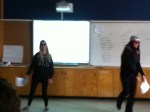
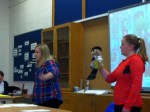
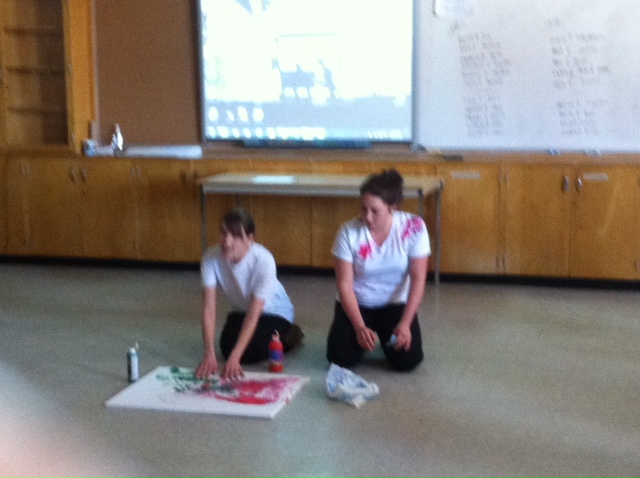
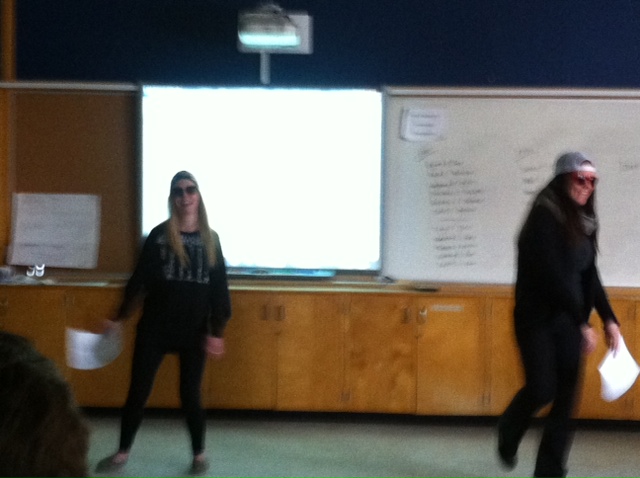
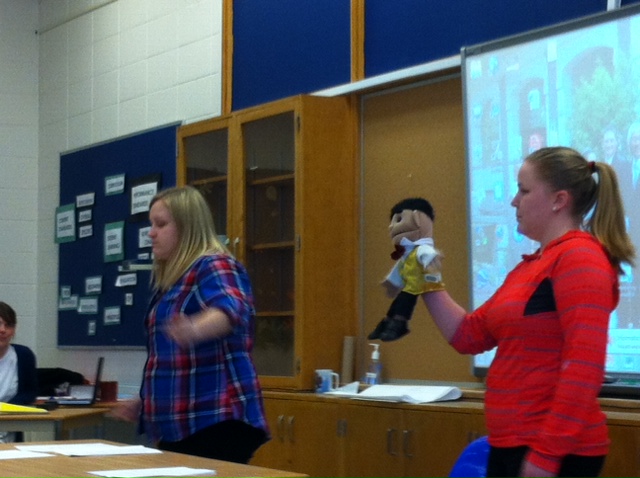
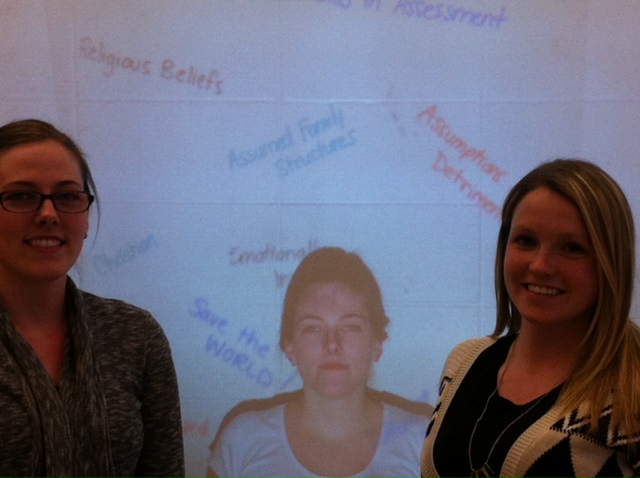
Collectively, we were all blown away by the results.  We were moved.  We were inspired.  My students all said they would definitely use multimodality now as teachers.  Below are a few images of my students presenting their projects:
role play poemfish bowlRAPguitarpuppet photo (13)

Now, I have to assess these designs… but that, dear reader, is for another blog.