Tag Archives: literacy

Reflecting on Our Strengths and Weaknesses

I (Cathy) was reading a literacy newsletter yesterday and was intrigued by an article by literacy educator, Clare Landrigan.  She reminisced about a saying her father used to share with her, “Everyone’s greatest strength is their greatest weakness and their greatest weakness is their greatest strength.” I have heard this before and tend to agree with it.  I have referred to it often while exploring Brookfield’s critical incidences with my student teachers.  We would reflect on the possibility of how our greatest strength could be holding us from recognizing our own literacy assumptions.

What intrigued me about Landrigan’s article was the educational perspective she introduced that I simply had not entertained before.  She asked her readers to look at the weaknesses of her students and try to see them as their greatest strength.  For example, the student who cannot sit still . . . has the potential to be incredibly productive and he student who takes forever to do something . . . is attentive and thoughtful.   What a wonderfully productive way to look at the students we teach, regardless of age.  It also might help us recognize positive aspects in ourselves when we are feeling particularly critical.  What is your greatest weakness?

Experimenting with Collaborative Discussion Strategies

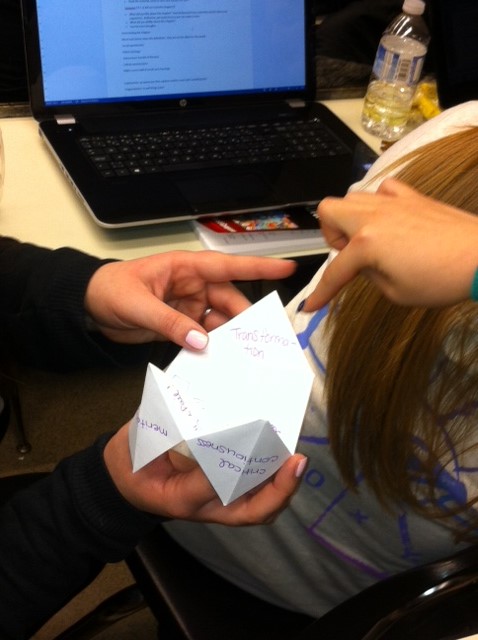
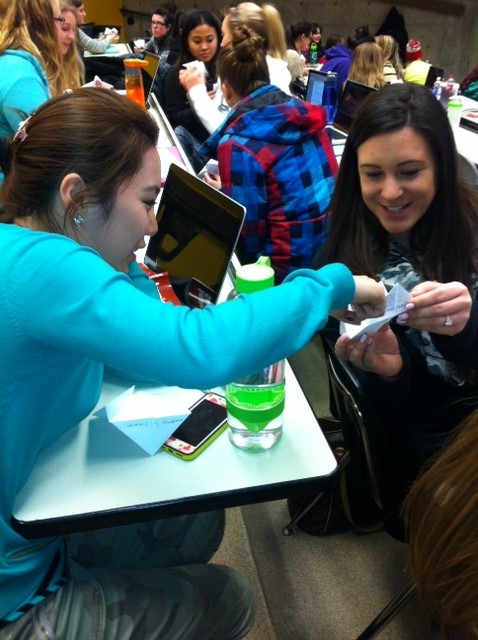
The class I (Cathy) teach for the Bachelor of Early Childhood Education program is from 7-10 in the evening.  I feel for my students as this is a demanding time to be learning something new.  To make matters worse, many of the students arrive rather fatigued having just left another class that is strictly lecture format.  I need to wake them up and get them thinking again.  So, capitalizing on my belief in a dialogical approach, for part of each class I implement a different collaborative discussion strategy (e.g. gallery walk, expert groups, four corners, placemat).  Our last class, however, was rather unique.  I was looking for a way to explore chapter summary and discussion.  Plus, I wanted to incorporate our ongoing work on metaphors in education.  Suddenly, the strangest memory came to mind… cootie catchers.   I wasn’t even sure that was the name until I found it online.  Traditionally, this is Japanese origami work, known in the paper folding world as the ‘Fortune Teller’.  How, I wondered, could I use this to motivate discussion and review?  After some tinkering with my objectives, I had the students place new/significant vocabulary from the chapter on the outside, which the origami maker had to define and spell to move the sections around.  Images representing significant ideas and concepts were drawn on the inside, which the player had to identify from the chapter.  Guesses were confirmed in writing which were under the hidden flap.  Guess what?  They loved it and played it many times with many partners, hence reviewing key concepts in the chapter with several people.  Then we discussed what happened.  Some said now they will never forget their selected words/phrases (e.g. critical consciousness, diaspora, social reproduction and juxtaposition).  They were a challenge to spell, too!  Others said the images were hard but made them think carefully about the chapter content. The most challenging images I drew on the board at the front of the lecture hall and collectively we tried to guess what they represented.  Sometimes we had to get clues from the image maker and we cheered or groaned when we finally got it.  At the conclusion of the class we left rather refreshed and interestingly, nostalgic.  Every student, no matter what the cultural background or gender, reminisced about playing this game as a child.  This was as diverse a literacy event as I have ever encountered and I don’t think I have ever enjoyed a collaborative review more.  Below is the website I used to remind the students how to create the origami form.  yes ori oop

http://www.origamiway.com/how-to-make-a-paper-fortuneteller.shtml
Family Literacy Day

Today is Family Literacy Day in Canada. http://abclifeliteracy.ca/fld/family-literacy-day
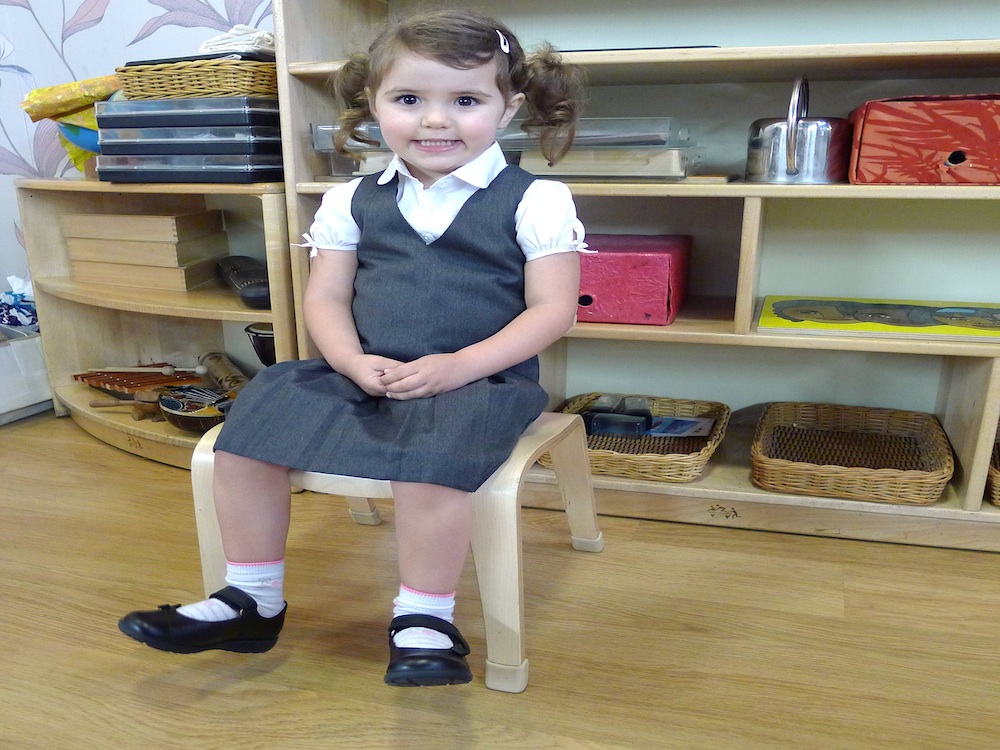
It is a day that recognizes the importance of families building literacy skills together.  Looking back, what did family literacy look like in your household? In what capacity did Young girl in schoolliteracy development occur? In my home I (Yiola) taught my parents the language of English and my parents taught me the value of English.
I find Family Literacy Day to be a very well intentioned initiative.  The ideas presented in the link on family literacy are interesting.  As a Teacher Educator who teaches from a critical perspective I cannot help but ask, how can the concept of family literacy be made accessible for all families? How do we make the concept more inclusive?  When thinking about ‘Daily Literacy Activities’ I wonder, what can we add to the list found on the website?
See: http://abclifeliteracy.ca/files/Daily_literacy_activities.pdf
I plan to share this list with my student teachers and ask them for additional activities to include that may draw in a variety of families.  I’m thinking of multilingual processes, digital opportunities, oral traditions.
Happy Family Literacy Day!
Yiola

Writing a Review Takes TIME

I (Cathy) discovered, having just submitted my first academic book review, that the process takes TIME.   The T in my acronym represents allowing for lots of time to move through the process. The I represents investigating the journal for which I am submitting.  The M is for mining the book under review. The E is for editing- of course- what would writing be without editing?  I developed my TIME acronym through both the experience of writing the review and doing some homework on review writing.  One of the suggestions I came across, which was a valuable piece of advice, was to allow one month to write the review:  two weeks to read the book; one week to write the review; and one week to edit the work.  This turned out to be true.  There was no hurrying the process.  I also spent time reading many other reviews from the same journal for which I was submitting.  This was the investigation part.  I compared five reviews for style, content and length.  One was much more academic in style than the others.  All were not hesitant to praise the work.  This was reassuring, as I liked the book a lot.  The mining part was the surprise.  As I read the book, I listed the things I liked about it and possible flaws, only to discover that when I got to the end, it was not enough information.  I had to read it again and work harder at comparing the chapters for content consistency, look for related themes and any patterns the editors may have requested.  I also spent a lot more time scrutinizing the forward and conclusion and discovered some great quotes I had missed the first time.  This was similar to reading a book in order to teach it.  Impressions are not enough.  I needed more meat.   And finally came the editing.  After several iterations, I thought it was ready for someone else to see.  I gave it to five people to read. Every one of them found corrections and made suggestions. Some I used, while others were stylistic suggestions that I let pass.  All were insightful.  The best part though, was the response.  When one of my friendly editors replied, “You really made me want to read this book!”  then I knew the review hit its mark.  Like I said, I liked the book.  Oh, and by the way, the book is called Literacy teacher educators: Preparing teachers for a changing world.  I recommend it!     BTW  The journal I submitted to is called Research in Teacher Education.  Excellent resource!  Check it out…  http://www.uel.ac.uk/rite

Mapping my morning commute

On twitter this week I (Lyida) read about a storytelling project that invited teachers to use digital tools to capture and represent dimensions of “their world”. The representations  (e.g. pictures, video, audio) were publicly shared on a blog. It would be interesting to use aspects of this idea in a teacher  education literacy course but I wanted to experiment with it first.

   Fruitstand  Subway1

Subway2  Bike  Museum

library

Critical Literacy vs Language Acquisition

Critical literacy and Language acquisition.  I (Yiola) have pondered these two concepts — what they mean, what they entail, and why they are important.  In much of the literature I have read, there appears to be distinct 2 camps:  those who study language acquisition that is, how we learn to read and write: how we develop phonemic awareness, and learn to decode, and develop syntax and those who study critical literacy: a newer approach to learning how to analyze and understand texts in a socially conscious way.  I have asked myself, are they in two distinct domains of Language discourse? They appear to be. Do you agree?  Yet, when I think about teaching literacy to children in the context of schooling and what readers and communicators need to know, then critical literacy is a form of language acquisition. Children must know how to read and analyze texts, and they must know how to read and analyze the world. Children acquire language through critical literacy. Critical literacy is then a significant part of language acquisition. In teacher education literacy courses, is the concept of critical literacy taught with the same importance and priority as the more traditional methods and means for language acquisition? Ultimately I’m wondering, what are the essential components of literacy curriculum for 21st century teacher education programs?

Telling Stories in Pre-Service

I (Cathy) instruct part-time at Brock University. Many of my mid-term evaluations from my pre-service students read, “Please, tell more stories”. It made me laugh, but it made a point. We all love stories, no matter what our age: family stories; folktales from another culture; scary stories… it doesn’t matter. So today, in our first classes for 2014 I focused on storytelling, but turned the tables somewhat and encouraged my student teachers to be the tellers. They were asked to share personal stories about their teaching practicum, which they had completed just before the winter break. I started us off by sharing a story about a disastrous placement I experienced many years ago when I was a student teacher. The flood gates were opened. My, oh my, such stories! Hilarious stories about indignant kindergardeners; touching stories about tough grade eight boys weeping because they thought they had hurt the student teacher’s feelings; frightening stories about overly demanding associate teachers; and joyous stories about building up deflated ELL students. The passion in the room was palpable; it glowed in their eyes, exuded in their hand gestures and spilled about the room with the rise in the decibel levels. Clearly, they loved working with the kids, the learning (good and bad) and the chance to make a difference. They loved teaching, and even in this climate of little prospects of obtaining a teaching position for a few years, they were exactly where they belonged. And so was I.  Cathy

Teaching in a Digital Age

Facebook Logo As an instructor of literacy methods courses in preservice teacher education, one of the challenges is remaining current. I feel that I must have current knowledge of research on literacy and literacy development, current knowledge of curriculum resources and government initiatives, and be current with ever-changing social media trends. The last point is one that is often overlooked but equally important. To prepare my student teachers to be effective literacy teachers, I need to know them and this entails knowing the social media they are using. If I do not have some working knowledge of their communication patterns they might view me as a dinosaur which in turn can create a barrier to me understanding where they are coming from. Also, both student teachers and I need to know what pupils are using if we want to connect home and school literacy practices. Not having a teenager makes it difficult to stay current – many adolescents are far more in tune than me. So what to do? I found this website http://www.commonsensemedia.org/educators/blog which is helpful. I am not sure who sponsors it but there is a treasure trove of info for those of us trying to figure out what adolescents and young adults are using. One page that was very useful lists11 sites that kids go to after Facebook http://www.commonsensemedia.org/educators/blog/11-sites-and-apps-kids-are-heading-to-after-facebook . I liked the thumbnail sketches of each site and the pros and cons of each site.
Another page identified top digital citizenship bloggers.
http://www.commonsensemedia.org/educators/blog/our-favorite-digital-citizenship-bloggers-to-follow-in-2014
These bloggers identify issues that are often invisible to me.
Knowing popular culture I feel is essential to being a literacy professor. Clare

Study of Literacy Teacher Educators

We are well into phase two of the study on literacy teacher educators in four countries having interviewed 27 of our 28 participants. In this phase we have been looking at goals for their preservice literacy courses, teaching style, and pedagogies. One of the most interesting series of questions has to do with assignments. I have found that asking professors about their assignments tells a great deal about their goals. We have classified assignments into a few categories: digital-related assignment (e.g., digital essay), literacy autobiography, reading logs, lesson plans, curriculum units, portfolios, case study of a child, and assessment-related. There has been remarkable consistency in the types of assignments. Interestingly, almost all feel that the workload is demanding. A question we as a research team and as experienced literacy instructors are asking ourselves, Is the workload too heavy? Clare