When I saw this comic it made me chuckle. I enjoyed the comic’s gentle reminder that children/youth routinely engage with and expertly navigate a variety of communication tools. Clare and I (Lydia) conducted a two-year collaborative self-study of our efforts to incorporate various technological resources (e.g. a wiki) into our pre-service literacy methods courses. This research helped us identify both the challenges and successes we encountered along the way. Our research efforts also made us more mindful of why we chose to incorporate certain technological resources into our pedagogical practice — questioning for what purpose and to what end. Through the analysis of our efforts we realized that we had initially seen technology as an end in itself, not as a tool to support learning. In the second year of the study, we focused much more on student learning and became more systematic in our efforts. Over the two years of the study, our identities as teacher educators shifted as our pedagogies became richer, our use of technology more fully integrated into our literacy courses, and we received validation from others and from each other.
Tag Archives: teacher education
Newer Modes of Communication Challenging the Written Word
Smartphones and templates offer a newer mode of communication and slowly, it seems, a new language is taking shape. Short, incomplete sentences with alternatively spelled words are dominating the domain. Incomplete thoughts… and abbreviations http://www.netlingo.com/acronyms.php are rapidly becoming familiar.
I’ve (Yiola) bin thinking about literacies and what txt and tweets and FB mean for literacy development. IDK what to make of this. It’s interesting cuz language changes. wordz change. punctuation ceases to exist. LOL
youth 2day use symbols, short forms, a variety of new symbols to communicate.
I’m still wondering how #hashtag came to be the symbol that it is. #justdontunderstand
The exclamation point has indicated strong emotion. now we have 🙂 😉 and 😦
Is one more correct than the other?
Plz share some insights… i’d luv 2 hear ur thoughts on the implications for teachers, teacher educators, parents. I mean, how r we to communicate and facilitate language development if we r not in tune with social media discourses of youth today? Do we ignore it? Incorporate it? Explicitly teach the differences between formal / traditional language and social text?
ttys, yiola
Professional Identity
Today I (Clive) was teaching my School and Society (social foundations) course in the preservice program. Our topic was professional identity. What a class we had! We discussed:
· Teachers’ perception of their role
· Motivation and satisfaction
· Challenges of teaching
· Work-life balance
· Confidence
· Stance in relation to system mandates
I selected a number of quotes from our chapter on professional identity from our upcoming text: Growing as a Teacher (Sense Publishers). The students took turns reading these quotes aloud which proved to be very powerful. We brought the “voices” of the teachers into the class. Here are a few of the quotes we read:
Classroom teachers have an enormously challenging job; I didn’t realize that when I first started teaching, but now I do. And that hasn’t made me any less effective, if anything it’s made me somewhat more; because now I’m kinder to myself. I see that basically the teacher sets the atmosphere of the classroom, and if you’re constantly stressed out and trying to attain the impossible you become a frustrated and burnt out person. (Felicity, eighth year teacher)
The most important aspects of my role are ensuring that my students develop a positive sense of self; that they acquire a love of learning; and that they develop a world perspective, with compassion and understanding for other people. Embedded in that are social skills; but it’s bigger than that, because I want them to see beyond their own life and community. This view of my role is broader than it used to be. If you’d asked me when I started teaching I would have said the world citizenship component was important, but it didn’t play into my daily practice to the extent it does now. (Tanya, eighth year teacher)
Coming out of my inner-city pre-service program, where the emphasis was on being a change-maker and inspiring every kid, I had to learn that it can often be slow going and I have to not feel defeated if I fail to accomplish everything I hoped for. Because…you really, really need to enjoy teaching to last in the profession, and it’s draining and can get frustrating. I’ve always worked in inner-city schools, so I’m mentally prepared for it…[but] I’ve had to learn not to take things personally. Otherwise you go home and things rest in your mind and you get physically sick. (Jessica, fifth year teacher)
Basing my teaching on where the students are and where they need to be [according to the standards-based approach], I found I ended up teaching to the test; and the whole fun and love of learning went out the door. So I changed my process, and asked: What am I teaching? What skills need to be taught? How can I get that across to them in a way that they’ll enjoy? And then after reflecting on it, and seeing where it didn’t work so well, I asked: What should I change? (Lucy, fifth year teacher)
Experimenting with Collaborative Discussion Strategies
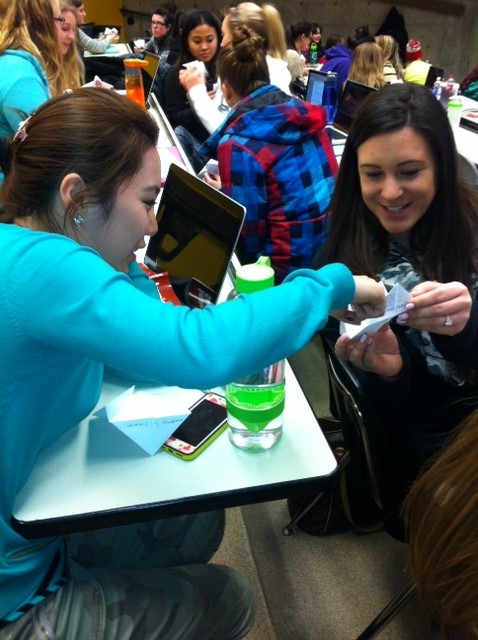
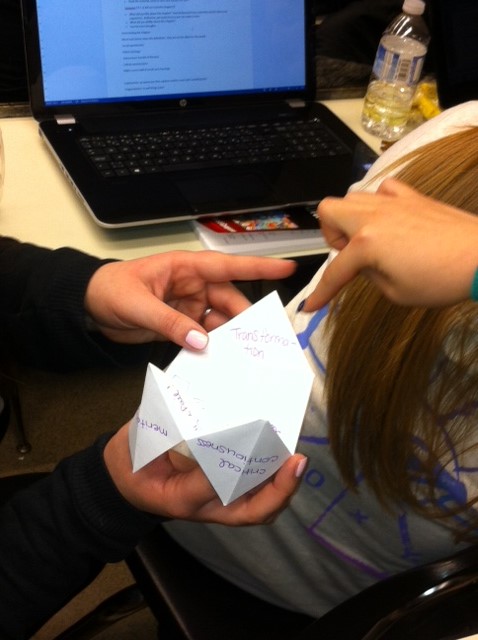
The class I (Cathy) teach for the Bachelor of Early Childhood Education program is from 7-10 in the evening. I feel for my students as this is a demanding time to be learning something new. To make matters worse, many of the students arrive rather fatigued having just left another class that is strictly lecture format. I need to wake them up and get them thinking again. So, capitalizing on my belief in a dialogical approach, for part of each class I implement a different collaborative discussion strategy (e.g. gallery walk, expert groups, four corners, placemat). Our last class, however, was rather unique. I was looking for a way to explore chapter summary and discussion. Plus, I wanted to incorporate our ongoing work on metaphors in education. Suddenly, the strangest memory came to mind… cootie catchers. I wasn’t even sure that was the name until I found it online. Traditionally, this is Japanese origami work, known in the paper folding world as the ‘Fortune Teller’. How, I wondered, could I use this to motivate discussion and review? After some tinkering with my objectives, I had the students place new/significant vocabulary from the chapter on the outside, which the origami maker had to define and spell to move the sections around. Images representing significant ideas and concepts were drawn on the inside, which the player had to identify from the chapter. Guesses were confirmed in writing which were under the hidden flap. Guess what? They loved it and played it many times with many partners, hence reviewing key concepts in the chapter with several people. Then we discussed what happened. Some said now they will never forget their selected words/phrases (e.g. critical consciousness, diaspora, social reproduction and juxtaposition). They were a challenge to spell, too! Others said the images were hard but made them think carefully about the chapter content. The most challenging images I drew on the board at the front of the lecture hall and collectively we tried to guess what they represented. Sometimes we had to get clues from the image maker and we cheered or groaned when we finally got it. At the conclusion of the class we left rather refreshed and interestingly, nostalgic. Every student, no matter what the cultural background or gender, reminisced about playing this game as a child. This was as diverse a literacy event as I have ever encountered and I don’t think I have ever enjoyed a collaborative review more. Below is the website I used to remind the students how to create the origami form.

http://www.origamiway.com/how-to-make-a-paper-fortuneteller.shtml
Writing a Review Takes TIME
I (Cathy) discovered, having just submitted my first academic book review, that the process takes TIME. The T in my acronym represents allowing for lots of time to move through the process. The I represents investigating the journal for which I am submitting. The M is for mining the book under review. The E is for editing- of course- what would writing be without editing? I developed my TIME acronym through both the experience of writing the review and doing some homework on review writing. One of the suggestions I came across, which was a valuable piece of advice, was to allow one month to write the review: two weeks to read the book; one week to write the review; and one week to edit the work. This turned out to be true. There was no hurrying the process. I also spent time reading many other reviews from the same journal for which I was submitting. This was the investigation part. I compared five reviews for style, content and length. One was much more academic in style than the others. All were not hesitant to praise the work. This was reassuring, as I liked the book a lot. The mining part was the surprise. As I read the book, I listed the things I liked about it and possible flaws, only to discover that when I got to the end, it was not enough information. I had to read it again and work harder at comparing the chapters for content consistency, look for related themes and any patterns the editors may have requested. I also spent a lot more time scrutinizing the forward and conclusion and discovered some great quotes I had missed the first time. This was similar to reading a book in order to teach it. Impressions are not enough. I needed more meat. And finally came the editing. After several iterations, I thought it was ready for someone else to see. I gave it to five people to read. Every one of them found corrections and made suggestions. Some I used, while others were stylistic suggestions that I let pass. All were insightful. The best part though, was the response. When one of my friendly editors replied, “You really made me want to read this book!” then I knew the review hit its mark. Like I said, I liked the book. Oh, and by the way, the book is called Literacy teacher educators: Preparing teachers for a changing world. I recommend it! BTW The journal I submitted to is called Research in Teacher Education. Excellent resource! Check it out… http://www.uel.ac.uk/rite
Mapping my morning commute
On twitter this week I (Lyida) read about a storytelling project that invited teachers to use digital tools to capture and represent dimensions of “their world”. The representations (e.g. pictures, video, audio) were publicly shared on a blog. It would be interesting to use aspects of this idea in a teacher education literacy course but I wanted to experiment with it first.
Is Alternative Certification Really an Option?
Our blog has included a number of posts about our longitudinal research on teachers. All of the teachers in our study completed a full teacher certification program yet many faced real struggles. Although we know that teaching is a very demanding profession, the clamor for Alternative Certification programs seems to be increasing. Alt Cert programs are flourishing in many countries which to me defies reason. I read a really interesting blog about a young teacher who was part of Teach for America (TFA) corps – her TFA program had 5 weeks of training. The title of the blog captured my interest: Tell-All From A TFA and KIPP Teacher: Unprepared, Isolation, Shame, and Burnout. Here the link to it: http://cloakinginequity.com/2013/12/29/tell-all-from-a-tfa-and-kipp-teacher-unprepared-isolation-shame-and-burnout/
The blog by reflections, video clips of TFA recruitment, and some stats. It is really interesting. Here are two excerpts from the new teacher’s reflections which I found heartbreaking:
Unpreparedness for the Classroom
The 5-week summer session at Rice University was a fast-paced, well-run training session, but it was not enough to prepare me to lead my own classroom in my first year. While I learned valuable techniques and tools to become a teacher, it certainly did not equip me for creating systems in my classroom, writing unit plans, and creating valuable assessment. Five weeks was not enough to create the type of magic that Teach For America describes in its vision. Training was like leading us to the top of a cliff before we had to jump off into the reality of our own classrooms. All I can say is the mountain was high and the fall was hard.
Shame
Shame has a terrible place in this organization. I never believed that shame would become a motivator in my Teach for America experience, but shame holds onto the necks of many Corps members. Placing young college graduates in some of the toughest teaching situations with 5 weeks of training has negative repercussions on the mind, body, and soul of Corps members. The message is “If only I were stronger, smarter and more capable, I could handle this. I would be able to save my students.” Unfortunately, TFA intentionally or unintentionally preys on this shame to push Corps members to their limits to create “incredible” classrooms and “transformative” lesson plans. Would these things be good for our students? Of course. Is shame a sustainable method for creating and keeping good teachers in the classroom? Absolutely not. It is defeating and draining.
Thanks Julian for your blog. After reading the blog can anyone actually say, that Alt Cert is a viable option? I think not. Clare
Research in Teacher Education Journal
Clare is on the International Advisory Board for the Research in Teacher Education Journal. This lovely journal which focuses on teacher education with a range of topics of interest to international readers. The latest issue is available with papers ranging on topics from foreign language instruction in rural Columbia to lifelong learning in UK primary schools. They are more than happy to take any fledgling PhD students who might be looking for their first opportunity to be published.
Check our their website http://www.uel.ac.uk/rite/