Tag Archives: teacher education

Topics and Methods for Class Debates

In previous postings, I (Clive) have recommended debates as a way to give students a voice in university and school classrooms and also introduce some variety into class activities. Of course, the topics have to be interesting to the students if they are to get really involved; and the overly combative tone of traditional debating needs to be avoided so there are no hard feelings.

This term, in my graduate class of 22, I used two debating topics that worked very well. They were: (1) Teaching Values in School and (2) Formal Professional Development for Teachers. In each case we formed 4 groups (by numbering off from 1 to 4 around the class, including myself) and then assigned “positions” to the groups as follows:

Teaching Values in School

Group 1: On the whole, teachers should keep their values to themselves

Group 2: It is often appropriate for teachers to promote the values they believe in

Group 3: On the whole, schools should advocate general “human” values (e.g., treating women and men equally) even if they conflict with the values of the family

Group 4: On the whole, schools should honor and respect the values of the family, even if they conflict with general “human” values

Formal Professional Development for Teachers

Groups 1 & 3: Formal professional development has a very important role to play in teacher learning and school improvement. Examples of effective formal PD include….

Groups 2 & 4: Formal professional development does not play a major role in teacher learning and school improvement. Examples of more important methods and factors are….

Each group spent 20 minutes preparing their case, with each person in the group proposing and outlining an argument and/or example. Then each group in turn presented their case to the whole class, with every member of the group speaking. Finally, we returned to the whole class circle and went around with each individual saying what they thought about the topic (we didn’t have time to go all the way round the class, but this final activity also proved very valuable).

Notice that the “opposing” positions were softened by using phrases such as “on the whole,” “it is often appropriate,” “not a major role” (rather than “not any role”). Also, the emphasis on giving examples to support one’s case was a big success – I hadn’t used this before.

So, this was my experience. If you have a chance to experiment with debates, let us know what topics you used and how it went – we can do a guest blog!


Photo Journal of my Experience @ AERA

Here are some snapshots and highlights of my experience at AERA this year. If I (yiola) could name the experience I would call it:  Goosebumps and Inspirations… it was just that good.

  1.  I attended a Round Table session (this is where presenters gather at a “round table” and share their research). The Round table is a great opportunity to not only share your work but hear from others in a less formal manner.  This round table was hosted by the  Writing and Literacies special interest group (SIG) and the focus of the round table was critical literacy.  Dr. Barbara Comber from the University of South Australia presented on critical literacy pedagogy in the early years. Her work and my work are closely aligned.

2.I attended a presidential talk that was a tribute to the life and work of Dr. Phil Jackson. The focus of the talk was on the question of education.  I really like what this panel did: each panel member selected a passage from a text written by Dr. Jackson and talked about its significance to them. A paragraph was read from The Practice of Teaching and the idea of transformative teaching… such an important and central idea in progressive education. A piece was read from Handbook of Research on Curriculum: Conceptions of Curriculum and the the idea that school is systematically harming children… and how can we work against that?  Linda Darling-Hammond read a passage from his famous book Life in Classrooms and spoke of the “multi-dimensionality and simultaneously nature of teaching” and the essential relationships associated with teaching. And, one panel member shared from Dr. Jackson’s last book published in 2012, What is Education and spoke of education as pure and simple; something we must rededicate ourselves too over time.

13001211_10156947381755121_1868962252431060235_n

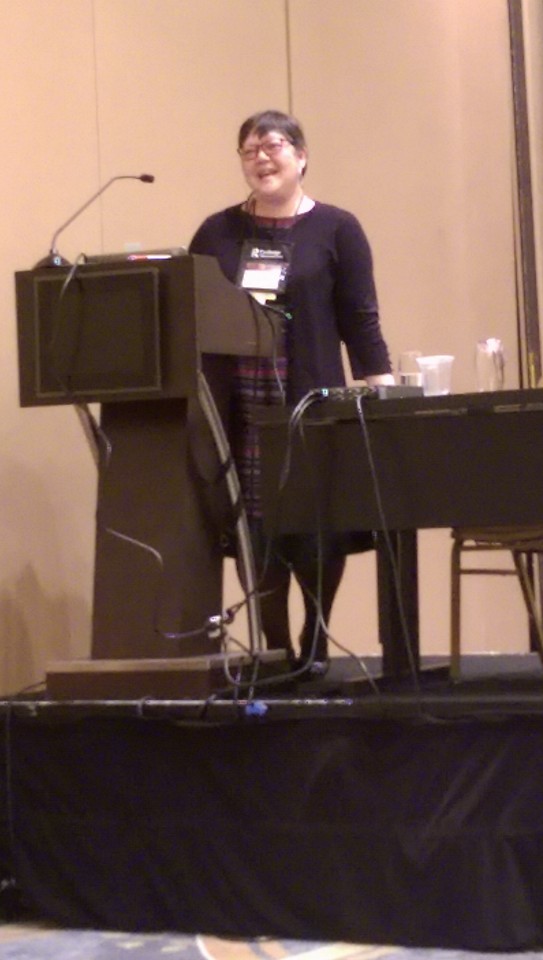
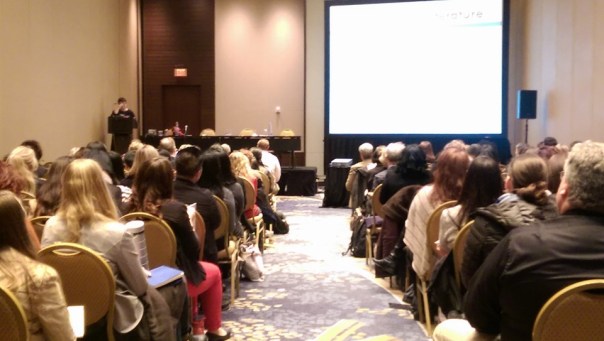
3. I was very fortunate to have the opportunity to listen to the presidential lecture  for Division K hosted by Dr. Lin Goodwin, Teachers College Columbia University.  A remarkable speaker who not only inspires with her words but truly challenged me to think about what quality teacher education requires. What I like most about Dr. Goodwin is her genuine nature. A distinguished academic and also a beautiful human being. Here are some pictures from her talk including slides from her presentation.

12998610_10156947381220121_6198746793740451746_n

13015255_10156947381525121_6392246007407300412_n13043368_10156947381450121_231103480067251929_n12994363_10156947381300121_7467634140817060326_n13012864_10156947381375121_7210803705214951729_n

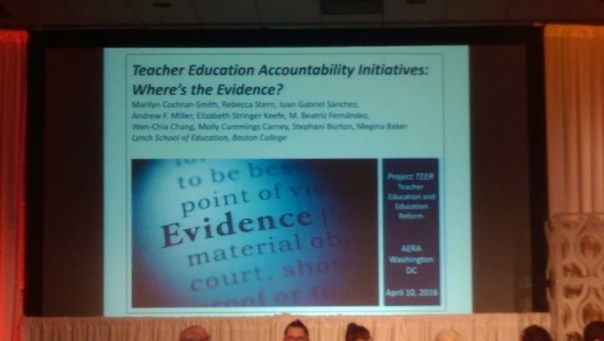
4. Yet another interesting Presidential session with Wayne Au, Marilyn Cochran-Smith, Kevin Kumashiro (and others) that explored policy and standards in Teacher Education. Laden with some controversial findings for the testing systems for new teachers and teacher education programs, the presentations were provocative and interesting:

13055504_10156947381160121_3248944785834068614_n13012858_10156947381050121_2214069562201491393_n

5. The last session I would like to share is one where we presented at the Constructivist SIG. A lovely group of people from across North America, we exchanged ideas of what it means to teach in constructivist ways. Our team leader Dr. Clare Kosnik presented work from the Literacy Teacher Education research and presented on a group of literacy teacher educators who had strong constructivist pedagogies.

Finally, AERA is held at such interesting places. One has to take some time to enjoy the beauty of the district and take in some of the sights.

Social Justice Study at AREA

I was once again thrilled to attend the AERA conference this past week.  It is such a remarkable opportunity- so many knowledgeable and committed educators from around the world.  Quite inspiring.  At the conference this year, one consistent theme emerged in the sessions I attended: Know your students. One particular study in a session entitled Preparing Preservice Teachers to Teach for Social Justice, resonated with me quite profoundly.  The study was called Candidate Change in a Community -Engaged Teacher Education Program and was led by Patricia Clarke from Ball State University.  Patricia maintained, ” a good teacher must understand the context in which a child lives grows and learns.”

Her team conducted a study which examined: preservice teacher candidates’ attitudes towards diversity and community, and how they changed over the course of a semester-long community-engaged experience. As teacher candidates came to know the community in which they were working, their expressed attitudes and beliefs changed from explicit statements of bias and stereotype to ones that sought community involvement and social action. 

This teacher education program at Ball University emphasized community involvement by holding classes in local community centers (as opposed to the university).  Student teachers also attended the local church on Sundays to be part of the community gatherings.  The teacher educators arranged for “community ambassadors” to welcome the student teachers to their neighborhood and guide the student teachers throughout their weeks in the school.  The results were remarkable.  The student teachers moved from “being nervous” and “afraid” in the neighborhood to feeling like a community member.

Patricia closed her session with a sweet anecdote shared by one of her student teachers, which I will share with you here. The student teacher was working in a class of grade two students and asked the children to share the markers.  She handed the basket of markers to the child beside her who seemed a bit confused.  Remembering what she had experienced the previous Sunday when she  attended the community church with the children, she said, “pass the basket like you do at church.” The child nodded, and said “Hallelujah!”  all the of the children immediately responded with “Praise be the Lord!” and they promptly passed the basket of markers around the circle. The student teacher was somewhat surprised by the response, but because of her inclusion in the community completely understood why the children responded they way they did.  She smiled, nodded, and continued on with the lesson.

basket

The commitment of the teacher educators in this program was outstanding and quite inspirational.  I sincerely hope teacher education programs worldwide can learn from not only this study, but the model of teacher education Ball University has implemented.

Understanding the communities our students are from

I (Pooja) have just returned from AERA 2016. I always leave AERA feeling inspired to continue my research and motivated to get back into the classroom. This year was no different. This year I learned about the work of Dr. Christopher Emdin, a recipient of the Early Career Award at AERA 2016. Dr. Emdin’s work considers  the relationships between Hip-Hop, urban education, and science education. Curious to learn more I about his work, I ordered his latest book entitled For White Folks Who Teach in the Hood… And the Rest of Y’All Too (2016).

An article in NPR reviewing Emdin’s book highlights some of Emdin’s main arguments he makes. His arguments are completely in line with what my own research (literacy teacher educators with a critical stance) has found: in order to effectively teach, we must understand the communities from which our students come. Below is an excerpt from the article outlining Emdin’s arguments along with some examples of practice:

  1. Teachers can’t be colorblind. It does their students a disservice.

“People who perceive themselves to be colorblind often times have biases that are hidden by their colorblindness,” Emdin says. Young people in urban spaces have different linguistic and cultural realities, like the gun shots that Emdin experienced.

If teachers recognize that difference, they can help their students deal with issues such as PTSD. If the trauma of their day-to-day life goes untreated, students won’t be able to learn effectively.

But, if they heal, “then they can learn. And if they can learn, then they can be successful.”

2. Urban schools tend to be authoritarian places, which doesn’t help kids heal or learn.

If it wouldn’t be acceptable in a white, suburban school, Emdin says, it shouldn’t be acceptable in an urban classroom.

That goes for metal detectors, searches, zero tolerance policies and bars on their classroom windows. “Those things don’t happen in places where students are from a higher socioeconomic status and are not overwhelmingly black and brown.”

Emdin acknowledges that it can be hard to avoid falling into this kind of teaching. He even found himself slipping into authoritarian teaching methods, a fact which, he says, only proves that these techniques have become deeply ingrained in certain school systems.

But he says we only need to look at the statistics — college completion rates or the increased need for remedial learning — to understand that this military approach to teaching isn’t working.

3. Schools need to celebrate students and their talents, even if those talents aren’t familiar.

In his book, Emdin lays out some of the ways that teachers can rethink their classrooms without spending money.

They can create a sense of community by eating with their students, making up a school handshake and bringing in community members — including people who have not graduated from high school — as liaisons.

Emdin also suggests that teachers go to churches and barbershops, both to better understand the community and to learn teaching strategies from the people their students admire.

And teaching should not be seen as a tug-of-war between enjoyment and hard work.

Emdin, for example, folds hip-hop into the curriculum. He has worked with GZA, a rapper from the Wu-Tang Clan, to host a science hip-hop battle for New York City high school students.

“If you give young people the opportunity to be able to express their academic brilliance on their own terms, they take the initiative to study,” he says. “They take the initiative to research, and they perform and they showcase that they’re brilliant.”

Read NPR article here: http://www.npr.org/sections/ed/2016/04/10/473500018/want-to-teach-in-urban-schools-get-to-know-the-neighborhood

Using Snapchat in Higher Ed

snapchat

I (Pooja) have always been somewhat of a late adopter to the latest technologies, but I know when things are shifting because of what learners in my class and my more technologically-inclined friends are using on  their phones. What I’ve noticed is that Facebook and Instagram are quickly becoming the social media tools of yesterday. Growing in popularity is Snapchat, a social media application known for its short-lived videos. On Snapchat, your followers can view the photos or videos you “snapped” for 10 seconds before they disappears for good. Started in 2011, Snapchat now has 100 million users and is gaining users at a rapid speed, especially post-secondary students.

It is for this reason I am curious to know how (and if) teachers are using Snapchat in their classrooms. I came across an article on NPR written by Jacquie Lee that highlights the work of one professor, Michael Britt using the app in his introductory psychology course. He uses the tool to post 10-second videos which relate to the theory and concepts discussed in class. For example, to help students connect to a lesson on the biology of the brain, Brit snapped his niece in during her ballet class standing on one leg. He “used the snap as an example of how the cerebellum in the brain controls balance” (Lee, 2016). Britt notes that approximately 90% of his students check his “snaps.” That is a significant number considering how many students don’t do/complete course readings. Snapchats seem to “reach” the students in a way perhaps course readings can’t.

I still do not have a Snapchat account. I can’t imagine people being interested in the details of my day. Perhaps I should reconsider. Perhaps Snapchat is an entry point into bridging the divide between theory and practice in our courses.

To read the entire article click here:

http://www.npr.org/sections/ed/2016/03/29/467091289/how-teachers-are-using-snapchat

The Wrong Way to Teach Math (and Other Subjects)

In the New York Times Sunday Review on Feb 28, Andrew Hacker published an article (p. 2) checkmark imagescalled “The Wrong Way to Teach Math,” based on his forthcoming book The Math Myth and Other STEM Delusions. It begins with this remarkable statement:

“Most Americans have taken high school mathematics, including geometry and algebra, yet a national survey found that 82 percent of adults could not compute the cost of a carpet when told its dimensions and square-yard price.”

Hacker, who teaches political science and mathematics at Queens College in New York, argues that while “calculus and higher math have a place…it’s not in most people’s everyday lives.” Students need to learn “numeracy” or “quantitative literacy”: “figuring out the real world – deciphering corporate profits or what a health plan will cost.”

I (Clive) find Hacker’s ideas and examples very helpful and plan to buy his book. But it occurs to me that similar things could be said about other subjects such as literacy (reading, writing, literature), history, science, etc. While “academic” aspects of these subjects have to be taught to prepare students for later education and (possibly) work settings, teachers need to do both (as I have posted before). It isn’t appropriate just to focus on Shakespeare and classical novels, for example, and not prepare students to find enjoyment and make wise choices in their everyday fiction and non-fiction reading.

Addressing both – the academic and the everyday – is not easy, given the extensive subject content teachers are expected to cover; but in teaching and teacher education this should be our goal, and over the years we should move as far as humanly possible in this direction.


Jackman Institute of Child Study

184SIn previous posts I (Clare) told you about my new position as Director of JICS. It is an desmond_coleamazing place because it is a Lab school, teacher education program, and research centre. We have put together a lovely brochure that includes info about the Tripartite Mission of JICS with little blurbs about some of our initiatives and summary of some of the research being done (e.g., Dr. Kang Lee’s research – Little liars and social perception; the importance of a Lab school). Attached is the brochure which I think you will find very interesting. JICS Brochure – March2016

Making Group Work More Personal and Inclusive

I (Clive) have posted before about the importance – in educational settings – of giving all Shawn Bullockmembers of a group a chance to speak. It now seems that similar observations are being made outside the educational realm. In Sunday’s New York Times Magazine (Feb 28, 2016), findings along these lines were noted in two studies from the world of work.

In a 2008-2010 Carnegie Mellon/M.I.T. study, a team of psychologists headed by Anita Wooley found that work teams with “pretty average members” were unusually effective when inclusive “group norms” were established. Wooley reported: “As long as everyone got a chance to talk, the team did well. But if only one person or a small group spoke all the time, the collective intelligence declined” (p. 24).

oopIn a later Google study called Project Aristotle, begun in 2012, researchers built on the Carnegie Mellon/M.I.T. study. They linked “conversational turn-taking” to a sense of “psychological safety” within a group. They found that work teams were more effective when there was a social emphasis and everyone had a chance to contribute. They reject a sharp personal/work dichotomy, stating that “no one wants to put on a ‘work face’ when they get to the office” (p. 72).

It seems hard to explain why group effectiveness and social inclusion would be connected Teachers working togetherin this way. More theory is needed in the area. But meanwhile I think we should consider these findings as we attempt to enhance our group discussion practices.


Building Bridges: Rethinking Literacy Teacher Education in a Digital Era

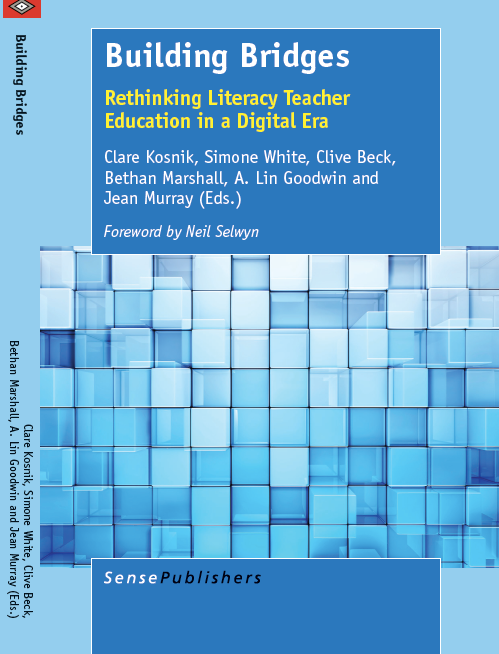
I (Clare) love sharing good news. Our book Building Bridges: Rethinking Literacy Teacher BookCoverCroppedEducation in a Digital Era has just been published. Being modest (tee hee) I think it is blockbuster!!!! Attached is a flier for the book and when you look at the Table of Contents you will see what I mean — incredible contributors. Here a flier for the book Building Bridges_Flyer
If you are comfortable share this info on your FB page/Twitter/Website. The tiny url is http://tinyurl.com/hwtvoua
I am so proud of this book and learned so much editing it!

Rethinking Positive Thinking, in Life and Education

I (Clive) know that self-help books are not everyone’s cup of tea, but given the interest in well-being these days (see Clare’s February 6 posting) they appear to have an important place. Recently I came across a rather impressive one called Rethinking Positive Thinking (Current/Penguin, 2014) by psychologist Gabriele Oettingen.

Oettingen agrees that learning to think positively is essential, but feels that writers on the selfiesubject have gone too far. Just focusing on the positive can result in frustration, failure, and un-happiness. As the saying goes, perfection is the enemy of the good. She recommends instead what she calls “mental contrasting,” which involves thinking about both the positive and the negative aspects of a situation, and of life in general.

As well as being helpful at a personal level, Oettingen’s approach seems to me to have application to teaching and teacher education. It supports being realistic about the challenges of teaching – and so not caught off guard by them, as many beginning teachers are – while also reminding ourselves of its many satisfactions and rewards. It calls into question over-the-top government and school district “targets” that promise to “transform” schooling, if only teachers would adopt the latest set of edicts. Mental contrasting can keep us aware of what we need to work on in teaching while taking comfort in the current successes of the profession.