Tag Archives: teacher education

Visiting the Rishi Valley School…Part 2

IMG_8033

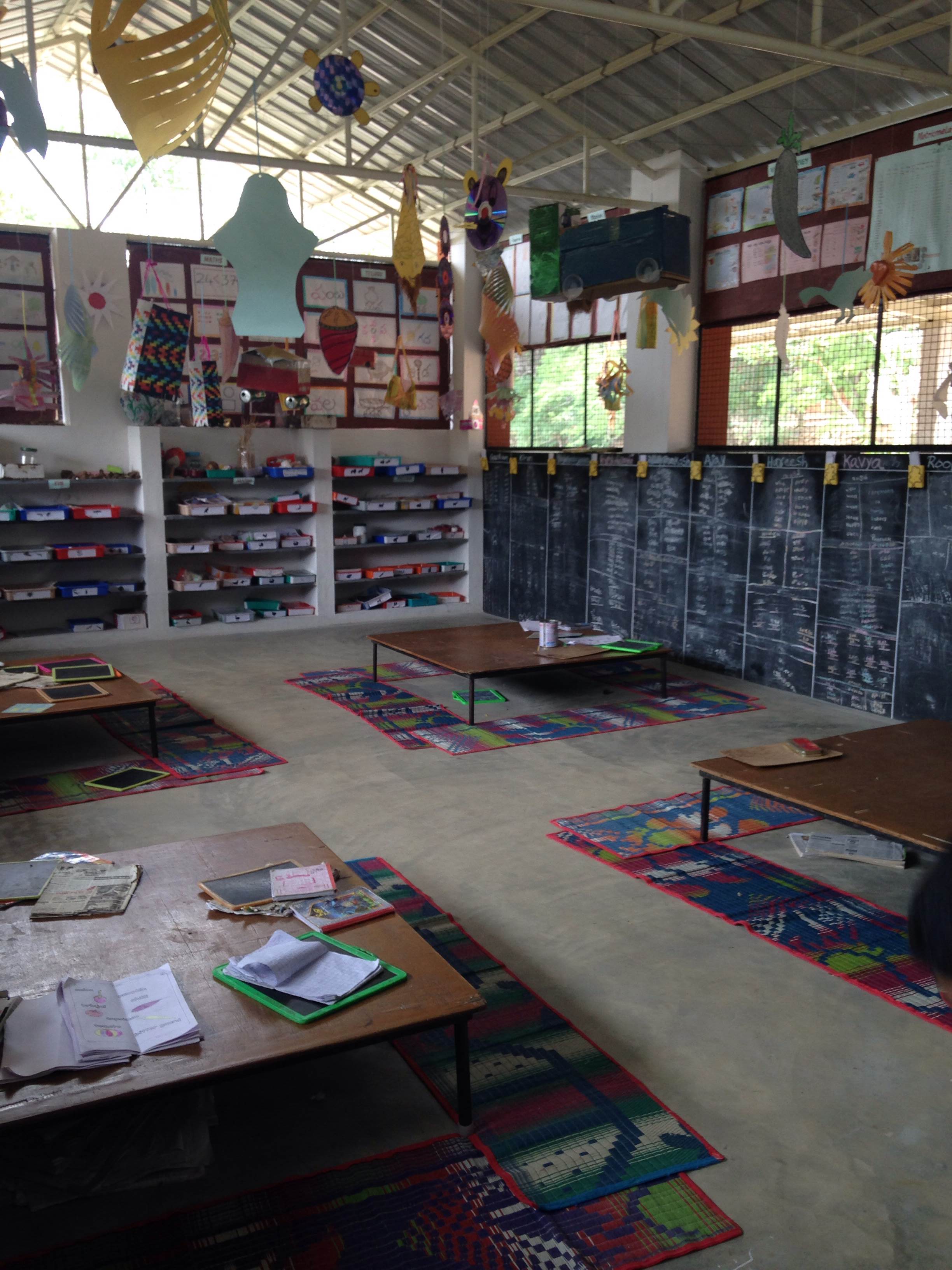
While at the Rishi Valley School I had the opportunity of visiting the Rishi Valley Institute for Education Resources (RIVER), a teacher training and development wing of Rishi Valley Rural Education Centre. The school serves children from the surrounding rural communities, several of which are impoverished. At first glance the RIVER school appears to be like many rural schools in India; one large classroom, one teacher, twenty-five students spanning across 5 grades. However, after spending an afternoon in the classroom it became clear that this classroom was not like the others. First, there are no desks or chairs; rather, there are four large tables with students purposefully seated at them. Second, Kala, the classroom teacher, does not do any stand-up teaching. Instead, she moves from table to table working with small groups of kids or one-on-one with a child with laminated graded cards. Kala is using the multi-grade, multi-level methodology which the Rishi Valley School has spent years developing, and she has spent years perfecting. At the RIVER school a “community-based curriculum is taught…where the academic curriculum is graded for individual levels of learning, grounded in up-to-date information, and framed in the local idiom, and…where the curriculum is integrated with activities.” (http://www.rishivalley.org/rural_education/RIVER.htm)
IMG_8031

The classroom

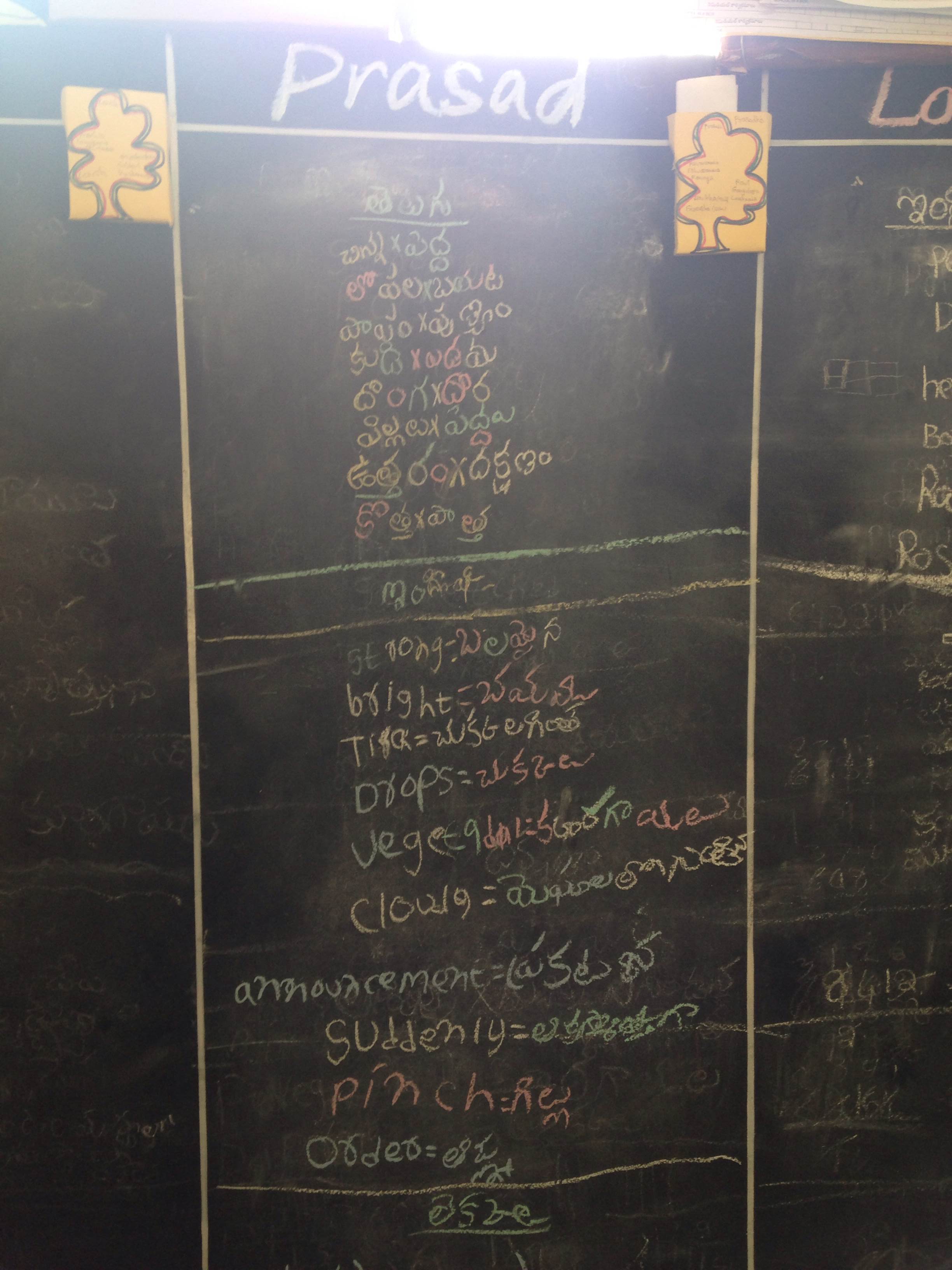
I was most interested in the pride the students took in their graded cards they had completed, as well as their designated space on the wall to record their progress (pictures below). They were all very aware of what level they were at for each of their subject. The graded cards are part of an educational kit the RIVER school has created.

This is how the educational kit works:

The education kit, a series of carefully graded cards, replaces textbooks in the area of language, mathematics and environmental science. Each card in the graded series is marked with a logo (rabbit, elephant, dog) and mapped on to a subject-specific “Learning Ladder”, a progress guide which traces out the learning trajectory for students.

Spaces on the Ladder are sub-divided into a set of milestones. These milestones consist of  cards that explain a concept;  the applications of the concept;  evaluation of students’ understanding and, finally, provide means of testing, remediation or  enrichment. A student identifies her own place on the ladder, and creates, within the broad confines of the milestones,  her own path from grade one to grade five. 

Blank spaces on the ladder allow teachers to introduce independent content into the learning process. Indeed the Ladder can be designed in flexible ways to allow for multiple trajectories between which teachers and students are able to choose so long as the sequencing required by the academic disciplines is maintained.(Source: http://www.rishivalley.org/rural_education/RIVER.htm)

 Although I only spent an afternoon in the classroom, it left a lasting impression on me. The MGML approach seemed to really have been working, and effectively addressing the prevalent issue of mutli-grade classroom across rural India. The MGML approach is being used in rural school across Andhra Pradesh, and has been adopted by many school in the state of Tamil Naidu. The creators are advocating for the approach in several other states in India. Take a look at some photos below!

IMG_8024

Kala (the teacher) working with the students. 

Screen Shot 2015-01-12 at 8.30.28 PM

Students working on Math problems at their own individual levels. 


IMG_8025
The Milestones Chart

IMG_8020

Student progress for the week. 

Helping Students Develop Their Way of Life

If we teach literacy/English and other subjects well – in a way that interests and engages students and deals with “big ideas” – we will inevitably get into life issues and “values.” This in turn will help students build their way of life. They will not have to wait until they graduate to start figuring out how to be in the world.

Teaching about values or life issues is sometimes questioned on the ground that it involves indoctrination. However, schools already push values in strong ways, e.g., punctuality, hard work, academic learning. What is needed is to expand values teaching (usually in the context of teaching subjects) and find non-indoctrinative ways to do it. Constructivism provides a solution here, because both teachers and students say what they think and everyone learns from each other. In the end, students decide what way of life to adopt, but with the benefit of input from others.

As you may know, I (Clive) am a great admirer of the work of Nel Noddings. I recently found a statement of hers in The Challenge to Care in Schools (2nd edn., 2005) that bears very directly on these matters:

I have heard teachers say, We’re not trained for [discussing values with students]. That’s a job for psychologists (or counselors, or parents, or pastors). Pressed, many will say that they do not have a right to impose their values on students, but these same teachers impose all sorts of rules – sensible and mindless equally – without questioning the values thus imposed. Surely intelligent adults should talk to the children in their care about…qualities that most of us admire. This talk need not be indoctrination any more than mathematics teaching need be lecture and rote learning. (p. 39)

Speaking of values, what could be more immoral than subjecting young people to 12 years of narrowly academic schooling with little attention to life matters? The time has come to make education much more useful to students than it has been for the past two-and-a-half millennia. This requires helping them explore values and develop their way of life.


Teaching with a Sense of Humour

The What is Education?  blog for teachers states that having  a sense of humor is, 

 very useful in creating a classroom climate and the development of learning processes that are more healthy and enjoyable. In fact, Melissa Kelly said that a sense of humor is one of the keys to being a successful teacher. According to Melissa, teachers’ sense of humor can relieve tension in the air and can prevent the onset of disruptive student behavior in the classroom, and can be used as a way to attract the attention of students in the class. And most importantly, with its sense of humor, a teacher would show that he/she is a person who has a personality and mental health, to enjoy life, and be able to live a normal life without the stress of his/her career.

http://what-education.blogspot.ca/2013/06/the-importance-of-teachers-using-humor.html

I (Cathy) was delighted to see one of my student teachers, Carolyn,  using her sense of humor throughout her literacy lesson. Her grade one and two students found her quite amusing and would joke along with her.  Sometimes her humor was self-depricating, and sometimes it was as innocent as, “Who me?  I would never do that!”  It was never sarcastic and always made her students smile.  She even used it as a classroom management technique to keep the students focused and engaged.  When I asked her about  her technique, she said it made teaching and leaning more enjoyable.  Then she described an art lesson she had just taught using candle wax and water colours.  She drew a picture on the white paper using a white candle, so it was not visible.  While introducing the lesson she held up the paper and kept telling the students how proud she was of her picture.  When the students kept insisting there was nothing there, she applied the water colours and, of course, the picture magically appeared.  The humor came to play when she allowed each student to play the same joke on her as they created their pictures.  All of the magic pictures were displayed proudly in the hallway of the school.  Carolyn said the students still refer to it and giggle.

I think having a sense of humor is an asset.   We all definitely need to laugh more, especially in our schools.  Carolyn

Teaching Between The Lines

A group of us just had a proposal accepted for AERA on teacher resistance, as part of a symposium on that topic. Our paper will be on how the teachers we are studying “teach between the lines,” finding ways to “live with” system mandates and teach (in varying degrees) in a holistic, constructivist manner.

I (Clive) just came across a very relevant quote in Nel Noddings’ 2013 book Education and Democracy in the 21st Century that will help us as we write the paper. She says:

“[In this book] we will consider how schools can help students to achieve satisfying lives in three great domains: home, occupation, and civic life…. [H]owever, I want to make it clear that I do not foresee dramatic changes in the basic structure of curriculum in America. We have to work within that basic structure. Sadly, I think we will go right on with English, mathematics, social studies, science, and foreign languages as the backbone of our curriculum. Indeed, if we continue in the direction we are now headed, the curriculum will become even more isolated from real life and its subjects more carefully separated from one another. It is this tendency that we should resist, and effective resistance will require collaboration, critical thinking, and creativity.” (p. 11, my italics)

Wow! While talking strongly of resistance Noddings says we have to work within the system, which if anything will get worse. What then does resistance mean?

It can mean campaigning publically against the retrograde measures; or negotiating at the school level to modify their implementation. Or it can mean finding holes – or “interstices” as the post-structuralists say – within the system that enable teachers to teach the way they believe in, to the extent possible.

This third approach is important because it allows teachers to keep their jobs and continue to be there for their students. We mustn’t dismiss this type of resistance as mere compromise. Rather, we must join with teachers in looking for ways to teach well within the system. And teacher educators must discuss the challenges and possible strategies at length with their students, so they come to teaching prepared to teach between the lines, rather than having to figure it out on their own.


Reading for Relevance AND Fluency

In the past, I (Clive) have posted about the need to teach for relevance. When recently re-visiting two of Richard Allington’s wonderful books on reading instruction – What Really Matters for Struggling Readers (2006) and What Really Matters in Fluency (2009) – I was impressed with his discussion of the link between relevance and fluency in reading. In his view, there are at least 4 instructional causes of reading difficulties:

  • Texts are too difficult
  • Texts are not interesting enough
  • Insufficient time is given for actual reading (as distinct from studying reading strategies)
  • Reading is interrupted for instructional reasons

Because of these factors, students don’t do enough reading to become fluent. Teaching reading strategies is important, but a balance is needed. Allington says:

[To increase their] store of at-a-glance words, readers need to consistently and repeatedly read a word correctly. [This requires] a lot of accurate reading…struggling readers [should] read at least as much as the achieving readers at their grade level. (2009, p. 38).

He cites what he sees as “one of the greatest failures of the [U.S.] federally funded Title I remedial reading and special education programs: Neither program reliably increased the volume of reading that children engaged in” (2006, p. 43). In fact, the amount of reading was often reduced.

But struggling students won’t read very much – either at school or at home – if texts are uninteresting to them. This is where relevance comes in. According to Allington, if we want students to read a lot they must see the point of reading. But if we force them to read books they aren’t interested in and bombard them with reading strategies, along with “comprehension” tasks that just require them to recall and retell, they may never realize that reading has a point. He comments:

I fear that we will continue to develop students who don’t even know that thoughtful literacy is the reason for reading. (2006, p. 116)

So relevance is valuable in two ways: it helps students learn about “life” and the real world, and it helps them learn how to read.


Responding Critically to Azalea’s ‘Bounce’

In class this week my (Cathy’s) teacher education students were exploring indirect  instruction through learning centers.  One of the centers featured Iggy Azalea’s music video, Bounce, and the instructions to discuss the work through a critical literacy lens.   (E.g. What message do you think the artist wants us to get from this video? Based on the artist’s thoughts and actions (expressed in the song), how would you say she is portraying herself to the world?)

Most of the students had heard of the video but never actually viewed it until arriving at the literacy center.  (Perhaps you haven’t either).  Without revealing the content, I will reiterate the general tone of the reactions.   Most students were annoyed by the video content.  One student said she was disgusted (and this is not sexual content).  One group, however,  tried to take a broader view.  They said they could not judge the work until they understood Azalea’s intent.  So they took it upon themselves to look up an interview in which Azalea discusses her purpose for portraying her song the way she did.  After viewing the interview, they were angry.  Azalea explained that she portrayed herself thusly so she would be seen as “flashy”.  No message, just glamour.  After this insight, some wonderful discussion ensued about cultural ethics and hegemony.

One student spoke to me at the conclusion of class and confessed that she was surprised by her own reaction.  In her words, “I have changed.    Studying literacy education has given me a different perspective.  I see the world differently, especially things like music videos.”

Below is the link so you can view this content for yourself and decide.  The second link is the video in which Azalea discusses her purpose for making the video.

Happy critical viewing!

They Made Me Eat My Words!

Each fall and spring I (Clive) invite the students – 65 this year – in my teacher education Clive Beckcohort program to an evening potluck at our house. Most of them come, some with their spouses or significant others, and we are deluged with food – especially desserts! It is a great opportunity for them to get to know each other better and for me to finally learn all their names. It also models the type of community building and teacher-student relationship that I think is so important in any school or university class.

We had the fall party a couple of weeks ago just after our fourth class together, which was on practice teaching and the theory-practice relationship generally (sounds dull I know). One thing I had discussed with them was the importance of bringing our theories about life and education down to earth, using practical ideas that we remind ourselves of in the heat of the moment. I told them how one of the teachers in our research project was having difficulty with her class last year, so she wrote “don’t take it personally” in capital letters (DTIP) on her wrist and found it helped.

Two of the students with special IT talents arranged to have a slab cream cake made, decorated with a photo of me in blue along with three of these sayings: another was “you can’t do and be everything.” They brought the cake to the party and put it on display, and we all hoed in when dessert time came. I didn’t mind having to eat my words, they were delicious!

An Infographic of Finland’s Education System

Much has been said about the education system in Finland. For the past decade or so Finland’s PISA scores have been at the top in both literacy and mathematics. Many studies have been conducted on their exemplary system. Some of the characteristics which set the education system apart:

  • Student- Teacher Ratio is better than in North America
  • Standardized testing and homework is kept to a minimum
  • Teaching is a highly respected profession

Below is a beautiful infographic outlining Finland’s stance on teaching and learning (Lepi, 2014). Lepi concludes the infographic with, what she believes, is most critical to Finland’s success: “Finland knows good teachers are essential.”

http://www.edudemic.com/homework-finland-infographic/

finland

Teacher Education, Schooling and the Teaching of Holidays

Today is Canadian Thanksgiving. For many Thanksgiving is a holiday of rest. A long weekend for a quick getaway or time to gather with friends and family to feast on turkey and pause for a moment to reflect on one’s blessings. For many, it is a happy holiday, not associated with historical ties or religion.  For others, Thanksgiving holds alternative feelings and reminders.  As a teacher educator I do not mention the holidays in my class nor do we discuss possibilities for addressing the holidays in the classroom. Now I am thinking maybe I should… not for the purpose of generating teaching ideas and strategies but for the broader more philosophical discussion of what should be considered when raising the topic of holidays in the classroom?

I remember Thanksgiving celebrations at school; we decorated autumn wreaths, coloured turkey pictures and shared what we were thankful for with one another. But, is that what Thanksgiving is about? To some, it may be just that. But is it something else? What are the perspectives? The history? And how do we share that information in ways that are inclusive and safe? In fact, how do we share any holiday content with children in our classrooms? I am interested in unraveling the embedded practices that are based more on tradition (doing what we’ve always done) and thinking more about the students in our classrooms and how the stories and histories and significances of the holidays may or may not touch their lives.

Quick searches online led me to inconsistent explanations of the origins of Thanksgiving in Canada. So I am left to share a simple wikipedia here:

http://en.wikipedia.org/wiki/Thanksgiving

There are significant differences between Canadian and USA Thanksgiving, far beyond the different date.

And then of course there is the perspective taking on the holidays. Thanksgiving is one where Aboriginal perspectives, for example, weigh heavily in my thoughts and move me to contemplate how best to approach the discussion of the holiday in schools.

There are several online resources available and people to talk to about the varying perspectives. Information can be found. Yet I am still left with the questions, how do we approach this in the classroom? Do we continue to colour in turkeys and refer to a ‘harvest’ that many 4 – 10 year olds cannot quite imagine and have children share what they are thankful for? Do we tell stories and share multiple perspectives on the past and present? Do we do nothing at all?

I’m interested to hear from teacher educators and teachers about what you are doing or have see done in teacher education and in schools.  An interesting discussion with many angles and points of view.

Sending warm wishes to those who have celebrated and enjoyed the holiday this weekend.

images

Happiness and Teaching – Insights from Dewey

In earlier postings, I (Clive) talked about the need to see teaching and teacher education in very broad terms; to see ourselves as ultimately helping students develop a satisfying, enjoyable or “happy” way of life. This week I came across some wonderful quotes from John Dewey along these lines.

The first is from Democracy and Education (Macmillan, 1916); it emphasizes that we can’t separate our philosophy or theory of education from our philosophy of life.

“[P]hilosophy is at once an explicit formulation of the various interests of life and a propounding of points of view and methods through which a better balance of interests may be effected. Since education is the process through which the needed transformation may be accomplished…philosophy is the theory of education as deliberately conducted in practice” (p. 387).

Two further quotes are from Theory of the Moral Life (Holt, Rinehart & Winston, 1960, orig. 1908, revised 1932). They emphasize again the need for a comprehensive philosophy of life and education, and show the connection between this philosophy and human enjoyment, satisfaction, happiness.

“In isolation, one enjoyment cannot be said to be higher or lower than another…a satisfaction which is seen, by reflection based on large experience, to unify in a harmonious way [one’s] whole system of desires is higher in quality than a good which is such only in relation to a particular want in isolation [satisfactions of the former type together constitute “happiness”] (p. 44). … The office of reflection [is] the formation of a judgment of value in which particular satisfactions are placed as integral parts of conduct as a consistent harmonious whole” (p. 60).

Dewey notes, however, that our philosophy of life and education is never complete: it is always a work in progress.

“The business of reflection in determining the true good cannot be done once for all…. It needs to be done over and over and over again, in terms of the conditions and concrete situations as they arise” (p. 62).

I’m going to share these quotes with my students next week and see what they think – and learn from them. My philosophy of life and education is never complete!