Tag Archives: teacher education

Mental Health Education in Teacher Education

Earlier this week I  (Yiola) participated in a Webinar on the teaching of mental health in teacher education. The webinar was called: Reading, Writing, Resiliency: A Briefing on the State of Teacher Education Toward Positive Mental Health.

This post is connected to Shelley’s recent post on Supporting Student Well-being through Mindfulness Practices as it looks closely at what Teacher Education programs are doing to prepare teachers to teach about Mental Health and Wellness.  It was interesting to read Shelley’s blog and learn about what she does and how mindfulness as a form of mental health practices are developed in her course on Special Education. I would love to hear what other teacher educators and classroom teachers do to promote and teach about well-being.

During the webinar I learned some interesting facts:

– parents are concerned and interested to learn more about in 2 key areas related to mental health education: 1) Abuse and its effects on mental health (bullying, emotional abuse, exclusion);  2) Health (depression, substance abuse)

– after (parents and) doctors, teachers are the next care professionals in line who are expected to address children’s mental health

– There is a gap between the strong perception of teachers responsibilities for addressing issues of mental health and their preparedness to do so

In a study conducted on mental health teaching in teacher education in Canada, over 400 courses in 66 teacher education programs were examined against 4 criteria. The 4 criteria were related to the following: course title, words in the course description, topics in the course outlines, practices and relationships. The findings showed that only 2 of the 400 courses met all 4 criteria for the inclusion of mental health learning; 23 courses met 3 of the 4 criteria, 84 courses met 2 of the criteria and 104 courses met just 1 criteria.   This finding suggests that there is very little by way of teaching mental health issues in teacher education programs.

From the study 5 recommendations were made: 1) all teacher education programs should include at least 1 course that focuses on fostering postive mental health and resiliency; 2) classroom management courses reflect proactive resiliency oriented strategies; 3) in-service opportunities need to be available to practicing classroom teachers; 4) provincial curriculum should identify outcomes for health education; and, 5) mental health and resiliency outcomes should be in grades K-12 curriculum.

The webinar was helpful in outlining where we stand today in teacher education and mental health teaching.  I am very keen on thinking about how to move forward in teacher education programming.  Mental health and resiliency content can and should in included in many courses including but not limited to: all curriculum areas (i.e. literacy, social studies, math, health and physical education); special education, methods (i.e. classroom environment, classroom management, collaborative practices).  There needs to be a shift in foci, moving beyond the traditional Health and Physical Education curriculum (i.e. the Healthy Living strand) into a more comprehensive way of thinking about well-being and resiliency.


Assignments: Bane of Student Teachers and Professors

checkmark imagesI (Clare) was in my department yesterday and ran into a number of colleagues. Most were bemoaning their heavy marking load. This is the end of the semester and most seemed snowed under with the grading papers. A few weeks ago I observed a number of student teachers submitting their assignments. They too looked tired and were complaining about their assignments and workload. Yes assignments are work. Yes as instructors we need to grade student work. But there is something wrong with this picture. Many of the student teachers do not find their assignments useful (as a few commented – “they are just make- work projects”) and faculty spend huge amounts of time marking projects their student teachers found wanting. We definitely need to have assignments but I think it is time to discuss what are useful assignments for student teachers. The corollary issue is how can marking assignment be useful for faculty?
A number of years ago when I was Director of the Elementary Preservice program at OISE we created a survey about assignments which we distributed to around 600 student teachers. The results were surprising: they did not like having to self-assess, they disliked group projects, and they would rather have fewer, more in-depth assignments, than many little ones. (Most criticized were submitting long lesson plans with reflections. Many admitted they simply made up the reflections.) What was not surprising is they valued assignments where they had choice in both the topic and the format. If we (faculty and student teachers) are going to spend significant time on assignments then let’s use our time more fruitfully and productively. We cannot do away with assignments but I think we can reconceptualize them to be more useful for everyone involved.

Victoria Embraces FDELK

FDELK is the acronym for the new Full Day Early Learning Kindergarten program in Ontario and it represents much, much more than just going to school all day. The program is based on the Reggio Emilia Inquiry approach to learning, which has been in existence in Italy for over 50 years. It is a new teaching/learning approach for Ontario, however, and some teachers are still working out a few of the kinks. It is well worth the effort, though, as the results I am seeing in the schools are very exciting.

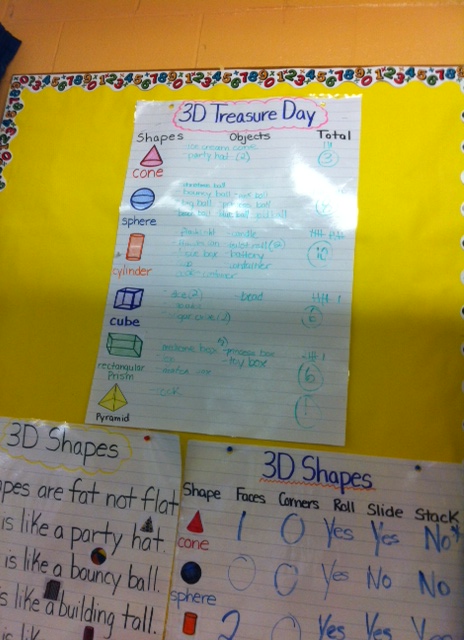
Imagine how delighted I (Cathy) was when I visited one of my practicum schools to observe a student teacher working in a FDELK placement and discovered not only had she embraced the inquiry learning process, she was sometimes leading the teachers in the approach. Her mentor teacher proudly showed me some of the things our student teacher, Victoria, had created for the class. While exploring 3D shapes, Victoria created for an with the students a: 3-D Bingo game; 3-D shape story; 3-D treasure hunt ; 3-D survey; and, 3-D art.

I knew the 3-D exploration was working too. As I watched a small group of K’s make sets of counters to add up to ten, one of the boys suddenly exclaimed, “Look! I made a rhombus !” Ahhh, to be so smart at 5. But it takes good teaching to guide them there.

VictoriaVictorias anchor

Electricity and the Joy of Learning

One of the greatest joys of my (Cathy’s) job is observing student teachers in their teaching practicums. In my next few blogs I will be happily sharing some of the highlights from these visits.

Yesterday I was observing a student teacher instruct a grade six science class exploring electrical currents. The student teacher wisely arranged his students into collegial groups and then gave each group a paper bag full of various parts (batteries, wires, light bulbs, switches etc.). The students were expected to find a way to put the put the parts together that would create an electrical current, hence lighting up the light bulb. It was fascinating watching the students trouble shoot their way through the process. They were so engaged. I was proud of the student teacher for setting up the investigation so well. Suddenly there was a squeal from the corner group. One of the boys was holding up a lit light bulb. His smile was brighter than the bulb. “What did you do?” I asked him. He was silent for a few seconds, staring in amazement at the lit bulb. Then he said, “I have no idea.” Everyone laughed. The process of deduction then began as the group tried to figure out why it worked. And next week I get to observe completely different classes, making entirely new discoveries. Lucky me.

circuit


Teacher Educators, Literacy Educators, and Digital Technology Experts Working Together

Making ConnectionsI (Clare) am pleased to share some good news. We submitted a proposal to the Social Sciences and Humanities Research Council of Canada (SSHRC) to fund the project Rethinking Literacy Teacher Education for the Digital Era: Teacher Educators, Literacy Educators, and Digital Technology Experts Working Together. One of the main activities of the project will be bringing together 16 experts from three fields and 4 countries (Canada, US, UK, and Australia) to address the following questions.

  • How is our understanding of literacy evolving in light of the new ways we communicate?
  • How can literacy/English teacher educators (LTEs) prepare student teachers to develop and implement literacy programs that capitalize on digital technology (DT)?
  • What teacher education curriculum changes are required to better prepare future teachers to integrate technology in their own teaching?
  • What professional learning support do LTEs need to develop courses that will integrate and make greater use of DT?

As a team we are going to work together to:

  • develop a statement on literacy teacher education that offers direction on how to integrate digital technology into teacher education literacy courses;
  • extend our website http://www.literacyteaching.net to include video interviews of all the participants discussing their views and current research and their course outlines and supplementary course materials;
  • produce an edited book Crossing Boundaries: Literacy/English Teacher Educators Incorporating Digital Technology in Their Courses

 Click here to read the summary of the proposal. Final Summary of Proposal

As academics we tend to work in our “silo” which although allows us to specialize it has Connecting Peoplelimitations. The symposium will provide an opportunity to work in an inter-disciplinary manner which may help us move forward the field of literacy teacher education. My co-applicants for the proposal are Lin Goodwin (Teachers College), Simone White (Monash University), Bethan Marshall (King’s College UK), Jean Murray (University of East London), and Clive Beck (University of Toronto). I will continue to provide updates on our work.

Photo Highlights from AERA 2014

The 2014 American Educational Research Association (AERA) conference took place this year in Philadelphia. I was able to attend some fascinating paper sessions, poster sessions, and symposiums during my time there. I also managed to make it to the memorable museum district area of Philadelphia. Here are some photo highlights below:

My dear friend and research colleague, Cathy Miyata, presenting her paper Negotiating Multiliteracies Pedagogy in International Preservice Teacher Education:

photo6

A fascinating panel titled Defending, Reforming and Transforming Teacher Education: The Future of Teacher Education in the United States. This panel’s members included Linda Darling-Hammond, Timothy Knowles,  Kwame Griffith, and Kenneth Zeichner.

photo3

An important symposium on ways teacher education programs around the world  are preparing preservice teachers for marginalized students. The symposium entitled Building Infrastructure and Capacity Research Innovations Worldwide That Prepare Teachers for 21st Century Schools That Service Marginalized and Poor Students in Transnational Contexts. Below is a photo of Dr. Clare Kosnik sharing findings from our international study on Literacy Teacher Educators:

photo5

A relaxing dinner with our research group, Becoming Teacher Educators.

photo4

Finally, a photo from the museum district which is looking south on Benjamin Franklin Parkway. I was standing on the iconic steps where Rocky trained while taking this photo!

photo2-3

St. Patrick’s Day

Today is St. Patrick’s Day – an Irish holiday. St. Patrick’s day is a significant day here in Toronto and includes a big parade, people wear Green, restaurant and pubs turning themselves into Green enterprises, classrooms talking about and celebrating all that is Green and Irish.  What began as a religious holiday is now a festive c Image Shamrock_with_Pipeelebration in many parts of the world.
St. Patrick’s Day is about St. Patrick, the Apostle of Ireland. St. Patrick is credited for bringing Christianity to Ireland. The shamrock is what St. Patrick used to illustrate the Holy trinity.  March 17th is believed to be the day St. Patrick died.
Thinking about schools and classrooms, should we teach St. Patrick’s Day from a perspective other than a festive celebration? Why is it a prominent celebration here in Canada?  How is it that Irish and other ethnicities alike rejoice in St. Patrick’s Day? When I taught in the public schools we encouraged students to dress in Green, we had a parade through the halls of the school, we read books about St. Patrick’s day and Ireland, and had several activities (arts, crafts, writing) to honour the celebration. Yet not once do I recall and inquiry or examination of what the Day represents both historically and for today.  What are the roles and responsibilities of teachers when it comes to celebrations and religious based traditions? In Toronto, Christmas has been the hotly debated and accommodated celebration for decades. What about the celebrations that are not framed in religion and yet are still entrenched in identity and power? Do we blindly and happily engage in the happiness and celebration without thought to the messages of exclusion and power we send when we honour one group and not another? Or do we engage in the often burdensome experience of exposing the inequities of such celebrations? Or, do we do nothing at all?
In an interesting article by Sallie Marston (1989), “Public rituals and community power: St. Patrick’s day parades in Lowell, Massachusetts, 1841–1874”, Marston states, “parades and other forms of mass public ritual are better characterized as demonstrations of community power and solidarity and serve as complex commentaries on the political economy of urban-industrial social relations”.  Perhaps a safe and productive space for exploring the ‘power’ of celebrations is better served in teacher education classrooms. Teacher educators who take a critical stance in their practice raise consciously engaging issues and connect social theories to classroom practice and student learning. Yiola

Dialogic Talk

It’s a powerful statement about a book when while reading it, you implement a suggested strategy the next day in class.  That’s exactly what happened while I was reading Classroom Talk: Understanding dialogue, pedagogy and practice, by Edwards-Groves, Anstey and Bull (2014).  The premise- talk is the foundation to all learning- is not new, but the connections made to multiple theories (e.g. Theory of  Practice Architectures, Theory of Multimodality, Social Semiotic Theory) makes this book very current.

book

I particularly enjoyed the section on conversation vs dialogic talk.  I do believe in “vacating the floor” as is suggested in the book and letting the students discuss issues in small groups.  In one particular class I teach, I always allowed my students to select their own discussion groups, as these are university students and felt they needed to make their own choices.  However, many of the groups were not focused, they veered way off topic (or never addressed the topic at all) and some students were still not voicing their opinion (even after much community building).  The section on dialogic talk prompted me to reframe my concept of small group discussion.  It suggested conversation is an informal discourse where direction and end point of the talk are unclear.  This was pretty much where my students were with their discussions.  Dialogic talk, however, sought to engage all listeners and had more purpose.  Plus, dialogic talk was not as relaxed as conversation, it was driven.  I needed driven.  I wanted more engagement.

As a result, I immediately set up ‘Dialogue Groups’ with an assigned moderator, who ensured everyone’s opinion was invited and heard.  I decided who would go into each group (which I thought they might resent and discovered they preferred!).  For each discussion I provided prompt questions to get the talk started.  I also assigned a time keeper who kept the dialogue to the time limit and a recorder who kept general notes about what was discussed.  I honestly didn’t think this would be necessary at the university level, but the difference was incredible.  There was thoughtfulness in the answers.  The discussants were suddenly animated and energetic.  They were really listening to each other.   This was a small change, but it made a world of difference in how they were hearing and responding to each other.

Of course there are many other interesting and practical suggestions in the book.  The connections between theory and practice are very strong.  I highly recommend it.  This book was published by the Primary English Teaching Association of Australia (PETAA).  Check out their web site!

http://www.petaa.edu.au/

Picture Books

arrival_02Clare and I (Lydia) routinely integrate picture books into our pre-service literacy methods courses. We often begin each class with a read aloud from a picture book. The feedback we have received from student teachers suggests they appreciate this practice because it introduces them to a variety of texts they can use in the classroom, and it models storytelling and read aloud techniques. We have often used the creative and compelling picture books of author Shaun Tan in our literacy courses. I wanted to share a quote from Shaun Tan in which he comments on the “visual language of illustrations”.

“the word illustration is a little misleading, because the best illustrations do not actually illustrate anything, in the sense of describing or illuminating. My own narrative images, and those of my favourite artists, are actually far more concerned with deepening the uncertainty of language, enjoying its ambiguous references, exploiting its slipperiness, and at times, confessing its inadequacy.  My own aspirations as an illustrator – using that term advisedly – is to simply present the reader with ideas that are essentially silent, unexplained, and open to very broad interpretation”.— Shaun Tan

(Quote taken from an essay originally written for ABC Radio National’s Lingua Franca.)