Below is a link to a vignette that really struck a chord with me (Cathy). There is a lot to learn about the etiquette of texting. According to Maralee McKee, “out attention is a gift.”
McKee also says,
Our full attention is the foundation of every kindhearted, other-centered interaction. Texting alters the continuity, focus, and momentum of our encounters.
It produces anxiety (mild to severe) in the other person, and whether they’re telling you (or even aware of it themselves) or not, they’re attention is apt to desire to focus on someone who pays them back equally.
These are big matters.
If we’re not being careful, texting can hurt our family, our friendships, our business relationships, even our ability to govern.
It’s snowing! But I (Gisela) have nothing to complain about! From January 2014 until today I have enjoyed many winter days in Toronto. I’ve been a Visiting Scholar from Brazil sponsored by Clare Kosnik for almost a year at OISE/University of Toronto. It has been an amazing experience! More than the cold weather I’ve discovered a great country: from red maple leaves to squirrels on streets, from Lake Ontario to Lake Louise, from Quebec City to Montreal, from AGO to Canadian Museum of Human Rights in Winnipeg, from rainbow positive to multicultural spaces. The environment and people have touched my heart and brain!
I have interviewed teachers and educators and I have observed many babies and kids at schools and Day Care Centres. I have met many smart people — undergraduate students, faculty, and newcomers to Canada (who have diverse cultures, values and languages).
This sabbatical opportunity contributed to my analysis of teacher education in Brazil. The insights I have gained came about through discussion of my data at Clare’s and Clive’s BTE team meetings and by comparing my findings to some of the points made in lectures that I attended at OISE and at conferences both in Canada and the U.S. One of the exciting developments was that my proposal on my research was accepted by AERA. I will present my work in Chicago next year.
This wealth of experiences and my academic partnership improved my own vision of education. Being a teacher is complicated because of the many dilemmas and issues yet being a teacher should connect to one’s own life. Teaching occurs in a dynamic, diverse, and interactional-based setting!
My experience in Toronto gave me spectacular new knowledge about being a teacher in a democratic and multicultural city! I have learned from OISE and the Toronto District School Board that a good and positive vision of education is supported by research. This vision is “tested” daily by students, parents, and principals. The most important piece of the education puzzle is teachers. I have been impressed with the ways that teachers think critically about education and have developed many good strategies for teaching which in turn supports student learning!
I learned also that accountability counts! More than policy initiatives, accountability should include the community’s attitude towards the kids and youths in schools! Even though Canadians complain about their schools, I have seen some great initiatives: Triangle Program that supports LGBQT high school’s students; a Parkdale school that supports ESL students who often struggle financially and has a number of refugee children from around the world; and schools with an Afrocentric-positive space to support student well- being. I have learned about connecting undergraduates students with teacher education research which will help these future teachers build a whole identity and professional practice.
Thanks everyone who supported me in the time I spent in Canada! I hope that OISE will help my country improve our national system of education. Doors are open between our countries! See you soon!
I came across this short yet powerful TED talk. Educator Clint Smith delivers a power piece of spoken word on what he believes to be the dangers of silence. Smith, like many educators, values students’ voices and opinions. He believes we must encourage our students to speak out against injustices because silence leads to discrimination, violence, and war. Through the use of poetry, Smith helps students shares their stories- share their “truths.” Smith begins his spoken work piece with a powerful Martin Luther King Jr. quote: “In the end, we will remember not the words of our enemies, but the silence of our friends.”
Smith also shares 4 core principles that he runs his classes by:
1. Read critically
2. Write consciously
3. Speak clearly
4. Tell your truth
Watch Smith’s 4-minute video here to hear more about the dangers of silence:
Full Day Kindergarten (FDK) Blog #4 tells the literacy teaching story from the perspective of a first time Full Day Kindergarten parent (Yiola). In this post I share elements of the assessment process and how my child’s development has been communicated.
Here in Ontario it is “Parent-Teacher Interview” time. First term report cards have been written and parents and teachers, and sometimes students, are meeting to discuss student progress. There are a number of ways the interviews are conducted: student-led conferences are now quite popular processes and the more traditional teacher-led conference sans student are still in effect.
When I received the school newsletter and read that report cards and interviews were about to take place I was surprised and a little anxious; I felt it was too early to have the teachers share my child’s development… I knew my Sylvia Clare was learning a lot but to put in writing her ‘levels’ or acquired learning after 8 short weeks of school seemed far too soon. Well, I was right. The report cards and formal interviews were meant for students in grades 1 and up, not for kindergarten. Phew! That made more sense to me. As a parent of a child in kindergarten it makes good sense that children in the early years are not formally assessed … well, too early. From a parent’s perspective, I wonder if I would feel the same way if my children were in first or second or third grade?
What the FDK program has established is an “observation” time where each parent/guardian is invited to visit the classroom in action, to observe the daily life of the classroom and their child in the classroom. During the observation time the teacher offers some time to discuss questions or concerns with the parents/guardians. I was thrilled with the sounds of process as I was feeling so very curious about the sounds and vibes of the classroom and how Sylvia Clare got on inside that environment. A first hand eye-witness makes such good sense.
A short note arrived home a week before the observation. We were assigned a half hour observation time the following Monday morning. This worked well for me, but I did wonder, how do full-time working parents without flexible schedules manage the observation?
Monday morning arrived and off I went to visit the classroom. Alive with children’s voices, questions, and energy I walked into a vibrant room filled with learning. I was welcomed by the Teacher and Early Childhood Educator. Sylvia Clare’s face lit up when she spotted me as she hustled over with excitement. I quickly slid into the flow of the room and began to learn what it was my child did in the FDK room. Sylvia Clare was working with another student building the 100s chart on the huge carpet area. She had the 70s cards and while the Senior Kindergarten student was building from the 40s, she watched and waited patiently for the 70s to turn up so she could add to the massive chart… a wonderful, collaborative learning experience. When done, she showed me around the room: building centres, reading nooks, sand table, art table, writing table, snack table and well organized low rise shelves embodied the room. The room was as I remembered it back in August (neutral colours, natural light, natural materials) but now evidence of student learning lined the walls; drawings, colourings, writings were on display and I could see Sylvia Clare’s work.
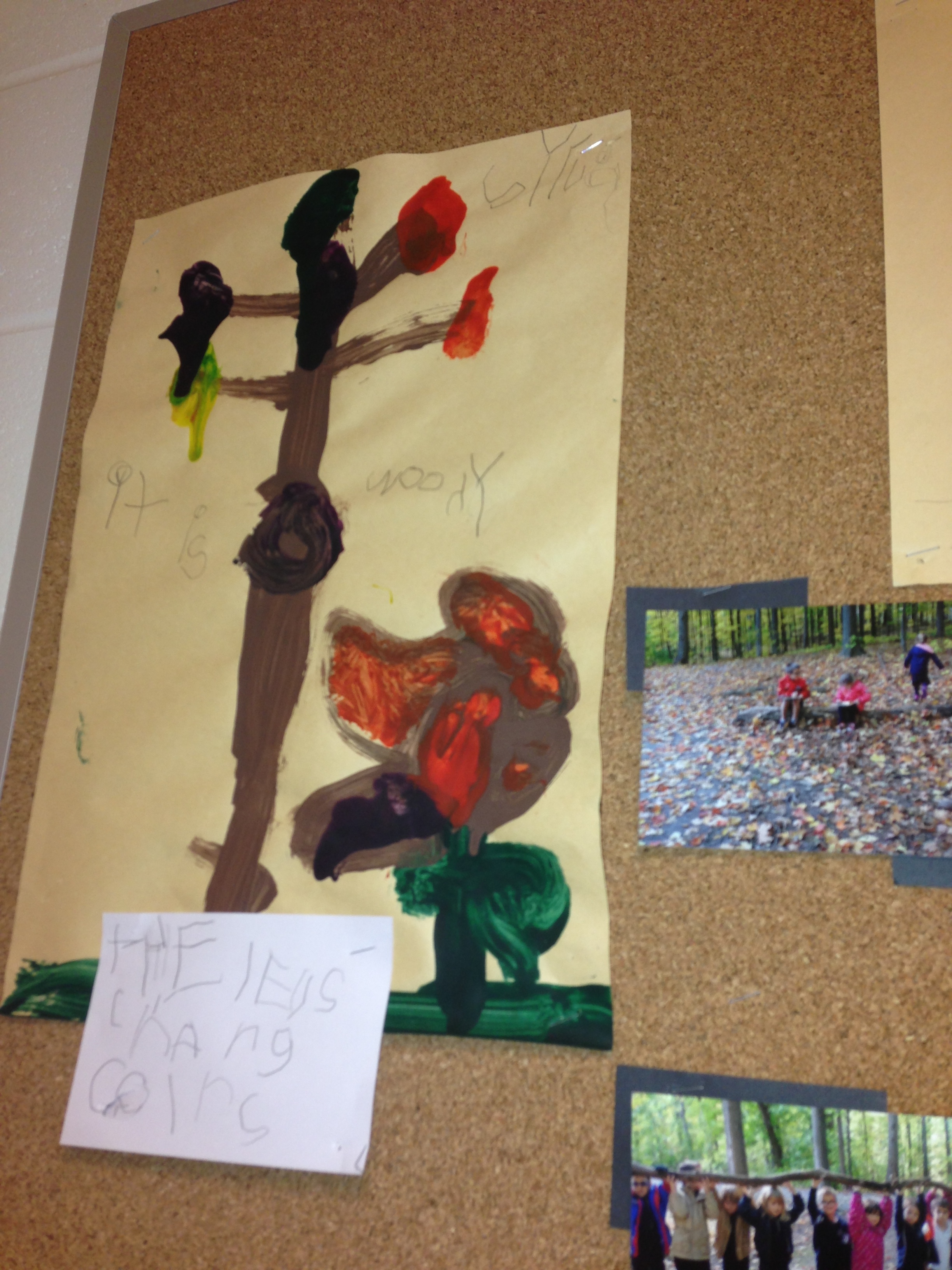
Sylvia Clare’s portrait of “Woody”, the tree the class adopted from the neighbourhood forest.
Children working in pairs, in small groups, independently on a variety of tasks throughout the room. The room was bustling yet highly organized. The room was loud but not noisy. I was thrilled to see so many “languages” brought to life (Reggio Emilia’s notion of the 100 languages in the classroom) ~ art opportunities everywhere; all purposeful and engaging. Everyone, including my Sylvia Clare had a place in the space and was engaged in the life of the room. The teachers encouraged Sylvia Clare to show me her portfolio (a binder with evidence of her work). Then Sylvia Clare led me to her interests where we explored and worked together. Once well settled into the observation, the teacher sat down next to me and asked, “Do you have any questions or concerns?” This was such an open and welcoming way to start our discussion. My questions:
Is Sylvia Clare happy at school?
Does she have friends and is she social? Who does she play with the most?
Where does she spend most of her time in the room?
I see she is learning a lot from all that she shares at home. What do you think?
The teacher provided specific description of Sylvia Clare’s work in the classroom: what she talks about, who she plays with, what she enjoys doing, and how she interacts in the classroom. It was clear to me the teachers have a good sense of who Sylvia Clare is, what she likes, areas she has shown significant growth already and areas for improvement. Then I asked:
What can we work on at home to support her learning?
Continued literacy development, focusing on sound/letter recognition. I realize now, as a parent of a child who is developing their reading skills just how complex the process is for children. It takes time. Some children acquire skills faster than others; some struggle but all children need time, exposure, practice to basic skill development. In theory, I knew this. To witness it through the lens of a parent however is somewhat different. Experiencing literacy development in one young child in live time, watching her gain letter recognition, one letter at a time, one sound at a time, is quite fascinating. Sylvia Clare is getting there. Beyond the daily read alouds and story telling I need to work through phonic games and drills with Sylvia Clare.
After our brief conversation I felt comfortable and confident that my child has adjusted to full day schooling and getting along well. Sylvia Clare then ushered me over to the snack table and we chatted while some of her friends came over to meet me. Shortly after, I said my goodbyes and was on my way.
It was remarkable observing my child in this setting; a setting outside our home, a setting in which I am but an observer and Sylvia Clare is the participant. The observation experience provided very clear, detailed description of my child’s work at school, far more than I would have gathered from a formal report card.
I (Clare) am the Principle Investigator of a large-scale study of 28 literacy/English teacher educators from four countries. This week I am doing a presentation at the Ontario Ministry of Education where I will give an overview of our findings. Attached is the powerpoint which I thought you might find interesting. MOE LTE 2014
For more information on the study click on the tab Projects and then click on Literacy Teacher Educators: Their Backgrounds, Visions, and Practices.
A group of us just had a proposal accepted for AERA on teacher resistance, as part of a symposium on that topic. Our paper will be on how the teachers we are studying “teach between the lines,” finding ways to “live with” system mandates and teach (in varying degrees) in a holistic, constructivist manner.
I (Clive) just came across a very relevant quote in Nel Noddings’ 2013 book Education and Democracy in the 21st Century that will help us as we write the paper. She says:
“[In this book] we will consider how schools can help students to achieve satisfying lives in three great domains: home, occupation, and civic life…. [H]owever, I want to make it clear that I do not foresee dramatic changes in the basic structure of curriculum in America. We have to work within that basic structure. Sadly, I think we will go right on with English, mathematics, social studies, science, and foreign languages as the backbone of our curriculum. Indeed, if we continue in the direction we are now headed, the curriculum will become even more isolated from real life and its subjects more carefully separated from one another. It is this tendency that we should resist, and effective resistance will require collaboration, critical thinking, and creativity.” (p. 11, my italics)
Wow! While talking strongly of resistance Noddings says we have to work within the system, which if anything will get worse. What then does resistance mean?
It can mean campaigning publically against the retrograde measures; or negotiating at the school level to modify their implementation. Or it can mean finding holes – or “interstices” as the post-structuralists say – within the system that enable teachers to teach the way they believe in, to the extent possible.
This third approach is important because it allows teachers to keep their jobs and continue to be there for their students. We mustn’t dismiss this type of resistance as mere compromise. Rather, we must join with teachers in looking for ways to teach well within the system. And teacher educators must discuss the challenges and possible strategies at length with their students, so they come to teaching prepared to teach between the lines, rather than having to figure it out on their own.
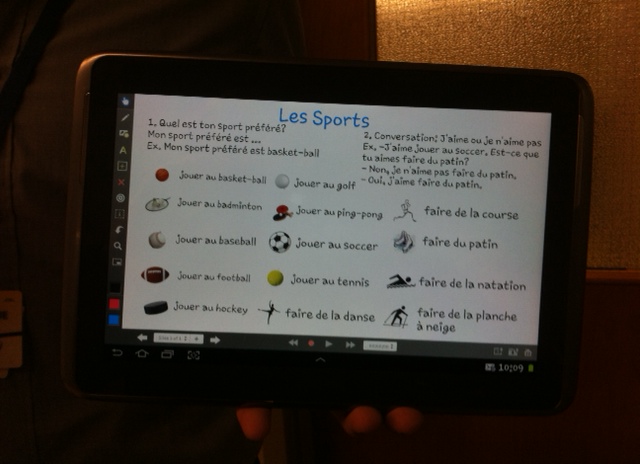
I (Cathy) find that one of the exciting aspects of teaching is learning from my students- especially about digital technology. One of my student teachers, Drake, taught a lesson last week using Explain Everything. With the aid of this app he successfully taught a lesson in French which enabled his grade 6 students to engage in conversations about sports. How he used the app was definitely key to the success of his lesson and I gave him full credit for cleverly scaffolding the sequence of the questions and answers so that that student conversations were set up for success. Yet, Drake insisted it was the app that enabled him to teach the lesson so clearly. Below are pictures of how Drake set up the lesson on his ipad and then mailed it to himself as a handout for his students. Well done Drake!
Intrigued, I began to play with this app myself. I discovered it has a wide range of applications. It feels like a cross between a power point and a smart board, but completely doable on an ipad. Very convenient. Below is an link to a you tube video that demonstrates how students can use the app in a classroom.
It seems to be the done thing these days to have a webpage about your research project.
In fact, I think it’s fair to say that it’s considered an increasingly essential part of research engagement and dissemination, and – really – it is so easy to set something up these days.
Right?
Well…yes and no. (Stay with me, I’m a humanities scholar and that’s how we answer everything)
I had a great chat recently with a researcher who was wanting to set up an online presence for his project. Part of the task of this presence was to recruit subjects for his PhD study.
It was a valuable conversation for him (or so he tells me…!) and also for me, because it clarified our perceptions of what was necessary, good, and ideal.
What I’m talking about in this post isn’t focused on what specific funding bodies…
In honour of author Margaret Atwood’s 75th birthday on November 18th CBC Books is celebrating her life and work with a week of special features including archival interviews, infographics, and a selection of passages from her acclaimed books in the searchable Essential Atwood Reading List. Follow link below:
They say a picture is worth a 1000 words. That is probably one of the reasons why Instagram has become my social media app of choice. I love the simplicity of it. There are no words, simply photos. You get to see what your friends, acquaintances, and public figures (you choose to follow) are up to. My use of facebook has slowly dwindled while my use of Instagram has quickly ramped up. This seems to be the general trend across the world. As educators in this digital age, we think about how to integrate social media effectively into the classroom. Facebook, wikis, blogs and twitter have made their way into many classrooms; however, Instagram is rarely used. I found this very cool infographic for educators and the use of Instagram in the classroom.
All of the below suggestions can be used in K-12 classrooms. Some can be used in higher ed. Contexts.
***Note: Before using Instagram in the classroom:
I think educators should have separate Instagram accounts if they are also using it for personal purposes.
Also, as a class you should establish a hashtag. So, if your students want to hashtag a relevant picture it gets included in the class hashtag.






 Literacy Teaching and Teacher Education