
He doesn’t receive much of an answer.
He doesn’t receive much of an answer.
Today is a holiday in Ontario and in several Canadian provinces: Family Day. A day to spend much needed time with family. Family Day comes at a good time since temperatures are beyond unbearable to many (me! ~ Yiola!) and the winter blahs bring a natural insistence to just take an extended break.
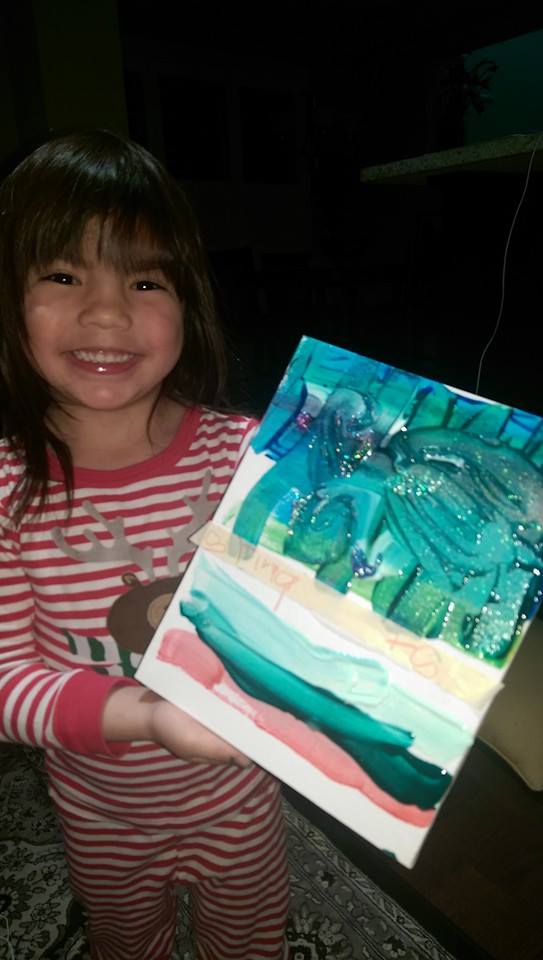
In honour of Family Day I would like to share a story about my family and how my Sylvia Clare (my four year old) is getting along in FDK. About one week ago, while at home Sylvia Clare decided to paint. This was not unusual as she often paints at home. What was new was her language and ideas about art and herself. She ushered me to the playroom, took the lead and began to explain that we were going to explore lines. Lines I thought? So Sylvia Clare understands an element of art? I sat in silence with what I imagine was a curious look on my face as she continued with confidence: “I’m an artist”. Those words screamed at me with sheer joy and power. I had never called Sylvia Clare an artist… it was not something I thought of doing, although of course in my heart and mind I believed my child was an artist and a scholar and an athlete and a….. ”
“Now mommy, you need to wear a smock so your clothes stay clean and roll up your sleeves. Please get the paints”.I followed her instructions. Next thing I saw was Sylvia Clare carefully dividing the canvas. She began at the bottom and drew careful lines across the canvas using primary colours. Then on the upper part of the canvas she created thick textured, almost bubble like “scribble” where she mixed the colours. The entire time she was talking about her art: “Here mommy I am painting straight lines with primary colours, you see? And up here (top of the canvas) I am trying to see what scribble is like and I added some sparkle”. She spent a lot of time working on her art and I sat and watched in amazement. Here are some pictures of Sylvia Clare from that day:


Days passed and I wondered how Sylvia Clare was able to develop such clear language about the arts and conceptually understand the elements and most importantly to see herself as an artist. And then, the FDK newsletter came home. The teachers shared the following in the newsletter:
The students have also been learning about a modern artist names Piet Mondrian from the Netherlands, who used primary coloured shapes and black lines to create famous pieces. They have used his method to create their own line designs. We have also experimented with bubble wrap. Some of the children are referring to themselves as “artists” now…
How one perceives oneself is often how one becomes. Sylvia Clare sees herself as an artist. She can talk about the arts and she confidently engages in art work. So, on Family Day today I am certain we will be back in the playroom painting and playing and reading and doing… and I am sure that I will be the one who will learn the most.
Happy Family Day!
I (Clare) have found Neil Selwyn’s writing about digital technology very helpful. In my  graduate course we watched a talk by Selwyn (at Monash university). My students and I discussed his perspective on the place of digital technology and the consensus was – his perspective is valuable and educators need to consider the questions he raises. His stance is so sensible and balanced because he asks us to consider issues around digital technology that are often not part of the conversation. The video is about 1 hour and it is so worth the time. Here is the link:
https://www.youtube.com/watch?v=0q6bk3RVD9k
Below are some of the notes I made from the video. As you can see he is asking us to think carefully and deeply about technology (and he is a real techie!) I know you will never think of technology in the same way after watching his talk.
Assumptions
– RHETORIC IS CRISIS TONE – easy to get carried away by rhetoric
Well, it’s Friday the 13th -a day I dread. Although I (Cathy) have never been a particularly superstitious person, I do believe in the law of averages. And I have been in three car accidents on Friday the 13th- never my fault! What has this got to do with keyboarding you might ask? Well, neck pain or whiplash (a common condition resulting from car accidents), is exacerbated by constantly using a laptop placed on the lap. Letting the head drop down towards the chest to view the keyboard, and letting it stay there for extended periods of time, worsens the condition. Sooo, to help myself heal from all the unlucky car accidents (and acquire a 21st century literacy skill ) I recently decided to learn to keyboard. I now have an external keyboard attached to my lap top and a large screen monitor on my desk. To view the screen I have to keep my head up, neck erect and hands somewhere down there on the keyboard. The goal, of course, is to not look down. Yikes! For those of you who are proficient at keyboarding, this might seem trite. But there was a time when you didn’t know how, so try to be empathetic.
About one week ago I finally managed to make the transition. My index fingers now automatically search out the little marker on the ‘j’ and ‘f’ keys so I know I am on the home row. (My own children found this fact hilarious as they had forgotten those keys were even marked. My husband , however is very impressed. He says its too hard to learn). Most importantly, I can now type without looking at the keys! But dear, oh dear, m y t y p i n g i s ss ooo ssss lll oooo wwww. (If you only knew how long it took me to type this blog post!)
Yet, I persist. Daily, I engage in a variety of speed tests and even play typing video games. (Yes, I can save the city from the aliens if I type the correct word fast enough). It’s actually quite fun. I am constantly searching the net for new typing courses. My two favourites so far are:
Learning to Type at http://www.learntyping.org/beginnertypinglesson3.htm
and
Typing for QWERTY at http://www.powertyping.com/qwerty/lessonsq.html
It’s amazing that effective courses like this are available on-line for free.
Now, if I coukd only type bti faster, but stll be acrate, i might be able to find more ocurses… Sigh. I wish I could just stay home today – not because it’s Friday the 13th- I just really want to practice my keyboarding!
I (Clare) a number of years ago started keeping an annotated list of books I have read. I  shared the list with my book club and then friends asked for it and on and on. I have continued to update my list. Here are the books I have read the last little while. Click here for the entire list. Books I have read You will notice that I really like murder mysteries but read almost all genres.
Feel free to share the title of a good book with me. Thanks. Happy Reading
February 2015
July 26, 2014
I watched an interesting Ted talk in which cognitive scientist and MIT researcher Deb Roy explains how he wired his house with video cameras to capture the rich details of his son’s language development. A complex motion analysis was applied to the 90,000 hours of video to map out how his son’s social interactions within different domains of the home informed his language development. Roy describes how the analysis revealed the scaffolding of language learning:
“Every time my son would learn a word, we would trace back and look at all of the language he heard that contained that word…And what we found was this curious phenomena, that caregiver speech would systematically dip to a minimum, making language as simple as possible, and then slowly ascend back up in complexity. And the amazing thing was that bounce, that dip, lined up almost precisely with when each word was born — word after word, systematically. So it appears that all three primary caregivers — myself, my wife and our nanny — were systematically and, I would think, subconsciously restructuring our language to meet him at the birth of a word and bring him gently into more complex language. And the implications of this — there are many, but one I just want to point out, is that there must be amazing feedback loops. Of course, my son is learning from his linguistic environment, but the environment is learning from him. That environment, people, are in these tight feedback loops and creating a kind of scaffolding.”
Link to the Ted Talk:
www.ted.com/talks/deb_roy_the_birth_of_a_word

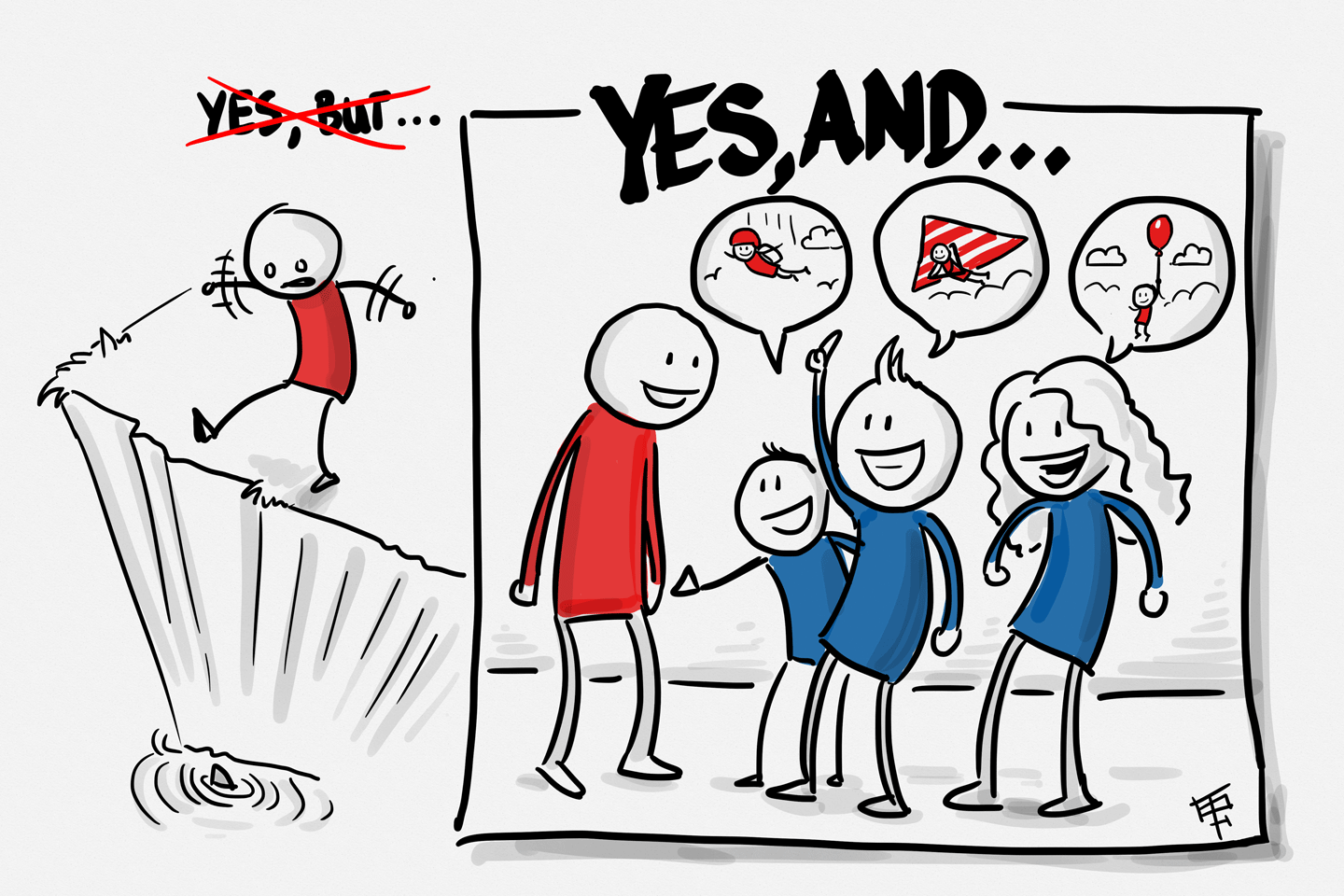
I’ve been to a few improv shows in my life, and whenever I walk away I am always in total awe of the performers. Their ability to think on their feet AND be funny while doing it is so impressive. That’s why when I came across the idea of using improv techniques in the classroom I was intrigued. Linda Flanagan from the blog Mindshift describes how the four pillars of improv(creativity, critical thinking, collaboration, and communication) are developed by following one simple rule: “Yes, and…” This means that any idea or suggestion is welcomed without judgment. This unconditional support helps improv students overcome fears and act without inhibition. It is no wonder why many educators are using tenets of improv in their classrooms.
Flanagan says:
Improv enthusiasts rave about its educational value. Not only does it hone communication and public speaking skills, it also stimulates fast thinking and engagement with ideas. On a deeper level, improv chips away at mental barriers that block creative thinking — that internal editor who crosses out every word before it appears on a page …
The article suggests both beginner and experienced improv activities for teachers of all levels to try. Read the link below to find out more:
Last week I (Yiola) tried something in my teacher education course that was less safe. I brought together divergent theorists, multiple contexts and eras and encouraged practicum connections in ways that are not typical. I was unsure of the outcome: would the student teachers understand? connect? appreciate? Just as I encourage our students teachers to take risk, I took a risk in hope new understandings, connections and realizations about teaching and learning would occur. At the end of class students applauded… when does that ever happen? The comments and reactions at the end of class indicate that students appreciated the class content and left class with much to think about.
I have recently re-read Dewey’s Education and Experience (1938) and was inspired to share the ideas with my class, namely what is miseducative practice? And how do traditional and progressive models of education play out in classrooms today? We discussed how both models are quite transparent in today’s classrooms. We also explored Dewey’s recommendation of a theory of education that is based on a philosophy of experience. Student teachers felt that the notion of experience is now more commonly understood and a desired practice in teaching. We discussed how finding a coherent theory of education based on a philosophy of experience would require transcending the notion of “either/or” traditional or progressive models and moving into integrative reasoning. So this is all quite typical… and then I introduced Delpit.
In Delpit’s work Other People’s Children (1988) Delpit described herself as “a product of skills-oriented approach to writing and a teacher of process oriented approaches”. Her amazing chapter, The Silenced Dialogue, illustrates Dewey’s request to have educators think deeply about the either/or debate between models of education and the implications of our practice on student learning. Delpit explains the following about her chapter, “My charge here is not to determine the best instructional methodology… Rather, I suggest that the differing perspectives on the debate over “skills” versus “process” approaches can lead to an understanding of the alienation and miscommunication, and thereby to an understanding of the “silenced dialogue”… this is precisely what Dewey asked of us fifty years prior, that as educators we must go deeper than thinking across methods; we must use a philosophy of experience to deepen our understanding of the best ways to teach children. For Delpit, the experiences are those of Children of colour and children who experience poverty.
Exploring Dewey’s concepts through the lens of power and Delpit’s context of literacy was remarkable. The process of grounding Dewey’s theories in Delpit’s work provided grounding for both scholars in ways that I wasn’t yet unprepared. Students were excited to talk about a philosophy of experience by looking as social context as a foreground for understanding models of education; for understanding why certain methods may work well and not well and how to move our practice forward so all students are not only learning but are successfully learning in ways that are empowering them.
The final layer of discussion in class was to connect the ideas to their own placements. To tell stories of methodological challenge and to explore how to address those challenges thinking about what Dewey suggests and what Delpit illustrates. Again, students were speaking in detail on the gaps and the glories in their classrooms and schools. The result of this class: discussion sophisticated and practices validated.
We finished the discussion by reading aloud the last paragraphs of Delpit’s chapter; as a reminder of the enormous but yet delightful task we have as teachers if we truly wish to create learning for all:
We must keep the perspective that people are experts in their own lives. There are certainly aspects of of the outs tide world of which they may not be aware, but they can be the only authentic chroniclers of their own experience. We must not be too quick to deny their interpretations or accuse them of “false consciousness”…And finally, we must be vulnerable enough to allow our world to turn upside down in order to allow the realities of others to edge themselves into our consciousness…

We in Toronto are having yet another snowstorm.
I (Clare) thought those of you living in our winter wonderland might enjoy this cartoon.
Hi, I (Cathy) am the new T&LC in CTL, working in FD at SC. Today I will be exploring ULD in the TLA. Yesterday I had a meeting with the BBAs from PSOB. I am now a member of OPSEU and CAAT. I look forward to working with FAST, FAAD, FAHCS, FHASS, and FCAPS.
Lost? Welcome to my world. Last month I started a new position in HE. I love the people, the work and the institution. What I am struggling with are the acronyms. OMG. If you think texting is bad, try starting a new position in a new institution. Everyone talks in code. During my first week as a new hire, I was given a cheat sheet of common internal and external acronyms to learn. I had my husband drill me on these so I could learn them right away and feel comfortable in meetings. Ah, no. I leave every meeting with a list I have composed that were not on my original list. Everyday I experience new discourses, practices and social norms. Enculturation is tiring. I feel as though I am living my research on new literacy practices. Yesterday an employee asked me what faculty I was in and I answered ” TLC” instead of “CTL” and he never even blinked. Was he just being polite or do we have a faculty called TLC? I wonder.
If you would like to know what my new position is and where I work now, just check the cheat sheet below. I’ll let you know in a month how I’m doing with my acronyms.
T&LC – Teaching and Learning Consultant CTL- Centre for Teaching and Learning FD- Faculty Development SC- Sheridan College ULD-Universal Learning Design TLA – Teaching and Learning Academy . BBA-Bachelor of Business Administration PSOB- Pilon School of Business OPSEU- Ontario Public Service Employees Union CAAT-Colleges of Applied Arts and Technology FAST – Faculty of Applied Science and Technology FAAD- Faculty of Animation, Arts and Design FAHCS- Faculty of Health and Community Services FHASS – Faculty of Humanities and Sciences FCAPS- Faculty of Continuing and Part Time Studies
 Literacy Teaching and Teacher Education