Monthly Archives: April 2016

Photo Journal of my Experience @ AERA

Here are some snapshots and highlights of my experience at AERA this year. If I (yiola) could name the experience I would call it:  Goosebumps and Inspirations… it was just that good.

  1.  I attended a Round Table session (this is where presenters gather at a “round table” and share their research). The Round table is a great opportunity to not only share your work but hear from others in a less formal manner.  This round table was hosted by the  Writing and Literacies special interest group (SIG) and the focus of the round table was critical literacy.  Dr. Barbara Comber from the University of South Australia presented on critical literacy pedagogy in the early years. Her work and my work are closely aligned.

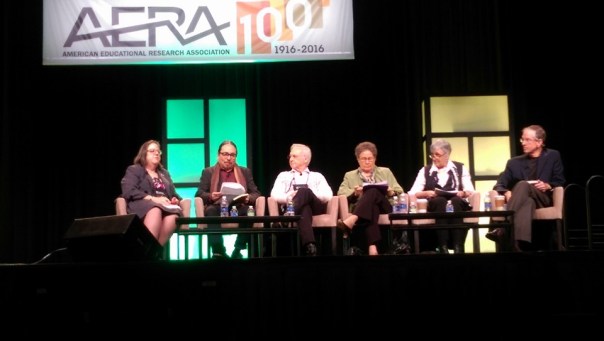
2.I attended a presidential talk that was a tribute to the life and work of Dr. Phil Jackson. The focus of the talk was on the question of education.  I really like what this panel did: each panel member selected a passage from a text written by Dr. Jackson and talked about its significance to them. A paragraph was read from The Practice of Teaching and the idea of transformative teaching… such an important and central idea in progressive education. A piece was read from Handbook of Research on Curriculum: Conceptions of Curriculum and the the idea that school is systematically harming children… and how can we work against that?  Linda Darling-Hammond read a passage from his famous book Life in Classrooms and spoke of the “multi-dimensionality and simultaneously nature of teaching” and the essential relationships associated with teaching. And, one panel member shared from Dr. Jackson’s last book published in 2012, What is Education and spoke of education as pure and simple; something we must rededicate ourselves too over time.
13001211_10156947381755121_1868962252431060235_n

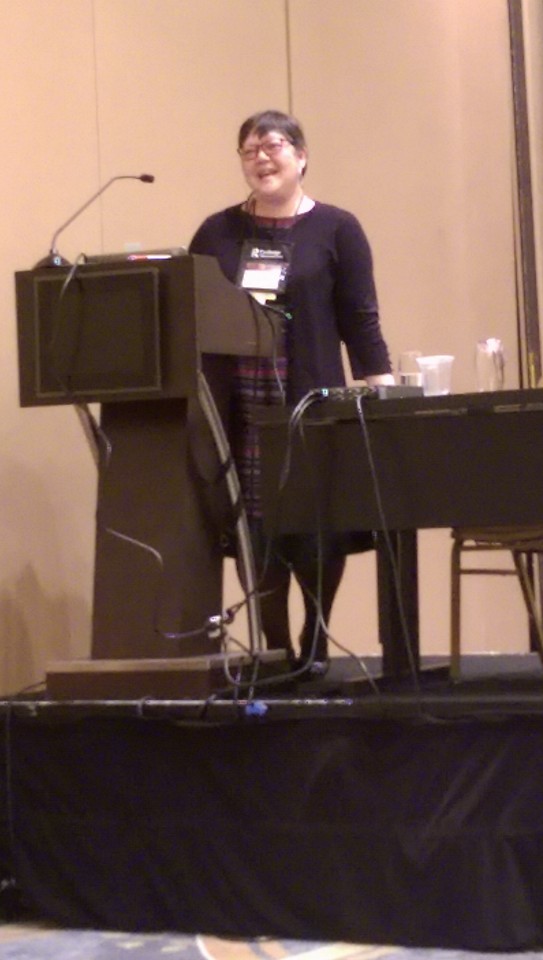
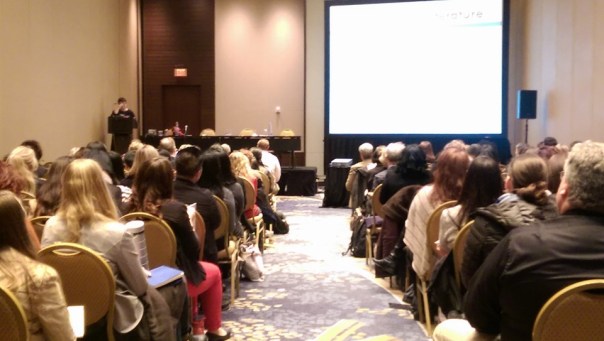
3. I was very fortunate to have the opportunity to listen to the presidential lecture  for Division K hosted by Dr. Lin Goodwin, Teachers College Columbia University.  A remarkable speaker who not only inspires with her words but truly challenged me to think about what quality teacher education requires. What I like most about Dr. Goodwin is her genuine nature. A distinguished academic and also a beautiful human being. Here are some pictures from her talk including slides from her presentation.
12998610_10156947381220121_6198746793740451746_n

13015255_10156947381525121_6392246007407300412_n13043368_10156947381450121_231103480067251929_n12994363_10156947381300121_7467634140817060326_n13012864_10156947381375121_7210803705214951729_n

4. Yet another interesting Presidential session with Wayne Au, Marilyn Cochran-Smith, Kevin Kumashiro (and others) that explored policy and standards in Teacher Education. Laden with some controversial findings for the testing systems for new teachers and teacher education programs, the presentations were provocative and interesting:

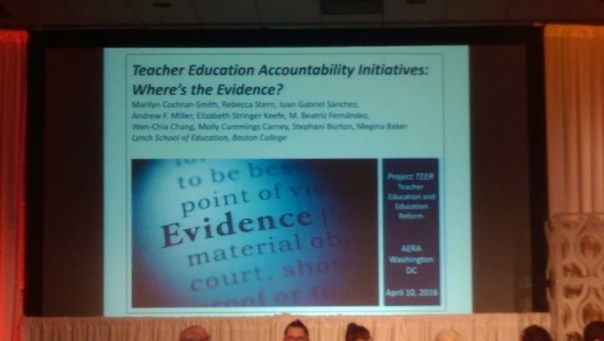
13055504_10156947381160121_3248944785834068614_n13012858_10156947381050121_2214069562201491393_n

5. The last session I would like to share is one where we presented at the Constructivist SIG. A lovely group of people from across North America, we exchanged ideas of what it means to teach in constructivist ways. Our team leader Dr. Clare Kosnik presented work from the Literacy Teacher Education research and presented on a group of literacy teacher educators who had strong constructivist pedagogies.

Finally, AERA is held at such interesting places. One has to take some time to enjoy the beauty of the district and take in some of the sights.

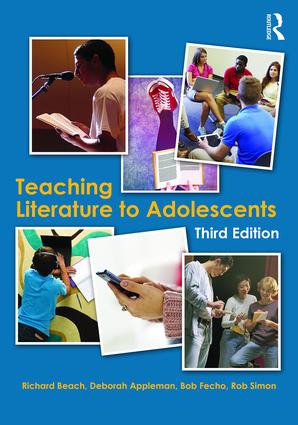
HOT off the press: Teaching Literature to Adolescents

My good friend Rob Simon is one of the co-authors of the third edition of Teaching 9781138891241Literature to Adolescents. Co-authored with Richard Beach, Deborah Appleman, and Bob Fecho this is an amazing new text. As a professor of literacy methods courses I (Clare) am always on the lookout for texts that go beyond the typical plodding through various topics. This text appealed to me because it emphasizes a critical approach to reading and interpreting text. The aim is to engage students with authentic issues. Well done Rob and your fellow authors. This text will be a staple on my bookshelf. Here is the link to the Routledge site: https://www.routledge.com/products/9781138891241

Below is a summary of the book.

This popular textbook introduces prospective and practicing English teachers to current methods of teaching literature in middle and high school classrooms. It underscores the value of providing students with a range of different critical approaches and tools for interpreting texts and the need to organize literature instruction around topics and issues of interest to them. Throughout the textbook, readers are encouraged to raise and explore inquiry-based questions in response to authentic dilemmas and issues they face in the critical literature classroom. New in this edition, the text shows how these approaches to fostering responses to literature also work as rich tools to address the Common Core English Language Arts Standards.

Each chapter is organized around specific questions that English educators often hear in working with pre-service teachers. Suggested pedagogical methods are modelled by inviting readers to interact with the book through critical-inquiry methods for responding to texts. Readers are engaged in considering authentic dilemmas and issues facing literature teachers through inquiry-based responses to authentic case narratives. A Companion Website [http://teachingliterature.pbworks.com] provides resources and enrichment activities, inviting teachers to consider important issues in the context of their current or future classrooms.


Social Justice Study at AREA

I was once again thrilled to attend the AERA conference this past week.  It is such a remarkable opportunity- so many knowledgeable and committed educators from around the world.  Quite inspiring.  At the conference this year, one consistent theme emerged in the sessions I attended: Know your students. One particular study in a session entitled Preparing Preservice Teachers to Teach for Social Justice, resonated with me quite profoundly.  The study was called Candidate Change in a Community -Engaged Teacher Education Program and was led by Patricia Clarke from Ball State University.  Patricia maintained, ” a good teacher must understand the context in which a child lives grows and learns.”

Her team conducted a study which examined: preservice teacher candidates’ attitudes towards diversity and community, and how they changed over the course of a semester-long community-engaged experience. As teacher candidates came to know the community in which they were working, their expressed attitudes and beliefs changed from explicit statements of bias and stereotype to ones that sought community involvement and social action. 

This teacher education program at Ball University emphasized community involvement by holding classes in local community centers (as opposed to the university).  Student teachers also attended the local church on Sundays to be part of the community gatherings.  The teacher educators arranged for “community ambassadors” to welcome the student teachers to their neighborhood and guide the student teachers throughout their weeks in the school.  The results were remarkable.  The student teachers moved from “being nervous” and “afraid” in the neighborhood to feeling like a community member.

Patricia closed her session with a sweet anecdote shared by one of her student teachers, which I will share with you here. The student teacher was working in a class of grade two students and asked the children to share the markers.  She handed the basket of markers to the child beside her who seemed a bit confused.  Remembering what she had experienced the previous Sunday when she  attended the community church with the children, she said, “pass the basket like you do at church.” The child nodded, and said “Hallelujah!”  all the of the children immediately responded with “Praise be the Lord!” and they promptly passed the basket of markers around the circle. The student teacher was somewhat surprised by the response, but because of her inclusion in the community completely understood why the children responded they way they did.  She smiled, nodded, and continued on with the lesson.

basket

The commitment of the teacher educators in this program was outstanding and quite inspirational.  I sincerely hope teacher education programs worldwide can learn from not only this study, but the model of teacher education Ball University has implemented.

Understanding the communities our students are from

I (Pooja) have just returned from AERA 2016. I always leave AERA feeling inspired to continue my research and motivated to get back into the classroom. This year was no different. This year I learned about the work of Dr. Christopher Emdin, a recipient of the Early Career Award at AERA 2016. Dr. Emdin’s work considers  the relationships between Hip-Hop, urban education, and science education. Curious to learn more I about his work, I ordered his latest book entitled For White Folks Who Teach in the Hood… And the Rest of Y’All Too (2016).

An article in NPR reviewing Emdin’s book highlights some of Emdin’s main arguments he makes. His arguments are completely in line with what my own research (literacy teacher educators with a critical stance) has found: in order to effectively teach, we must understand the communities from which our students come. Below is an excerpt from the article outlining Emdin’s arguments along with some examples of practice:

  1. Teachers can’t be colorblind. It does their students a disservice.

“People who perceive themselves to be colorblind often times have biases that are hidden by their colorblindness,” Emdin says. Young people in urban spaces have different linguistic and cultural realities, like the gun shots that Emdin experienced.

If teachers recognize that difference, they can help their students deal with issues such as PTSD. If the trauma of their day-to-day life goes untreated, students won’t be able to learn effectively.

But, if they heal, “then they can learn. And if they can learn, then they can be successful.”

2. Urban schools tend to be authoritarian places, which doesn’t help kids heal or learn.

If it wouldn’t be acceptable in a white, suburban school, Emdin says, it shouldn’t be acceptable in an urban classroom.

That goes for metal detectors, searches, zero tolerance policies and bars on their classroom windows. “Those things don’t happen in places where students are from a higher socioeconomic status and are not overwhelmingly black and brown.”

Emdin acknowledges that it can be hard to avoid falling into this kind of teaching. He even found himself slipping into authoritarian teaching methods, a fact which, he says, only proves that these techniques have become deeply ingrained in certain school systems.

But he says we only need to look at the statistics — college completion rates or the increased need for remedial learning — to understand that this military approach to teaching isn’t working.

3. Schools need to celebrate students and their talents, even if those talents aren’t familiar.

In his book, Emdin lays out some of the ways that teachers can rethink their classrooms without spending money.

They can create a sense of community by eating with their students, making up a school handshake and bringing in community members — including people who have not graduated from high school — as liaisons.

Emdin also suggests that teachers go to churches and barbershops, both to better understand the community and to learn teaching strategies from the people their students admire.

And teaching should not be seen as a tug-of-war between enjoyment and hard work.

Emdin, for example, folds hip-hop into the curriculum. He has worked with GZA, a rapper from the Wu-Tang Clan, to host a science hip-hop battle for New York City high school students.

“If you give young people the opportunity to be able to express their academic brilliance on their own terms, they take the initiative to study,” he says. “They take the initiative to research, and they perform and they showcase that they’re brilliant.”

Read NPR article here: http://www.npr.org/sections/ed/2016/04/10/473500018/want-to-teach-in-urban-schools-get-to-know-the-neighborhood

Arriving in Washington DC

AERA_Logo

I (Cathy) am delighted to be arriving in Washington D.C. today to attend the American Educational Research Association Conference.  I will be presenting a paper entitled, Examining the Influences: Literacy Teacher Educators who us a Multiliteracies Approach. This study is a subset of a larger study on which I have been a researcher.  I examined 7 participants who demonstrated a proclivity toward multilitercies.  As I used a grounded theory approach (which does not begin the research with a hypothesis) I was  both intrigued and surprised by the findings.   Hope you can join me on Monday, April 11, 11:45am to 1:15pm, at the Marriott Marquis, Level Three, Mount Vernon Square.

Abstract:

According to Dewey (1974) “[e]ducation, experience, and life are inextricably intertwined”.  This study examined how early life experiences and other influences affected the practices of 7 literacy teacher educators (LTEs) who currently enact a multiliteracies approach.  Early childhood experiences, mentors along their journey, personal and professional turning points, and developing notions of literacy were explored.  Three findings (a) an innate love of language/literature, (b) inspiring mentorship, and (c) a unique set of dispositional qualities were significant contributing factors to these literacy teacher educators adopting a multiliteracies approach. The participants for this study were a subset from a large-scale study entitled, Literacy Teacher Educators: Their Backgrounds, Visions, and Practices which examines the lives of teacher educators from four countries:  Canada, the USA, England and Australia.   

Hope you can join me!

http://www.aera.net/EventsMeetings/tabid/10063/Default.aspx


Preparing for AERA

I (yiola) along with the research team and many other colleagues are preparing for the American Educational Research Association (AERA) conference that will be held in Washington DC this year. The conference begins on Thursday April 7th until Tuesday April 12th.

An enormous conference that attracts thousands of educational researchers from around the world and across disciplines and methodologies in the area of education. Each year the conference has a theme. This year the theme is Public scholarship to educate diverse democracies.  Here is a link to the site and more information about the conference:

http://www.aera.net/EventsMeetings/AnnualMeeting/2016AnnualMeetingTheme/tabid/15861/Default.aspx

The team and our close colleagues will be presenting at AERA.  We will be sure to post pictures and updates from the various sessions we attend. We hope to see you there. If you are not attending this year be sure to check out out blog for highlights next week.


Nell Duke: 10 Things Every Literacy Educator Should Know About Research

In my (Clare) graduate literacy course last night we talked about Nell Duke’s excellent Library book shelvesarticle: 10 Things Every Literacy Educator Should Know About Research. This is a highly informative article because Duke systematically addresses key questions about research – often questions that are not posed because the instant the word “research” is attached to a statement it seems to have more weight. She begins the article: Research-based,” “research-proven,” “scientifically based”—in the reading world these days, it seems that the term research is being used everywhere. it is also being misused and misunderstood.

My graduate students found the article very accessible and enlightening. Many said they will look at “research claims” more closely. It is well worth the read. Here is a link to article which was published in Reading Teacher. 10_things_to_know_about_research_duke_trtr1002

Duke addresses the following questions.

  1. what research can do.
  2. what research is.
  3. what research is not.
  4. the difference between research-based and research-tested.
  5. Many kinds of research have valuable contributions to make to our understanding of literacy learning, development, and education.
  6. different kinds of research are good for different questions.
  7. high-quality research has a logic of inquiry.
  8. conclusions drawn from research are only as sound as the research itself.
  9. where and how research is published or presented requires particular attention.
  10. educational research proceeds through the slow accumulationof knowledge.