All posts by Dr. Cathy Miyata

Unknown's avatar

About Dr. Cathy Miyata

Cathy Miyata is a professor at Wilfrid Laurier University. She is also an acclaimed storyteller and writer. She has performed and lectured in Serbia, Japan, Malaysia, Germany, Greece, Portugal, Sweden, Mexico, the United States, Egypt, and across Canada

Learning to Keyboard

Well, it’s Friday the 13th -a day I dread.  Although I (Cathy)  have never been a particularly superstitious person, I do believe in the law of averages.  And I have been  in three car accidents on Friday the 13th- never my fault!  What has this got to do with keyboarding you might ask?  Well, neck pain or whiplash (a common  condition resulting from car accidents), is exacerbated by constantly using a laptop placed on the lap.  Letting the head drop down towards the chest to view the keyboard, and letting it stay there for extended periods of time, worsens the condition.   Sooo, to help myself heal from all the unlucky car accidents (and acquire a 21st  century literacy skill ) I recently decided to learn to keyboard.  I now have an external keyboard attached to my lap top and a large screen monitor on my desk.  To view the screen I have to  keep my head up, neck erect and hands somewhere down there on the keyboard.   The goal, of course, is to not look down.  Yikes!  For those of you who are proficient at keyboarding, this might seem trite.  But there was a time when you didn’t know how, so try to be empathetic.

About one week ago I finally managed to make the transition.  My index fingers now automatically search out the little marker on the ‘j’ and ‘f’ keys so I know I am on the home row.  (My own children found this fact hilarious as they had forgotten those keys were even marked.  My husband , however is very impressed.  He says its too hard to learn).  Most importantly, I can now type without looking at the keys!  But dear, oh dear, m y    t y   p  i  n  g  i s ss ooo   ssss lll oooo wwww.  (If you only knew how long it took me to type this blog post!)

Yet, I persist.  Daily, I engage in a variety of  speed tests and even play typing video games.  (Yes, I can save the city from the aliens if I  type the correct word fast enough).  It’s actually quite fun.  I am constantly searching the net for new typing courses. My two favourites so far are:

Learning to Type at  http://www.learntyping.org/beginnertypinglesson3.htm

and

Typing for QWERTY   at  http://www.powertyping.com/qwerty/lessonsq.html

It’s amazing that effective courses like this are available on-line for free.

Now, if I coukd only type  bti faster, but stll be acrate, i might be able to find more ocurses… Sigh.  I wish I could just stay home today – not because it’s Friday the 13th-  I just really want to practice my keyboarding!


Buried in Acronyms

Hi, I (Cathy) am the new T&LC in CTL, working in FD at SC.  Today I will be exploring ULD in the TLA.  Yesterday I had a meeting with the BBAs from PSOB.   I am now a member of OPSEU and CAAT.  I look forward to working with FAST, FAAD, FAHCS, FHASS, and FCAPS.

Lost?  Welcome to my world.  Last month I started  a new position in HE.  I love the people, the work and the institution.  What I am struggling with are the acronyms.  OMG.  If you think texting is bad, try starting a new position in a new institution.  Everyone talks in code.  During my first week as a new hire, I was given a cheat sheet of common internal and external acronyms to learn.  I had my husband drill me on these so I could learn them right away and feel comfortable in meetings.  Ah, no.  I leave every meeting with a list I have composed that were not on my original list.  Everyday I experience new discourses, practices and social norms.  Enculturation is tiring.  I feel as though I am living my research on new literacy practices.  Yesterday an employee asked me what faculty I was in and I answered ” TLC” instead of  “CTL” and he never even blinked.  Was he just being polite or do we have a faculty called TLC?  I wonder.

If you would like to know what my new position is and where I work now, just check the cheat sheet below.   I’ll let you know in a month how I’m doing with my acronyms.

T&LC – Teaching and Learning Consultant                                                                                                       CTL- Centre for Teaching and Learning                                                                                                           FD- Faculty Development                                                                                                                                      SC- Sheridan College                                                                                                                                              ULD-Universal Learning Design                                                                                                                            TLA – Teaching and Learning Academy                                                                                                .  BBA-Bachelor of Business Administration                                                                                                      PSOB- Pilon School of Business                                                                                                                       OPSEU- Ontario Public Service Employees Union                                                                                       CAAT-Colleges of Applied Arts and Technology                                                                                             FAST – Faculty of Applied Science and Technology                                                                                   FAAD- Faculty of Animation, Arts and Design                                                                                           FAHCS- Faculty of Health and Community Services                                                                                 FHASS – Faculty of Humanities and Sciences                                                                                               FCAPS- Faculty of Continuing and Part Time Studies

Phoning vs Texting

I (Cathy) really like texting.  The post Clare shared with us last week entitled Texting is Killing Language really rang true for me.  It is a wonderful tool of communication.  My own children will text me regularly in lieu of using the phone.  Usually it’s fun, definitely like passing a note in class.  However, it also has its limits.  When should someone use a phone instead of a text message?    Following is a texting conversation between myself and my son while I was away on vacation…

in emerg

Y?

anorism?

CALL ME

Interesting how the  simplistic message spoke volumes and was loaded with emotion, yes? I have been told repeatedly not to use CAPS, because it is the equivalent of shouting.  In this incident I felt perfectly justified.

This incident reminded me of Hemmingway’s six word novel:

Baby shoes

For sale

Never worn

We can say sooo much with so little and texting is the perfect tool for this- within limits

Btw, number one son is fine.  Wasn’t an aneurysm- thank goodness.  But, I nearly had a heart attack while waiting for the call.  Sometimes, texting just isn’t enough, at least not for this mom.

Creating an Audit Trail

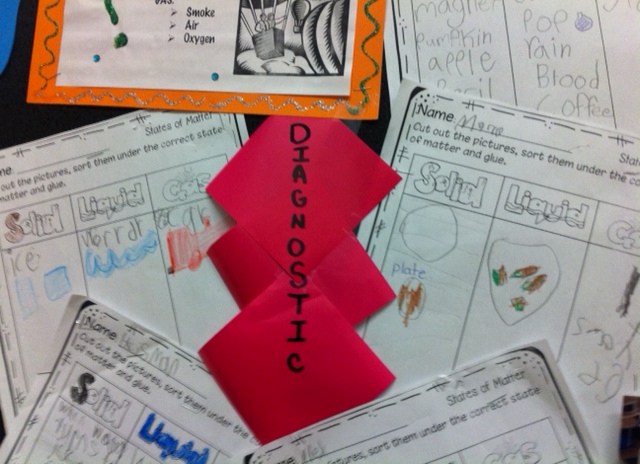
During one of my final practicum visits, I (Cathy) was excited to see one of my student teachers had created an audit trail.   When I mentioned this to her, she replied, “I thought  it was just a bulletin board.” But it was far more than ‘just a bulletin board’.   The student work Melissa had beautifully displayed represented an entire science unit of learning from pre-diagnosis to final summaries.

Audit trails were popularized by Dr. Vivian Vasquez, in her ground breaking critical literacy work with 3-5 year olds.  Vasquez says,                                                                                                             An audit trail or learning wall, as my three to five year old students called it, is a public display of artifacts gathered together by a teacher and their students that represents their thinking about different issues and topics.  This strategy is useful for creating spaces for students to re-visit, reread, analyze, and re-imagine various topics or issues. It is also a powerful tool for connecting past projects or areas of study to newer projects or areas of study. Further, it can be used as a tool for building curriculum as it visibly lays out the journey of the group’s thinking and learning over a period of time.

http://hwcdn.libsyn.com/p/c/f/3/cf355fe54466c4e0/Audit_Trail.pdf?c_id=4270455&expiration=1418946485&hwt=2cc91c9a05310c5ca082ae4a61c9c725

more walldiagnostic molecules

Encouraging Inquiry at an Early Age

I (Cathy) was inspired by the posting below of a young girl’s science experiment.  It actually made  make me rethink purchasing organic foods.  From an educator’s point of view,  it also demonstrated how significant inquiry, experimentation and science literacies are, and the impact they can have, especially when conducted at an early age.  While watching the video, I wondered if the process of doing this experiment will influence this young girl’s future educational leanings.  I had the pleasure of visiting my own daughter recently and was awed as I watched her conduct experiments with bacteria in her lab.  She became a biomedical researcher and is published in medical journals all over the world.  Science is her life now, and it all started with simple biology experiments in high school.

Sarah


Who knows what we inspire in children by encouraging them to build inquiries and conduct purposeful experiments.  The young girl in the following video may well be in the same position as my daughter some day.

http://www.spiritscienceandmetaphysics.com/this-little-girls-experiment-will-change-the-way-you-think-about-food/


Inspiration from Pinterest

I (Cathy) find one of the most popular social media sites used by my student teachers is Pinterest.  They rave about the interesting and engaging ideas they find on the site for lessons.  I saw evidence of this just recently while visiting a school.   My student teacher, Melissa, had found a writing exercise on the site entitled, If I Was  Trapped in a Snow Globe.  It involved the students creating a snow globe scene inside of a white plastic container and then describing the adventure in writing.   The associate teacher was so excited by the results, she lead me into the hallway to see what  her young students had accomplished.  The associate declared, “This student never writes anything, but look at this!  Two pages!  They loved this writing assignment.”

Often, good writing results by students are the results of a good inspirational ideas. Luckily educators have many more resources to access now, due to social media.  I highly recommend Pinterest for many ideas in variety of subjects.

http://primarypunch.blogspot.ca/2013/01/thank-you-pinterest.html

globesstory

Teaching with a Sense of Humour

The What is Education?  blog for teachers states that having  a sense of humor is, 

 very useful in creating a classroom climate and the development of learning processes that are more healthy and enjoyable. In fact, Melissa Kelly said that a sense of humor is one of the keys to being a successful teacher. According to Melissa, teachers’ sense of humor can relieve tension in the air and can prevent the onset of disruptive student behavior in the classroom, and can be used as a way to attract the attention of students in the class. And most importantly, with its sense of humor, a teacher would show that he/she is a person who has a personality and mental health, to enjoy life, and be able to live a normal life without the stress of his/her career.

http://what-education.blogspot.ca/2013/06/the-importance-of-teachers-using-humor.html

I (Cathy) was delighted to see one of my student teachers, Carolyn,  using her sense of humor throughout her literacy lesson. Her grade one and two students found her quite amusing and would joke along with her.  Sometimes her humor was self-depricating, and sometimes it was as innocent as, “Who me?  I would never do that!”  It was never sarcastic and always made her students smile.  She even used it as a classroom management technique to keep the students focused and engaged.  When I asked her about  her technique, she said it made teaching and leaning more enjoyable.  Then she described an art lesson she had just taught using candle wax and water colours.  She drew a picture on the white paper using a white candle, so it was not visible.  While introducing the lesson she held up the paper and kept telling the students how proud she was of her picture.  When the students kept insisting there was nothing there, she applied the water colours and, of course, the picture magically appeared.  The humor came to play when she allowed each student to play the same joke on her as they created their pictures.  All of the magic pictures were displayed proudly in the hallway of the school.  Carolyn said the students still refer to it and giggle.

I think having a sense of humor is an asset.   We all definitely need to laugh more, especially in our schools.  Carolyn

Texting at the Table

Below is a link to a vignette that  really struck a chord with me (Cathy).  There is a lot to learn about the etiquette of texting.  According to Maralee McKee, “out attention is a gift.”

McKee also says,

Our full attention is the foundation of every kindhearted, other-centered interaction. Texting alters the continuity, focus, and momentum of our encounters.

It produces anxiety (mild to severe) in the other person, and whether they’re telling you (or even aware of it themselves) or not, they’re attention is apt to desire to focus on someone who pays them back equally.

These are big matters.

If we’re not being careful, texting can hurt our family, our friendships, our business relationships, even our ability to govern.

http://www.mannersmentor.com/only-at-work/seven-ways-to-text-with-graciousness-and-savvy

In the vignette a father makes his point to his sons the ‘old fashaoined way’.  Enjoy.

http://faithtap.com/2114/dad-asks-pass-the-salt-while-sons-text/


Explaining Explain Everything (App)

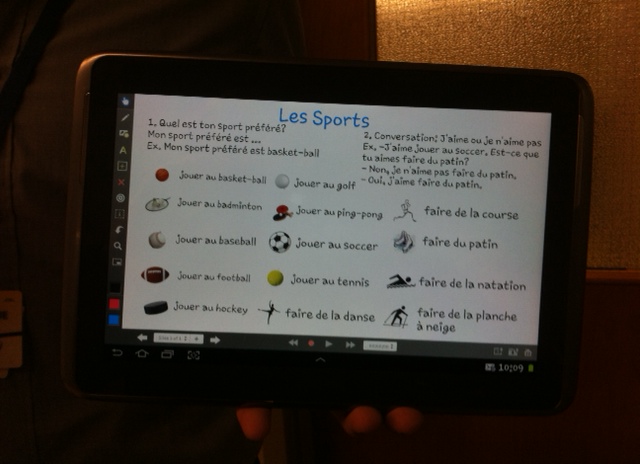
I (Cathy) find that one of the exciting aspects of teaching is learning from my students- especially about digital technology.    One of my student teachers, Drake, taught a lesson last week using Explain Everything.  With the aid of this app he successfully taught  a lesson in French which enabled his grade 6 students to engage in conversations about sports.  How he used the app was definitely key to the success of his lesson and I gave him full credit for cleverly scaffolding the sequence of the questions and answers so that that student conversations were set up for success.  Yet, Drake insisted it was the app that enabled him to teach the lesson so clearly.  Below are pictures of how Drake set up the lesson on his ipad and then mailed it to himself as a handout for his students.  Well done Drake!

Drakeipad

Intrigued, I began to play with this app myself.  I discovered it has a wide range of  applications. It feels like a cross between a power point and a smart board, but completely doable on an ipad.   Very convenient.  Below is an link to a you tube video that demonstrates how students can use the app in a classroom.


Engaging Students in Math

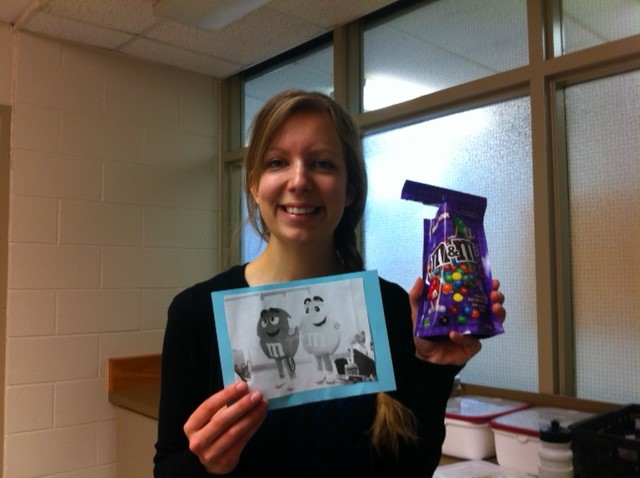
The day after Halloween, one of my (Cathy’s) student teachers, Megan, presented a wonderful lesson to a group of grade four students on probability.  She opened the lesson with a picture of herself dressed as an M&M.  (This was not really her of course, but the students didn’t know that).  She told the story of how she disguised herself as an M&M and went out trick or treating.  One nice lady gave her a whole bag of M&Ms because of her great costume.  Megan wondered aloud on the probability of pulling out red M&Ms as opposed to green M&Ms or yellow ones.  This student teacher had these children with the picture, but the M&Ms clenched it.  All of the students wanted to predict.   The students moved from large group work to small groups to independent work with ease.  Interestingly, Megan did not allow the children to eat the M&Ms.  They were data.  The children accepted this fact and made no protest.  The math remained the focus throughout the lesson.  The lesson was an absolute delight to watch.   Trouble is, I may never eat M&Ms the same way again.  I will always be calculating the probabilities of pulling that red one.

photo