All posts by poojadharamshi

Happy Canada Day!

Tomorrow Canada turns 148 years old! We are a relatively young country but have plenty to be proud of. Below are some super interesting facts about Canada (as of 2013). Wishing all my fellow Canadians a relaxing, FUN, and warm Canada Day!

50-insane-facts-about-canada-infographic_52050620a6ce4

Source: http://www.huffingtonpost.ca/2013/08/13/insane-facts-canada-infographic_n_3748965.html

“Tech isn’t a shortcut”

Source: http://blog.markitx.com/2012/08/13/ipads-in-the-classroom-and-their-continued-growth/

An article in Time Magazine makes an interesting case for why iPads should be left out of the classroom. Author Jervey Tervalon from Los Angeles argues that his school district (and perhaps several others) after spending millions “saw the iPad as a magic talisman that could just about transplant knowledge into students’ brains directly, bypassing teachers.” Through classroom teaching experience, Tervalon understands that “teaching isn’t always efficient. Often it’s messy, and because it’s messy, the process can produce epiphanies, and sparks of creative thinking.”

Tervalon warns that technology isn’t a shortcut to major educational reforms:

“An iPad is an amazing device but it isn’t so amazing without content or the right pedagogical context. School reform isn’t expensive tech and high-stakes testing; it’s the incredibly difficult task of creating highly functioning, transformative educational communities.

Link to the article: http://time.com/3926875/ipad-use-classroom/

Creating “Legible” Cities

In preparing for the 2015 PanAm games, Toronto is installing new signage to make the city an easier place to navigate. A wayfinding approach is being used which is defined on Wikipedia as: “ the ways in which people and animals orient themselves in physical space and navigate from place to place.” In addition to traditional maps, the wayfinding strategy uses multimodal approaches to make a city more “legible.” Landmarks, new media, public art, and street furniture are examples of ways the wayfinding strategy uses multimodalities. The project is currently being piloted in 21 locations around the Toronto.

Below are examples of Wayfinding signage in cities:

Interactive signage up currently up in Toronto, Canada
publicfurniture
Wayfinding public furniture in a London, U.K. shopping centre.

Brent Raymond, a partner at the design firm responsible for the new signage, commented on in the Globe and Mail on the wayfinding approach:

“It isn’t just about signs. It’s about helping people navigate space. The best examples are always places like airports. People who aren’t familiar with a place at all, they need to be able to find information quickly and feel confident about their environment.”

Read more about this approach to city living here:

http://www.theglobeandmail.com/news/toronto/new-signage-about-to-make-navigating-toronto-on-foot-a-whole-lot-easier/article24951383/

http://www1.toronto.ca/wps/portal/contentonly?vgnextoid=8057524d63f02410VgnVCM10000071d60f89RCRD&vgnextchannel=d90d4074781e1410VgnVCM10000071d60f89RCRD

Teacher Image in the U.K.

uk

Gillian Harvey from The Telegraph argues for a shift in how teachers are viewed in the U.K. She argues:“[r]ather than heaping initiative upon initiative or effecting more change on a curriculum that is altered almost before it can be implemented, it would be better to take measures to improve the image of the profession as a whole.”

Harvey claims teachers fall victim to a culture of blame in education. Teachers are blamed for many things ranging from unprepared youth for the work force to a failure to raise standards. However, Harvey points out that the government officials often receive credit for perceived successes in education. She comments: “[y]ou can rest assured that the moment improvements happen, the praise will be placed at the doors of Nicky Morgan and David Cameron.”

In an era of educational reform driven by data, teachers are feeling pressure to do what it takes to have the data reflect their “effective” teaching. However, as result, pupils in the classroom may be suffering. Harvey says, “teachers are spending more and more time on meaningless bureaucracy and less on teaching and learning or interacting with pupils.”

An interesting read! To read the entire article click here: http://www.telegraph.co.uk/education/educationopinion/11645808/Does-teaching-have-an-image-problem.html

Digital Technology Tools for the Classroom

Popular educational website Mindshift compiled a list of useful technology tools for the classroom. I have heard/used a few of the tools identified, however most are new to me. The article describes how these tools can be useful for social studies classrooms, but I think most tools can be used across a variety of subjects.

Below are a few I am most interested in exploring:

Screen Shot 2015-06-01 at 6.58.59 PM

Screen Shot 2015-06-01 at 6.59.08 PM

Screen Shot 2015-06-01 at 6.59.25 PM

Screen Shot 2015-06-01 at 7.01.16 PM

Read entire article here: http://ww2.kqed.org/mindshift/2015/05/21/favorite-tech-tools-for-social-studies-classes/

High Levels of Stress, Low Levels of Autonomy

The Washington Post recently reported on a survey conducted by the American Federation of Teachers (AFT) of approximately 30,000 teachers. Survey results reported teachers felt high levels of stress and low levels of autonomy. The rise of government initiatives such as the Common Core Standards were identified as a source of stress for teachers. The article reported: “Teachers said they feel particularly anxious about having to carry out a steady stream of new initiatives — such as implementing curricula and testing related to the Common Core State Standards — without being given adequate training, according to the survey. “

help

The AFT website reports some key findings from the survey:

  • Only 1 in 5 educators feel respected by government officials or the media.
  • Only 14% strongly agree with the statement that they trust their administrator or supervisor.
  • More than 75 % say they do not have enough staff to get the work done.
  • 78% percent say they are often physically and emotionally exhausted at the end of the day.
  • 87% percent say the demands of their job are at least sometimes interfering with their family life.
  • Among the greatest workplace stressors were the adoption of new initiatives without proper training or professional development, mandated curriculum and standardized tests.

Randi Weingarten, president of the AFT, noted stress could be a result of teachers wearing multiple hats in the classroom:

“We ask teachers to be a combination of Albert Einstein, Mother Theresa, Martin Luther King Jr….We ask them to be Mom and Dad and impart tough love but also be a shoulder to lean on. And when they don’t do these things, we blame them for not being saviors of the world. What is the effect? The effect has been teachers are in­cred­ibly stressed out.”

Read more about this issue at: http://www.aft.org/news/survey-shows-need-national-focus-workplace-stress#sthash.mryeqegY.dpuf

61 Years Later…

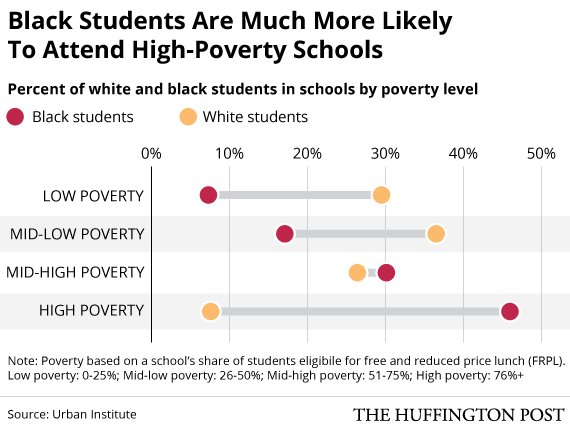
Sunday marked the 61st anniversary of the landmark case in the U.S.:  Brown vs. Board of Education. The supreme court case declared segregated schooling unconstitutional. However, 61 years later many schools remain separate and unequal. Often students in low socio-economic neighbourhoods, which tend to have a more diverse population, remain at a disadvantage compared to their counterparts in more affluent neighbourhoods . Rebecca Klein, author at the Huffington Post, put together six powerful graphs which illustrate how far we still have to go for a truly equitable educational system. Below are a couple graphs from Klein’s article:

funding


lessqualteachers

To read the entire article click here:

http://www.huffingtonpost.com/2015/05/17/brown-v-board-61-anniversary_n_7293344.html

Words to Avoid

As a doctoral student, I aim to write very clearly. This is not always easy and often takes several revisions. However, there are some words we have just become so used to saying/writing that we hardly notice they aren’t saying much at all.

In the listicle (listing article) “15 Words You Should Eliminate From Your Vocabulary to Sound Smarter”Jennie Haskamp identifies vague and often meaningless words most of us are guilty of using. Below are a few of the words, along with explanations taken directly from the article, I am most guilty of using (as demonstrated above).  I’m trying my best to eliminate them from my vocabulary:

  1. That

It’s superfluous most of the time. Open any document you’ve got drafted on your desktop, and find a sentence with “that” in it. Read it out loud. Now read it again without “that.” If the sentence works without it, delete it. Also? Don’t use “that” when you refer to people. “I have several friends that live in the neighborhood.” No. No, you don’t. You have friends who. Not friends that. 

  1. Very

Accurate adjectives don’t need qualifiers. If you need to qualify it? Replace it. “Very” is intended to magnify a verb, an adjective, or another adverb. What it does is makes your statement less specific. If you’re very happy? Be ecstatic. If you’re very sad, perhaps you’re melancholy or depressed. Woebegone, even. Very sad is a lazy way of making your point. Another pitfall of using very as a modifier? It’s subjective. Very cold and very tall mean different things to different people. Be specific. She’s 6’3″ and it’s 13 degrees below freezing? These make your story better while also ensuring the reader understands the point you’re making.

  1. Amazing

The word means “causing great surprise or sudden wonder.” It’s synonymous with wonderful, incredible, startling, marvelous, astonishing, astounding, remarkable, miraculous, surprising, mind-blowing, and staggering. You get the point, right? It’s everywhere. It’s in corporate slogans. It dominated the Academy Awards acceptance speeches. It’s all over social media. It’s discussed in pre-game shows and post-game shows.

Newsflash: If everything is amazing, nothing is.

  1. Just

It’s a filler word and it makes your sentence weaker, not stronger. Unless you’re using it as a synonym for equitable, fair, even-handed, or impartial, don’t use it at all.

To read the entire list click here:

http://mashable.com/2015/05/03/words-eliminate-vocabulary/

Sir Ken Robinson’s New Book!

skr

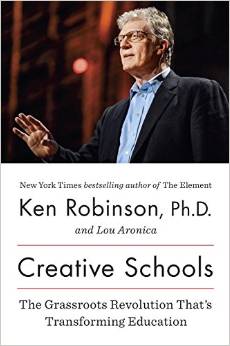
It has been nearly a decade since Sir Ken Robinson’s famous TED talk, How Schools Kills Creativity. (If you haven’t seen it, click here: http://www.ted.com/talks/ken_robinson_says_schools_kill_creativity?language=en). Robinson along with Lou Aronica have recently published a book titled Creative Schools: The Grassroots Revolution That’s Transforming Education. The text has received glowing reviews. I look forward to reading it in the very near future. Some of the reviews of the book (as listed on Amazon.com) include:

  • “This book is a wake-up call to the emerging global human resources crisis. Increasing boredom, disengagement and dropouts among students have become chronic aspects of many school systems around the world. Creative Schools is a must-read for anyone who is interested in critique, vision, and theory of change for the new course of schooling.” —PASI SAHLBERG, author of Finnish Lessons 2.0: What can the world learn from educational change in Finland 
  • Creative Schools is one of those rare books that not only inspires and brings a new sense of possibility to the goal of transforming education, but also lays out an actionable strategy. Ken Robinson is leading a daring revolution to change how we understand schools, learning, and most importantly, the passion and talent of our students. This is a global game-changer and I’m in.”—BRENÉ BROWN, PH.D., author of the #1 New York Times bestseller Daring Greatly
  • “This is the book we have been waiting for from Sir Ken Robinson —laying out what is fundamentally wrong with our education systems, and correspondingly showing what and how it should and could be different. He makes creativity, and much more, come alive. Don’t start reading this book unless you have three hours before you, as you will have difficulty putting it down. Then, think about what you might do and re-read the book with others to start making the changes. Creative schools indeed! The timing is perfect.”—MICHAEL FULLAN, OC. Professor Emeritus, OISE/University of Toronto and author of The Principal: Three Keys to Maximizing Impact

A focus on digital literacy practices at AERA 2015

aera2015

I  just returned from another American Educational Research Association (AERA) conference. While in Chicago, I attended several sessions focused around literacy education, teacher education, and critical pedagogy and noticed digital literacy practices were discussed in all sessions. Interestingly, in the studies discussed digital technology was used not only as a tool to teach but a tool to re-imagine the definition and uses of literacy practices. Interesting sessions I attended included:

*Digital Storytelling as Method and Narrative Assemblage (Korina Jocson, University of Massachusetts)

 *Digital Storytelling as Racial Justice: Digital Hopes for Deconstructing Whiteness in Teacher Education (Cheryl Matias, University of Colorado & Tanetha Grosland, Morgan State University)

*Digital Authoring: Negotiations of Identity, Agency, and Power Among Girls Resettles as Refugees from Thailand (Delila Omerbasic, University of Utah)

 *Digital Storytelling in Preservice Teacher Education: Diverse Understandings of Writing, Pedagogy, and Meaning Making (Sandra Schamroth Abrams, Saint John’s University)

Benjamin Herold from the Education Week blog noticed a similar trend at this year’s conference. On his blog he said, “Digital reading and early literacy were among the hot topics at the annual meeting of the American Education Research Association, held here last week.” He describes the findings of four studies which study digital reading and early literacy. He noticed a common thread which ran through many of these papers: “It’s important to look at how digital devices, apps, and e-books are actually being used in classrooms, and the most promising literacy practices with these new tools involve lots of human-to-human interaction.”

Read Herold’s blogpost here:

http://blogs.edweek.org/edweek/DigitalEducation/2015/04/ipads_e-readers_literacy_research.html