I (Yiola) am excited to share news on a technology conference hosted in the Child Study and Education program at OISE/UT last week. The conference, Technology for Learning, was designed for our first year MA students. To develop the conference, we surveyed the students to better understand their knowledge of technology use in the classroom. We discovered that while most students were users of technology, very few used technology in the classroom and very few were familiar with educational approaches and applications for the classroom. The survey was helpful in developing the structure and content for the conference. We then carefully examined which technology based topics and themes were covered in program courses and from there we decided which areas would be best for the conference.
Students expressed they lacked knowledge in, and seemed most interested in, applied uses of technology in educational settings so we decided to host sessions on: blogging, online literacy, assessment, social media in the classroom, gaming, formal and informal learning sights, coding, assistive/adaptive technologies. For a complete list of the sessions and their descriptions click on the website we designed for the conference here:
Students signed up for the conference via the website and after significant planning, emails and bookings, we were set to go.
Ready for student registration. There were 77 students in attendance.
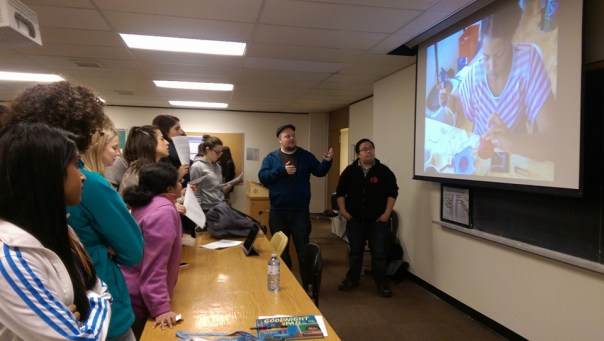
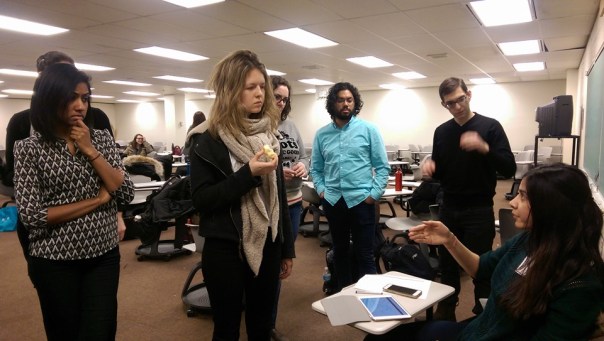
The full day conference included: an introduction, 2 one-hour sessions, lunch break, a 3rd one-hour session, student led poster presentations, Q & A and closure. The introductory session led by myself and Heather (co-designers and hosts) set the stage for the day. I introduced the notion of digital citizenship, its themes and local resources and Heather introduced theoretical frameworks for thinking about technology in education. She shared 3 frames: 1) T-Pack 2) Ed Tech Quintet and, 3) SAMR. Each framework was explained and examples were provided. We left students with the suggestion to select one theme from digital citizenship and one framework that resonated with them and to think about them in relation to the 3 sessions there were about to attend. Here are some pictures from the day:
Director of OISE libraryMonique
Lab School Teacher
Lecturer in Teacher Education
Doctoral Student
Professor from OISE
Teacher from local school board
Doctoral student
We worked hard to include a variety of presenters, from a variety of settings. Included were the Director of OISE library, a lab school Teacher, Professors from the university, a Teacher from the public school board, and Doctoral students.The images above show some of our amazing presenters.
We provided a lunch where the presenters along with Department Chair Professor Earl Woodruff and Program Chair Professor Rhonda Martinussen gathered to share ideas regarding technology for learning.
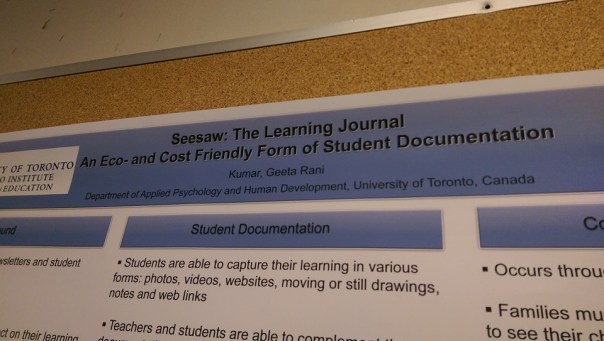
After lunch there was one more set of sessions followed by student-led poster presentations (see images below for student led poster presentations). Students submitted proposals which were reviewed and returned with feedback. The poster presentations provided a wonderful opportunity for students to share their expertise and knowledge in an academic setting. It was a moving and motivational part of the conference.The following 4 images show examples of the student-led poster presentations.
We closed the conference with a Q & A and an unplugging of technology through the fun and fitting picture book “Good night iPad”.
It was a wonderful day. The informal feedback from students has been positive. We plan to send out a post survey about the conference to deepen our understanding of student learning and to improve our own practice in the area of digital literacy teaching. For more information about our conference please feel free to contact us via our blog.
The International Literacy Association (ILA) has its annual Conference coming up in Boston in July. An inspiring organization that works to build global capacity in the area of literacy, pre-service and experienced teachers alike have much to gain from learning about ILA and attending the conference.
Check out the website for more information and be inspired!
In a recent article our research team wrote about the complex work of experienced literacy teacher educators.
Kosnik, C., et al. (2014). Beyond initial transition: An international examination of the complex work of experienced literacy/English teacher educators. English in Education. 48 (1). 41-62.
The findings show the complexity of being the “linchpins of education” where on the one hand literacy teacher educators negotiate their evolving identity as classroom teachers and on the other hand are navigating the university professorial landscape.
As a teacher educator I (Yiola) can relate to the tensions expressed by our participants. To address some of the tensions I have developed a model that brings together the schools and student teachers through my university courses. My work as the “linchpin” is to make the theoretical and scholarly connections with the student teachers. In this post I give an example of the relationship between the schools/teachers and one of my teacher education courses.
I teach a curriculum course that explores the arts (Visual Arts, Music, Drama and Dance) and Health and Physical Education. In a very short period time teacher candidates are expected to have competence and confidence in teaching these subjects across the elementary grades. I have designed a course that explores the literature, both content and pedagogy, and that provides opportunities for exploration and experience. To achieve the exploration piece I have reached out to exemplary teachers in the community seeking their participation in the course. Each and every teacher I have reached out to has been keenly interested to share insights into their practice. We have gone to school gymnasiums and experienced a physical education class and also observed a teacher teach children in the gym. We have gone to a “ballet” school to learn more about movement competence and what that means, and we have visited classrooms to learn more about teaching the visual arts.
Last week our class “set up shop” at the Fraser Mustard Academy for Early Learning where teacher Niki Singh shared her expertise on teaching visual arts in the early years.
Here our learning was brought to life. She spoke about the school’s philosophy, key elements of the program, and connected the curriculum to practice. This discourse alone cannot be achieved through academic readings and discussion. Then, we were invited to observe a one-hour class in action. From observing the classroom set up, materials, learning environment to watching the opening procedures and capturing the nuances of teachers’ language, tone, pace, and rhythm. We then toured the classroom as children engaged with the arts. We observed; we interacted; and we explored. Hearing the sounds, seeing the sights and capturing the details of a day in the life of what Niki calls “The Living Gallery” was a worthwhile learning opportunity. Here are some images of the experience:
Student teacher begins working with one child who has an interest in string and letters. She encourages him to cut the string and create letters. After some time a crowd of curious students gather and join in the process: cutting, lines, and literacy through the exploration of the arts.
Exploring materials and how they are set up and utlized by the children. Art, culture, child development and curriculum all working in harmony for the student teachers to observe.
Watching children problem solve in the arts. Here two students are creating fashion designs using a variety of textiles. How to combine fabrics? How to make them fit?
Examining documentation and understanding how assessment in the visual arts can take shape was another area explored. In the picture above we see children’s work along with their talk about the art, capturing their understandings.
There is mutual benefit to the student teachers and the school community when the university comes together. Teachers are able to share their knowledge and student teachers are able to gain understandings outside of their practicum obligations.
I end this blog with an observation so inspirational that it cannot be felt through a text or screen but that can only be understood when seen in the context of the school. Niki, the visual arts teacher brought nature, the outdoors, into her classroom when she gathered fallen branches in the community into the school. The children created a “Rainbow Forest” where they wove colourful wool around the branches and sculpted a beautiful forest inside their school. We were able to see the children’s artwork and the language around the artwork. Children talked about diversity and how difference stands united. Here we see the commitment to diversity and inclusion.
The student teachers enjoyed the experience. I see their engagement by the ways they are involved, the questions the ask, the thoughtfulness and effort placed on connecting scholarship to the experience. The teachers have often shared that they feel re-inspired after listening to and sharing with the student teachers. The relationship between schools and the university is beneficial and is one way I am able to reconcile some of the tensions I feel as a teacher educator.
I (Yiola) have been building in how to embed creativity in classroom practice in my Teacher Education course for a number of years. This year I invited Lina Pugsley, a graduate of the Creativity and Change Leadership Program and Masters of Science in Creativity student from SUNY Buffalo State, to share with us what creativity means and how to teach creatively and teach for creativity through weaving creativity skills into our classroom lessons.
Our class consisted of information sharing about what creativity is and its complexity. I appreciated that we took time to unpack some of the misconceptions (a major one being creativity equals the visual arts) and to solidify some of its characteristics (creativity is problem solving, its innovation, its incubation, its idea generating, its colourful, etc.)
Lina presented us with a number of models and frameworks to think about ways of thinking about, teaching, and embedding creativity into our classroom practice.
Several great resources were shared and a number or creativity scholars introduced. From E. Paul Torrance to Ronald Beghetto, we were inspired!
Once the theoretical and conceptual foundations were laid students in the class began to think more practically about what skills and strategies nurture creativity. This video set our curiosity in motion:
And, in creative fashion students explored, talked about and shared ways of bringing creativity skills into their teaching and lessons. We examined E. Paul Torrance’s 18 thinking skills from his book “Making the Creative Leap Beyond”
Some of the skills:
Be Original
Be Open
Visualize it Rich and Colourfully
Combine and Synthesize
Look at it Another Way
Produce and Consider Many Alternatives
Playfulness and Humour
Highlight the Essence
Make it Swing! Make it Ring!
Be Aware of Emotions
Be Flexible
The energy in the room was high. Students were interested and engaged. They were encouraged to consider their personal teaching philosophy and to make creative thinking a priority in their teaching. It was an inspiring experience. This particular teacher education course looks at methods in education. We explore planning, the learning environment, pedagogies and practices. Creativity, now in the 21st century, is a skill that students must acquire. It is not an innate skill that some are born with while others are not. Everyone has the capacity to develop their creativity skills and as teachers we need to learn how to create classrooms that foster, encourage, and celebrate creative thinking.in I believe the MA students gained a solid sense of what this is about.
For more information on Lina’s focus and work check out here website at:
Something has been weighing on my mind this year as I teach my courses in teacher education. I (Yiola) have been teaching a number of different courses in teacher education (curriculum, foundations, child development, assessment) and each one has been carefully crafted with the students in mind (some are Masters level courses and others are undergraduate). Wherein lies the balance of teaching academic courses that are seeped in ideology and the promotion of critical thinking?
I believe it is inevitable that ideologies find there way into our course outlines, our lectures, our readings, our practice ~ after all, we are humans with perspectives and schemas. Knowing where we stand on issues that we teach, I think, is key to developing a course that is not only filled with information (content/pedagogy) for future teachers but that is accessible, inviting, and open to deeper understandings. In my courses for example critical pedagogy is a framework. Students know that when they take my courses they will be presented with readings, discourses, case studies, and policies that are framed in critical theory. I choose this for a number of reasons: I believe in equity and social justice education; I believe in equitable opportunity for learning; I believe in disclosing and deconstructing status quo in order to deepen our understanding of “what is going here”? and I believe that many student teachers are hearing of this ideology for the very first time.
And so, I am often left questioning: how far do I take this? how far can I go when presenting an ideology in teacher education? Is it fair to present a dominant perspective? Is it inevitable? Some would argue that by not expressing a point of view, we are simply adhering to one anyway and silencing many others. Where and when does ideology channel into indoctrination? Do student teachers feel imposed upon or offended when only one perspective is shared? but what about when its a perspective that is often marginalized? Is there even time to invite critical thinking about ideologies when teaching students about curriculum?
Let me provide an example: Literacy Curriculum in Teacher Education. Literacy education is taught in as many ways as there are literacy educators. We know from our research in literacy teacher education that there are powerful, effective, and varied ways of approaching literacy teacher education. And so, there is not one right way. One teacher educator may teach with a critical stance while another teaches from an empirical psychological stance, while yet another teaches from a holistic perspective. If I could, I would love to be a student in each of these courses to catch a glimpse of the ways in which teaching literacy can be considered. To the student teacher, is one way better than another? Is one way less indoctrinating than the next? Is there a way to prompt critical thinking while teaching subject content/pedagogical knowledge?
I am constantly thinking about the perspectives I bring to my courses, what gets included and what is omitted and why. I am constantly thinking about my tone and the messages I relay and the possibilities of interpretation from the learners in my class. I am interested in critical thinking and pushing boundaries of understanding. I am not interested in indoctrination. This in and of itself is an ideology of sorts.
Happy New Year! Best wishes for a happy and healthy 2016 to our friends and readers.
With the coming of another year there is much to look forward to. I (yiola) am faced with a language and literacy dilemma. My darling Sylvia Clare… my young pre-reading, 5 year-old who loves inquiry and creativity, has an opportunity to go into French Immersion next year. Do I sign her up? As a parent I am inclined to say yes — why wouldn’t I? There is opportunity to learn a second language and its FREE… And yet, as someone who studies literacy pedagogy and language development, I’m not convinced that French Immersion is the best pathway for Sylvia Clare’s education.
Teachers
Resources
Pedagogy
Vocabulary
Inquiry
Reading ~ Reading ~ Reading
Creativity
Love of learning
The research has something to say in some of the above domains, yet, when I think of my child, I’m not entirely convinced either way. One interesting article I found that clearly explores literacy development in early French Immersion is provided below:
And then, there are social considerations. How one stream attracts a certain community… I find it offensive that many consider the French stream a “private school like setting” within the public school. That just does not seem right. An interesting article that outlines the social considerations is provided below:
I will know if Sylvia Clare will be in the French Immersion program by next week. If she has one of the 46 spots available at her school, it will be up to us to decide if French Immersion starting in first grade is the right pathway for her.
If you have thoughts, suggestions, experiences with early French Immersion please share!
The literature on language development varies. What we know: the major components of Language include: (phonology, semantics, syntax, pragmatics, lexicon, and metalinguistics); language development is based on biological (maturation) and behaviouristic (environmental) and interactive and contextual factors; there are several components of the reading process (decoding, understanding, and fluency) and each component has multiple elements.
So, is there a “critical period for language acquisition”? The critical period hypothesis suggests that if certain conditions related to language development are missing (internal and/external conditions), then a child will never acquire language. I don’t buy that. While I agree language acquisition in the early years is central to development, children can acquire language skills later in life.
There appears to be some universal patterns in language acquisition yet there are also important individual differences that depend on a number of variables. For example, studies have shown great variation in the growth of children’s vocabulary across typically developing youngsters.
So, from reading readiness to emergent reading, when is it (if ever) a good time to focus on ‘reading’ in the early years? There are some schools of thought (i.e. Waldorf) who do not begin formal language teaching until 2nd or 3rd grade. So why are some of us excited when a child in kindergarten “can read”? What is the hurry?
Setting up a literacy based environment that is balanced is key. However, there is an underlying tone of high expectation that we, as educators and teachers, need to be mindful of. The article I share below takes an interesting perspective on reading development and the implications of starting the expectations too soon.
As a mother of 2 children in the early years I see first hand their curiosity and interest in texts. They love stories, they love books. They love to be read to… but, they are not yet ready to read. Should they be at age 4 and 5? Why press the issue? Why not develop vocabulary? Play with language? Explore sounds and letters? Why press the formal reading of books? My daughter, now 5, is just beginning to make sense of sentence structure through a computer program called “Raz Kids”. This online program has hundreds of level books children can listen first, then read, then answer comprehension questions. For this little learner, it is amazing to see her answer the comprehension questions 100% of the time yet not yet recognize basic sight words (my, this, the) but use the illustrations and understanding of pattern to guide her through. I wonder… why start now? why set these expectations now? So, I tread very slowly, because she is motivated to earn her “Raz stars” to build her rocket ship… but I place no pressure on to know those site words. I see she “gets” it… but doesn’t quite yet “have it”. I also often feel a sense of worry about literacy and numeracy and whether or not my children will “get it” sooner rather than later.
Thankfully, her teachers have no worry at all and feel no pressure to push reading. Thankfully, her teachers have a good sense of child development.
There are multiple sites of learning, multiple forms of education, and multiple kinds of learners. From time to time, I (Yiola) have shared posts on Muay Thai as an alternative site of education with a focus on the teacher/student relationship. Muay Thai is a beautiful martial art that originates from Thailand. Most would likely watch Muay Thai and cringe, call it brutal and see it as violent. It would seem to be a sport that gains popularity through the thrill of watching and cheering and betting and celebrating in celebrity style the fighters. In the video I share here, World Champion Simon Marcus shares his perspective on the sport.
The way he describes his experience is remarkably peaceful and remarkably personal. He talks about himself as student of the art and how his teachings bring out his best personal self, where he finds his “most peaceful” moment. He talks about his gratitude for his teacher and the respect for his learnings.
One may perceive the fight as brutally violent while another perceives the fight as moment of peace and clarity ~ a fine example of multiple perspectives. “A Brutal Ballet” indeed.
Education is about knowing yourself, knowing your ability and opening yourself to exciting possibilities for development, growth and achievement. Teaching is about being open to multiple perspectives and appreciating the multiple ways our students find knowledge, achievement and peace… and finding ways to embrace and invite multiple perspectives into our learning environments.
I (Yiola) am forever thinking about how to make the material in my courses accessible to my student teachers. How does one connect theory and research to practice in a way that is accessible for student teachers? It is not uncommon to have student teachers feel skeptical about what their Professors share in class because they are not seeing the connections in their placements. In spite of what the research states, practice is often not clear. Last week I documented what I believe to be a remarkable process for doing just that. In this post I will share the value of the relationship between teacher education course instructor and classroom teachers who supervise student teachers in the classroom.
On this particular day, my class was exploring “classroom management”. We know that classroom management is one of the most, if not the most, challenging aspects of classroom practice for beginning teachers. To add to the complexity, I embedded thinking of classroom management through the lens of culturally relevant pedagogy. For this class, I did not intend to provide a bag full of tricks for managing a classroom. No, this class was intended to spark critical thinking about equity and how the learning environment influences classroom management.
The first thing I did was clarify and highlight key considerations from the article that was read for class and invite discussion about it. For example:
“The ultimate goal of classroom management is not to achieve compliance or control but to provide all students with equitable opportunities for learning” (Weinstein, Tomlinson-Clarke, Curran, 2004, 27). Framing what “classroom management is for” needed to be the start of the conversation.
We then reviewed Weinstein’s, Tominlinson-Clarke and Curran’s components of culturally relevant classroom management (see link to article below):
1 Recognition of one’s own ethnocentrism and biases
2. Knowledge of students’ cultural background
3. Awareness of the broader social, economic and political context
4. Ability and willingness to use culturally appropriate management strategies
5. Commitment to building caring classroom communities
These components are powerful and make such good sense to me, an experienced classroom teacher, researcher and teacher educator who approaches teaching with a critical lens. However, to a student teacher, the components may not be so clear. It seemed the theoretical ideas were understood, but how they were enacted in a classroom was harder to pinpoint.
I then shared Rita Pierson’s Ted Talk (https://www.ted.com/talks/rita_pierson_every_kid_needs_a_champion?language=en) and afterwards I invited everyone to share their understandings of what Pierson expressed to the theory. The student teachers shared thoughtful insights, asked big questions; I sensed they were thinking hard about the messages. Ultimately, student teachers were able to connect Pierson’s talk to components 3 and 5 of the culturally relevant classroom management framework.
Following our discussion, I shared examples of how culturally relevant classroom management may play out in classrooms. I shared specific strategies and we spent time thinking about the language we use in our classrooms; we discussed tone and approach (Brice-Heath) and we talked about praise ~ what research says about the praise and what to do instead. It seemed to me that the class went well in that students were talking about classroom management and its relationship to culturally relevant pedagogy and thinking of how to employ some of the thinking in their classrooms. And yet, it still seemed to me that the understandings were surface at best.
The next part of the class involved classroom teachers. Supervising teachers Ben and Zoe came to visit my class to discuss their thoughts and suggestions for effective classroom management. This is where we turned a corner in our learning. Ben and Zoe sat down and talked to the students. They talked about what they felt was important, gave examples, and advice. Their talk was specific and embedded in daily practice. My role as course instructor was to listen. It was also my role to work with the teachers by making connections between what they shared and what I shared earlier in class, to make the connections explicit for the students. Let me give an example:
Ben talked about the role of the teacher in relation to classroom management. He shared the idea that relationships were central to good classroom management. We know that the literature on classroom management states the same. He talked about how important it was to be your authentic self; your true self because students know when you are being fake. Ben also talked about going to class being the best version of yourself. Thinking of the role and responsibility of the teacher in relation to building relationships as good classroom management was shared.
Ben’s point made me think about the first component of the culturally relevant classroom management, “Recognition of one’s own ethnocentrism and biases” and when their was a pause in the sharing I joined the talk and made the connection for students. I explained that what Ben was sharing was closely connected to our culturally relevant frame in that being your best self includes being in touch with your biases. I shared that in order to be your authentic self, that you must really know yourself and so stepping back, reflecting and questioning your views, perspectives and biases is central to being authentic. Further to this, I connected Ben’s point of bringing your best self to class everyday with Pierson’s point that you may not like all of your students, but the students can never know. This emphasizes the point of building relationships with all students and reinforces the power that we have as educators.
Zoe then shared how this was closely connected to building community and that community is not something that happens by itself. A student teacher then asked, “How exactly do we do this? We have talked about community but how do we do that?” So here I saw that the student teacher understand the concept but was now looking for ways to bring it to life, to somehow make sense of it in practice. I appreciated how at this moment the intersection of researcher/course instructor, student-teacher, and experienced teacher came together in the most effective way. Zoe began by providing suggestions clear and practical suggestions. These included:
1 Talking to the children, asking questions, and getting students to talk about themselves.
2. Reaching out to parents in the summer or soon into the new school year, asking questions and seeking information about the family and their child.
3. Scheduling the day for smooth transitions. For example, have the first 15 minutes in the morning be about settling in, having individualized tasks so those who come in late are not anxious, and parents who may want a quick word have your attention while students inside the classroom have a purpose/task that is accessible to them. Scheduling the day so their is ease in how children move about and learn is central to a safe, inclusive environment.
I then took the opportunity to reinforce the critical perspective:
4. Where Zoe noted talking to students to learn about who they (component #2), I added the same message but through a different lens: Listen and listen carefully to students: their words, their values, and language. Take note of the broader community setting and what is going on outside your classroom. Put yourself in the role of learner and deeply investigate your surroundings in order to better understand who are your students.
I also made connections to previous classes and guest speakers:
5. Do you remember in our Assessment course where the school principal noted that “Sunshine calls” (a welcome call at the beginning of the year) were important for developing relationships, trust and knowing your learners? This is another reason why they are important. Sunshine calls not only set up communication patterns for reporting, they also help build classroom management.
The student teachers seemed to respond to this kind of teacher education design. Questions were asked, heads were nodding, there seemed to be a strong sense of listening and engagement in the class.
The partnership between teacher education course instructor and supervising classroom teachers can be powerful. In this scenario I can see:
voices shared
a demonstrated shared understanding of teaching and learning between what we read and what we do
explicit connections made between theory and practice
embedding the layer of critical theory to practice
collaboratively shaping best practice
big picture thinking while sharing the nuanced work of teachers
giving value to supervising classroom teachers
validating information at the university
The meeting place of theory and practice in teacher education is often hard to find. This particular relationship between myself and the teachers at the Dr. Eric Jackman Laboratory School seems to benefit all involved: the student teachers gain rich and meaningful connected information in one central location, the course instructor listens and learns from the classroom teachers, and the classroom teachers gain insights to perspectives that connect to their work.





 Literacy Teaching and Teacher Education