Category Archives: education

Finding a New Community- in Baseball

The wild ALDS Blue Jays Game Clare mentioned in her post earlier this week marked my (Cathy’s) induction into a new community.   The “baseball fan” community.  This may seem strange to people who know my family well, as they see us as a baseball family.  Both of my children were catchers in elite ball.  They toured the United states, and played in several world series tourneys. They trained year round.  My husband was a coach and scout.   For twelve years, every weekend during the official season I attended a baseball tournament in some city or other.  As the dutiful and loving wife and mother, I was ever supportive: cheering in the rain, patching their injuries; cursing poor sportsmanship, and; washing smelly baseball socks in hotel laundry mats in the dead of night.  Even today, with my children well into adulthood, my son coaches a rep team; my daughter plays on several adult softball teams; my husband is a rep pitching coach;  and I still attend some games. But it has always been their passion, not mine.  I was, and am, an artsy.  To their chagrin  I still occasionally refer to their uniforms as costumes and their practices as rehearsals.

This all changed this past season and Wednesday was the culminating event.  This year, I decided to be an “insider.”  I worked hard at not watching, but belonging.  I wanted to have a team .  I learned the names of all of the Jays players and their positions.  I learned about them as people, and watched specials about their lives and how many obstacles they had to overcome to get to wear a Jays cap.   I picked a favourite player, Jose Bautista, and proudly wore his name and number on the back of my new T-shirt.  I even wore a cap. Strangely,  I felt akin to complete strangers who also wore Bautista garb.   I quickly learned that I could cheer and sing, wave towels and even dance in the street after a game in Toronto, and it was smiled upon.  (As an artsy I would have willingly  done this anytime, but my husband would not have necessarily smiled!).  I even found a vendor outside of the Rogers Center who served gluten-free wieners, and brought my own bun so I could eat hot dogs like everyone else.  I learned it is work to belong to a new community- any community- but you have to really want it.

On Wednesday I watched the game at home with my husband and found myself  on the edge of my seat.  I was so tense!  I waved a towel to support my pitchers; Stroman, Sanchez, and Osuna.  I found myself yelling in protest in the 7th inning when  Toronto catcher Russell Martin’s return throw to the mound hit Choo’s bat and Odor raced home.  I shouted and danced when my man, Bautista, hit that remarkable home run.

As I reflect on this now, I have to laugh.  I actually know these players’ names.  I am emotionally involved in people I don’t even know.  I have acquired a new language, and a different way to communicate with people .  I can and want to discuss the plays, highlights, and quirks of the game.  I was texting friends and family throughout the game- about the game.  My son was lucky enough to be at the game and I waited up for him so I could talk to him about it- actually needed to talk about it!

I feel like I am part of something. It was worth the effort.  I suspect I still may slip up and refer to practices as rehearsals, but that is okay.  My literacy research informs me we belong to many communities and foster many identities.  I am no longer just the artsy and the baseball mom and wife. I am a FAN.jays game             My husband and I on our way to a game with my new-found community.
How Self- Selected is Self -Selected Reading?

I (Cathy)  was touched by the following tale shared by guest bloggers Burkins and Yaris (Think Tank for 21st Century Literacy) on Brenda Power’s Choice Literacy blog site.  The post is titled, The Tyranny of Levels. It reminded me of the time I was visiting a classroom to observe my student teacher and saw two bins labelled Boy’s Books and Girl’s Books.  When I inquired about the bins, my student teacher assured me the children never dared choose from “the wrong bin.”  I was mortified.  Thankfully my student teacher also was mortified.  After that experience, the tale below did not seem very far fetched…

Daisy: A Cautionary Tale

Once upon a time, there was a third-grade girl, Daisy, who loved to read. She read all the time. While she liked to read about horses and outer space, she especially loved to read stories. She had read every single Magic Tree House, Junie B. Jones, and Amber Brown book ever written.  Recently, she had been into reading books about animals, and had devoured Shiloh and Charlotte’s Web.

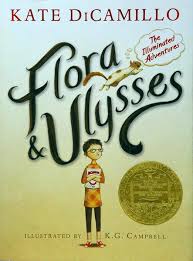
One day, as she browsed through books at the school library, she found a book with a beautiful cover of a girl wearing glasses and holding a comic book. When she saw it, she thought, “That girl looks like me!” She ran her fingers over the letters scrawled grandly across the cover and read the title aloud: Flora and Ulysses.

download

It was then that she noticed a small animal tucked up in the corner, which compelled her to read the back cover. As her eyes skimmed over the words describing a story about a squirrel who gets run over by a vacuum cleaner and strangely develops superpowers, she opened the book and began to read.

Before she knew it, the librarian was shouting a last call to check out books.  Daisy hurried to have her book scanned and joined the rest of the children lined up at the door to return to class. Ms. Wright, her teacher, walked up and down the line surveying the children’s choices. Every now and then she’d murmur things like, “Oh! Great author!” and “You’ll love this one.”  By the time Ms. Wright arrived at Daisy, she was nearly bursting with excitement.  Daisy couldn’t wait to tell her how she loved what she had read so far, and she longed to hear Ms. Wright say what a great choice she had made, choosing a book with a medal on the cover.

However, when Ms. Wright glanced at the book in Daisy’s hand, she looked between the book and Daisy and said, “Oh sweetheart, you’re going to need to return this book.”

Return this book?  Did she hear correctly? Confused, Daisy looked at her teacher who kneeled beside her, looked   her eyes, and said, “You’re a level R.  This book is much harder than that.  Run and put this back. You can choose something from the R bin when we get to the classroom.”

Crestfallen, Daisy handed the book back to the librarian. In her head, she kept hearing the echo of Flora’s voice speaking the same words she said when she witnessed Mrs. Tickham vacuum up the squirrel: Holy bagumba.

What was she going to read now?

Back in the classroom, Daisy dragged herself to the R bin and without even looking, grabbed the book that was on top.  She returned to her seat and muttered the title: Captain Underpants and the Attack of the Talking Toilets. Grudgingly, she began to read.

 Fellow teacher educators, I guess we still have much work to do… Be diligent. Our furture generations need you.

https://www.choiceliteracy.com/contributors-bio.php?id=11


After 2 Weeks We Tend to Remember…

I (Pooja) am taking a course at U of T this term which focuses on the practice and theory of teaching in higher education. When discussing approaches to teaching, the professor displayed Edgar Dales’ Cone of Learning graphic. Although this was something I was aware of, it served as a good reminder in how I design my courses and lessons each class.

Cone-Of-Learning

Growing through Research

drama children

Embedded within my passion for literacy is my love for developmental drama.  I do love theatre as well (I as a professional actress for a couple of years), but developmental drama is fundamentally different than theatre.  Theatre is about performance.  Developmental drama is about developing human potential, and that is my heart song.

I was recently asked to present a Literacy Workshop for the Royal Conservstory’s new Smart Start Programme .  This Early Childhood Education (ECE) programme uses a multiple arts approach to develop four specific cognitive skills: attention, memory, perception, cognitive flexibility.  It was my role to model and lead a group of ECE leaders through creative drama experiences so they could experience first-hand how developmental drama can and does develop cognitive skills. We explored many drama strategies in the workshop: storytelling; role play; group drama; teacher-in-role; voice over narration; hot seat; tableaux, and; story drama.  My favourite of the eight listed is story drama which uses the events and characters in a story to stimulate the drama experiences, plus, I got to use my storytelling skills.   We became the characters; good and bad.  We learned about a culture from the other side of the world.  We asked questions.  We problem solved.  We also had fun.  The participants left with many practical ideas and felt they were inspired to explore this world with the children they are responsible for.  But, in all honesty, I think I was the one who left with the most insight.

I used to present this kind of workshop regularly, but have not done one in a few years. Due to my dissertation work in multiliteracies (Cope & Kalantzis, 2000), I discovered I was seeing the experiences through new eyes.  I was identifying modes instead of arts disciplines and using critical discernment instead of point of view.  The experience was a literacy event that we constructed within a social paradigm and the participants contributed their own knowledge and expertise in an environment that supported situated practice.  It wasn’t just a new set of vocabulary; it was a much more informed and theoretical perspective of the work.  Vygotsky, Luke, Peabody, Vasquez, Kress, Cope and Kalantzis occupied every corner of the room.  I was well supported.  I recognized a noticeable difference between my role as  intuitive drama leader and informed theoretical guide.  It was progress and it felt good.

drama


Cope, B. & Kalantzis, M. (Eds.) (2000). Multiliteracies: Literacy Learning and the Design of             Social Futures. New York: Routlage

Guest Post: Monica McGlynn-Stewart: Talking Stickers

Image_TalkingStickersI (Monica) am an advisor to a team of recent MBA graduates from the University of Toronto who are one of six teams in the finals for a $1 million start-up fund for their product. Here is how they describe their work:

The Attollo technology assisted learning concept has been developed for use by parents and children in informal urban settlements in developing countries as part of the 2015 Hult Prize Challenge – which is the world’s largest student-based competition. Talking Stickers involves stickers with embedded bar codes (QR codes) that can be scanned by a device, which in turn is prompted to record and replay user generated audio content or replay pre-recorded audio content stored on the device. This spring and summer we have piloted our device in Toronto in George Brown College’s lab schools, and in Hyderabad, India and Mombasa, Kenya.

Whether these young professionals win the final prize this weekend or not, they are committed to bringing their technology to developing communities in India and Kenya to support the literacy learning of children in low-income communities.

Here is a link to a short video on their recent pilot projects in Kenya and India:

https://vimeo.com/139652753

Here is a recent article in The Globe and Mail about the project:

http://www.theglobeandmail.com/report-on-business/careers/business-education/beedie-selects-veteran-ali-dastmalchian-as-its-new-dean/article26401703/

Canadian school in global final for social enterprise prize

The question, on paper, is simply stated: How would you provide quality education by 2020 for 10 million children under the age of 6 living in the world’s urban slums?

Six business school teams from around the world, including one from Canada, think they have an answer to the question posed by organizers of the Hult Prize, a global competition for young social entrepreneurs that drew 22,000 applicants this year.

Next week in New York, at a session of the Clinton Global Initiative, a Hult partner, the winning team will walk off with $1-million (U.S.) and a chance to market a potentially game-changing, socially conscious business idea.

Win or lose, the four-person team of MBA graduates from the University of Toronto’s Rotman School of Management plans to pursue its idea for “talking stickers” – quick response bar codes that activate a low-cost reader enabling children to listen to a recorded voice or to record their own voice to say or sing the words.

For example, with talking stickers, the child (or parent) could use a hand-held device to scan a bar code near, for example, a bright yellow star on the page of a nursery rhyme book to hear Twinkle, Twinkle, Little Star. By scanning over a differently programmed sticker with a bar code, the child or parent then could record their voices to practice their language skills. The stickers are not just in books; they can be placed on household items, which then become tools for the language development of young children.

Earlier this year, having scrapped their initial idea for the Hult Prize, the members of Team Attollo (Latin for elevator) turned their attention to the literacy challenges faced by young children in impoverished countries. According to Hult Prize organizers, 112 million children up to 6 live in slums without access to schooling while 70 million children, more than half of whom are girls, are prevented from attending school.

“We found that language development and vocabulary is the key issue in early childhood development,” says Jamie Austin, who like teammate Lak Chinta, holds a PhD in neuroscience and earned a Rotman MBA this year. The other team members are engineers Peter Cinat and Aisha Bukhari, who earned their Rotman MBAs in 2014 and 2015, respectively.

Over the summer, with advice from early childhood professor Monica McGlynn-Stewart, the team conducted trials in Kenya and India, working with local school officials and families who cannot afford even modest school fees for their children. The early results were promising, with children and their parents adding to their vocabulary.

Meanwhile, with help from Toronto-based Autodesk Research and U of T engineers David Johns and Matt Ratto, the Attollo team developed a low-cost prototype for the hand-held device, with a view to making it affordable ($1.50 a month) to families who earn between $2 and $5 a day. As well, the team is working with local publishers and schools to develop school curriculum content for the stickers.

Over the summer, Hult Prize organizers brought finalists to a boot camp in Boston to make their business idea “investment ready.”

“It was a little bit collaborative and competitive,” says Mr. Austin, of the relationship with the other five teams. “We would talk out the ideas and we saw each other’s presentations every week,” he says, with coaching from academics and industry leaders. “We got tons of feedback from the Hult Prize business experts.”

Mr. Austin and his colleagues are so committed to their venture that, for now, they have quit their day jobs to found Attollo as a social enterprise company.

The other Hult finalists are: ESADE Business School (Spain); the University of Tampa (United States); Oxford University (England); and two from China – Jiao Tong University Shanghai Advanced Institute of Finance and National Chengchi University.

Follow Jennifer Lewington and Business School News by subscribing to an RSS feed here.

Contact Jennifer at jlewington@bell.net

In lab schools, learning in classrooms benefits students and researchers

In lab schools, learning in classrooms benefits students and researcher

In the Globe and Mail, our national newspaper in Canada, David Israelson wrote an article on the Jackman Institute of Education. I (Clare) found it captured the spirit of ICS. It would be great if every child could have an education like ICS. http://www.theglobeandmail.com/news/national/education/in-lab-schools-learning-in-classrooms-benefits-students-and-researchers/article26498016/

Six-year-old Sophia Salamon and her nine-year-old sister Anna are being watched.ICS

The Salamon sisters, in Grade 1 and Grade 4, respectively, are part of a bigger learning experience. Their school is the Dr. Eric Jackman Institute of Child Study Laboratory School, at the University of Toronto, where educators study how children learn by using the school’s classes as living models.

“When we looked up the school, we thought it sounded fantastic,” says Tracy Pryce, Anna and Sophia’s mother and a student at the University of Toronto.

“It’s in line with our educational philosophy. I compare it with my own experience when I went to school. Seeing my kids and what they’re getting from what they’re learning is such a difference from what I feel I had as a child.”

At a laboratory, or lab school, there are almost always visitors in the classroom, says Jackman’s principal Richard Messina. He laughs at the idea of his school’s 200 students being the educational equivalent of lab rats.

“It does conjure up images of mazes and exercise wheels,” he admits, “but our children become quite desensitized to having adults in the room.”

In September, for example, the school, which runs classes from nursery to Grade 6, was visited by a delegation of 24 educators from Kobe, Japan. “We have had 700 and 1,000 visitors per year,” says Principal Messina. “The children just continue with whatever they are working on and they’re used to speaking with adults about learning.”

The concept of a lab school comes from the work of educator and philosopher John Dewey, who set up the first lab school in Chicago in 1896. Prof. Dewey believed that the best way to train teachers was to have them teach and to accumulate new research and knowledge directly from the classroom.

The Jackman lab school, a few blocks from the U of T’s main downtown campus, is one of only a handful of schools of this type in North America.

The best-known lab schools in the United States are at Columbia University in New York and the original at the University of Chicago.

“Just as the physics department or the chemistry department have labs, the education department has a lab,” Mr. Messina says.

Being a lab school fulfills three functions, he adds. It produces research that can be applied to public education, it’s a forum for teachers to further their knowledge, and “we provide exemplary education to the children we are fortunate to have with us.”

“I feel very fortunate that we’re there,” Ms. Pryce says. There are 22 children in each class – half boys, half girls – and the school is committed to diversity.

To help ensure diversity in its enrolment, 13 per cent of the students receive tuition support, Mr. Messina says.

In addition to its teachers, each classroom has two Masters of Education students who are pursuing two years of graduate work while teaching.

“Almost all teachers in the school are involved in research that’s going on in their classroom,” says Julia Murray, a Grade 5-6 teacher at the school who is now on maternity leave and did her Masters at the Institute several years ago.

“The research going on is often cutting edge, and it’s about best practices in education,” she adds.

For example, Mr. Messina says scholars are researching the emerging concept of brain plasticity: “Think of the brain as a muscle that can be developed, metaphorically, so that errors should not be considered embarrassing but a natural and necessary part of learning.”

The Jackman lab school was also one of the major providers of research for developing play-based kindergarten programs and full-day kindergarten, he adds.

Ms. Pryce says she likes the school’s inquiry-based learning approach – encouraging her children’s natural inquisitiveness while maintaining classroom structure.

“There’s a strong philosophy of teaching children to ask questions, not for children to get information but to develop their own theories,” she says.

“It’s a secure environment socially, mentally, intellectually so they develop the confidence to speak out.

“The benefits for my children have really been clear.”

The school has a waiting list that parents sign up for when their children are born, he says. “We seem to draw applications through word of mouth. Many people seem to know about us even though we don’t advertise,” Mr. Messina says. Jackman evaluates its programs to make sure that students are being well educated and finds that they do well as they move toward higher education.

“We hear that our children seamlessly move on to Grade 7 and beyond, that they’re very comfortable with the inquiry process, stating opinions and knowing that these may change,” Mr. Messina says.

Creating Cultures of Thinking: An Amazing PD Experience

I (Clare) blogged in a previous post that I am incoming Director of the Jackman Institute of Child Studies. http://www.oise.utoronto.ca/ics/ JICS includes a lab school, teacher education program, and research centre. It is truly an amazing place!

Last week I had an opportunity to attend the Lab School teachers’ faculty meeting. They 618L8vDZYNL._SX376_BO1,204,203,200_had a week of PD and central to their activities was reading and discussing the text Creating Cultures of Thinking: The 8 Forces We Must Master to Truly Transform Our Schools by Ron Ritchhart. http://www.amazon.ca/Creating-Cultures-Thinking-Transform-Schools/dp/1118974603/ref=sr_1_1?ie=UTF8&qid=1442084403&sr=8-1&keywords=Ron+Ritchhart

The teachers had read the book over the summer and were reporting on chapters, selecting key quotes, and discussing implications for their practice. This was truly PD at its best – the teachers were thoughtful, involved, and relating theory to their practice. Under the leadership of the principal Richard Messina so much learning occurred and the community was strengthened.

Below are a few quotes they selected from Ritchhart’s text which I found very inspiring:

“…when both teachers and students have the expectation, or mindset, that one gets smarter through one’s efforts, then challenge and mistakes can be embraced as learning opportunities.” p. 7

“…traditional academic skills…do not adequately define the kind of students we collectively hope to send into the world. Nor do they define the kind of employee [skills] businesses are looking for…professionalism, work ethic, collaboration, communication, ethics, social responsibility, critical thinking, and problem solving…” p. 17

“…in a learning-oriented classroom, teachers and students focus their attention on the learning as a priority, letting the work exist in context and serve the learning.” p. 45

“…lots of new teachers, and perhaps some experienced ones, struggle with learning to listen, yet listening is one of the powerful ways we show respect for and interest in our people’s thinking.” p. 82

“for classrooms to be cultures of thinking for students, schools must be cultures of thinking for the adults” p. 102

Being part of a school where teachers are decision-makers, expert educators, treated as intellectuals, and work collaboratively is a true honour. I suspect there are going to be many more blogs about what I am learning at JICS.

Celebrate the Start the School Year!

As we begin another year (or new year) of teaching, I (Cathy) thought you would enjoy this video of a marvelous Flash Mob created for the West Des Moines Community School District to celebrate the start of a new school school year.  The flash mob was published on Youtube Aug 23, 2015.
Descriptor:

“While the West Des Moines Community School District Superintendent was beginning her speech to the staff of WDMCS at the district-wide welcome back meeting, the teachers of the district created a flash mob to the enjoyment of their unsuspecting colleagues. With only one more day of preparation left, the teachers shared their talents by performing a parody of the song, “One more day” from Les Miserables.”

Enjoy!  And have a terrific year!

Wearing Technology

I (Cathy) looked up the definition of technology the other day because I had lost track of the meaning outside of my association of technology with computers.  According to Dictionary.com, technology is “the application of scientific knowledge for practical purposes, especially in industry.  This refresher helped me to better grasp the technological clothing my husband has been wearing as of late.

For Father’s Day my husband was given an UnderArmour shirt (from our son-in-law) and challenged to wear it for a day. My husband has been a stanch believer in wearing cotton for many, many years, yet our son-in-law insisted that the new technology in fabric was far advanced in comfort and temperature control. I was intrigued.  Fabric technology?  I had to look it up and found this on the net…

“As a fullback at the University of Maryland, Kevin Plank got tired of having to change out of the sweat-soaked T-shirts worn under his jersey; however, he noticed that his compression shorts worn during practice stayed dry. This inspired him to make a T-shirt using moisture-wicking synthetic fabric.  After graduating from the University of Maryland, Kevin Plank developed his first prototype of the shirt, which he gave to his Maryland teammates and friends who had gone on to play in the NFL. Plank soon perfected the design creating a new T-shirt built from microfibers that wicked moisture and kept athletes cool, dry, and light”

220px-Kevin_Plank_-_UA_photo                                                                                 Kevin Plank

My husband agreed to try the shirt and fell in love with the texture, weight and maintained coolness of this new technologically advanced fabric against his skin. He has several shirts now and is looking at other forms of apparel.  My husband may not be up to date in computer technology, but he is sure ‘in’ when it comes to fabric technology.

My new awareness of technological fabric has given me pause to reconsider what technological advances are in store for us in education that are not computer based.  What will change?  Desks?  Art materials?  Windows?  Will the entire classroom environment transform?  Will we dress differently as a result of technology?  The possibilities are endless… and exciting.

https://en.wikipedia.org/wiki/Under_Armour#Early_history