Category Archives: education

Books, books, books

If you are like me (Clare) you are always on the lookout for a good book. If you are a Comic Book Warclassroom teacher or literacy teacher educator you are probably always Image Red Maple_How-To-Outrun-A-Crocodilesearching for good children’s literature and young adolescent literature. A student in my grad course on literacy told me about the Ontario Library Association : founded in 1900, the Ontario Library Association is the oldest continually operating library association in Canada. With more than 5,000 members, the OLA is the largest library association in the country.

She shared the a link of the Red Maple Fiction Nominees:

https://www.accessola.org/web/OLAWEB/Forest_of_Reading/Awards_Nominees/Red_Maple_Fiction_Nominees.aspx

This site has short blurbs about the nominated books. Image Red Maple_Dead-Mans-SwitchImage Red Maple Award_The-Boundless

I like Goodreads which now that they has a section on children/adolescent literature. If you are a classroom teacher or teacher educator you can set up a secure community for the students in your class. They can post reviews and comments and share titles of books they liked or did not like. Thw community is “closed” (only open to those registered in it). This is a great way to create a reading community. Here is the link for Goodreads young adolescent literature: http://www.goodreads.com/genres/young-adult

Literacy Pilot Program at First Nations’ Schools

Former Prime Minister Paul Martin recommends a four-year literacy pilot program implemented at two First Nations’ elementary schools should be put into place across Canada. Martin suggested the reading and writing program, implemented at Walpole Island and Kettle and Stony Point First nations in Ontario, improved students literacy performance. The program, designed by Julia O’Sullivan dean of the Ontario Institute for Studies in Education at the University of Toronto, required schools to carry out a mandatory reading and writing period for every student during the first 90 minutes of each day. Kettle and Stony Point First Nation chief Thomas Bressette drew attention to the underfunding of First Nations schools. Bressette noted “there needs to be a period of catch-up time because our people have been looked down on and set back because of underfunding, not because we’re ignorant and we’re dumb and uneducated and incapable of learning, but because of the circumstances.”

Link to the news article: http://www.ctvnews.ca/politics/literacy-pilot-project-leads-to-improvements-at-first-nations-schools-1.2251422

Debating the Common Core

The Washington Post calls attention to the ongoing debate over the Common Core Standards by featuring a letter writing exchange between two school Principals who express their differing views on the standards. The first letter is written by Carol Burris, Principal of South Side High School in New York, who was once a strong supporter of the Common Core but is now a critic of the standards. Burris noted, “I do not think it is a good idea to homogenize standards as untried as the Common Core, across our nation. What we teach our children is far too important to submit to a national experiment. Practicing educators, child development experts and parents should be deeply engaged in the process of standard setting in our states. Standards should be debated, reviewed and refined.” A response will be written by Jayne Ellspermann Principal of West Port High School in Ocala, Florida. See the link provided to read this informative exchange:

www.washingtonpost.com/blogs/answer-sheet/wp/2015/02/17/why-i-once-liked-common-core-but-changed-my-mind-one-principals-view


FDK update: Language and the Arts

Today is a holiday in Ontario and in several Canadian provinces: Family Day. A day to spend much needed time with family. Family Day comes at a good time since temperatures are beyond unbearable to many (me! ~ Yiola!) and the winter blahs bring a natural insistence to just take an extended break.

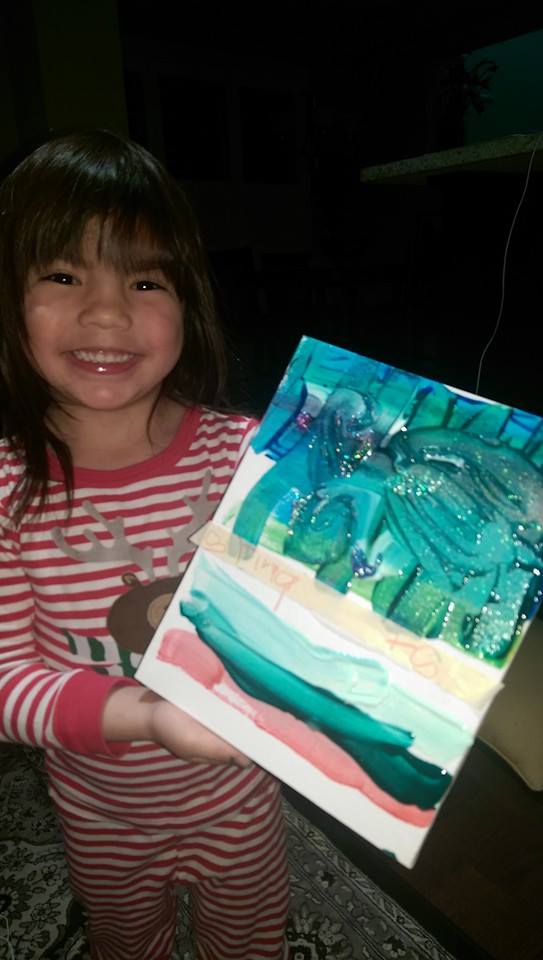
In honour of Family Day I would like to share a story about my family and how my Sylvia Clare (my four year old) is getting along in FDK.  About one week ago, while at home Sylvia Clare decided to paint. This was not unusual as she often paints at home. What was new was her language and ideas about art and herself.  She ushered me to the playroom, took the lead and began to explain that we were going to explore lines.  Lines I thought? So Sylvia Clare understands an element of art?  I sat in silence with what I imagine was a curious look on my face as she continued with confidence: “I’m an artist”.  Those words screamed at me with sheer joy and power. I had never called Sylvia Clare an artist… it was not something I thought of doing, although of course in my heart and mind I believed my child was an artist and a scholar and an athlete and a…..   ”

“Now mommy, you need to wear a smock so your clothes stay clean and roll up your sleeves. Please get the paints”.I followed her instructions.  Next thing I saw was Sylvia Clare carefully dividing the canvas. She began at the bottom and drew careful lines across the canvas using primary colours. Then on the upper part of the canvas she created thick textured, almost bubble like “scribble” where she mixed the colours. The entire time she was talking about her art: “Here mommy I am painting straight lines with primary colours, you see? And up here (top of the canvas) I am trying to see what scribble is like and I added some sparkle”.  She spent a lot of time working on her art and I sat and watched in amazement. Here are some pictures of Sylvia Clare from that day:

sylsmock

sylpaint

paint


Days passed and I wondered how Sylvia Clare was able to develop such clear language about the arts and conceptually understand the elements and most importantly to see herself as an artist. And then, the FDK newsletter came home.  The teachers shared the following in the newsletter:

The students have also been learning about a modern artist names Piet Mondrian from the Netherlands, who used primary coloured shapes and black lines to create famous pieces. They have used his method to create their own line designs. We have also experimented with bubble wrap. Some of the children are referring to themselves as “artists” now…

How one perceives oneself is often how one becomes. Sylvia Clare sees herself as an artist. She can talk about the arts and she confidently engages in art work.  So, on Family Day today I am certain we will be back in the playroom painting and playing and reading and doing… and I am sure that I will be the one who will learn the most.

Happy Family Day!

Dewey meets Delpit: Bringing theory to life in teacher education

Last week I (Yiola) tried something in my teacher education course that was less safe. I brought together divergent theorists,  multiple contexts and eras and encouraged practicum connections in ways that are not typical.  I was unsure of the outcome: would the student teachers understand? connect? appreciate? Just as I encourage our students teachers to take risk, I took a risk in hope new understandings, connections and realizations about teaching and learning would occur.  At the end of class students applauded… when does that ever happen? The comments and reactions at the end of class indicate that students appreciated the class content and left class with much to think about.

I have recently re-read Dewey’s Education and Experience (1938) and was inspired to share the ideas with my class, namely what is miseducative practice? And how do traditional and progressive models of education play out in classrooms today? We discussed how both models are quite transparent in today’s classrooms. We also explored Dewey’s recommendation of a theory of education that is based on a philosophy of experience. Student teachers felt that the notion of experience is now more commonly understood and a desired practice in teaching. We discussed how finding a coherent theory of education based on a philosophy of experience would require transcending the notion of “either/or” traditional or progressive models and moving into integrative reasoning. So this is all quite typical… and then I introduced Delpit.

In Delpit’s work Other People’s Children  (1988) Delpit described herself as “a product of skills-oriented approach to writing and a teacher of process oriented approaches”.  Her amazing chapter, The Silenced Dialogue,  illustrates Dewey’s request to have educators think deeply about the either/or debate between models of education and the implications of our practice on student learning. Delpit explains the following about her chapter, “My charge here is not to determine the best instructional methodology… Rather, I suggest that the differing perspectives on the debate over “skills” versus “process” approaches can lead to an understanding of the alienation and miscommunication, and thereby to an understanding of the “silenced dialogue”… this is precisely what Dewey asked of us fifty years prior, that as educators we must go deeper than thinking across methods; we must use a philosophy of experience to deepen our understanding of the best ways to teach children. For Delpit, the experiences are those of Children of colour and children who experience poverty.

Exploring Dewey’s concepts through the lens of power and Delpit’s context of literacy was remarkable. The process of grounding Dewey’s theories in Delpit’s work provided grounding for both scholars in ways that I wasn’t yet unprepared. Students were excited to talk about a philosophy of experience by looking as social context as a foreground for understanding models of education; for understanding why certain methods may work well and not well and how to move our practice forward so all students are not only learning but are successfully learning in ways that are empowering them.

The final layer of discussion in class was to connect the ideas to their own placements. To tell stories of methodological challenge and to explore how to address those challenges thinking about what Dewey suggests and what Delpit illustrates. Again, students were speaking in detail on the gaps and the glories in their classrooms and schools.  The result of this class: discussion sophisticated and practices validated.

We finished the discussion by reading aloud the last paragraphs of Delpit’s chapter; as a reminder of the enormous but yet delightful task we have as teachers if we truly wish to create learning for all:

We must keep the perspective that people are experts in their own lives. There are certainly aspects of of the outs tide world of which they may not be aware, but they can be the only authentic chroniclers of their own experience. We must not be too quick to deny their interpretations or accuse them of “false consciousness”…And finally, we must be vulnerable enough to allow our world to turn upside down in order to allow the realities of others to edge themselves into our consciousness…  

By doing what Delpit suggests and with keeping Dewey’s foundational perspectives in mind we as teachers can begin to understand how models work in classrooms.

Questioning the Benefits of Toddlers’ Digital Technology Use

Researchers at Boston University School of Medicine suggest toddlers’ overuse of mobile digital technologies could hinder their social-emotional development. While the researchers recognize “that educational apps on smartphones and tablets may facilitate some academic skills for children” they voice concern that the extended use of such technologies by toddlers could displace valuable play-based interactions. The researchers point out that “toddlers younger than two years are known to learn best via hands-on exploration of their physical world.” Their commentary published in the journal of Pediatrics reviews  existing literature, examines future research directions, and suggests preliminary guidelines for families. What are your thoughts on this topic?

Link to CBC article: http://www.cbc.ca/m/news/topstories/toddlers-overusing-mobile-tech-may-stunt-development-1.2940848

Phoning vs Texting

I (Cathy) really like texting.  The post Clare shared with us last week entitled Texting is Killing Language really rang true for me.  It is a wonderful tool of communication.  My own children will text me regularly in lieu of using the phone.  Usually it’s fun, definitely like passing a note in class.  However, it also has its limits.  When should someone use a phone instead of a text message?    Following is a texting conversation between myself and my son while I was away on vacation…

in emerg

Y?

anorism?

CALL ME

Interesting how the  simplistic message spoke volumes and was loaded with emotion, yes? I have been told repeatedly not to use CAPS, because it is the equivalent of shouting.  In this incident I felt perfectly justified.

This incident reminded me of Hemmingway’s six word novel:

Baby shoes

For sale

Never worn

We can say sooo much with so little and texting is the perfect tool for this- within limits

Btw, number one son is fine.  Wasn’t an aneurysm- thank goodness.  But, I nearly had a heart attack while waiting for the call.  Sometimes, texting just isn’t enough, at least not for this mom.

When Caring Fuels Creativity

Students at a public school in Brampton Ontario are developing an app to help one of their classmates with autism learn math. One of the young developers, Priya Joshi explained that her classmate’s struggle with math was “our inspiration” so “we asked him some questions and that’s how everything started.” The FIRST Lego League, an international science and technology competition for young people, recognized the students’ design achievement with the rookie team award. Next month the students travel to Waterloo Ontario for the provincial level of the competition. Watch these inspiring students discuss the project at: http://www.cbc.ca/m/news/canada/toronto/sir-isaac-brock-students-make-autism-math-app-1.2934090


“The Long Shadow”: The fortification of socio-economic class

A mere 4 percent of the first-graders Alexander and Entwisle had classified as the “urban disadvantaged” had by the end of the study completed the college degree that’s become more valuable than ever in the modern economy. A related reality: Just 33 of 314 had left the low-income socioeconomic status of their parents for the middle class by age 28.

A 25 year long study named The Beginning School Study out of John Hopkins University explores “disadvantaged” populations in Baltimore. The researchers observed and interviewed first graders into their adult lives over the course of twenty-five years. The evidence shows there is little upward mobility.

http://www.washingtonpost.com/blogs/wonkblog/wp/2014/12/27/what-your-first-grade-life-says-about-the-rest-of-it/

I am troubled by a comment made in the article: The families and neighborhoods these children were born into cast a heavy influence over the rest of their lives, from how they fared in the first grade to what they became as grownups. 

In my (Yiola) opinion, the perspective of family and community as the influence and determinant of health and success is short sighted. How a society and government collectively and resourcefully (or not) engage with families and neighbourhoods is by far the greater influence as is illustrated when the journalist explains:

The findings, meanwhile, accumulated in dozens of journal articles. Alexander and Entwisle helped establish that young children make valuable subjects, that their first-grade foundations predict their later success, that more privileged families are better able to leverage the promise of education. Also, disadvantaged children often fall even further back over the summer, without the aid of activities and summer camps.

These findings are not about the influence of family or neighbourhood; they seem more the result of the influence of quality of education, resources, opportunities that are available to populations, all of which surround socio-economic class. The structures and systemic values and institutions in place are not equal between those of high and low economic status: for example, inner city schools do not have the same resources as the schools in affluent areas – this is not the fault of the families nor the neighbourhoods nor the teachers.

We like to think that education is an equalizer — that through it, children may receive the tools to become entrepreneurs when their parents were unemployed, lawyers when their single moms had 10th-grade educations. But Alexander and Entwisle kept coming back to one data point: the 4 percent of disadvantaged children who earned college degrees by age 28.

“We hold that out to them as what they should work toward,” Alexander says. Yet in their data, education did not appear to provide a dependable path to stable jobs and good incomes for the worst off.  

My question then become  WHAT CAN BE DONE WITHIN EDUCATION and POLICY to allow education to be a dependable pathway?

It is not only a question of class but race certainly factors into the discussion as the researchers also discovered the following:

Alexander and Entwisle found one exception: Low-income white boys attained some of the lowest levels of education. But they earned the highest incomes among the urban disadvantaged.

They were able, Alexander and Entwisle realized, to tap into what remains of the good blue-collar jobs in Baltimore. These are the skilled crafts, the union gigs, jobs in trades traditionally passed from one generation to the next and historically withheld from blacks. These children did not inherit college expectations. But they inherited job networks. And these are the two paths to success in the Beginning School Study.

The findings confirm what we have known all along, that is classism and racism are an integral and embedded piece of our policies and existence. The idea that families and neighbourhoods are the influence is not accurate. Families and neighbourhoods are the circumstances caused because of the structures/policies/beliefs of society.

I cannot help but think of the book “The Short and Tragic Life of Robert Peace” a biography that Clare recommended some time ago here on the blog. Robert Peace grew up much like the urban youth in Baltimore. He was a genius and thrived in school so much so that he found himself a Yale graduate. However, he could not escape the drug-dealing life and was ultimately murdered in the neighbourhood where he grew up. Moving upward in socio-class is not only a matter of doing well in school or acquiring money (although these elements too are extremely difficult today). Education and money are not indicators of moving outside one’s class. There seems to be fortress like walls around different classes of our given society and only with extreme leaps and bounds and circumstances can one truly cross the borders.

The research methodology of this study is fascinating. 25 years of observation and interviews, of relationship building and reporting. The work of the researchers is exciting and so very interesting.

Creating an Audit Trail

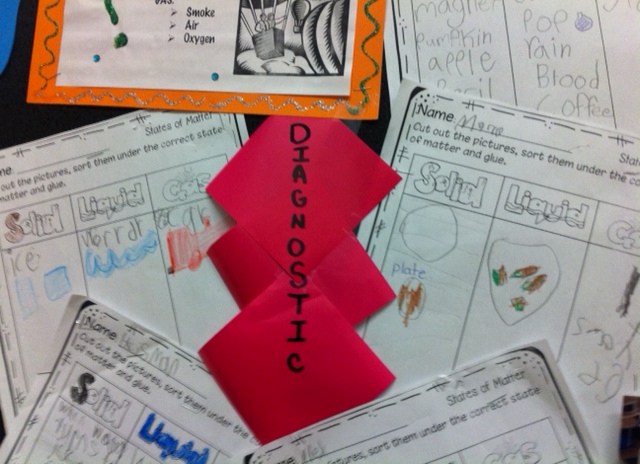
During one of my final practicum visits, I (Cathy) was excited to see one of my student teachers had created an audit trail.   When I mentioned this to her, she replied, “I thought  it was just a bulletin board.” But it was far more than ‘just a bulletin board’.   The student work Melissa had beautifully displayed represented an entire science unit of learning from pre-diagnosis to final summaries.

Audit trails were popularized by Dr. Vivian Vasquez, in her ground breaking critical literacy work with 3-5 year olds.  Vasquez says,                                                                                                             An audit trail or learning wall, as my three to five year old students called it, is a public display of artifacts gathered together by a teacher and their students that represents their thinking about different issues and topics.  This strategy is useful for creating spaces for students to re-visit, reread, analyze, and re-imagine various topics or issues. It is also a powerful tool for connecting past projects or areas of study to newer projects or areas of study. Further, it can be used as a tool for building curriculum as it visibly lays out the journey of the group’s thinking and learning over a period of time.

http://hwcdn.libsyn.com/p/c/f/3/cf355fe54466c4e0/Audit_Trail.pdf?c_id=4270455&expiration=1418946485&hwt=2cc91c9a05310c5ca082ae4a61c9c725

more walldiagnostic molecules