Category Archives: education

Entering a new communication paradigm

I (Cathy) have recently found myself in a new communication predicament. Diagnosed with vocal cord nodules, I have been instructed not to speak for 8 weeks. So here I am, and after only two weeks into my ‘treatment,’ I have observed some interesting things about peoples’ communication patterns.

  1. Since I can’t talk, people often whisper to me. I’m not sure why, but they do, or…
  2. They get MUCH LOUDER. I can hear just fine, but for some reason this is the reaction.
  3. People gesture wildly. Again, I can hear them, but they clearly need to emphasize what they are saying.

I could theorize about the reasons why they do this: a need overcompensate for my sake; empathy perhaps; or they are just plain uncomfortable with the situation. But wait, there is more…

I started carrying a note pad to write messages to communicate and discovered these patterns:

  1. If the message is longer than two sentences, people get restless. The common quip is “Are you writing a novel?”
  2. Once I start to write an answer, if they don’t want to wait, they answer their posed question for me! I am always fascinated by ‘my response.’
  3. Some people prefer me to print as opposed to write, so I have to rewrite/print the message. My son actually told me to “just text him” at the dinner table. (BTW, my handwriting has improved dramatically due to the necessity of being understood)

In an effort to be more current and efficient, I started using the “speak feature” on my iPad and iPhone, but this has its own set of complications:

  1. The response process: typing, highlighting the text, and then tapping the ‘speak’ feature, takes less time than it does for me to write a note in longhand, yet people are less patient with the electronic process. I suspect they feel it should be immediate.
  2. Most people have trouble understanding the electronic voice. They frequently say, “I didn’t get that.” I think it’s because the intonation is usually off. I often have to repeat the message. (I have totally given up on using a ‘cool’ voice app as people can’t understand the regular voice. I was hoping to use the Stephen Hawkings app).
  3. Instead of listening to the voice again, often people reach for my iPhone to read the message in print for themselves, but sometimes the print is too small for them to read, so I have to enlarge it- which takes even more time.
  4. Interestingly, people often want to type their response on my iPad instead of speaking back to me. They take the iPad right out of my hands to do this. I also tried using the chat feature on Skype so I could respond to the person on the screen, but the other person only wanted to type in chat too. Although they were right there in front of me, and were perfectly capable of talking- they didn’t! This leads me to believe that people are getting more comfortable communicating through print  than speaking.

Finally, I play a large role in this and am just a quirky:

  1. I often try to mouth the words which becomes a great game of “guess what Cathy is trying to say.”
  2. As I am familiar with rudimentary sign language, having taken several courses to communicate with my niece and having taught in a total language classroom, that is my default. I sign to people, which of course they don’t understand because it is another language! One friend told me “I have no idea what you are saying, but I love to watch.”

Sadly, my friends and colleagues who are ELL totally empathize with me, as they tell me this is all too familiar for them. I truly feel for them now.

All in all, this is a fascinating study in multimodal communications. Mostly, I just listen. I was told that people pay a great deal of money to attend ‘silent retreats,’ so I am trying to treat this like a gift in self-discovery. Apparently, I have a lot to learn.


Teachers Spend Own Money for Supplies

As a teacher I (Clare) was always on the look out for resources for my classroom and like many other teachers spent my own money to supplement when necessary. With education budgets getting even tighter I think that more and more teachers are dipping into their wallets to simply run their classrooms. Below is a graphic and an article that I thought you might find interesting (but discouraging). And since when did being a fund-raiser become part of a teacher’s job.

TeachersPayforSupplies


Bruce Hogue is always looking for ways to make teaching science more interesting.

But the money he uses for the boxes of Cheerios, Bran Flakes and Total needed for one his experiments usually comes out of his pocket.

“As a science teacher, I have an official budget, but that is usually gone by the beginning of the year,” says Hogue, who works in suburban Denver. “When I want to do a science lab, I usually pay for it all on my own.”

Hogue is one of the millions of teachers across the country who are shelling out their own hard-earned cash to pay for books, pens, pencils and other basic supplies that schools have provided in the past.

According to a new survey, teachers spent an average of $448 of their own money on instructional materials and school supplies for the 1998-99 school year.

The survey conducted last summer by the National School Supply and Equipment Association — a trade group representing the school supply industry — found that teachers pay for 77 percent of the school supplies needed in their classrooms. The rest comes from the school, parent-teacher groups and other school funds.

Spending to Learn

This doesn’t surprise teachers and their advocates.

“What other profession do you know where professionals have to use their own money to do their job properly?” says Janet Fass, spokeswoman for the American Federation of Teachers. “Do engineers, do accountants spend their own money? Why should teachers when they are far lower paid than other professionals?”

Teachers say they not only buy school supplies with their money, but many times they help out students who may not have cash for lunch or to get home.

In Philadelphia, where teachers are in intense contract negotiations with school administrators this week, one-fourth of teachers said they gave their own money to students for transportation, books and lunches, according to a survey conducted by the city’s teachers union. Furthermore, 47 percent said they lacked basic supplies such as paper, pens and pencils for their classrooms.

The contract proposal under consideration now would take away a $50 stipend that teachers get for school supplies, says Barbara Goodman, communications director for the Philadelphia Federation of Teachers.

“We are talking about a school system that is not able to supply funding for what should be priorities — books, pens, paper,” says Goodman.

Suburbia Also Affected

And it is not just in urban neighborhoods that teachers often become charity workers.

Hogan, the suburban Denver science teacher, says he recently gave lunch money to one of his students whose disabled mother is in the process of applying to get her son in the school’s free lunch program.

“It’s the little stuff that falls through the cracks that we usually have to pick up,” said Hogue, who has been teaching science for 30 years.

But Hogue has found a creative way to solve his money problems.

He has turned to private funding for help. Groups like NASA, the U.S. Geological Society and private corporations like Lockheed-Martin have donated thousands for his classroom experiments.

Now, when other teachers panic, Hogue has good advice.

He takes out his list of where he gets his grant material and reminds them there are people willing to help out.


Ode to Children’s Writers

I (Cathy) finished my third Kate Morton novel yesterday, The Forgotten Garden. Intriguing style. Here is the synopsis shared on http://www.austcrimefiction.org

When thirty-eight year old Cassandra Ryan discovers her grandmother Nell’s secret – that she was not the biological child of her parents, but a foundling – she is intrigued. Inside the suitcase found with the abandoned child at the Port of Brisbane in 1913 Cassandra finds a package of letters, a children’s storybook, and a coded manuscript belonging to Eliza Makepeace Rutherford: the Victorian authoress of dark fairy-tales who disappeared mysteriously in the early twentieth century. And so begins the quest to solve a century-old literary mystery.

I found the story line more interesting than some of Morton’s other books, partly because it was about a woman- Eliza Makpeace (Authoress)- who wrote fairy tale stories for children. The stories were included in the novel as chapters: The Cuckoo’s Flight, The Crone’s Eyes, and The Golden Egg. I particularly enjoyed the Crones Eyes. Deliciously dark!

As a collector and teller of traditional folk lore (I love the collections of Lang, Grimm and particularly, Jacobs), I found her stories strikingly similar to the old folk tales of Europe- frightening and heroic. People often died in those, not like in the Disney versions of today (e.g., in the original Andersen version of The Little Mermaid, the mermaid dies). As I was mulling this over, I happened to come across Morton’s acknowledgements:

I would also like to pay tribute here to authors who write for children. To discover early that behind the black marks on white pages lurk worlds of incomparable terror, joy, and excitement is one of life’s great gifts. I am enormously grateful to those authors who’s works fired my childhood imagination and inspired in me a love of books and reading that has been a constant companion. The Forgotten Garden is in part an ode to them.                                               Kate Morton

I was warmed by this acknowledgement. I think the stories of our youth live in us forever. If you enjoy traditional lore as much as I, I highly recommend reading The Forgotten Garden. For my part, I plan to write to Kate Morton’s publisher to obtain permission to tell them. They would make a delightful set at a festival and would hopefully fire the imaginations of the children (and adults) who listen.

garden

Support for Teachers from the Field of Medicine

At last someone has linked the problems of inappropriate use of testing in education with Doctorthose of the prestigious profession of medicine. Robert Wachter, Professor of Medicine at UCSF, has written a book titled The Digital Doctor: Hope, Hype, and Harm at the Dawn of Medicine’s Computer Age in which he argues that measurement has gotten out of hand. In a New York Times article “How Measurement Fails Us” (Sunday Review, Jan 17, 2016, p. 5) he states:

“Two of the most vital industries, health care and education, have become increasingly subjected to metrics and measurements. Of course, we need to hold professionals accountable. But the focus on numbers has gone too far.”

In the article Wachter notes that “burnout rates for doctors top 50 percent” and he says recent research has shown that “the electronic health record was a dominant culprit.” He then draws a parallel with teaching.

“Education is experiencing its own version of measurement fatigue. Educators complain that the focus on student test performance comes at the expense of learning.”

Wachter maintains that what is needed is “thoughtful and limited assessment.” “Measurement cannot go away, but it needs to be scaled back and allowed to mature. We need more targeted measures, ones that have been vetted to ensure that they really matter.” We also need to take account of the harm excessive measurement does. Again he compares the two professions: research has shown that

“In medicine, doctors no longer made eye contact with patients as they clicked away. In education, even parents who favored more testing around Common Core standards worried about the damaging influence of all the exams.”

With this welcome support, we in education need to consider how we can keep measurement within limits and focused on key matters, so it does not undermine our profession. When is measurement useful, and when does it do more harm than good?

Second Wave Change

Every once and a while I check online to see if my favorite literacies scholar, Allan Luke, has presented something new I can learn from.

Allen

Although not ‘new’, this time I happened upon a  short and poignant video called Second Wave Change.  It’s a succinct  explanation of  the kind of substantive content our students need to be discussing and thinking about to change our world.  This is a perfect video for student teachers.

So worth watching, but Allen Luke always is.


Professional Learning in Top Performing Systems, part 2

I (Clare) thought you might find this blog interesting about high performing schools. Not sure I agree with all of it but food for thought

internationalednews's avatarInternational Education News

PDinfographicv2The National Center on Education and the Economy’s (NCEE) Center on International Education Benchmarking has released two reports on professional learning environments in top performing systems: Beyond PD: Teacher Professional Learning in High-Performing Systems and Developing Shanghai’s TeachersTo explore and share the findings of these reports, the NCEE held a conference last week featuring presentations and panel conversations with the leading voices in education from around the world. This conference was also streamed live and can be viewed online. Moderated by Marc Tucker, president and CEO of NCEE, speakers included Ben Jensen (author of Beyond PD) and Minxuan Zhang (author of Developing Shanghai’s Teachers).

Ben Jensen began his presentation with the questions, “What is at the core of high performing professional learning systems? What is the strategy to ensure effectiveness?”

Jensen argued that we need to move past the idea that there is a single answer…

View original post 303 more words

You think you know what teachers do. Right? Wrong.

I (Clare) was sent this article from a friend and it truly captures the complexity of teaching and the misconceptions about teaching. All parent, politicians, and journalists should have to read it. A shout out to all teachers! Here is the link to the article from the Washington Post: https://www.washingtonpost.com/news/answer-sheet/wp/2014/02/22/you-think-you-know-what-teachers-do-right-wrong/

By Valerie Strauss February 22, 2014

School_Globe

You went to school so you think you know what teachers do, right? You are wrong. Here’s a piece explaining all of this from Sarah Blaine, a mom, former teacher and full-time practicing attorney in New Jersey who writes at her parentingthecore blog, where this first appeared.

By Sarah Blaine

We all know what teachers do, right? After all, we were all students. Each one of us, each product of public education, we each sat through class after class for thirteen years. We encountered dozens of teachers. We had our kindergarten teachers and our first grade teachers and our fifth grade teachers and our gym teachers and our art teachers and our music teachers. We had our science teachers and our social studies teachers and our English teachers and our math teachers. If we were lucky, we might even have had our Latin teachers or our Spanish teachers or our physics teachers or our psychology teachers. Heck, I even had a seventh grade “Communications Skills” teacher. We had our guidance counselors and our principals and some of us had our special education teachers and our study hall monitors.

So we know teachers. We get teachers. We know what happens in classrooms, and we know what teachers do. We know which teachers are effective, we know which teachers left lasting impressions, we know which teachers changed our lives, and we know which teachers sucked.

We know. We know which teachers changed lives for the better. We know which teachers changed lives for the worse.

Teaching as a profession has no mystery. It has no mystique. It has no respect.

We were students, and therefore we know teachers. We denigrate teachers. We criticize teachers. We can do better than teachers. After all: We do. They teach.

We are wrong.

We need to honor teachers. We need to respect teachers. We need to listen to teachers. We need to stop reducing teachers to arbitrary measurements of student growth on so-called objective exams.

Most of all, we need to stop thinking that we know anything about teaching merely by virtue of having once been students.

We don’t know.

I spent a little over a year earning a master of arts in teaching degree. Then I spent two years teaching English Language Arts in a rural public high school. And I learned that my 13 years as a public school student, my 4 years as a college student at a highly selective college, and even a great deal of my year as a master’s degree student in the education school of a flagship public university hadn’t taught me how to manage a classroom, how to reach students, how to inspire a love of learning, how to teach. Eighteen years as a student (and a year of preschool before that), and I didn’t know anything about teaching. Only years of practicing my skills and honing my skills would have rendered me a true professional. An expert. Someone who knows about the business of inspiring children. Of reaching students. Of making a difference. Of teaching.

I didn’t stay. I copped out. I left. I went home to suburban New Jersey, and a year later I enrolled in law school.

I passed the bar. I began to practice law at a prestigious large law firm. Three years as a law student had no more prepared me for the practice of law than 18 years of experience as a student had previously prepared me to teach. But even in my first year as a practicing attorney, I earned five times what a first-year teacher made in the district where I’d taught.

I worked hard in my first year of practicing law. But I didn’t work five times harder than I’d worked in my first year of teaching. In fact, I didn’t work any harder. Maybe I worked a little less.

But I continued to practice. I continued to learn. Nine years after my law school graduation, I think I have some idea of how to litigate a case. But I am not a perfect lawyer. There is still more I could learn, more I could do, better legal instincts I could develop over time. I could hone my strategic sense. I could do better, be better. Learn more law. Learn more procedure. But law is a practice, law is a profession. Lawyers are expected to evolve over the course of their careers. Lawyers are given more responsibility as they earn it.

New teachers take on full responsibility the day they set foot in their first classrooms.

The people I encounter out in the world now respect me as a lawyer, as a professional, in part because the vast majority of them have absolutely no idea what I really do.

All of you former students who are not teachers and not lawyers, you have no more idea of what it is to teach than you do of what it is to practice law.

All of you former students: you did not design curricula, plan lessons, attend faculty meetings, assess papers, design rubrics, create exams, prepare report cards, and monitor attendance. You did not tutor students, review rough drafts, and create study questions. You did not assign homework. You did not write daily lesson objectives on the white board. You did not write poems of the week on the white board. You did not write homework on the white board. You did not learn to write legibly on the white board while simultaneously making sure that none of your students threw a chair out a window.

You did not design lessons that succeeded. You did not design lessons that failed.

You did not learn to keep your students quiet during lock down drills.

You did not learn that your 15-year-old students were pregnant from their answers to vocabulary quizzes. You did not learn how to teach functionally illiterate high school students to appreciate Shakespeare. You did not design lessons to teach students close reading skills by starting with the lyrics to pop songs. You did not miserably fail your honors level students at least in part because you had no books to give them. You did not struggle to teach your students how to develop a thesis for their essays, and bask in the joy of having taught a successful lesson, of having gotten through to them, even for five minutes. You did not struggle with trying to make SAT-level vocabulary relevant to students who did not have a single college in their county. You did not laugh — because you so desperately wanted to cry — when you read some of the absurdities on their final exams. You did not struggle to reach students who proudly announced that they only came to school so that their mom’s food stamps didn’t get reduced.

You did not spend all of New Years’ Day crying five years after you’d left the classroom because you reviewed The New York Times’ graphic of soldiers killed in Iraq and Afghanistan and learned that one of your very favorite students had been killed in Iraq two years before. And you didn’t know. Because you copped out and left. So you cried, helplessly, and the next day you returned to the practice of law.

You did not. And you don’t know. You observed. Maybe you learned. But you didn’t teach.

The problem with teaching as a profession is that every single adult citizen of this country thinks that they know what teachers do. And they don’t. So they prescribe solutions, and they develop public policy, and they editorialize, and they politicize. And they don’t listen to those who do know. Those who could teach. The teachers.


Promoting creativity in teacher education

I (Yiola) have been building in how to embed creativity in classroom practice in my Teacher Education course for a number of years. This year I invited Lina Pugsley, a graduate of the Creativity and Change Leadership Program and Masters of Science in Creativity student from SUNY Buffalo  State,  to share with us what creativity means and how to teach creatively and teach for creativity through weaving creativity skills into our classroom lessons.

Our class consisted of information sharing about what creativity is and its complexity. I appreciated that we took time to unpack some of the misconceptions (a major one being creativity equals the visual arts) and to solidify some of its characteristics (creativity is problem solving, its innovation, its incubation, its idea generating, its colourful, etc.)

12572972_10156583591315121_606339910252037085_n

Lina presented us with a number of models and frameworks to think about ways of thinking about, teaching, and embedding creativity into our classroom practice.

Several great resources were shared and a number or creativity scholars introduced. From E. Paul Torrance to Ronald Beghetto, we were inspired!

12540548_10156583591375121_6677389572199015190_n

Once the theoretical and conceptual foundations were laid students in the class began to think more practically about what skills and strategies nurture creativity. This video set our curiosity in motion:

And, in creative fashion students explored, talked about and shared ways of bringing creativity skills into their teaching and lessons. We examined E. Paul Torrance’s 18 thinking skills from his book “Making the Creative Leap Beyond”

Some of the skills:
Be Original
Be Open
Visualize it Rich and Colourfully
Combine and Synthesize
Look at it Another Way
Produce and Consider Many Alternatives
Playfulness and Humour
Highlight the Essence
Make it Swing! Make it Ring!
Be Aware of Emotions
Be Flexible


The energy in the room was high. Students were interested and engaged.  They were encouraged to consider their personal teaching philosophy and to make creative thinking a priority in their teaching. It was an  inspiring experience. This particular teacher education course looks at methods in education. We explore planning, the learning environment, pedagogies and practices. Creativity, now in the 21st century, is a skill that students must acquire. It is not an innate skill that some are born with while others are not. Everyone has the capacity to develop their creativity skills and as teachers we need to learn how to create classrooms that foster, encourage, and celebrate creative thinking.in I believe the MA students gained a solid sense of what this is about.

For more information on Lina’s focus and work check out here website at:

http://www.keepingcreativityalive.com


Parent Research Night

This week I (Clare) attended the Parent Research Night at the Dr. Eric Jackman Institute of Child Studies (where I am the Director). It was a truly amazing evening because the two presentations demonstrated research that was for teachers and parents, done by teachers, and inspired by teachers. It was such a beautiful form of dissemination of research. The findings are not confined to a peer-reviewed article but were shared with the public.

IMG_1147Dr. Patricia Ganea talked about the importance of shared reading with children. And she shared data on how children respond to images in children’s books – realistic (photos) vs fantastical (comic-like). Interestingly they relate much more to the latter.

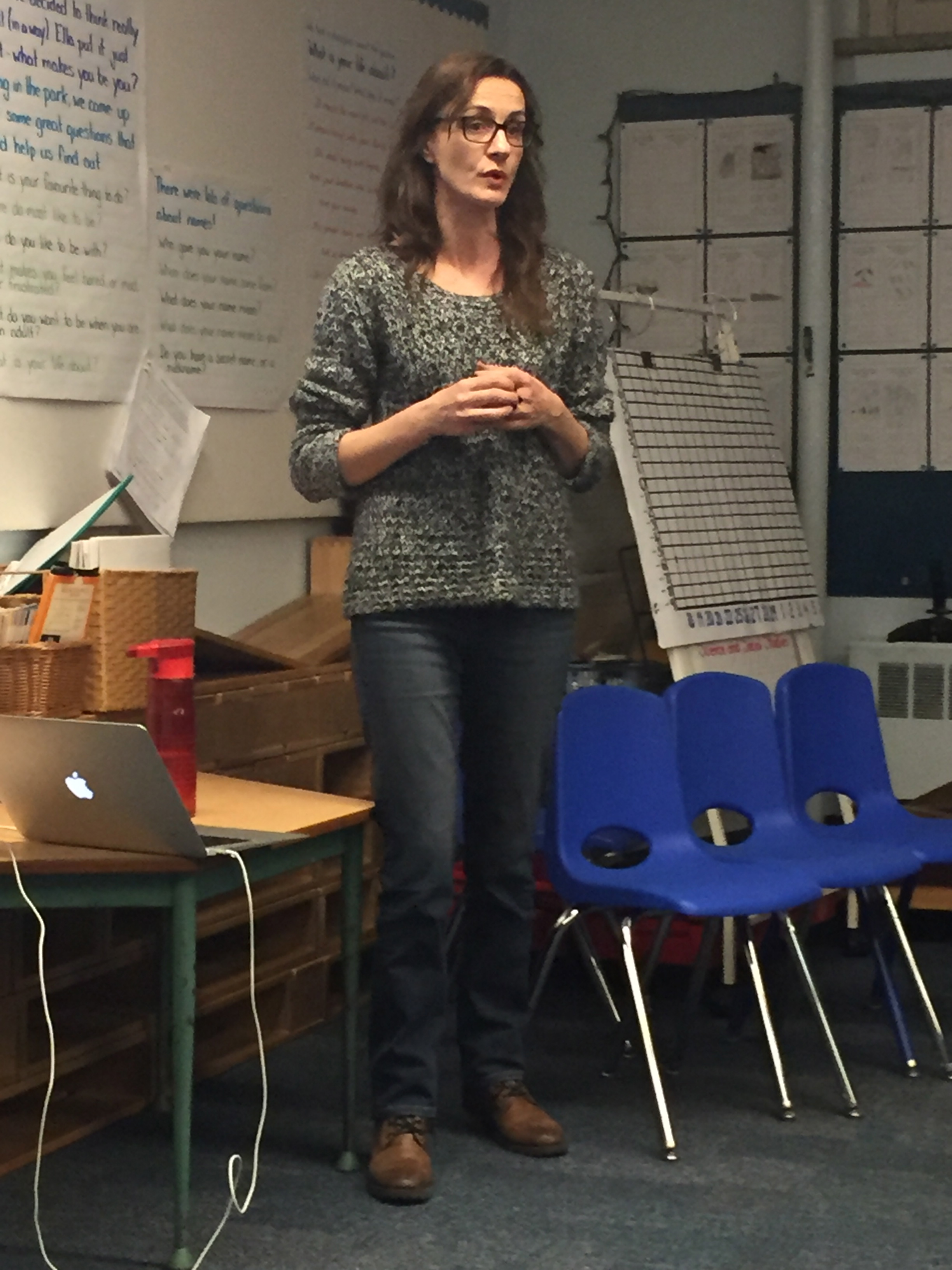
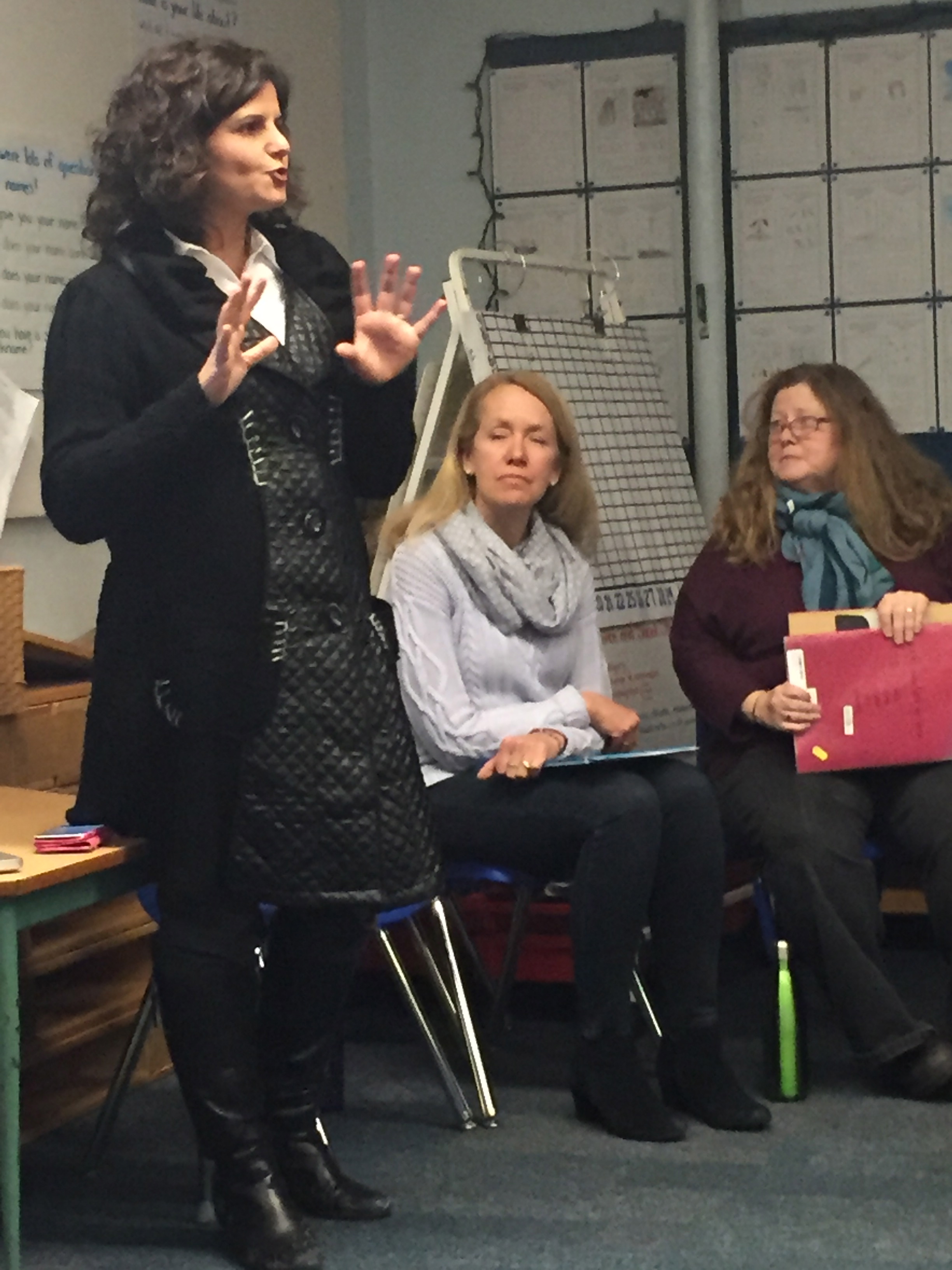
Then Dr. Yiola Cleovoulou and 3 teachers (Zoe Honahue, Cindy Halewood, and Chriss Bogert – who is now the VP) from the Lab School IMG_1153presented on their work with the children that was framed by critical literacy with an inquiry focus. They shared student work, read transcripts of actual conversations, and described activism work.

JICS has a tripartite mission: Lab school, teacher education program, and a research centre. Parent Research night truly brought all three together. http://www.oise.utoronto.ca/ics/index.html