Category Archives: knowledge building

Happy New Year

I (Clare) always enjoy David Eddie’s column in the Globe and Mail. Today (New Year’s Day) he has a great article. I was so impressed with his final new year’s resolution – be grateful. Earlier on he talks about being nice. So for 2016 being nice and grateful will be my resolutions. Below are a few excepts from the article and here is the link to the entire article. http://www.theglobeandmail.com/life/relationships/seven-new-years-resolution-suggestions/article27967792/

To all of the readers of our blog best wishes for a happy and healthy year!

7. BE GRATEFUL

My main one. I started off this piece talking about self-loathing, but it doesn’t mean I don’t count my blessings. Be grateful for all the people and things in your life, however imperfect – because they could be taken away, and then you’d miss them. Every morning, after looking in the mirror and doing my daily de-affirmations (“You suck, you’re fat,” etc) I always follow up by counting my blessings: “God (who as I say I believe in) thank you for this, thank you for that, thank you for him and her and them – and P.S., nice day today! Those clouds are brushed in with a maestro’s touch!”

I’ve done that every day, year in, year out, but I’m updating it for 2016. We’ve always had refugees among us, but they’re more “top of mind,” lately, I think – and now, before I complain about something, I think: “How would my complaint seem to a refugee?” If I could imagine a refugee rolling his/her eyes at my “problem,” I inhale, exhale and let it go.

So, to sum up: Be nice, do you, quash self-doubt, go strong to the hoop, count your blessings, own up to your mistakes and when you’re tempted to complain about something, imagine a refugee rolling his eyes at you. Do all these things, and I have a feeling it’ll be a great year for you, friends. Rock it hard!
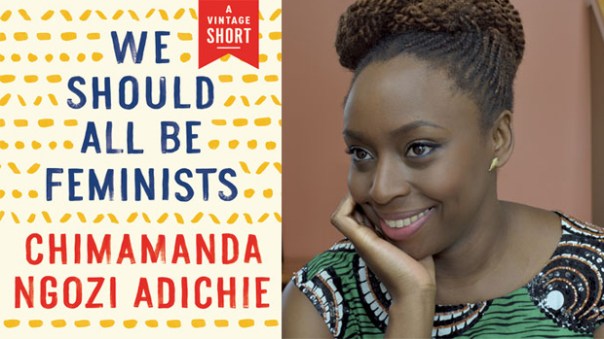
 

Chimamanda Ngozi’s Book Being Distributed to ALL 16- Year-Old Students in Sweden

I have written about the powerful words of Ms. Adiche before. Her words stop us in our tracks and make us re-consider notions of identity, language, and gender. She has a new book out entitled We Should All Be Feminists. It is based on a speech she delivered at a TEDx conference a few years ago. I have already ordered it!

The most amazing thing about her new book is how it is being distributed. The Swedish Women’s Lobby has decided to distribute Adiche’s book to every 16-year-old student in Sweden. In a CBC article, publisher Johanna Haegerström believes her book will be an entry point into a larger discussion about gender roles in society. He said:

“Our hope is that the Chimamanda Ngozi Adichie text will open up a conversation about gender and gender roles, starting from young people’s own experiences”

adichie-composite

http://www.cbc.ca/books/2015/12/we-should-all-be-feminists-by-chimamanda-ngozi-adichie-is-being-given-to-every-16-year-old-in-sweden.html

Findings from a Study on Knowledge Building

Richard Messina who is the Principal of the Jackman Institute of Child Studies is the co-author of the article: Fostering sustained idea improvement with principle-based knowledge building analytic tools by Huang-Yao Hong, Marlene Scardamalia, Richard Messina, Chew Lee Teo

I (Clare) thought this might be of interest to you because of the extensive use of knowledge building tools. Here is the abstract:

The purpose of this study is to explore the use of principle-based analytic tools to improve community knowledge building in a class of Grade 5/6 students. A flexible design framework was used to engage students in use of three analytic tools a Vocabulary Analyzer, a Social Network Tool, and a Semantic Overlap Tool. These tools are built into Knowledge Forum technology so principle-based assessment is integral to knowledge work. The primary source of data was discourse generated by students in Knowledge Forum over a school semester (approximately four months). Findings based on a mixed methods analysis reveal principle-based knowledge building analytic tools to be effective in increasing the frequency with which key terms are used by individuals, in their own productive vocabulary as well as in the shared community space, thus creating a more discursively connected community. Results additionally show a shift from problem generation and breadth of inquiry to increased self-assessment, reflection, and depth of inquiry; also, students report significant ways in which knowledge building analytic tools can increase knowledge building capacity.

Here is a link to the article: Huang-Yao article[1]